Uneven Roman Shade Folds: How to Fix Them in 5 Steps

Authored By Michael Turner -30 Years Home Improvement Expertise | Updated 2026 | BlindShades.pro
Updated on July 10, 2026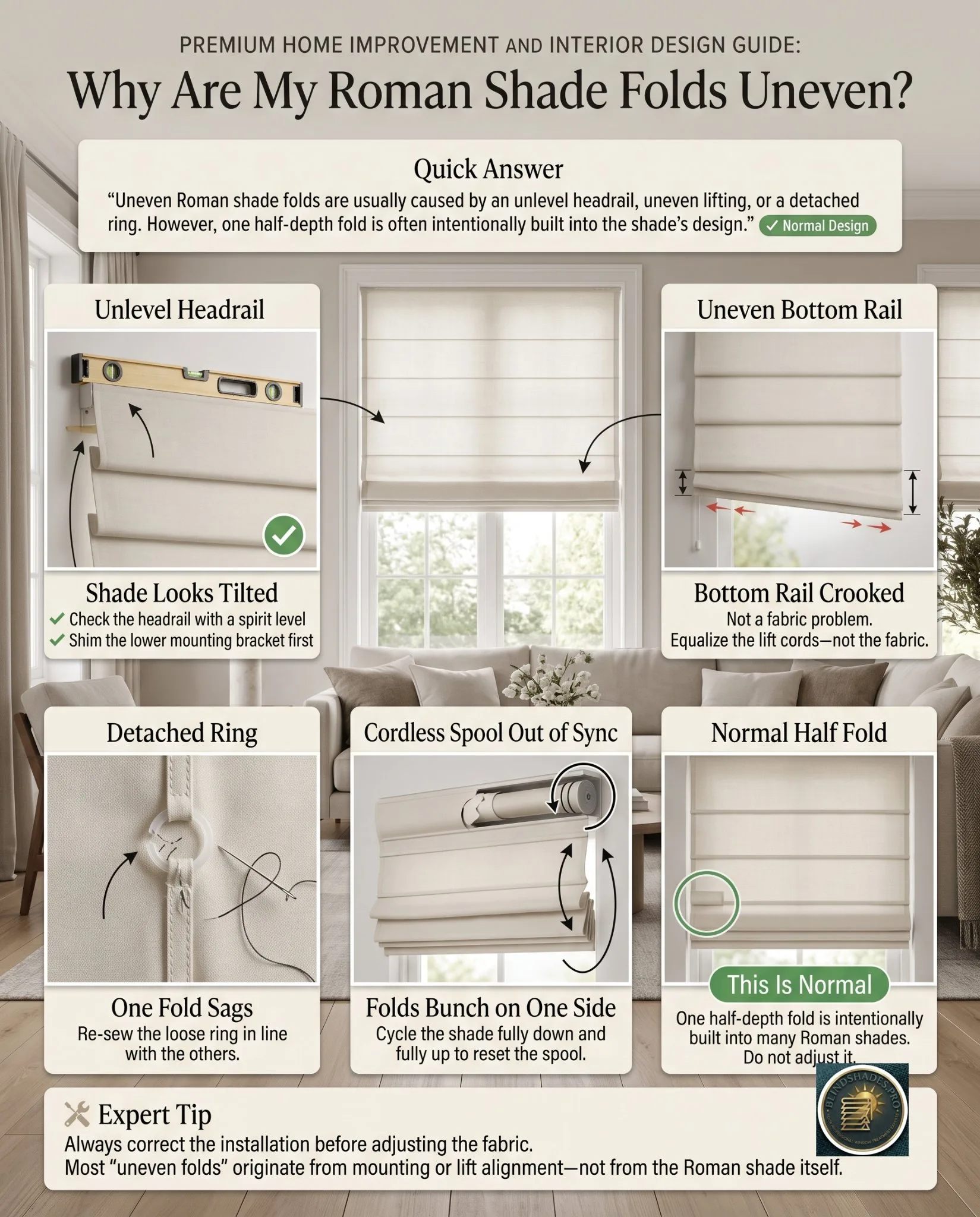
By Michael Turner | 30 years in window treatments
Uneven Roman shade folds come from exactly one of four things: a headrail that is not level, a lift system pulling harder on one side, a detached ring on the back panel, or fold spacing built that way on purpose. Three are repairs. The fourth is not a fault. Most guides skip that distinction and send you to the cords — the last place to look, and, on most shades sold this decade, a place that no longer exists.
🎯 5 Key Takeaways
- Diagnose in order: mount, drop, rings, lift, fabric. Shortening a lift cord to correct an out-of-level headrail trains a permanent skew into the fabric.
- Crooked and uneven are different faults. Measure sill to bottom rail at both ends. Different numbers mean crooked; matching numbers mean a fold problem.
- One fold is supposed to be shallower. Terry’s Fabrics documents the math: a thirty-eight-inch blind is four full folds of 8.44 inches plus one half fold of 4.22 inches.
- The “re-tie the lift cords” fix is obsolete. Under ANSI/WCMA A100.1-2018, effective December 15, 2018, stock window coverings must be cordless or have inaccessible or short cords.
- Know when to stop. A fold at a random depth, a spool that will not re-seat, and mid-span sag are manufacturer problems. Do not open the headrail.
⭐ Quick Answer
Uneven Roman shade folds are caused by an unlevel headrail, an uneven lift, or a detached ring — and sometimes by nothing at all, because one half-depth fold is built in by design. Before the guide:
- Folds look wrong, shade looks tilted: spirit level on the headrail. Shim behind the low bracket first.
- One end of the bottom rail hangs lower: that is crooked, not uneven. Equalize the lift, not the fabric.
- One fold sags or bellies: a ring has pulled loose or its stitching snapped. Re-sew it in alignment with its row.
- Folds bunch on one side when raised: a cordless spool has taken an extra turn. Cycle the shade to both stops. If it will not hold position at all, see why a Roman shade won’t stay up.
- Exactly one fold is half the depth of the others: that fold is correct. Stop working on it. Fold style decides what “even” should look like, so check yours against flat vs relaxed vs hobbled Roman shades.
Before you reach for the cords, check whether your shade has any. Under ANSI/WCMA A100.1-2018, effective December 15, 2018, stock coverings sold in the US must be cordless or have inaccessible or short cords — the WCMA standard summary explains why the usual re-tie advice no longer applies. Replacing the shade? Start with our best Roman shades buying guide.
Best Sources: U.S. Consumer Product Safety Commission (cordless standard); Window Covering Manufacturers Association (ANSI/WCMA A100.1-2018); Federal Register (operating-cord rulemaking); Terry’s Fabrics (fold spacing math); Blindsgalore (fold ranges); Blinds.com (fold styles); Sense Blinds (shimming); Thrifty Decor Chick (ring re-sewing); SmartWave Shades (spools).
Why Are My Roman Shade Folds Uneven?
Because uneven folds are a symptom, not a diagnosis — four faults produce the same look, and each is confirmed by a different test.
Homeowners cycle through fixes because they begin at the back of the shade. An out-of-level headrail produces uneven folds even when every ring, cord, and dowel is perfect, and shortening a lift cord to compensate trains the error into the fabric permanently. Work the symptom table before you unfold anything.
| Symptom | What failed | Confirming test | Difficulty |
|---|---|---|---|
| Bottom rail lower on one side | Headrail not level; bracket on uneven wall | Spirit level; measure both rail ends to sill | Easy |
| One fold shallower, rest level | Nothing. Manufactured fold math | Measure fold depths against neighbors | None |
| A fold sags or bellies mid-shade | Detached ring or snapped ring-tape stitching | Lower fully; inspect ring rows from behind | Moderate |
| Folds bunch on one side when raised | Uneven lift; tangled cord; misaligned spool | Raise halfway; watch which side lags | Moderate |
| Wide shade sags mid-span only | Too few lift points across a long span | Measure width against maker’s maximum | Manufacturer |
Find your row, then read the matching section below.
The LEVEL Diagnostic: Fix the Mount Before You Touch the Cords
The LEVEL Diagnostic: run five checks from cheapest and most reversible to most invasive — Level, Evaluate, Verify, Equalize, Lock — because every step you skip gets baked into the fabric by the step after it.
Most repair pages start at step four. That is what turns a twenty-minute adjustment into a replacement.
- Level the reference. Spirit level on the headrail, then the sill. Shim behind the low bracket. Sense Blinds, writing about wavy old plaster walls in July 2025, notes a shim is almost always the fix when a shade looks saggy after installation. A settled window can sit out of square while the headrail reads level.
- Evaluate the drop. Measure sill to bottom rail at the left edge, then the right. Different numbers mean a crooked shade; matching numbers mean a fold problem.
- Verify the rings and rods. Lower fully, lay the shade flat, follow each ring row bottom to top. A pulled ring or snapped stitching drops the fabric there and produces the classic single-fold sag — the failure Thrifty Decor Chick documented in July 2022, especially common on woven wood and bamboo. Re-sew in exact horizontal alignment with the row.
- Equalize the lift. Branch by lift type. Nothing here holds if the mount is still out.
- Lock the folds in. Work each fold by hand into its crease; press cotton and linen on low heat.
Affordable Blinds suggests grabbing the bottom rail at both ends by hand. That works as a first pass, but a tape measure removes the guesswork, and you will need those numbers if you file a claim.
Are Roman Shade Folds Supposed to Be Uneven?
Partly, yes. On a correctly built Roman shade one fold is deliberately a different depth from the others, and no adjustment at the window will change it.
This is the most misunderstood thing about Roman shades, and it drives an enormous amount of wasted repair effort. Fold placement is set during fabrication from the finished drop, and the arithmetic rarely divides evenly.
Blindsgalore places typical fold spacing between six and ten inches, so a taller shade carries more folds. Because a drop is rarely an exact multiple of that spacing, workroom convention builds one half-depth fold rather than spreading the remainder across every fold. Terry’s Fabrics publishes the method: a thirty-eight-inch blind is four full folds of 8.44 inches each plus a single half fold of 4.22 inches, sitting at the bottom so the lowest section tucks behind the stack instead of overhanging it.
So if exactly one fold measures roughly half the depth of the others, it is correct. A fold at a random depth is a fabrication error and a warranty matter, not a repair. Construction style changes what “even” should look like, too.
| Construction | Normal appearance | What counts as a defect |
|---|---|---|
| Flat fold | Smooth face lowered; crisp folds only when raised | Visible fold lines when fully lowered |
| Plain fold (battened) | Seams every few inches; folds break at seams | A fold breaking away from a seam |
| Hobbled or soft fold | Permanent overlapping loops, even lowered | A loop deeper or shallower than its neighbors |
| Relaxed or European fold | Soft curved hem, higher at edges | An off-center or asymmetric curve |
| Woven wood and bamboo | Irregularity inherent to the material | Sagging at one ring row |
Blinds.com describes the plain fold as its most popular style precisely because the seams force the fabric to break in the same place every time. A relaxed shade is supposed to hang with a curve. Unsure which you own? Our guide to flat vs relaxed vs hobbled Roman shades sorts them by sight.
How Do You Fix a Roman Shade That Hangs Crooked?
Match the procedure to the lift system — advice written for corded shades will not work on a cordless one, and forcing it damages the mechanism.
Before attempting equalization, identify what is inside the headrail. The answer changes everything that follows.
| Lift system | How to identify it | Equalization procedure |
|---|---|---|
| Corded with cord lock | Pull cord and lock at one side of the headrail | Lower fully; release the bottom-rail knots; shorten the low-side cord |
| Cordless spring lift | No cord; holds position when pushed or pulled | Cycle to both stops three or four times; check spool alignment |
| Continuous loop | Closed beaded chain down one side | Check the loop has not jumped its sprocket; verify the tension device |
| Motorized | Remote, wall switch, or app control | Re-run the manufacturer’s limit-setting routine; never adjust by hand |
For cordless shades the spool is what matters. SmartWave Shades, writing about the same problem on cellular shades, advises checking that internal spools are aligned and cords not wound too tightly. If one spool takes an extra turn, that side lifts faster and the folds bunch there every time. Driving the shade to both stops re-seats many spools without disassembly.
Width matters too. Wide shades on too few lift points sag mid-span however carefully the cords are tensioned — a specification problem for the manufacturer. If the shade will not hold position at all, the fault is in the lifting mechanism instead: see why a Roman shade won’t stay up.
Why Doesn’t the “Re-Tie the Lift Cords” Fix Work Anymore?
Because most Roman shades bought off the shelf since 2018 have no accessible lift cords to re-tie, which makes the most common repair instruction on the internet impossible to follow.
Under ANSI/WCMA A100.1-2018 — developed by the Window Covering Manufacturers Association with the U.S. Consumer Product Safety Commission through the American National Standards Institute — all stock window coverings sold in stores and online must be cordless or have inaccessible or short cords. It took effect December 15, 2018. The CPSC defines a compliant short cord as eight inches or less in any position. WCMA states stock products account for more than eighty percent of window coverings sold in the United States and Canada, and estimated as much as ninety percent of products sold would end up cordless or inaccessible-cord.
Custom shades may still be corded, but the standard tightened those too: the default operating-cord length on a custom corded product is capped at forty percent of the blind height, previously unlimited. The CPSC then published a notice of proposed rulemaking on January 7, 2022 in the Federal Register, seeking a mandatory standard for operating cords on custom window coverings.
So when a repair page tells you to untie the low-side lift cord, ask first whether your shade has one. A stock Roman shade bought after December 2018 almost certainly does not, and the cordless procedure above applies instead. Springs Window Fashions and Norman USA rebuilt their lines around this standard. Cordless is the default, not the upgrade.
When Should You Repair, Claim, or Replace?
Try the free checks first, re-sew a ring second, and hand the shade back whenever the fault is inside the headrail or the fold math.
The honest escalation ladder, in cost order.
| Step | What it costs | When to do it |
|---|---|---|
| Level the headrail; shim the bracket | Free, ten minutes | Always try this first |
| Re-sew a loose ring in alignment | Low, needle and thread | One fold sags or bellies |
| Claim: fold at a random depth | Free if in warranty | Neither a full fold nor a half fold |
| Claim: spool will not re-seat | Free if in warranty | Cordless shade still lifts unevenly after cycling |
| Replace the shade | Highest | Fabric creased, sun-degraded, or discolored along fold lines |
The decision point is whether the fault lives in the fabric or the mechanism. Do not open a cordless headrail to reach a spool; on most models that ends the warranty and rarely ends the problem. Before you call, have your bottom-rail measurements, fold depths, and order number ready — manufacturers resolve fabrication-error claims quickly when the numbers are in front of them. If the shade is beyond saving, our best Roman shades buying guide covers replacements.
Related Buying Guides
- The Best Roman Shades Buying Guide — specifying a replacement
- Why Won’t My Roman Shade Stay Up? — the mechanism that holds position
- Flat vs Relaxed vs Hobbled Roman Shades — how fold style defines “even”
- Cordless vs Motorized Roman Shades — the lift systems compared
Frequently Asked Questions
How do you fix uneven Roman shades? Level the headrail and shim any bracket that sits low. If the headrail is level and the bottom rail still hangs unevenly, inspect the ring rows behind the shade for a loose or snapped ring and re-sew it in alignment with its row. Only then adjust the lift system, which differs for corded, cordless, continuous-loop, and motorized shades.
How many folds should a Roman shade have? It depends on the finished drop. Blindsgalore places typical fold spacing between six and ten inches, so a taller shade carries more folds. Workrooms divide the drop into full folds plus one half-depth fold rather than forcing every fold identical. Terry’s Fabrics gives a worked example: a thirty-eight-inch blind is four full folds of 8.44 inches plus one half fold of 4.22 inches.
How do you get wrinkles out of Roman shades? Lower the shade fully and let it hang for several days; many creases relax on their own. For fabric shades that do not recover, press the fold lines lightly on low heat with the shade laid flat, working along the crease rather than across it. Woven wood and bamboo cannot be pressed; train them by hand.
Why is my Roman blind not rolling up evenly? One side is lifting faster than the other. On a corded shade the fast side’s lift cord is effectively shorter and needs re-tying. On a cordless shade a spool has wound an extra turn, so cycle the shade to both stops three or four times. If the lag persists, the mechanism needs manufacturer attention.
How do you fix cordless Roman shades that hang crooked? There are no cords to adjust. Under ANSI/WCMA A100.1-2018, effective December 15, 2018, stock window coverings sold in the United States must be cordless or have inaccessible or short cords. Level the headrail, shim the low bracket, then cycle the shade to both stops several times to re-seat the internal spools. If it still lifts unevenly, the spool assembly is faulty and the shade is a warranty candidate.
How do you fix uneven bamboo Roman shades? Bamboo and woven wood shades fail at the ring stitching more often than fabric shades, because the rings are sewn into a lighter substrate. Lower the shade fully, lay it flat, and follow each ring row from the bottom up, looking for a ring that has pulled free. Re-sew it in alignment with its row. Weave irregularity is inherent to natural material, not a defect.
