The Best Plantation Shutters Buying Guide

Authored By Michael Turner

Updated on May 4, 2026

Plantation Shutters Are the Only Window Covering That Adds Appraised Value to Your Home — But Only If You Buy the Right Ones

By the Editorial Team at BlindShades.pro | Updated 2026 | 30 Years of Home Improvement Expertise


⭐ Quick Answer — Best Plantation Shutters for Most Homes

  • Best Overall: Hunter Douglas NewStyle Hybrid — composite construction, hidden tilt rod option, lifetime warranty, dealer-installed (~$200–$550 per window)
  • Best Premium Wood: Norman Woodlore Shutters — basswood, widest louver selection (2.5″, 3.5″, 4.5″), split tilt available, lifetime warranty (~$180–$500 per window)
  • Best Budget Custom: Bali Shutters at Home Depot — composite, professional installation included, accessible pricing (~$120–$300 per window)
  • Best for Bathrooms/Kitchens: Polywood Shutters — solid cellular PVC (not hollow), 100% waterproof, lifetime warranty (~$150–$420 per window)
  • Best Online / DIY: SelectBlinds or US Blinds Composite Shutters — measure-yourself, accessible pricing for confident DIY installers (~$100–$280 per window)
  • Best Resale Investment: Any quality custom composite or wood shutter professionally installed with lifetime warranty — the only window covering appraised into home value

⚠️ The Permanence Warning: Plantation shutters are permanently installed — the frame is built into your window. The wrong material, louver size, or frame type cannot be easily changed. Unlike blinds or shades that unhook in minutes, removing plantation shutters requires patching the window casing. Make every specification decision correctly before ordering. See the full material and louver guide below.

💡 The R-Value Reality: Properly installed plantation shutters provide an insulation R-value of 4.0–10.0, reducing heat loss through windows by 75–90% — verified by Cornell University research. This is only achievable with a precision-fit frame and sealed louvers. Professional installation is the difference between R-1 and R-10 performance. See the full energy guide below.

📖 Before you spend a dollar — read the complete guide below. Covers 5 material types (basswood/poplar/MDF/composite/PVC), louver size guide (2.5″/3.5″/4.5″), hidden vs traditional tilt rod, split tilt explained, 6 frame types, R-value data, custom vs retail quality, brand reviews & 10 FAQs.


Thirty years in home improvement has given me a specific perspective on plantation shutters that most buying guides miss.

Plantation shutters are not just window coverings. They are permanent architectural elements — installed with frames that become part of the window itself, with panels that swing open like cabinet doors, and with louvers that have operated the same way for over two hundred years of American interior design.

This permanence is their greatest advantage and their most significant risk.

The advantage: plantation shutters are the only window covering that residential real estate appraisers can legitimately include in a home’s appraised value. Custom shutters installed by a professional in a primary living space are a home improvement, not a decoration. According to interior design industry data, quality plantation shutters can add 1–3% to a home’s appraised value — more than any other window covering investment.

The risk: if you buy the wrong shutters — the wrong material, the wrong louver size, the wrong frame type, or the wrong quality tier — you cannot easily change them. They are built into your window frames. Replacement requires removing the installed L-frames or Z-frames and patching the window casing.

This guide makes sure you buy the right shutters the first time.

Want the full picture? The complete guide covers the 5 material types, louver size guide (2.5″/3.5″/4.5″), hidden vs traditional tilt rod, split tilt explained, frame type selection, R-value data, custom vs retail quality, professional installation guide & 10 FAQs below.


What Are Plantation Shutters? The Complete Direct Answer

Plantation shutters are interior window shutters consisting of a rigid frame that mounts to the window opening and hinged panels containing horizontal louvers (slats) that tilt to control light and privacy.

Unlike any other window covering, plantation shutters are permanently mounted architectural fixtures:

  • The frame is installed into or around the window opening — it stays when the panels are removed
  • The panels hinge on the frame like cabinet doors — they swing fully open for cleaning or to expose the window completely
  • The louvers tilt like venetian blind slats — but in a much larger, more robust format

What makes plantation shutters genuinely unique:

  • The only window covering permanently installed as part of the window architecture
  • The only window covering that adds appraised value to a home
  • Full louver tilt control plus full panel swing open — two completely different light positions
  • The most durable window covering available — quality shutters last 25–50+ years
  • Completely cordless by design — no cords, no chains, inherently child-safe
  • Available in more frame configurations than any other window covering
  • Compatible with specialty window shapes (arched, angled, circular) where most other coverings cannot be used

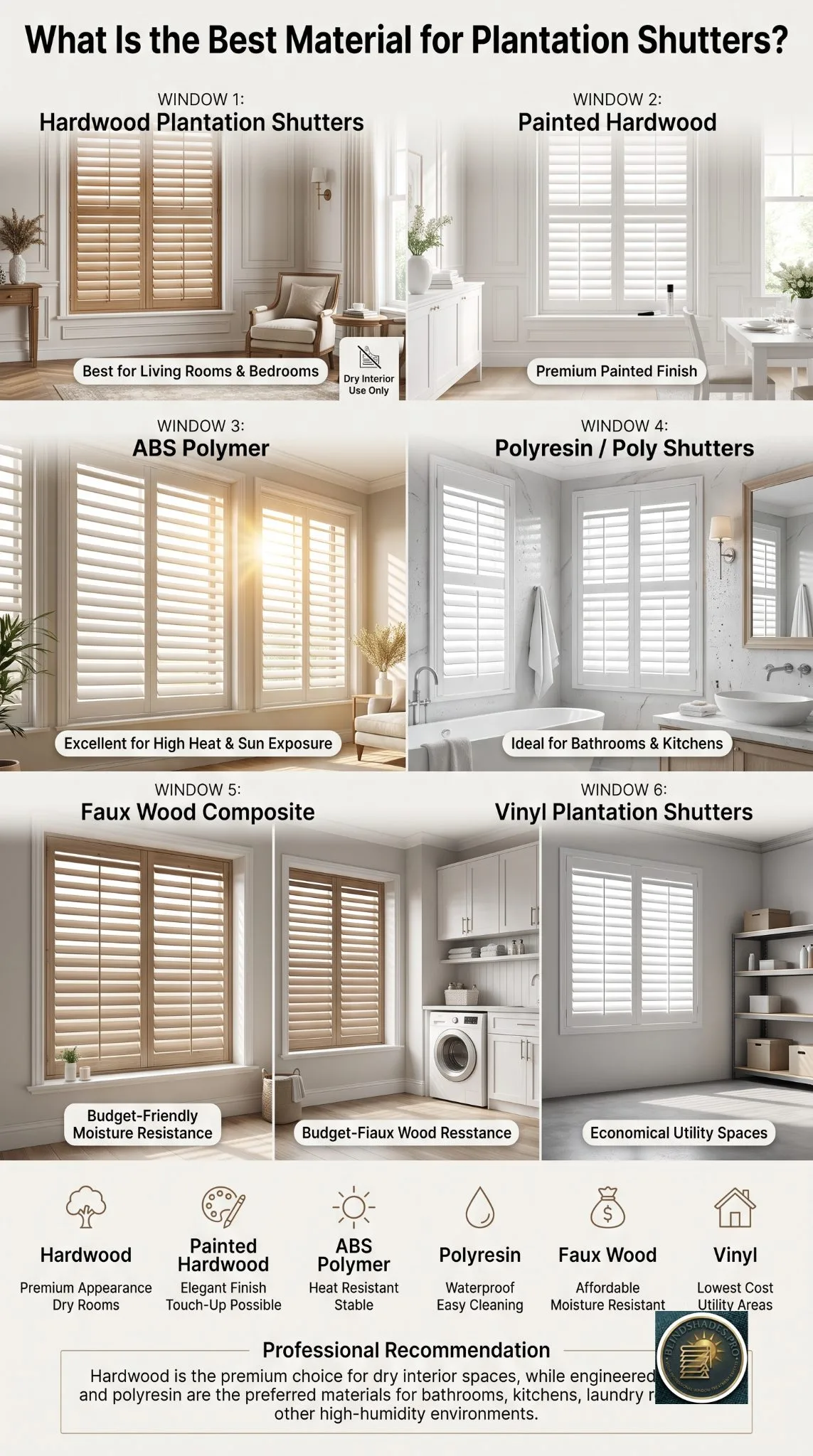
The 5 Plantation Shutter Material Types — Honest Performance Guide

This is the most critical specification decision in plantation shutter purchasing. Material determines durability, moisture tolerance, weight, finish quality, and price — and the distinctions between material types are more significant in shutters than in any other window covering category.

Material 1 — Basswood (The Premium Solid Wood Choice)

Basswood is the #1 material for premium solid wood plantation shutters — the same species that dominates real wood blinds (see Guide #15) for the same reasons.

Why basswood for shutters:

  • Lightest of all hardwoods used in shutter manufacturing — less stress on hinges and frames
  • Fine, consistent grain that accepts paint and stain evenly
  • Very stable dimensionally — less prone to warping than other wood species
  • Strong enough to maintain louver tension over decades of operation

Limitations:

  • Most expensive solid wood option
  • Not appropriate for high-humidity applications — basswood absorbs moisture and can warp in sustained steam environments
  • Requires periodic repainting or refinishing over a 15–25 year lifespan

Best for: Primary living rooms, bedrooms, dining rooms, home offices in moderate-to-dry climates. Any room where genuine wood character and grain are important design elements.


Material 2 — Poplar

A soft hardwood — slightly harder and denser than basswood, with a slightly more pronounced grain. Used by some shutter manufacturers as a cost-effective basswood alternative. Norman Woodlore Plus uses a poplar-core composite construction.

Performance comparison to basswood:

  • Slightly heavier than basswood
  • Grain slightly more visible — which can be attractive in stained finishes
  • Similar moisture sensitivity to basswood
  • Slightly less expensive than basswood in finished shutter form

Best for: Standard residential applications where basswood pricing is a constraint but solid wood character is still wanted.


Material 3 — MDF (Medium-Density Fiberboard)

MDF is wood fiber compressed with resin binders into a dense, uniform board. Used in some budget shutter products and as the core material in many composite shutters.

Advantages:

  • Highly stable — does not have grain direction, so it does not warp the way solid wood does
  • Very smooth surface — ideal for painted finishes
  • Less expensive than solid wood

The critical limitations of MDF for shutters:

  • Heavy — significantly heavier than basswood or poplar, which creates stress on hinges over time
  • Extremely vulnerable to moisture — MDF swells, delaminates, and deteriorates rapidly when exposed to water or sustained high humidity
  • Chips and dents more easily than solid wood
  • Over time, heavy MDF panels sag on their hinges

My recommendation after 30 years: Avoid MDF shutters in any primary room application. MDF is an acceptable core material in quality composite shutters (where it is coated) but unacceptable as a standalone shutter material in residential applications.


Material 4 — Composite (The Best All-Around Material)

Composite plantation shutters use an engineered core — typically basswood, poplar, or MDF — wrapped in a polymer coating or encased in a PVC shell. This construction combines the structural rigidity of wood with enhanced moisture resistance.

Why composite is the best choice for most applications:

  • Better moisture resistance than solid wood: The polymer coating or PVC casing resists moisture penetration significantly better than uncoated wood
  • Lighter than vinyl: The wood-core composite is lighter than solid PVC at equivalent dimensions
  • More realistic appearance than vinyl: The wood core gives composite shutters a more natural feel and slightly better acoustic quality than hollow PVC
  • Lower maintenance than solid wood: The coating resists the need for periodic refinishing
  • More affordable than premium solid wood

Best quality indicator for composite shutters: Look for shutters with solid wood cores (not MDF) encased in a quality polymer coating. Hunter Douglas NewStyle Hybrid uses a proprietary composite construction. Norman Woodlore uses an engineered wood core.

Best for: Most residential applications — living rooms, bedrooms, dining rooms. Any room where the combination of wood character, moisture resistance, and lower maintenance than solid wood is the right balance.


Material 5 — Vinyl / Solid PVC (The Waterproof Choice)

Solid PVC or poly shutters are manufactured entirely from synthetic polymer material with no wood content. These are the appropriate choice for genuinely high-humidity applications.

Advantages:

  • 100% waterproof — genuinely appropriate for steam bathrooms and direct water exposure
  • No warping, swelling, or moisture damage of any kind
  • Very durable in high-humidity and coastal environments
  • Easy to clean — wipe with any household cleaner

Limitations:

  • Heaviest material — solid PVC is significantly heavier than wood or composite at equivalent dimensions
  • More stress on hinges over time due to weight
  • Less realistic wood grain appearance than composite
  • Can develop slight yellowing with sustained UV exposure (same mechanism as faux wood blinds)
  • Maximum practical panel width is limited by weight

The hollow vs solid PVC distinction: Some budget vinyl shutters use hollow PVC profiles rather than solid PVC. Hollow PVC shutters are significantly less durable — they flex and crack under normal louver operation over time. Louver Shop’s LouverWood and similar quality brands use solid cellular PVC — ask explicitly whether PVC shutters are solid or hollow before purchasing.

Best for: Bathrooms with showers, kitchens, laundry rooms, coastal properties, any high-humidity or water-exposure application.


custom window treatments

The Louver Size Guide — The Most Visible Decision

Louver size is the horizontal width of each individual rotating slat. This is the specification that most defines the visual character of plantation shutters — and the one that determines the quality of light and view-through.

2.5-Inch Louvers

The smallest common plantation shutter louver size. Traditional and classic in appearance — creates the most slat-lines per panel height, giving a detailed, fine-grained look.

Light and view characteristics:

  • Most light control gradations between open and closed
  • When fully open, provides the most filtered view (more slat overlap in view path)
  • Most traditional appearance — associated with period-appropriate historic styles

Best for: Traditional, colonial, Victorian, and classical interiors. Smaller windows where a finer-scaled louver looks proportional. Any room where a traditional period-appropriate shutter aesthetic is the design intent.

Honest consideration: 2.5-inch louvers are less popular in 2026 than in previous decades. The design trend toward cleaner, more open aesthetics has shifted the market toward 3.5-inch and 4.5-inch louvers. For contemporary and transitional homes — 2.5-inch louvers can feel dated.


3.5-Inch Louvers (The Most Popular Residential Specification)

The standard louver size for most residential plantation shutter installations in 2026. A balanced proportion — not too traditional, not too contemporary. Works on most standard window sizes.

Light and view characteristics:

  • Excellent light control with smooth louver tilt
  • When fully open, provides a clearer view than 2.5-inch with fewer slat-lines in the view path
  • Compatible with both traditional and contemporary interior styles

Best for: Most residential applications — living rooms, bedrooms, dining rooms, home offices with standard window sizes. The default specification when louver size has not been specifically considered for a different reason.


4.5-Inch Louvers (The Contemporary Statement)

The largest common plantation shutter louver size. Fewer, wider louvers create a bold, modern horizontal statement with maximum view-through when open.

Light and view characteristics:

  • Maximum view-through when louvers are fully open — approaches the look of an open window
  • Fewer light control gradations than smaller louvers
  • The most contemporary appearance — used by designers to update the traditional shutter look

Best for: Contemporary, transitional, and modern interiors. Large windows where the wider louver looks proportional. Any room where maximum view-through when the louvers are open is a design priority. Homes where the shutter should feel architectural rather than traditional.

The Ron Carter design principle: “We like to use the widest 4.5-inch louver for transitional and contemporary homes combined with hidden tilt rods — so all you see is the openness of the large louver, which updates the traditional shutter look and brings it into today’s updated home interior.”


Hidden Tilt Rod vs Traditional Tilt Rod — The Aesthetic Choice

The tilt rod is the vertical bar that connects the louvers and controls their simultaneous opening and closing. This specification makes a significant visual difference in the finished shutter appearance.

Traditional (Visible) Tilt Rod

A visible vertical rod runs up the center of each shutter panel, connecting all louvers mechanically. This is the classic plantation shutter appearance — the vertical rod is visible from both inside and outside the room.

Characteristics:

  • The traditional, recognizable plantation shutter look
  • Slightly simpler mechanism — more reliable under heavy daily use
  • All louvers move simultaneously when the tilt rod is adjusted
  • Available on every shutter manufacturer at every price tier

Best for: Traditional, colonial, and period-appropriate interiors where the visible tilt rod is part of the intended classic shutter aesthetic. Any application where maximum mechanism durability is a priority.


Hidden (Invisible) Tilt Rod

The tilt mechanism is concealed — louvers are connected internally and can be adjusted by touching any individual louver rather than operating a visible rod. The front face of the shutter panel shows only the louvers themselves.

Characteristics:

  • Cleaner, more modern appearance — the shutter looks like a continuous series of louvers without any vertical element
  • Particularly effective with 4.5-inch louvers — the combination creates a contemporary statement
  • Allows each louver to be adjusted individually if desired (in some designs)
  • Slightly more complex mechanism — premium versions are extremely reliable; budget versions can develop play over time

Best for: Contemporary and transitional interiors where a clean, uninterrupted louver appearance is the design intent. Any application where the shutter appearance should feel architectural rather than traditional.


Split Tilt — The Unique Plantation Shutter Privacy Feature

Split tilt is a plantation shutter feature with no equivalent in any other window covering category — and one that is consistently under-explained in buying guides.

What Split Tilt Is

In a standard plantation shutter, the tilt rod (or internal tilt mechanism) moves all louvers simultaneously. When you tilt the louvers open, all open. When you close them, all close.

Split tilt divides each panel into two independently operating zones — typically upper and lower halves. The upper louvers and lower louvers can be tilted to different angles independently of each other.

Why Split Tilt Is Uniquely Valuable

The privacy problem it solves: In most rooms, the specific privacy concern is at eye level — people outside can see in at the height of seated furniture. But blocking the eye-level view by closing all louvers also blocks the light from the upper portion of the window.

With split tilt: Close the lower louvers (below eye level from outside) for street-level privacy. Keep the upper louvers open to admit light from above the eye-level sightline. The room receives natural light from the upper portion of the window while the lower portion provides privacy.

This is the same benefit as a Top Down Bottom Up cellular shade — achieved within the plantation shutter format.

When to Specify Split Tilt

  • Street-facing windows in living rooms and dining rooms
  • Ground floor bedrooms where nighttime privacy at eye level matters
  • Home offices with windows at street level
  • Any window where “light plus privacy simultaneously” is the design requirement

Split tilt is available from most quality shutter manufacturers — Hunter Douglas, Norman, and others. Confirm this specification is available in your chosen material and louver size before ordering.


Frame Types — The Complete Selection Guide

The frame type determines how the shutter panels attach to and operate within the window opening. This is the specification that most buyers discover too late — after measuring incorrectly for the intended frame type.

L-Frame (Standard Inside Mount)

An L-shaped frame that mounts directly inside the window opening, with one face of the L sitting against the window casing and the other face forming the shutter panel mount inside the opening.

Best for: Most standard window applications. Clean, built-in appearance. Works on any window with adequate frame depth and a clean square opening.

Minimum depth required: 3/4 inch to 1.5 inches inside the frame, depending on manufacturer and louver size.


Z-Frame (Outside Mount / Casing Mount)

A Z-shaped frame that mounts on the face of the window casing (the trim around the window). The shutter sits in front of the window casing rather than inside it.

Best for: Windows with insufficient depth for inside mount. Windows with existing trim that should not be disturbed. Windows with handles, cranks, or hardware that would be obstructed by inside mount.

Visual result: The shutter appears to sit in front of the wall plane — a slightly more prominent appearance than inside mount. In some design contexts, the more architectural presence of outside mount is preferred.


Café Style (Bottom Half Only)

A frame that covers only the lower half of the window — typically from the midpoint to the sill. The upper half of the window remains uncovered.

Best for: Kitchen windows, dining room windows facing a street, any window where privacy at eye level is needed but full-height coverage is not desired. Creates the characteristic French bistro window appearance.

The functional advantage: Natural light enters freely through the uncovered upper half while the café shutters provide street-level privacy in the lower half.


Tier-on-Tier (Full Height, Two Independent Sections)

Two completely separate sets of shutter panels stacked vertically — upper panels and lower panels that operate completely independently. The lower panels can be closed while the upper panels are open, or vice versa.

The distinction from split tilt: Tier-on-tier involves separate complete panels for each zone. Split tilt involves one panel with independent louver zones. Tier-on-tier provides more dramatic separation — you can fully open the upper panels while the lower panels are completely closed.

Best for: Large windows where maximum light control flexibility across the full height is needed. Traditional British colonial window style. Any application where the ability to completely open the upper section independently is a priority.


Bypass Style

Shutter panels that slide on a track rather than hinging — similar to sliding doors. Used for large openings including sliding glass doors and patio doors where hinged panels would project too far into the room when open.

Best for: Sliding glass doors, wide patio openings, any very wide window where hinged panels are not practical.


Bi-Fold Style

Multiple panels hinged together that fold accordion-style when opened. Allows full-width openings to be covered with shutters that fold compactly to one or both sides.

Best for: Extra-wide windows, French doors, any application where the full window needs shutter coverage but hinged single panels would not stack compactly enough.


Energy Performance — The R-Value Data

This is one of the most frequently cited plantation shutter selling points — and one where accurate data matters.

The Cornell University Study Data: A study conducted by the Department of Design and Environmental Analysis at Cornell University found that properly installed wood shutters:

  • Reduce heat loss through windows by 75–90%
  • Provide an insulation R-value between R-4.0 and R-10.0

Context for these figures: Standard double-pane windows have an R-value of approximately R-2 to R-3. A properly installed wood plantation shutter effectively creates an air buffer between the louver panel and the window glass — this air buffer, properly enclosed by the L-frame or Z-frame creating a tight seal, is what drives the thermal performance.

The “properly installed” qualifier is critical: A shutter with gaps around the frame, a loose L-frame seal, or louvers that do not close completely does not create an effective air buffer and does not achieve this R-value. This is one of the most important arguments for professional installation and quality custom framing — the energy performance only materializes with a precise fit.

For comparison:

  • Standard roller shade: R-value approximately R-0.5
  • Cellular shade (double cell): R-value approximately R-3 to R-5
  • Wood plantation shutters (properly installed): R-value R-4.0 to R-10.0

For homes with significant heating and cooling costs — the energy case for plantation shutters is genuine and backed by independent university research.


custom window treatments

Custom vs Big-Box Shutters — The Quality Indicators to Check

This is the comparison that most buyers need to navigate before deciding where to purchase.

What Big-Box / Retail Shutters Provide

Advantages:

  • Available for order at Home Depot and Lowe’s with in-store guidance
  • Typically lower unit pricing
  • Standard lead times (3–6 weeks typical)
  • Basic professional installation services available

Quality limitations:

  • Typically use thinner material profiles than custom dealers
  • Frame depth and seal quality may be less precise
  • Limited louver size selection (often 2.5-inch and 3.5-inch only)
  • Hidden tilt rod and split tilt may not be available
  • Installation by third-party contractors who may not specialize in shutters

What Custom Shutter Dealers Provide

Advantages:

  • In-home measurement by shutter specialists
  • Thicker material profiles and more robust hinge hardware
  • Full louver size selection including 4.5-inch
  • Complete frame type selection for specialty windows
  • Hidden tilt rod and split tilt available
  • Professional installation by shutter-certified technicians
  • Manufacturer lifetime warranties honored by the dealer

Quality indicators to check in a custom dealer:

  1. Panel thickness: Quality shutters are 1 1/8 inch to 1.5 inches thick. Budget shutters are often 7/8 inch.
  2. Hinge count per panel: Standard is 3 hinges on a standard panel; quality shutters use 4 hinges for better weight distribution.
  3. Frame depth and seal: The frame should create a tight seal against the window casing — no visible gaps when louvers are closed.
  4. Louver tension: Quality louvers maintain their position when set — they do not sag or drift. A good louver tilt requires deliberate force to change.
  5. Warranty: Quality manufacturers offer limited lifetime warranty on both materials and operation.

What to Look For When Buying Plantation Shutters — The Complete Checklist

✅ 1. Match Material to Room

RoomRecommended MaterialAvoid
Living roomBasswood or compositeVinyl (too heavy for wide panels)
BedroomBasswood or compositeMDF (heavy, moisture risk)
KitchenComposite or solid PVCSolid wood (moisture issues)
Bathroom (steam)Solid PVC (hollow-free)Any wood or MDF
Coastal / humid climateComposite or solid PVCSolid wood
Rental / commercialCompositeSolid wood

✅ 2. Louver Size to Window and Interior Style

Interior StyleWindow SizeRecommended Louver Size
Traditional / colonialAny2.5 inch
TransitionalStandard3.5 inch
Contemporary / modernAny4.5 inch
Any styleLarge windows over 48″ wide3.5 or 4.5 inch
Any styleSmall windows under 24″ wide2.5 or 3.5 inch

✅ 3. Tilt Rod Style

  • Traditional: For period-appropriate, traditional interiors; maximum mechanism durability
  • Hidden: For contemporary and transitional interiors; cleaner appearance with 4.5-inch louvers

✅ 4. Consider Split Tilt for Street-Facing Windows

For any window where privacy at eye level matters during the day — split tilt provides a uniquely effective solution without sacrificing light from the upper portion of the window.


✅ 5. Frame Type to Window Situation

  • Standard square window with adequate depth: L-frame inside mount
  • Shallow window frame or existing trim to preserve: Z-frame outside mount
  • Ground floor street-facing window, privacy priority: Café style or Tier-on-tier
  • Sliding glass door or extra-wide opening: Bypass or Bi-fold
  • Very tall window needing independent zone control: Tier-on-tier

Top Plantation Shutter Brands Reviewed

🏆 Hunter Douglas NewStyle Hybrid Shutters — Premium Tier ($200 – $550 per window)

Hunter Douglas’s NewStyle is the benchmark for premium plantation shutters in the American market. The proprietary hybrid composite construction — a polymer-wrapped engineered wood core — provides the warmth and feel of real wood with enhanced moisture resistance. The ClearView hidden tilt rod option with 4.5-inch louvers produces the most contemporary shutter appearance available from any major manufacturer. PowerView motorization available for louver tilt. Lifetime limited warranty.

Honest assessment: The market leader for quality and longevity. Available only through Hunter Douglas authorized dealers who provide in-home measurement and professional installation. The professional installation service is genuinely important for shutters — installation precision directly affects both appearance and energy performance. Worth every dollar for primary living rooms and bedrooms in homes where the shutters are a long-term architectural investment.


🥈 Norman Woodlore Shutters — Mid-to-Premium Tier ($180 – $500 per window)

Norman’s Woodlore line is the most respected alternative to Hunter Douglas in the USA shutter market. Basswood construction with moisture-resistant coating. Available in 2.5-inch, 3.5-inch, and 4.5-inch louvers — the widest louver selection in the mid-premium tier. Hidden tilt available. Split tilt available. Strong authorized dealer network. Lifetime warranty.

Honest assessment: The right choice for buyers who want genuine basswood quality with professional installation at pricing consistently below Hunter Douglas. Norman’s louver selection — particularly the 4.5-inch option — is one of the best in the market. Their Woodlore Plus poly shutter is the best composite alternative for humid climates.


🥉 Polywood Shutters — Mid-to-Premium Tier ($150 – $420 per window)

Polywood’s solid polymer construction is the benchmark for high-humidity and coastal shutter applications. Made in the USA from solid PVC (not hollow). Unlike most vinyl shutters, Polywood uses a solid cellular PVC profile — significantly more durable than hollow PVC. Available in 2.5-inch, 3.5-inch, and 4.5-inch louvers. Lifetime warranty.

Honest assessment: The correct specification for steam bathrooms, coastal homes, Florida/Gulf Coast climates, and any application where moisture resistance is the primary priority. The solid PVC construction is genuinely more durable than composite in sustained high-humidity environments.


Bali Shutters (Home Depot Custom) — Mid-Range ($120 – $300 per window)

Bali’s plantation shutters available through Home Depot’s custom program are a solid mid-market choice for buyers who want quality shutters with professional installation at accessible pricing. Composite construction. 2.5-inch and 3.5-inch louvers available. Cordless operation standard. Professional installation included.

Honest assessment: The most accessible quality custom shutter available in USA retail. The Bali composite quality is genuine — not at Norman or Hunter Douglas level, but well above budget alternatives. The Home Depot professional installation service is reliable. For buyers who want custom shutters without going to a specialty dealer — Bali at Home Depot is the right choice.


SelectBlinds / US Blinds Composite Shutters — Online Value Tier ($100 – $280 per window)

Online mail-order composite shutters with measure-yourself installation guides. Accessible pricing with reasonably broad material and louver selection. Available in 3.5-inch and 4.5-inch options.

The honest caveat about DIY shutter installation: Plantation shutter installation is more demanding than any other window covering installation. The frame must be perfectly level and square — any deviation causes the panels to bind, hang unevenly, or create gaps. If the window casing is not perfectly true (which is common in homes over 20 years old), shim adjustments are required. For buyers with genuine carpentry experience — DIY is feasible. For most homeowners — professional installation for shutters is worth the cost.

Honest assessment: The right choice for buyers who are confident DIY installers with carpentry experience, or for secondary rooms like laundry rooms where precision matters less. For primary living rooms — professional installation is strongly recommended.


Plantation Shutters vs Real Wood Blinds — When to Choose Which

This comparison appears in Guide #15 but deserves a dedicated section here from the shutter perspective:

FactorPlantation ShuttersReal Wood Blinds
PermanencePermanent — frame stays in windowSemi-permanent — easily removed
Resale valueAppraised into home valueMinimal resale value benefit
Price per window$120 – $550+$50 – $450
Light controlTilt + full panel swingTilt + full raise only
Energy performanceR-4.0 to R-10.0 (properly installed)R-1 to R-2
Privacy optionsSplit tilt for zone controlAll slats move together
MaintenanceVery low — wipe periodicallyLow — dust regularly
Moisture toleranceMaterial-dependentNot suitable for humid rooms
AestheticsArchitectural, furniture-gradeElegant, horizontal slat pattern
Best forLong-term home investmentFlexible, affordable wood aesthetic

The honest guidance: Choose plantation shutters when you are making a long-term investment in a home you own and intend to stay in or sell. Choose real wood blinds when you want the wood aesthetic at lower cost, without installation permanence.


Where to Buy Plantation Shutters in the USA

Home Depot / Lowe’s Custom Programs

Best for: Bali (Home Depot) or VIMLE (Lowe’s) composite shutters, professional installation, accessible entry into custom shutters Price range: $100 – $350 per window installed Honest take: The most accessible custom shutter experience in US retail. The professional installation is included and reliable. Material quality is mid-market — adequate for most secondary living spaces and rental properties. For primary rooms where the shutters are a design centerpiece — custom shutter dealers deliver meaningfully better results.

Hunter Douglas Authorized Dealers

Best for: NewStyle Hybrid — the quality benchmark, hidden tilt, widest finish library, lifetime warranty with dealer accountability Price range: $200 – $600+ per window installed Honest take: The complete custom shutter experience — in-home measurement, material samples, dealer installation by shutter-trained technicians. The dealer accountability is as valuable as the product quality: if something is wrong after installation, the dealer returns to correct it.

Norman Window Fashions Dealers

Best for: Woodlore basswood shutters and Woodlore Plus poly — widest louver selection, competitive Hunter Douglas alternative Price range: $180 – $500 per window installed Honest take: The strongest alternative to Hunter Douglas for buyers who want genuine basswood quality or the widest poly selection. Find authorized Norman dealers at their website.

Online (SelectBlinds, US Blinds, Shutterfly)

Best for: DIY-confident homeowners, secondary rooms, rental properties, budget-conscious applications Price range: $80 – $280 per window (materials only, installation separate or DIY) Honest take: Viable for experienced DIY installers. For anyone without carpentry confidence — the money saved on material cost can be quickly offset by poor installation that requires corrections or causes shutter panel damage.


How to Measure for Plantation Shutters

Plantation shutter measurement is the most demanding of any window covering category. The following steps are for informational understanding — professional measurement by a shutter dealer is strongly recommended for primary room applications.

Step 1 — Determine Frame Type Before Measuring

The frame type determines what dimensions to measure. Inside mount (L-frame) requires the interior window opening dimensions. Outside mount (Z-frame) requires the casing face dimensions plus overlap amounts.

Step 2 — Inside Mount Measurement

  1. Measure the width of the window opening at top, middle, and bottom — record all three
  2. Measure the height at left, center, and right — record all three
  3. Check for out-of-square: if width measurements vary by more than 1/4 inch — indicate this to the shutter manufacturer. Shutter frames can be compensated for out-of-square windows, but the measurement must indicate the variation.
  4. Measure the frame depth — typically needs to be at least 1.5 to 2 inches for plantation shutter L-frame installation

Step 3 — Outside Mount Measurement (Z-Frame)

  1. Measure the window casing face width from outside edge to outside edge
  2. Add 1 to 2 inches per side for light blocking overlap
  3. Measure from the top casing to the sill

Step 4 — Check for Obstructions

  • Window handles, cranks, or hardware that would be blocked by inside mount
  • Existing trim or molding profiles that would require modification
  • Any window mechanical features (casement cranks, double-hung sash locks) that the shutter frame must accommodate

Step 5 — Professional Verification

For custom shutters — have a dealer or shutter installer verify measurements before ordering. The cost of professional measurement ($0–$50, often included in purchase) is trivial compared to the cost of replacing incorrectly sized shutter panels.


Cleaning and Maintaining Plantation Shutters

Plantation shutters are the lowest-maintenance window covering available.

Routine Maintenance

  • Dust louvers with a feather duster, dry microfiber cloth, or vacuum brush attachment weekly or bi-weekly
  • Tilt louvers to one angle and dust; reverse and dust the other face

Periodic Cleaning

  • Wipe each louver with a barely damp cloth for more thorough cleaning
  • For composite and vinyl shutters: mild dish soap solution is safe
  • For solid wood shutters: barely damp cloth only — immediately dry

What Never to Do

  • Never spray water onto solid wood shutters — moisture penetrates the end grain and frame joints
  • Never use solvent cleaners on composite or vinyl — may damage the polymer coating
  • Never force louvers beyond their tilt range — louver tension is set at manufacture and forcing beyond range damages the louver pivot points

Lubrication

Quality shutters do not require lubrication for 10–15 years of normal operation. If hinges develop squeaking or resistance — a tiny amount of white lithium grease on the hinge pins resolves it.


custom window treatments

Plantation Shutters FAQ

Q: Are plantation shutters worth the investment? A: For homeowners who own their home and plan to stay for 5+ years — yes, definitively. Plantation shutters are the only window covering that adds appraised value to a home. They last 25–50 years with minimal maintenance. And their energy performance (R-4.0 to R-10.0 when properly installed) delivers genuine utility savings. The investment is not justified for renters, for homes that will be sold in under 3 years, or for secondary rooms where lower-cost alternatives provide adequate performance.

Q: What is the difference between 2.5-inch, 3.5-inch, and 4.5-inch louvers? A: Louver width determines the visual character and view-through quality of the shutter. 2.5-inch is the most traditional — fine horizontal lines, classic plantation appearance. 3.5-inch is the current residential standard — balanced and versatile. 4.5-inch is the contemporary choice — bold horizontal statement, maximum view-through when open. Most designers in 2026 specify 3.5-inch for traditional homes and 4.5-inch for contemporary and transitional.

Q: What is a hidden tilt rod on plantation shutters? A: The tilt rod is the mechanism that moves all louvers simultaneously. A traditional tilt rod is a visible vertical bar on the front face of the shutter panel. A hidden tilt rod conceals the mechanism internally — you adjust louvers by touching them directly, and the front face of the shutter shows only the louvers without any vertical bar. Hidden tilt rods create a cleaner, more contemporary appearance and are particularly effective with 4.5-inch louvers.

Q: Do plantation shutters provide good insulation? A: Yes — when properly installed with a tight frame seal. A Cornell University study found properly installed wood plantation shutters reduce heat loss through windows by 75 to 90 percent and provide an R-value of 4.0 to 10.0. The air buffer created between the shutter panel and the window glass, enclosed by a tight-fitting frame, is the thermal mechanism. This is why professional installation matters — a poorly fitting frame with gaps eliminates the air buffer and dramatically reduces energy performance.

Q: What is split tilt and do I need it? A: Split tilt divides each shutter panel into two independently operating zones — typically upper and lower halves. The upper and lower louvers can be tilted to different angles simultaneously. This allows you to close the lower louvers for ground-level privacy while keeping the upper louvers open for natural light from above. For street-facing windows in living rooms, bedrooms, and home offices — split tilt is a genuinely valuable feature that no other window covering achieves as elegantly.

Q: Are plantation shutters suitable for bathrooms? A: Yes — with the right material. Solid PVC (poly) plantation shutters are genuinely waterproof and appropriate for even steam-producing bathrooms. Composite shutters with polymer coating are suitable for normal bathroom humidity but not for sustained steam exposure. Solid wood and MDF shutters should not be installed in any bathroom. Confirm the material specification before ordering any shutter for a bathroom.

Q: What is the difference between custom shutters and store-bought shutters? A: Custom shutters from specialty dealers are built to your exact window dimensions with quality material profiles, robust hinge hardware, and installed by shutter-trained technicians. Store-bought shutters (Home Depot, Lowe’s) use thinner profiles, limited louver selection, and are installed by general contractors who may not specialize in shutters. The energy performance difference (the air buffer R-value) depends on precise installation quality — an argument for professional custom installation.

Q: How long do plantation shutters last? A: Quality plantation shutters from Hunter Douglas, Norman, and Polywood last 25–50 years with minimal maintenance. The louver pivot points are the first components to show wear — typically after 15–25 years of daily use. Frame and panel integrity typically outlast the louver mechanism. Budget shutters from Amazon or off-brand online retailers: 5–10 years before visible deterioration.

Q: Can plantation shutters be painted or refinished? A: Solid wood and composite shutters with paintable surfaces can be repainted. The process is more involved than painting a wall — louvers must be removed or masked, and the new paint must be flexible enough to not crack at louver pivot points. Most shutter manufacturers recommend their own refinishing products. Vinyl/PVC shutters cannot be painted — the polymer surface does not accept paint adhesion.

Q: How do I choose between composite and solid wood plantation shutters? A: For most residential applications in moderate climates — composite is the better choice. Composite provides better moisture resistance, lower maintenance, and comparable appearance at lower cost than premium solid wood. Choose solid wood (basswood) when: the authentic wood grain character is a specific design requirement, the room is a primary living space where premium character justifies the cost, and the climate is moderate and dry.


The 2026 Plantation Shutter Trends

4.5-inch louvers with hidden tilt are the dominant contemporary specification. The combination of the widest louver with the cleanest tilt mechanism is the specification that designers are requesting most in 2026. It updates the traditional shutter look completely — what looks dated in 2.5-inch traditional tilt looks fresh and architectural in 4.5-inch hidden tilt.

Warm white and soft white finishes are replacing bright white. The cool, stark white plantation shutter of the 2010s is giving way to warm white, antique white, and linen white finishes that integrate better with 2026’s warm interior design palettes.

Motorized louver tilt is growing. Hunter Douglas PowerView tilt motorization for plantation shutters — adjusting louver angle via app or voice command — is growing in primary living room applications. The convenience of adjusting light throughout the day without touching the shutters is particularly compelling for homeowners who adjust louver angles frequently.

Specialty window shutters are mainstream. Arched, circular, and angled window shutters — once a specialty order requiring weeks of lead time — are increasingly standard offerings from major shutter dealers. The technical capability to fit plantation shutters to non-rectangular windows has expanded significantly.

Composite is definitively outpacing solid wood. Market share data shows composite construction now accounts for over 65% of residential plantation shutter sales — up from under 40% a decade ago. Lower maintenance, better moisture resistance, and competitive pricing with solid wood have made composite the clear majority choice.


Related Buying Guides on BlindShades.pro


Supporting Articles — Plantation Shutters Deep Dive

  • (Coming Soon) Plantation Shutters vs Wood Blinds — When Is Each the Right Choice?
  • (Coming Soon) What Louver Size Should I Choose for Plantation Shutters — 2.5 vs 3.5 vs 4.5 Inch Explained
  • (Coming Soon) Hidden Tilt Rod vs Traditional Tilt Rod — What Is the Actual Difference?
  • (Coming Soon) What Is Split Tilt on Plantation Shutters — And Why It Is the Best Privacy Solution
  • (Coming Soon) Do Plantation Shutters Add Value to Your Home — The Appraised Value Reality
  • (Coming Soon) Plantation Shutters for Bathrooms — Which Material Is Actually Safe for Steam
  • (Coming Soon) Hunter Douglas vs Norman Shutters — An Honest Comparison
  • (Coming Soon) The R-Value of Plantation Shutters — Real Energy Savings or Marketing Claim?
  • (Coming Soon) Are Plantation Shutters Worth It in 2026 — The 5-Year and 10-Year ROI Calculation
  • (Coming Soon) Custom Shutter Dealers vs Home Depot — What You Actually Get for the Price Difference

Final Verdict

Best overall plantation shutter for most American homes: Hunter Douglas NewStyle Hybrid with 3.5-inch louvers — the composite quality, hidden tilt option, professional installation service, and lifetime warranty make this the practical default for primary living rooms and bedrooms.

Best value plantation shutter: Bali at Home Depot custom program — composite quality with professional installation at accessible pricing. The right choice for buyers who want custom shutters without going to a specialty dealer.

Best for contemporary interiors: Hunter Douglas NewStyle or Norman Woodlore with 4.5-inch louvers and hidden tilt rod — the cleanest, most architectural shutter specification available.

Best for humid climates and bathrooms: Polywood or Norman Woodlore Plus solid PVC — genuinely waterproof construction that is appropriate for any moisture level.

When NOT to buy plantation shutters: Renters — the permanent installation is not appropriate for rental properties. Homes to be sold within 3 years — the installation cost and lead time don’t return full value in short-term ownership. Any application where budget is the primary constraint and long-term value is secondary — real wood blinds or faux wood blinds provide a similar aesthetic at a fraction of the cost.


This buying guide is maintained and updated by the editorial team at BlindShades.pro. We have no paid relationships with any manufacturer mentioned in this guide. All assessments reflect 30 years of independent home improvement industry experience.

Last updated: 2026 | www.blindshades.pro

Authored By Michael Turner

Authored By Michael Turner A master carpenter, home improvement specialist, and technical consultant! Michael Turner is a U.S.-based craftsman with over 30 years of hands-on experience in residential construction, custom woodwork, and interior upgrades. Known for his expertise in blinds and shades installation, smart window treatments, and precision carpentry, he bridges traditional craftsmanship with modern home technology. Michael has worked with leading home improvement firms, contributed to DIY renovation communities, and frequently shares practical insights on efficient installations, material selection, and energy-efficient home solutions.

Disclosure

This article contains affiliate links. If you purchase through these links, I may earn a commission at no extra cost to you. All recommendations are based on independent testing.