Are Pleated Shades Machine Washable — No. Here Is What Machine Washing Does to Them and the Correct Cleaning Protocol

Authored By Michael Turner -30 Years Home Improvement Expertise | Updated 2026 | BlindShades.pro
Updated on May 10, 2026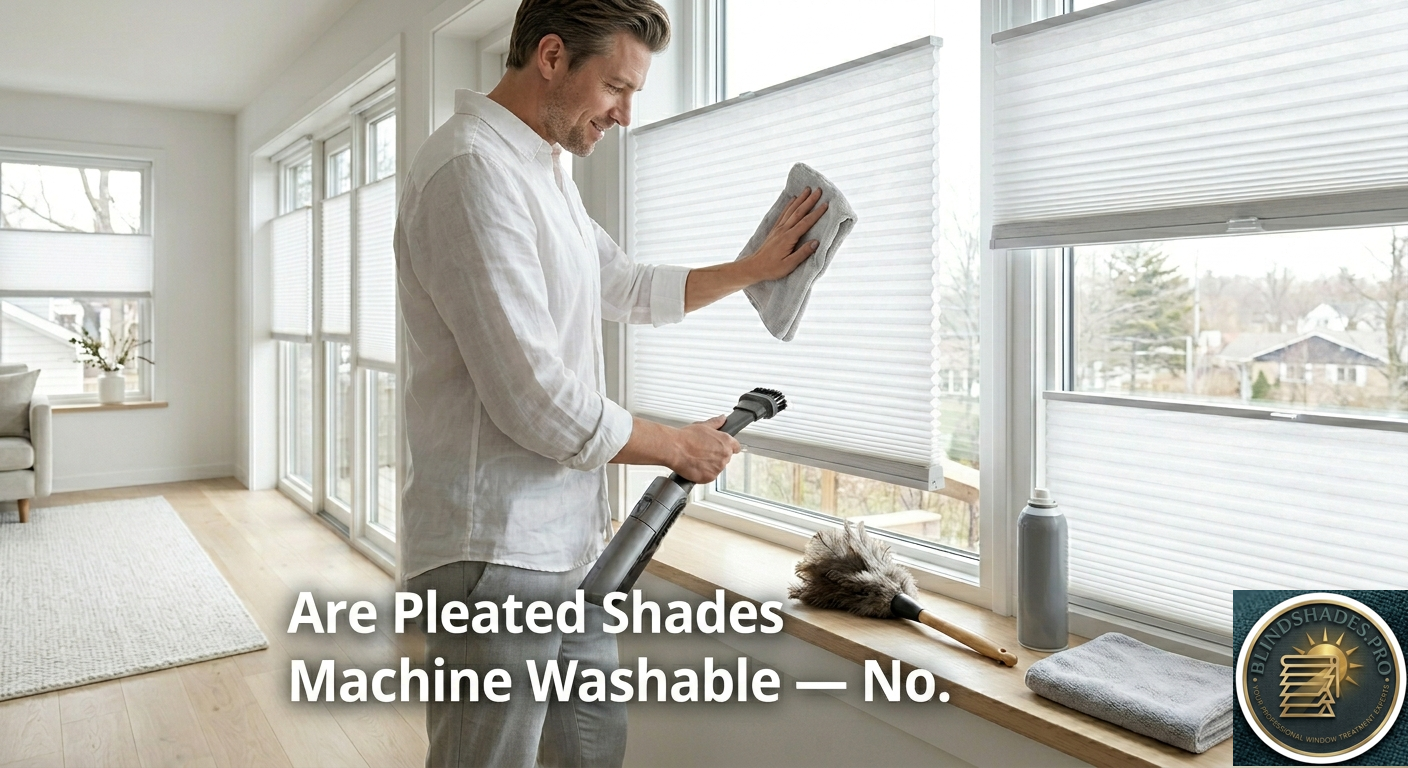
⭐ Quick Answer — Are Pleated Shades Machine Washable?
- No — machine washing destroys pleated shades in 3 specific ways: breaks down the pleat adhesive holding fold lines in shape · permanently distorts the accordion structure through agitation · allows water to infiltrate and corrode the headrail mechanism
- The Correct Frequency Schedule: Weekly → dry feather duster or microfibre along pleat direction · Monthly → low-suction vacuum + soft brush along pleat lines · Every 3–6 months → compressed air into the fold channels
- The Critical Technique: Always clean in the direction of the pleats (horizontal, following the fold lines) — never perpendicular. Cleaning against the pleat direction permanently stretches and distorts the fold structure
- For Spot Stains: Barely-damp cloth with mild soap along the pleat lines · immediately dry with hairdryer on cool setting (no heat) · never bleach, never iron, never spot removers
- Why It Gets Dusty Again Within Days: Static electricity in synthetic fabrics attracts and bonds dust. Fix: apply anti-static fabric spray after each monthly vacuum session — available from any laundry supply aisle
- If You Have a Blackout Liner: Dry cleaning only — no moisture whatsoever. Water between the face fabric and liner causes delamination and water spotting that cannot be reversed
⚠️ The Bathtub Soak Controversy — When It Is and Isn’t Safe: Some cleaning guides recommend bathtub soaking. Others warn it causes permanent water stains. Both are correct — for different shades. Bathtub soaking is appropriate ONLY for: (1) unlined 100% polyester shades with heat-bonded pleats (not pleat adhesive), (2) where the headrail can be protected from water, (3) soak no longer than 10–15 minutes in cool water with mild soap. Bathtub soaking is NOT safe for: lined shades (blackout/room-darkening/privacy liner), any shade with metallic backing, any natural fibre shade (cotton, linen, wool), or any shade not explicitly listed by the manufacturer as water-safe. Per mitsannapolis.com — water contact causes shrinkage, fabric distortion, or damage to pleat adhesives on non-water-safe shades. See the full bathtub soak decision guide below.
💡 The Compressed Air Technique — For Inside-Fold Dust Accumulation: Standard vacuuming removes surface dust but cannot reach dust trapped inside the accordion fold channels — where the most significant accumulation occurs. Every 3–6 months: remove the shade or work carefully with it hanging, direct short bursts of compressed air (the type used for keyboards) into the fold channels from 2–4 inches away, then immediately vacuum the expelled dust. This clears the inside-fold accumulation that causes shades to look grey or yellowed despite regular surface cleaning. Never use continuous stream or close-range bursts — cool propellant at close range can distort delicate fabric. See the full deep-clean protocol below.
📖 Read the complete guide below for: exactly why machine washing destroys pleated shades (3 failure modes), the full frequency schedule (weekly/monthly/3–6 months), the fold-direction technique, the compressed air inside-fold method, spot cleaning 5-step protocol, why the shade gets dusty within days and the anti-static fix, the lined shade dry-only protocol, the bathtub soak decision framework, and the quick-reference summary table.
Why Machine Washing Destroys Pleated Shades — The Three Specific Failures
Most guides say “machine washing is not recommended” without explaining why. Understanding the failure mechanism determines how aggressively you can clean your shades safely.
Failure 1 — Pleat Adhesive Breakdown
The crisp accordion pleat shape in a pleated shade is maintained by one of two methods: heat-bonded pleat creases built into the fabric during manufacturing, or pleat adhesive applied along the fold lines. Prolonged submersion in water — even cool water — begins to break down adhesive bond lines. The pleats lose their sharp crease, the shade collapses to a flat fabric, and the accordion structure cannot be restored.
What this means practically: A pleated shade submerged in a washing machine drum for a full wash cycle (typically 30–60 minutes) is in water far too long for the pleat construction to survive intact. Even gentle cycle agitation in water is destructive.
Failure 2 — Permanent Pleat Distortion from Agitation
The washing machine drum creates centrifugal force and agitation — the fabric is pushed against the drum walls, tangled with itself, and wrung during the spin cycle. Each accordion pleat fold is a precise angle created under controlled heat and pressure during manufacturing. Agitation permanently deforms these folds.
According to Made in the Shade (Eastern Shore), the spinning motion and water pressure can cause “fabric distortion.” According to mitsannapolis.com, machine washing “can cause shrinkage, fabric distortion, or damage to pleat adhesives.” The distortion is irreversible — the pleated shade cannot be reshaped after agitation damage.
Failure 3 — Headrail Mechanism Corrosion
The headrail of a pleated shade contains the operating mechanism — the cord or cordless system, the return spring, the mounting hardware. This mechanism is sealed but not waterproof. A machine wash cycle forces water into the headrail through the fabric slots and attachment points. The mechanism corrodes over days after the wash, eventually seizing or failing.
The correct conclusion: Pleated shades are not machine washable. The only exception is a very small number of purpose-made washable pleated shade products specifically marketed as machine washable — these use different construction methods to address all three failure modes. If your shade is not explicitly marketed as machine washable — assume it is not.
The Cleaning Frequency Schedule — What to Do and When
This is the structure that makes cleaning manageable — and one that most guides omit entirely.
Weekly — Light Dusting (2–3 minutes)
Purpose: Remove surface dust before it bonds with moisture or grease and becomes harder to remove.
Method: Draw a clean feather duster or dry microfibre cloth along each row of pleats in the direction of the pleat folds — horizontally, following the accordion lines. Do NOT run the duster or cloth perpendicular to the pleats — see the fold-direction technique section below.
What to avoid: Do not use any damp cloth for weekly dusting — moisture on the shade attracts and bonds more dust than dry fabric.
Monthly — Thorough Vacuuming (5–10 minutes)
Purpose: Remove accumulated dust from the pleat valleys and surface that the weekly dusting missed.
Method:
- Set the vacuum to the lowest suction setting — high suction can deform delicate fabric pleats
- Attach the soft brush attachment (upholstery brush) — never use the crevice tool directly on the fabric
- Move the brush slowly along each pleat row in the direction of the folds — horizontal passes following the accordion lines
- Vacuum both sides of the shade if accessible — dust accumulates on the back as much as the front
Why low suction matters: According to Aero Shade Co., the vacuum must be on a low setting to avoid damaging delicate fabric. High suction on a pleated shade can pull the pleat fold out of position and stretch the fabric.
Every 3–6 Months — Deep Clean with Compressed Air (10–15 minutes)
Purpose: Clear the accumulated dust from inside the pleat fold channels — the area that vacuuming from outside cannot reach.
The fold-channel problem: The accordion folds of a pleated shade create closed channels between each fold where dust, pet hair, and debris accumulate. A vacuum applied to the outside of the shade removes surface dust but cannot reach into these channels. Over months — significant accumulation builds inside the folds.
Method — Compressed Air:
- Take the shade down from the window (or work carefully with it hanging)
- Use a can of compressed air (the same type used for computer keyboards — available at any office supply store)
- Direct short bursts of compressed air INTO the pleat fold channels — working from the face of the shade into the fold, then along the fold channel
- Follow each compressed air burst with a vacuum pass on the outside of the shade to capture the expelled dust
- Work systematically across the width of the shade
What to avoid: Never use compressed air on a hot setting or continuous stream — the pressure and cold temperature of the propellant can cause fabric distortion at close range. Keep the can nozzle 2–4 inches from the fabric.
The Fold-Direction Dusting Technique — The Most Important Cleaning Rule
This is the cleaning detail that no competitor article makes prominently enough — and the mistake most commonly responsible for premature pleat distortion.
The rule: Always move your cleaning tool (duster, vacuum brush, or damp cloth) in the direction of the pleat folds — which means horizontally along each row of the accordion structure.
Why this matters: The accordion pleat fabric has a built-in directional tension — the fabric is under tension perpendicular to the folds (the direction that would spread or close the accordion). Moving a cleaning tool perpendicular to the pleats — up-and-down across the fold lines — applies tension in the direction that stretches and permanently deforms the pleat structure.
What incorrect cleaning looks like: After several months of perpendicular vacuuming — the pleats begin to look uneven, some folds are deeper than others, and the shade no longer sits flat when lowered. This is permanent distortion caused by repeated tension in the wrong direction.
Visual test: Before cleaning, look at the pleat lines. They run horizontally across the shade width. Move your cleaning tool parallel to these lines — left to right, following each pleat row — never up and down across them.
Spot Cleaning — The Correct Stain Treatment
For visible stains or marks on the pleated shade fabric:
Step 1 — Act immediately: Fresh stains are far easier to remove than set stains. Blot (do not rub) the stain with a clean dry cloth immediately after contact.
Step 2 — Prepare the solution: Mix a small amount of mild liquid soap (dish soap or a gentle laundry detergent) with lukewarm water. The solution should be barely sudsy — not concentrated.
Step 3 — Apply with a barely-damp cloth: Wring the cloth thoroughly until it is barely damp — not wet. Apply with light dabbing pressure along the pleat fold lines. Do not rub.
Step 4 — Rinse: Use a second barely-damp cloth with clean water (no soap) to blot the treated area and remove the soap residue.
Step 5 — Dry immediately: Use a hairdryer on the cool setting (no heat) to dry the fabric immediately. According to Blindster, this prevents “warping, fading, or staining” that can occur when the fabric stays damp. Direct the cool air along the pleat lines.
What never to use on pleated shade fabric:
- Chlorine bleach — weakens fibres and damages pleat mechanisms (Aero Shade Co. specifically warns against this)
- Oxygen bleach — only if specifically tested on an inconspicuous area first
- Ironing — the heat melts synthetic fibres and permanently removes pleat crease lines
- Spot remover products (OxiClean, Spray ‘n Wash) — can fade colour and weaken fibres according to Budget Blinds
- Steam cleaner at close range — excessive moisture causes water spotting
The Static Electricity Problem — and Its Solution
This is the cleaning challenge no competitor guide solves directly.
The problem: Synthetic fabric pleated shades (polyester, nylon) develop static electricity through contact with air currents and physical contact. The static charge attracts and holds dust to the fabric even after vacuuming — you may notice the shade looks dusty again within days of a thorough clean.
The solution: Anti-static fabric spray — the same product used on clothing and upholstery to eliminate static cling. Available from Amazon, Walmart, or any laundry supply aisle.
Application method:
- After the monthly vacuuming, hold the anti-static spray 12–18 inches from the shade surface
- Apply a light even mist across the fabric — not saturating, just lightly coating
- Allow to dry completely before raising the shade (typically 5–10 minutes)
The result: The anti-static treatment significantly reduces the rate at which dust re-accumulates on the shade surface. Monthly application after vacuuming extends the period between visible dust build-up from days to weeks.
Lined Pleated Shades — A Different Cleaning Protocol
This is the most overlooked pleated shade cleaning distinction. If your pleated shade has a blackout liner, room-darkening liner, or privacy liner bonded or sewn to the face fabric — the cleaning protocol changes.
The specific risk: Water applied to the face fabric of a lined pleated shade can penetrate between the face fabric and the liner backing. The water becomes trapped between the two layers, unable to evaporate. This trapped moisture causes:
- Water staining between the layers (visible as a tide mark through the face fabric when backlit)
- Delamination of the liner bond at the pleat fold lines (the liner peels away from the face fabric)
- Mould growth between the layers in humid environments
The lined shade cleaning protocol:
- Weekly: Dry dusting only — no moisture of any kind
- Monthly: Dry vacuuming only — no moisture of any kind
- Spot treatment: Use the most minimal possible moisture — a cloth that is barely damp, immediately dried with cool air. Test on an inconspicuous corner first to confirm no water spotting between layers occurs.
- Never: Bathtub soaking, steam cleaning, or any wet cleaning method on a lined pleated shade
The Bathtub Soak — When It Is and Isn’t Appropriate
Some cleaning guides recommend bathtub soaking for deep cleaning pleated shades. Others warn that soaking causes water stains. Both are correct — for different products.
When bathtub soaking is appropriate:
- Unlined 100% polyester pleated shades
- The shade does not have pleat adhesive (heat-bonded pleat crease construction only)
- The headrail can be detached or protected from water
Method for appropriate shades:
- Detach or protect the headrail mechanism from water
- Fill the bathtub with cool water and a small amount of mild soap
- Submerge the shade for no more than 10–15 minutes — not a prolonged soak
- Gently swish — do not agitate vigorously
- Drain and rinse with clean cool water
- Do not wring or twist the shade
- Lay flat on clean towels to remove excess moisture
- Rehang while still damp — the pleats will re-form as the shade dries hanging in position
- Use cool air from a fan or open window to accelerate drying — never direct heat
When bathtub soaking is NOT appropriate:
- Any shade with a blackout, room-darkening, or privacy liner
- Shades with pleat adhesive construction
- Shades with metallic backing
- Natural fibre shades (cotton, linen, wool)
- Any shade where the headrail cannot be protected from water
- Any shade not explicitly described by the manufacturer as water-safe
The Frequency Summary — Quick Reference
| Frequency | Method | Time | Tools |
|---|---|---|---|
| Weekly | Dry dust along pleat direction | 2–3 min | Feather duster or dry microfibre |
| Monthly | Soft-brush vacuum at low suction, along pleat direction | 5–10 min | Vacuum + soft brush attachment |
| Monthly (after vacuuming) | Anti-static spray | 5 min | Anti-static fabric spray |
| Every 3–6 months | Compressed air into fold channels + vacuum | 10–15 min | Compressed air can + vacuum |
| As needed | Spot treatment with barely-damp cloth + cool dry | 5–10 min | Mild soap, barely-damp cloth, cool hairdryer |
| Never | Machine wash | — | — |
| Never (lined shades) | Any wet cleaning, steam, soaking | — | — |
Frequently Asked Questions
Are pleated shades machine washable? No — standard pleated shades should not be machine washed. Machine washing causes three specific failures: it breaks down the pleat adhesive that holds the fold structure in shape, permanently distorts the accordion pleat structure through agitation and centrifugal force, and allows water to infiltrate the headrail mechanism causing corrosion. According to mitsannapolis.com, machine washing causes shrinkage, fabric distortion, and damage to pleat adhesives. The only exception is a small number of purpose-made washable pleated shades explicitly marketed as machine washable.
How often should I clean my pleated shades? Follow a three-tier schedule. Weekly — dry dust along the pleat direction with a feather duster or dry microfibre cloth. Monthly — vacuum at low suction with a soft brush attachment along the pleat fold lines, followed by an application of anti-static spray to reduce dust re-accumulation. Every 3 to 6 months — deep clean the pleat fold channels with compressed air directed into the fold channels followed by vacuuming the expelled dust.
Why does my pleated shade get dusty so fast after cleaning? Static electricity in synthetic fabric shades attracts and holds dust. The shade generates static through air movement and contact, and the electric charge bonds dust particles to the fabric surface. The solution is to apply anti-static fabric spray after each monthly vacuuming session. This eliminates the static charge and significantly extends the time before visible dust re-accumulation.
Can I steam clean a pleated shade? With caution. Use a handheld steamer on the lowest heat setting, kept several inches from the fabric surface per Aero Shade Co.’s cleaning guidance. Never use a steam cleaner at close range or on high heat — excessive moisture causes water spotting and high heat melts synthetic fibres. Never use an iron — it permanently removes the pleat crease lines. Do not steam clean any lined pleated shade.
How do I clean a blackout-lined pleated shade? Dry cleaning methods only — weekly dry dusting and monthly dry vacuuming. Never apply moisture to a lined pleated shade. Water penetrating between the face fabric and liner becomes trapped and causes water spotting between layers, liner delamination at the pleat fold lines, and potential mould growth. Spot treat only with the most minimal possible barely-damp cloth and immediately dry with cool air, testing on an inconspicuous corner first.
Can I soak a pleated shade in the bathtub? Only if the shade is unlined, 100% polyester, and has heat-bonded pleat creases rather than pleat adhesive. Soak for no more than 10 to 15 minutes in cool water with mild soap. Detach or protect the headrail from water. Do not wring. Rehang while slightly damp to allow the pleats to reform as the shade dries. Never soak any lined shade, any shade with metallic backing, or any natural fibre shade.
Related Guides on BlindShades.pro
- The Best Pleated Shades Buying Guide — full pleated shade specification guide
- Can Pleated Shades Be Blackout — The Liner Upgrade Guide — includes liner construction and cleaning considerations
- Why Are Pleated Shades Cheaper Than Cellular — the construction difference that also affects cleaning
- Pleated Shades vs Cellular Shades — The Honest R-Value and Price Comparison — includes the cleaning comparison between both products
By Michael Turner | 30 Years Home Improvement Expertise | Updated 2026 | BlindShades.pro
