How Do You Cover a Front Door Window for Privacy?

Authored By Michael Turner -30 Years Home Improvement Expertise | Updated 2026 | BlindShades.pro
Updated on May 28, 2026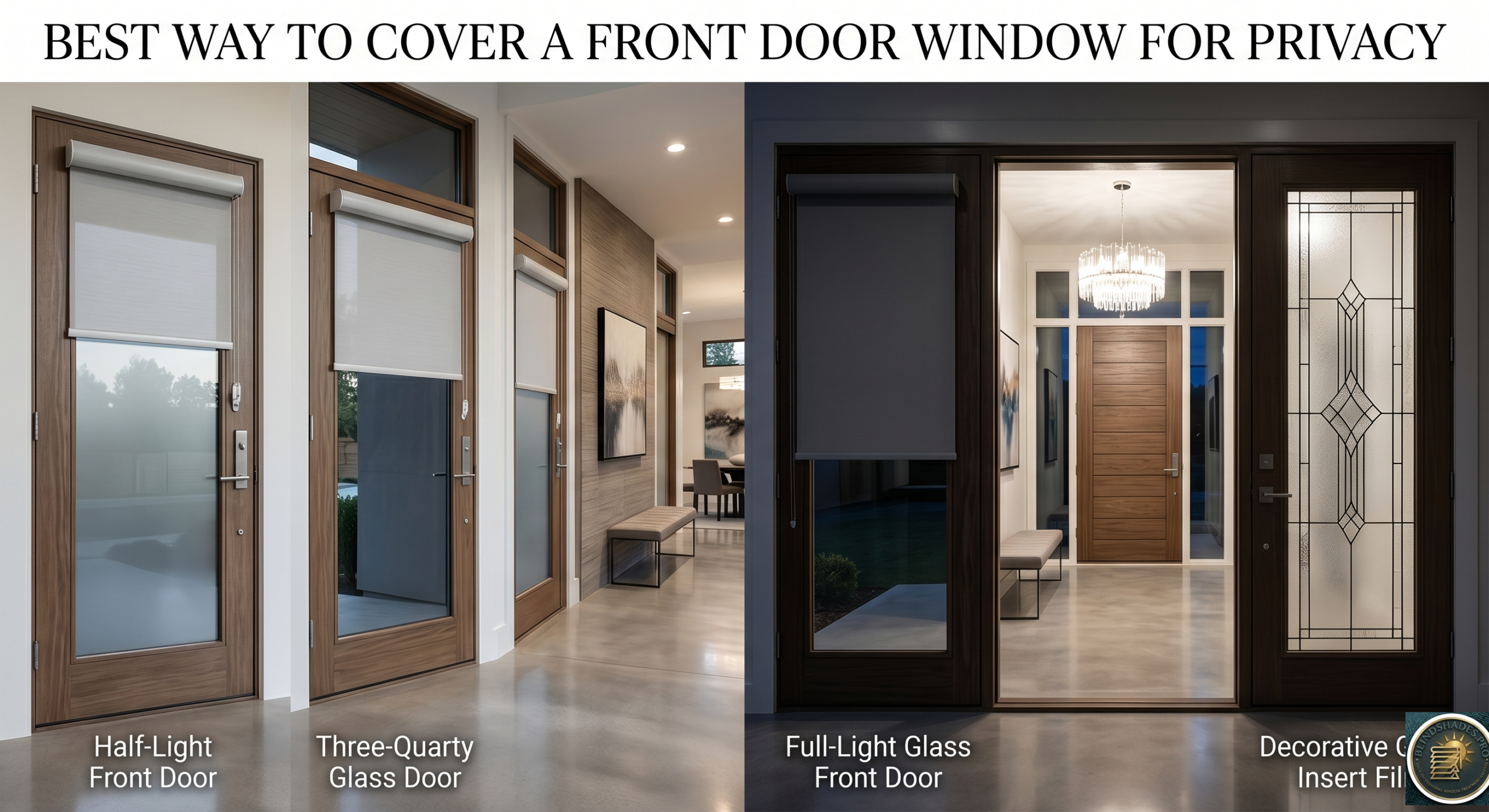
Key Takeaways:
- One-way mirror film and solar shades provide daytime-only privacy for front door windows – the entryway chandelier or foyer light at night creates an interior luminance of 100 to 500 lux versus near-zero exterior, reversing the one-way effect and making the front door glass fully visible from outside; a secondary opaque shade is required for any front door window used in the evening
- Magnetic blinds are the structurally correct specification for steel-core entry doors – approximately 62 percent of US residential entry doors are steel-core; drilling brackets into a steel-core door compromises the structural integrity at that point; magnetic mounting brackets require no drilling and are removable for painting or door replacement
- The front door treatment is the only window treatment in the home that is simultaneously an exterior architectural element visible to every visitor – specify treatments that complement the door’s architectural style from the street as well as providing interior privacy
- A door-mounted blind in the lowered position swings through the full door arc (approximately 32 inches for a standard 32-inch door) when the door opens – entry consoles, coat racks, and hallway furniture within the door arc will be struck by the lowered blind; the blind must be raised before opening the door
- Frame-mounted treatments (installed on the door frame, not the door itself) are stationary, do not require hold-down brackets, do not swing with the door, and do not conflict with smart locks or door keypads – frame-mount is the preferred specification when frame depth allows
⭐ Quick Answer — How Do You Cover a Front Door Window for Privacy?
- The Night Reversal Warning — One-Way Film Fails After Dark: The most important fact for front door window privacy: one-way mirror film and solar shades provide daytime privacy only. Your entryway chandelier or foyer light creates 100–500 lux of interior luminance against 0–5 lux exterior at night. This reverses the one-way effect — the film becomes transparent from outside, making your front door glass the single most visible interior surface in the home after dark. During the day: bright exterior (1,000–10,000 lux) blocks inward visibility. At night: bright interior illuminates the glass from inside. For full day-and-night front door window privacy: frosted film (permanent, both directions at all times) or frosted film + adjustable opaque shade for light control
- The Five Door Glass Types and Their Correct Treatments: Covering a front door window for privacy depends on the glass type. Half-light (most common): glass in upper half only — frame-mounted cordless roller shade above the glass panel; room-darkening fabric; hold-downs if door-mounted. Full-light: full glass door — full-panel roller shade with hold-downs mandatory; magnetic brackets for steel-core doors. Three-quarter light: same as half-light specification but longer shade. Small decorative insert (6–12 inches): frosted or privacy film only — a mounted blind is disproportionate to the glass area. Oval/arched/shaped glass: window film cut to shape only — rectangular blinds cannot cover shaped panels
- Magnetic Blinds — The Correct Specification for Steel-Core Doors: Approximately 62 percent of US residential entry doors are steel-core construction. Drilling standard blind brackets into a steel-core door compromises the steel skin’s moisture resistance and may void the door manufacturer’s warranty. Magnetic mounting brackets use rare-earth magnets to attach to the steel door face without drilling — installed in under 5 minutes; removable without trace; no structural compromise. Magnetic hold-down brackets at the bottom rail prevent swing. Magnetic mounting does NOT work on fibreglass, wood, or composite doors — test with a household magnet before ordering. If the magnet adheres firmly: magnetic mounting viable
- Frame-Mount First — Preferred Over Door-Mount for Three Reasons: For any front door window treatment where the door frame offers mounting depth: frame-mount is preferred. A frame-mounted treatment is stationary — the door opens behind it; no hold-down brackets required; no door swing clearance concern; no smart lock keypad conflict. A door-mounted blind in the lowered privacy position swings through the full door arc (approximately 32 inches for a standard 32-inch door) when the door opens — entry consoles, coat racks, and hallway furniture within this arc will be struck. And if your door has a smart keypad or electronic lock at 36–42 inches, a fully lowered door-mounted blind covers the controls — you cannot enter the code without raising the blind first
- Curb Appeal — Your Treatment Is an Exterior Architectural Element: Unlike any other window treatment in the home, the front door window privacy treatment is visible from the street to every visitor. The treatment in both the raised and the lowered position is an exterior architectural feature. Plantation shutters complement traditional and craftsman doors; clean roller shades in neutral fabric suit modern and contemporary styles; ornate fabric panels conflict with modern minimalist doors; plain rectangular roller shades conflict with Victorian arched glass. Before confirming any purchase: stand outside and look at the door from the street. The treatment must be acceptable from both inside and outside in both its open and closed positions
- Best Sources: Day-and-night privacy combination (film + shade) → Concord Window Film front door guide · Door-mounted roller shade with hold-downs → SelectBlinds door blinds range · Hold-down bracket installation → Blinds Chalet hold-down guide
⚠️ The See-Out Preservation Principle and the Frosted Film Decision: The front door window serves a dual function: blocking inward visibility from outside AND preserving the homeowner’s ability to see OUT to identify visitors before opening the door. The correct front door window privacy treatment preserves both functions. One-way mirror film: preserves see-out during the day (exterior is brighter; you see out clearly); fails at night (luminance reversal). Frosted film: permanent privacy in both directions; eliminates inward visibility permanently; also eliminates the homeowner’s ability to see out through that glass; the door viewer/peephole becomes the identification tool. TDBU roller shade (top panel down): the top panel lowered from the headrail covers the upper zone where the visitor’s inward sightline enters, while the lower portion remains clear for the homeowner to look out at a downward angle toward the visitor. This is the only treatment that simultaneously blocks the inward sightline and preserves the outward see-out view. For the complete sidelight-specific privacy specification including approach-angle failure of solar shades and the TDBU + hold-down combination for sidelights, see What Are the Best Blinds for Sidelights. See the full door glass type matrix below.
💡 The Architectural Style Guide for Front Door Window Treatments: Choosing the right front door window privacy treatment requires matching the treatment to the door’s architectural style — visible to every visitor from the street. Traditional / Colonial doors: plantation shutters and neutral-fabric roller shades complement; industrial hardware conflicts. Craftsman / Arts and Crafts doors: cellular shade in natural tones, woven wood blind, or plantation shutters; modern solar shade in bright synthetic fabric conflicts. Modern / Contemporary doors: clean roller shade with minimal hardware, solar shade (daytime use only with secondary night shade), or PDLC smart film (transparent by day, opaque on command); plantation shutters and ornate fabric panels conflict. Victorian / Traditional ornate with shaped glass: custom frosted film cut to match the glass profile; plain rectangular roller shade that contrasts with shaped glass conflicts. Farmhouse style: woven wood, natural linen roller shade, or relaxed Roman shade; blackout synthetic roller shade in black or grey conflicts. Always view the door from outside before confirming any purchase — both the raised (open) and lowered (privacy) positions must complement the exterior facade. For the full comparison of frosted film versus adjustable blinds including cost, reversibility, and the permanent vs adjustable privacy trade-off, see Is Frosted Film Better Than Blinds for Sidelights. See the full night privacy reversal guide below.
📖 Read the complete guide below for: the five door glass types (half-light / full-light / three-quarter light / small decorative insert / shaped glass) and their correct treatments, the night privacy reversal mechanism (entryway chandelier 100–500 lux vs exterior 0–5 lux at night; one-way film becomes transparent), the magnetic blind specification for 62 percent steel-core entry doors (no drilling, removable, structurally correct), the door-mounted vs frame-mounted decision (frame-mount preferred: stationary, no hold-downs, no door swing arc conflict, no smart lock keypad coverage), the door swing clearance warning (32-inch arc, entry furniture struck by lowered blind), the smart lock and keypad conflict at 36–42 inches, the see-out preservation principle (TDBU top-down for door glass), and the architectural style guide for matching treatments to door style from the street.
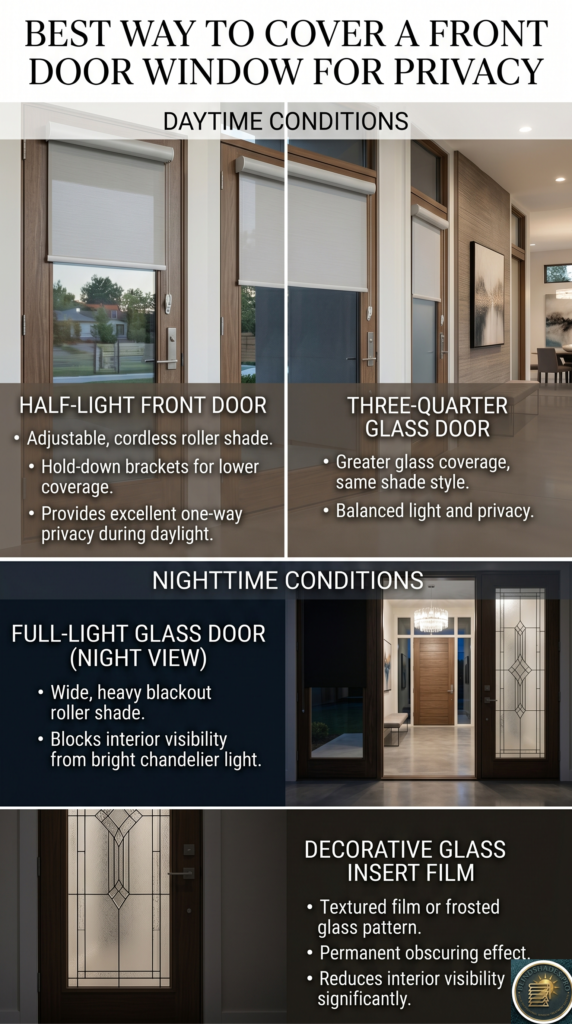
Front Door Window Privacy – The Door Glass Type Matrix
Definition: A front door window is any glass element that is part of the entry door unit itself — as distinct from sidelights (separate window units beside the door) covered in Article 45-1. Front door windows include the glass panels, lights, and decorative inserts built into the door structure.
The five door glass types and their correct privacy treatments:
Type 1 – Half-Light Door (Most Common)
Description: Glass occupies the upper half of the door — typically a 15-24 inch wide glass panel(s) in the upper 30-36 inches of a standard 80-inch door.
Why it is the most common: Half-light doors provide natural light to the entryway while maintaining a solid lower panel for thermal insulation and structural rigidity. The upper glass at 44-80 inches above the floor is in the primary sightline of a standing visitor at 60-66 inches eye height.
Correct treatment:
- Door-mounted cordless roller shade: mounted at the top of the glass panel with hold-down brackets at the bottom of the panel — provides full adjustable coverage
- TDBU configuration: lower the top panel from the headrail to cover the upper portion (where the visitor sightline enters) while preserving the lower portion for the homeowner’s see-out view
- Privacy film (permanent): appropriate if treatment adjustability is not required
Night privacy note: Requires opaque shade (not one-way film alone) for evening use when the entryway is lit — see Night Privacy Reversal section below.
Type 2 – Full-Light Door
Description: Glass occupies the full or near-full face of the door — from top to bottom rail. Common in craftsman, modern, and French-door style entry configurations.
Privacy challenge: Maximum glass area; maximum inward visibility from any angle; requires the most comprehensive treatment.
Correct treatment:
- Full-panel door roller shade: mounted at the top of the door glass panel; covers the full glass from top to bottom when lowered; hold-down brackets at the bottom rail mandatory
- For steel-core full-light doors: magnetic roller shade mounting brackets; no drilling
- Night privacy: opaque blackout fabric required; one-way film alone is inadequate at night when entryway is illuminated
Curb appeal note: A full-light door with a lowered opaque shade visible from outside changes the character of the facade significantly. Consider whether the daytime raised position of the shade (shade rolled up at the headrail, glass fully visible) and the lowered privacy position both complement the exterior appearance.
Type 3 – Three-Quarter Light Door
Description: Glass occupies the upper three-quarters of the door — approximately 60 inches of glass in an 80-inch door, with a solid bottom panel of approximately 20 inches.
Correct treatment: Same as half-light specification — door-mounted roller shade or blind on the glass panel with hold-down brackets. The longer glass panel requires a longer shade — confirm the shade’s maximum rolled length accommodates the glass panel height when fully raised.
Type 4 – Small Decorative Insert (6-12 inch glass panel)
Description: A small glass panel at eye level — typically 6-12 inches tall and 6-12 inches wide — positioned in an otherwise solid door for minimal light admission and identification.
Correct treatment: Frosted or privacy film applied directly to the glass. A mounted blind or shade is disproportionate to the small glass area and creates an aesthetic mismatch with the door design. Film provides permanent privacy appropriate for a decorative insert that does not require adjustability. One-way mirror film is acceptable for small inserts in well-lit exterior positions where daytime-only privacy is adequate.
Type 5 – Oval, Arched, or Shaped Glass
Description: Non-rectangular glass elements — ovals, arches, half-rounds, and decorative shaped panels common in traditional and Victorian door designs.
Correct treatment: Window film only. Standard rectangular roller shades, mini blinds, and cellular shades cannot cover a shaped glass panel without leaving uncovered corners or requiring a custom-fabricated arched treatment. Custom arched shutters exist but cost $400-$1,200 for a single small arched panel. For most homeowners with shaped door glass: frosted or privacy film cut to the glass shape is the practical solution.
The Night Privacy Reversal — The Critical Warning
Every guide that recommends one-way mirror film for front doors mentions it provides “daytime privacy.” None explain why it completely fails at night, or why front doors are specifically the most affected location in the home.
The luminance reversal mechanism:
One-way mirror film creates a reflective exterior surface when exterior luminance is higher than interior luminance. During the day: bright exterior (1,000-10,000 lux outdoors) versus moderate interior (50-200 lux in a typical entry). The film appears as a mirror from outside — inward visibility blocked.
After dark: interior entryway luminance with a standard chandelier or foyer light fixture (100-500 lux) is dramatically higher than exterior luminance (0-5 lux on a residential street at night). The one-way effect reverses — the bright interior illuminates the glass from inside, making the film transparent from outside.
Why front doors are specifically the most affected location:
Unlike any other window in the home, the front door is:
- Directly adjacent to the entry light or chandelier — the primary interior light source closest to the door glass
- Oriented directly toward the street — any exterior observer looking toward the house looks directly at the door glass
- Backlit from within when the homeowner is present — a lit entryway signals that someone is home and approaching the door
The combination of close-range interior backlighting and direct exterior viewing angle makes the front door glass at night the single most visible glass surface in any home.
The correct night privacy specification:
For any front door window privacy requirement that extends into evening hours:
- Daytime: one-way mirror film or solar shade provides adequate privacy
- Evening: a secondary opaque shade (roller shade in room-darkening or blackout specification) is required
- Preferred combined solution: frosted film (provides day AND night privacy permanently, without a secondary shade) + roller shade for adjustable daytime light control
- Best for maximum privacy at all times: frosted film alone (permanently obscures from both directions at all times, eliminates the night reversal problem entirely)
Magnetic Blinds — The Correct Specification for Steel-Core Doors
This is the single most important specification insight for front door window blinds and is absent from all competitor guides.
The steel-core door prevalence: Approximately 62 percent of residential entry doors sold in the United States are steel-core construction — a solid wood core with a formed steel skin. This construction provides superior security, insulation, and fire resistance compared to wood or fibreglass doors.
The drilling problem: Standard door-mounted blind brackets require 2-4 screws drilled into the door face. In a steel-core door, this means drilling through the steel skin, potentially into the wooden core. This creates:
- Entry points for moisture infiltration that can cause core rot over years
- Potential voiding of the door manufacturer’s warranty (most warranties exclude modifications)
- Structural weakening at the drilling point — the steel skin around a drill hole has reduced dent resistance
The magnetic mounting solution: Magnetic blind mounting brackets use strong rare-earth (neodymium) magnets to attach to the steel door face without drilling. The blind headrail mounts in magnetic brackets, and magnetic hold-down clips at the bottom rail prevent swing. The entire system can be installed in under 5 minutes, removed without trace, and reinstalled after door painting or weatherstripping replacement.
The limitation: Magnetic mounting requires a ferromagnetic (steel/iron) door surface. It does not work on:
- Fibreglass doors (most premium entry doors are fibreglass)
- Wood doors
- Composite or vinyl doors
- Glass doors
Test with a household magnet before ordering magnetic blind hardware — if the magnet adheres to the door surface, magnetic mounting will work.
Door-Mounted vs Frame-Mounted — Choosing the Right Installation
The distinction that determines whether hold-down brackets are required and whether smart locks are affected.
Door-mounted (blind installed on the door itself):
- The blind moves with the door when it opens — it swings through the full door arc
- Hold-down brackets are mandatory to prevent swing and door strike damage
- The bottom rail travels through the door arc when the door opens — furniture within this arc (approximately 32 inches from the door face for a standard door) will be struck by a lowered blind
- Smart lock keypads on the interior door face may be covered by a lowered blind
- Required for: doors where the glass extends to the door edges and no adjacent frame offers mounting surface
Frame-mounted (blind installed on the door frame or adjacent wall):
- The blind is stationary — the door opens behind the blind
- No hold-down brackets required for the blind’s stability (brackets may still be specified to prevent HVAC draft swing)
- No door swing clearance concern — the stationary blind does not travel through the arc
- No smart lock conflict — the blind hangs in front of the door, not on it
- Preferred specification whenever frame depth allows (minimum 1.5-2 inches for standard hardware)
For most half-light and three-quarter light doors with an adjacent frame: frame-mount is the preferred specification. Door-mount is required only when the glass extends to the door edges with no adjacent frame mounting surface, or when frame depth is inadequate.
The Door Swing Clearance Warning
Absent from all competitor guides — the most common cause of damaged door-mounted blinds.
A standard 32-inch entry door swings inward through a 90-degree arc. When the door is fully open, the face of the door (and any treatment mounted on it) has traveled approximately 32 inches into the entry space.
Common entry features within this 32-inch arc:
- Entry console tables (typically placed against the adjacent wall, often within 24-30 inches of the door face)
- Coat racks or wall-mounted hooks
- Side tables with decorative items
- Storage benches
A door-mounted blind lowered to the full privacy position will strike any item within the door swing arc when the door is opened. The blind bottom rail — a rigid bar — hits furniture and decor at full door-swing speed.
The prevention:
- Raise the door-mounted blind to the headrail position before opening the door — make this a household habit
- Measure the door swing arc (32 inches for a 32-inch door, 36 inches for a 36-inch door) and ensure the area within this arc is clear of furniture
- Specify frame-mount instead of door-mount wherever possible — eliminates the swing clearance problem entirely
The Smart Lock and Keypad Consideration
With smart home entry devices now installed in approximately 35 percent of new US homes, this conflict is increasingly relevant and absent from all treatment guides.
Many modern front doors have:
- Numeric keypads at door handle height (approximately 36-42 inches from the floor)
- Smart lock thumb-turn controls on the interior face at 36-42 inches
- Biometric (fingerprint) readers at 36-44 inches
- Smart doorbells with display panels at 48-52 inches
A door-mounted roller shade or blind in the fully lowered position covers the interior door face from top to bottom — including the keypad height zone. An occupant arriving home who has lowered the blind for privacy cannot enter the door code without first raising the blind.
The solutions:
- Frame-mount the treatment — the blind hangs in front of the door without covering the door face controls
- Specify the blind drop length to stop above the keypad height — rather than full-panel coverage, specify a blind that stops 6 inches above the keypad height when fully lowered (sacrificing some lower-panel privacy)
- Use window film only — permanent frosted or privacy film on the glass provides privacy without any mechanism that can cover door controls
The Curb Appeal Architectural Consideration
The front door treatment is uniquely visible from both inside and outside — no other window treatment in the home carries this dual requirement.
From outside the home, visitors see:
- The treatment in its raised position (rolled up at the headrail, or film on the glass permanently)
- The treatment in its lowered position (full coverage — shade colour and texture visible from the street)
- The treatment hardware (headrail, side channels, bottom rail)
The architectural style guide:
| Door Style | Compatible Treatments | Conflicting Treatments |
|---|---|---|
| Traditional / Colonial | Plantation shutters, roller shade in neutral fabric, privacy film | Industrial roller shade with visible hardware; solar shade (modern look) |
| Craftsman / Arts and Crafts | Cellular shade in natural tones, woven wood blind, plantation shutters | Modern solar shade; roller shade in bright synthetic fabric |
| Modern / Contemporary | Clean roller shade, solar shade, PDLC smart film | Plantation shutters; curtains with ties; ornate valance |
| Victorian / Traditional ornate | Custom arched treatment matching door glass profile, frosted film with etched pattern | Plain rectangular roller shade that contrasts with shaped glass |
| Farmhouse | Woven wood, natural roller shade, linen curtain panel | Blackout roller shade in synthetic fabric |
The practical guidance: when selecting any front door window privacy treatment, look at the door from outside the home before confirming the purchase. The treatment will be viewed from the street by every visitor who approaches.
Where to Order
For one-way mirror film + combination approach guide: Concord Window Film front door privacy guide at windowfilm.com provides the most complete coverage of film-plus-shade combination for daytime and nighttime front door privacy. Includes the specific recommendation for combining transparent film with an evening shade — the only guide to address the night reversal problem at a surface level.
For door-mounted roller shade with hold-down brackets: SelectBlinds door blinds range at selectblinds.com/door-blinds — specify: cordless, room-darkening or blackout fabric, door-mount or frame-mount, hold-down brackets if door-mount. For steel-core doors: confirm magnetic mounting bracket availability for your selected product.
For hold-down bracket installation guidance: Blinds Chalet hold-down bracket guide at blindschalet.com covers the full installation process for door blinds with hold-down brackets, including the clip mechanism and bottom rail pin configuration.
Frequently Asked Questions
How do you cover a front door window for privacy? To cover a front door window for privacy, identify the door glass type first. For half-light and three-quarter light doors (the most common types), specify a cordless roller shade frame-mounted on the door frame above the glass, with room-darkening or blackout fabric and hold-down brackets if door-mounted. For small decorative inserts, apply frosted or privacy film directly to the glass. For all front door window privacy installations requiring evening privacy, add an opaque shade in addition to any film – one-way mirror film fails at night when interior entryway lighting reverses the luminance differential. For steel-core doors, specify magnetic mounting brackets rather than drilling.
Why does one-way mirror film not provide night privacy for front door windows? One-way mirror film works by reflecting exterior light when exterior luminance is higher than interior luminance. During the day, bright exterior conditions (1,000 to 10,000 lux outside) compared to interior lighting (50 to 200 lux) create this difference, making the film appear as a mirror from outside. At night, interior entryway lighting from a chandelier or foyer light creates 100 to 500 lux inside versus near-zero lux outside. This reverses the luminance differential and makes the film transparent from outside. The front door is particularly affected because the entry light is directly adjacent to the door glass. A secondary opaque shade is required for evening front door window privacy, or frosted film which obscures in both directions at all times.
Should door blinds for front door windows be door-mounted or frame-mounted? Frame-mounted treatments are preferred when frame depth allows because they are stationary, do not require hold-down brackets, do not swing through the door arc when the door opens, and do not cover smart lock keypads or door controls on the interior door face. Door-mounted treatments are required when the glass extends to the door edges with no adjacent frame mounting surface or when frame depth is inadequate. For door-mounted treatments, hold-down brackets are mandatory to prevent blind swing, and the entry space within the door swing arc (approximately 32 inches for a standard door) must be clear of furniture and obstructions that the lowered blind would strike when the door opens.
Do magnetic blinds work on front doors? Magnetic blinds work on steel-core entry doors, which represent approximately 62 percent of US residential entry doors. Magnetic mounting brackets use rare-earth magnets to attach to the steel door face without drilling, preserving the door structure and manufacturer warranty. Magnetic blinds do not work on fibreglass, wood, composite, or vinyl doors. Test with a household magnet before ordering – if the magnet adheres to the door surface, magnetic mounting is viable. Magnetic hold-down brackets at the bottom rail prevent blind swing when the door moves.
What is the best way to achieve both day and night front door window privacy? The best way to achieve both day and night front door window privacy is to combine frosted privacy film with an adjustable shade. Frosted film applied to the glass provides permanent two-directional privacy at all times – it does not fail at night like one-way mirror film. For adjustable light control during the day, an interior roller shade can be raised when light is desired and lowered for additional privacy or blackout. This combination provides maximum flexibility: full privacy at night from the film alone without needing the shade lowered, and adjustable light control during the day from the shade.
Related Guides on BlindShades.pro
- The Best Sidelights and Front Door Blinds Buying Guide
- What Are the Best Blinds for Sidelights
- What Is the Best Privacy Treatment for Front Door Sidelights
- Is Frosted Film Better Than Blinds for Sidelights
- What Are the Best Blinds for Front Door Glass
By Michael Turner | 30 Years Home Improvement Expertise | Updated 2026 | BlindShades.pro
