The Best Motorized Curtains Buying Guide

Authored By Michael Turner -30 Years Home Improvement Expertise | Updated 2026 | BlindShades.pro
Updated on May 5, 2026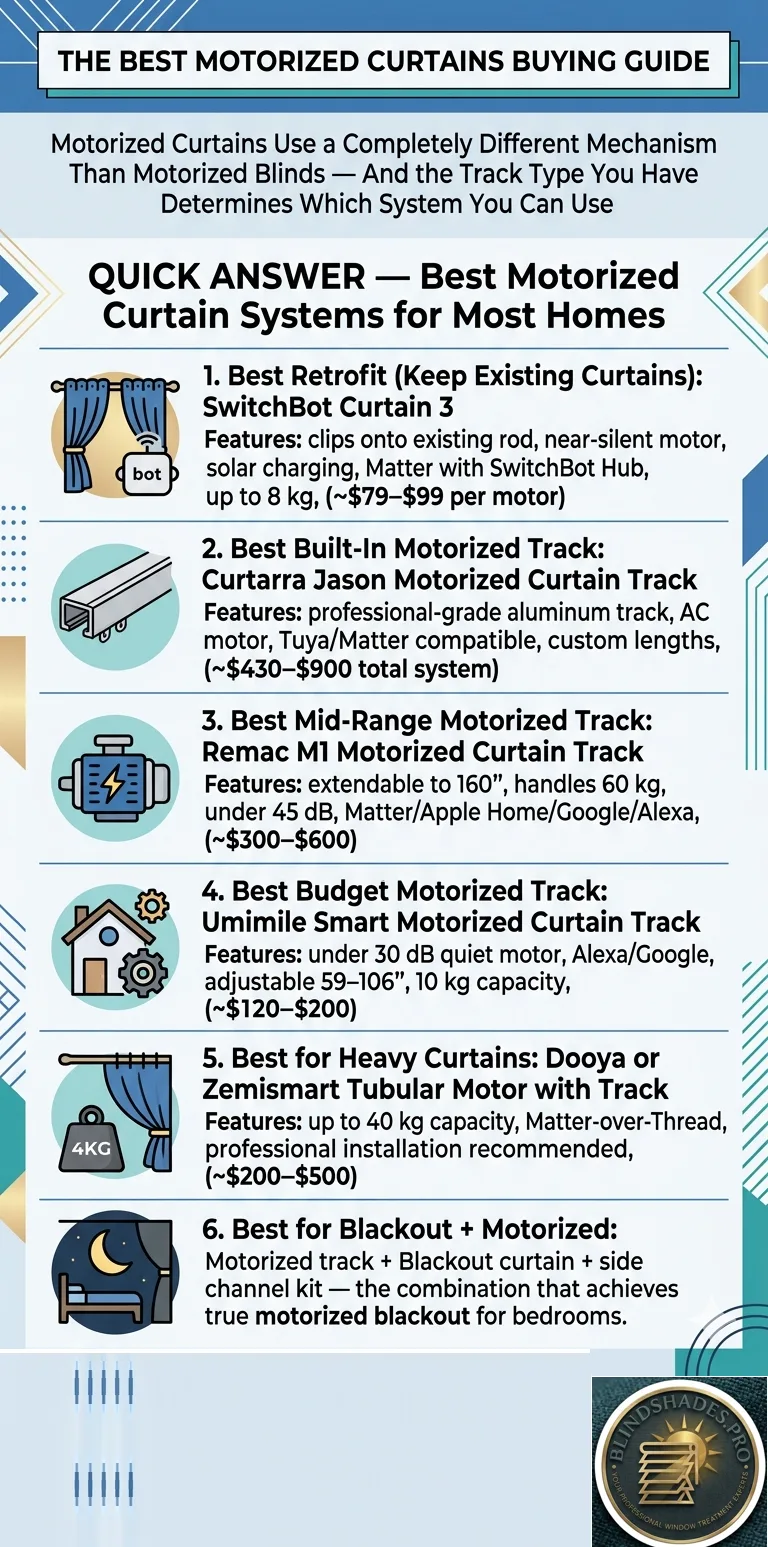
Motorized Curtains Use a Completely Different Mechanism Than Motorized Blinds — And the Track Type You Have Determines Which System You Can Use
By the Editorial Team at BlindShades.pro | Updated 2026 | 30 Years of Home Improvement Expertise
⭐ Quick Answer — Best Motorized Curtain Systems for Most Homes
- Best Retrofit (Keep Existing Curtains): SwitchBot Curtain 3 — clips onto existing rod, near-silent Gen 3 motor, solar charging available, Matter with Hub, max 8 kg (~$79–$99/motor)
- Best Mid-Range Full Track: Remac M1 Motorized Track — extends to 160″ without cutting, handles up to 60 kg, under 45 dB, Matter/Apple Home/Google/Alexa (~$300–$600)
- Best Budget Smart Track: Umimile Smart Motorized Track — under 30 dB (bedroom-quiet), Alexa/Google, adjustable 59–106″, 10 kg capacity (~$120–$200)
- Best Professional AC System: Curtarra Jason Motorized Track — custom lengths, 40 kg AC motor, Tuya/Alexa/Google, pre-programmed (~$430–$900/system)
- Best for Heavy Curtains: Dooya or Zemismart MT82 Matter Motor — up to 40 kg, Matter-over-Thread, professional installation recommended (~$200–$500)
- Best for Apple HomeKit: Remac M1 or SwitchBot Curtain 3 + SwitchBot Hub — the only accessible motorized curtain systems with native Matter/HomeKit support
⚠️ Check Your Rod Type and Curtain Weight Before Ordering: Motorized curtain systems are not interchangeable. The SwitchBot Curtain 3 only works on round rods (15–28mm diameter), I-rail, and U-rail — not recessed ceiling tracks or bay windows. It is also limited to 8 kg (17.6 lbs) total curtain weight. Heavy velvet or lined curtains can easily exceed this. Weigh your curtains before ordering any retrofit motor. See the full rod and track compatibility guide below.
💡 The Stack-Back Problem on Wide Windows: When motorized curtains open, the fabric bunches to the sides — covering part of the window glass even when “fully open.” For a 120-inch window at 2× fullness, the stack-back per side is approximately 30–40 inches. Mount your track 12–24 inches wider than the window on each side so stacked fabric rests over the wall, not the glass. See the full stack-back formula below.
📖 Before you spend a dollar — read the complete guide below. Covers the motorized curtains vs motorized blinds distinction, rod and track type compatibility, 3 motorized system types (retrofit/full track/tubular), weight limits by motor (8–60 kg), stack-back formula, motor noise decibel ratings, obstacle detection, power options, protocol guide, 6 brand reviews & 10 FAQs.
How Motorized Curtains Differ From Motorized Blinds — The Mechanism Distinction
This is the most important clarification in this category — and almost no buying guide addresses it directly.
Motorized blinds use a motor to raise and lower (or roll) the blind. The fabric moves vertically. The motor is typically inside the headrail or the roller tube.
Motorized curtains use a motor to move curtain carriers along a horizontal track. The fabric moves horizontally — opening and closing like a pair of curtains. The motor drives a belt or chain system inside the track, and carriers clipped to the curtain rings slide along that track.
Why this distinction matters for buyers:
- A motorized blind motor (SmartWings, Levolor, Hunter Douglas PowerView) cannot be used for curtains — they are mechanically incompatible
- A motorized curtain track cannot be used for roller shades, cellular shades, or Roman shades
- The protocols, hub requirements, and installation methods are distinct from motorized blinds
What “What Kind of Rod or Track Do I Have?” Determines
Before choosing any motorized curtain system — you must identify what is currently hanging your curtains. This determines which motorized solution is compatible.
Round Decorative Rod
A circular rod — wood, metal, or resin — typically with finials at each end. Curtain rings with clips or rod-pocket headers thread over the rod.
Motorized options: SwitchBot Curtain 3 clips onto round rods (15–28mm diameter). Aqara Roller Shade Driver is not compatible. For a full motorized track system — the round rod must be removed and replaced with a motorized track.
I-Rail / U-Rail Curtain Track
A functional channel-type track (not decorative) — curtain hooks or carriers slide along the channel. Typically white or off-white. Common in apartments, older homes, and UK-origin construction in the USA.
Motorized options: SwitchBot Curtain 3 and Aqara E1 are both compatible with I-rail and U-rail tracks through compatible clip attachments. Built-in motorized track systems replace the existing I-rail.
Ceiling-Flush / Recessed Track
A track mounted flush with or recessed into the ceiling — the most architecturally refined curtain track option. No visible mounting hardware.
Motorized options: Full motorized track systems (Curtarra Jason, Remac M1) are available in ceiling-mount configuration. Retrofit clip-on motors (SwitchBot) are not compatible with recessed ceiling tracks.
Bay Window / Curved Track
A curved track that follows the contour of a bay window.
Motorized options: Specialized curved motorized tracks available from professional suppliers. Retrofit clip-on motors cannot navigate curves. This is the most complex motorized curtain application.
The 3 Motorized Curtain System Types
System Type 1 — Retrofit Clip-On Motor (Keep Your Existing Curtains)
A small motor unit that clips onto your existing curtain rod or track and drives the existing curtain rings/carriers using its own internal mechanism. You keep your existing curtains and rod.
How it works: The motor clips onto the rod. A small drive wheel or clip mechanism grips the curtain carrier or the rod itself and moves the first curtain ring, which pulls the rest of the curtain along.
Best example: SwitchBot Curtain 3 — clips onto round rod, I-rail, or U-rail. Near-silent third-generation motor. Solar charging available. Matter support with SwitchBot Hub. Weight capacity: 8 kg / 17.6 lbs total curtain weight. Compatible rod diameter: 15–28mm round rod.
The weight limit is critical: If your curtains weigh more than 8 kg — the SwitchBot Curtain 3 cannot drive them reliably. Weigh your curtains before ordering. Heavy velvet, thermal-lined, or interlined curtains can easily exceed 8 kg on a standard window.
Best for: Renters, buyers who want to keep existing curtains, anyone who wants the lowest-cost motorized curtain solution.
Limitation: Limited weight capacity; one motor per curtain panel typically means two motors per window for center-opening curtains; not compatible with all rod types.
System Type 2 — Built-In Motorized Curtain Track (Full Replacement)
A complete track system with a motor integrated into the track mechanism. Replaces the existing curtain rod entirely. The motor drives a belt or cable that moves all carriers simultaneously.
How it works: The track has a motor at one end (or center). A continuous drive belt runs the full length of the track. Curtain carriers are attached to this belt — when the motor turns, all carriers move simultaneously in the same direction. The curtains hang from these motorized carriers.
Key advantages over retrofit:
- All carriers move simultaneously — no risk of one curtain moving faster than another
- Higher weight capacity — 10–60 kg depending on system
- Any curtain header style can be used
- More reliable long-term operation
- More uniform movement
Opening configurations:
- Center-open (bi-parting): Motor at the center or end; both curtain panels separate from the center, moving to opposite sides. Best for symmetrical windows.
- One-way draw: All curtains move to one side. Best for window configurations adjacent to a wall or for a cleaner asymmetric look.
Best for: Permanent residential installations, floor-to-ceiling windows, heavy curtains, and any application where the retrofit motor’s weight limit is insufficient.
System Type 3 — Retrofit Tubular Motor for Existing Tracks
A tubular motor that is installed into an existing curtain track — replacing the non-motorized drive mechanism while keeping the track itself. Available from Dooya, Zemismart, and other OEM suppliers.
Best for: Professional installers upgrading existing curtain tracks in commercial spaces, hotels, or large residential installations. Not a standard DIY product for most residential buyers.

The Stack-Back Calculation — Why Wide Windows Need More Planning
When motorized curtains open, the curtain fabric bunches (“stacks”) to one or both sides of the window. The stack-back width — the space the bunched curtain occupies — determines how much of the window glass is covered even when the curtains are “fully open.”
The stack-back formula: Stack-back = Total curtain fabric width ÷ (number of stacking sides × typical compression ratio)
Simple practical estimate: For most woven curtain fabrics at 2× fullness:
- Stack-back per side ≈ 25–35% of the total fabric width per panel
Example: A 120-inch window with center-opening curtains, 2× fullness:
- Total fabric needed: 240 inches (120 × 2)
- Per panel: 120 inches
- Stack-back per side: approximately 30–40 inches
This means 30–40 inches of the window glass on each side is covered by stacked curtain fabric even when “fully open.” The total window glass visible when open = 120″ – (2 × 35″) = approximately 50 inches of unobstructed glass.
The solution for wide windows: Specify track overhang — mount the track 12–24 inches wider than the window on each side (or whichever side the curtains stack), so the stacked fabric rests over the wall rather than over the window glass.
The most common installation mistake: A track mounted exactly at the window frame width. When the curtains open, the stacked fabric covers a significant portion of the glass — reducing the effective usable window area dramatically.
Weight Limits by Motor Type — The Critical Specification
| Motor/System | Weight Limit | Notes |
|---|---|---|
| SwitchBot Curtain 3 | 8 kg / 17.6 lbs | Per motor; use two for center-open |
| Aqara E1 Curtain Motor | 10 kg / 22 lbs | Per motor |
| Umimile Smart Track | 10 kg / 22 lbs | Per track; under 30 dB |
| Remac M1 | 60 kg / 132 lbs | Total system capacity |
| Curtarra Jason AC Motor | 40 kg / 88 lbs | AC powered; professional grade |
| Dooya / Zemismart Tubular | 20–40 kg | Varies by model |
| Commercial-grade tracks | 50–100+ kg | For hotel/large residential |
How to determine your curtain weight: Remove one panel and weigh it on a bathroom scale. Multiply by the number of panels. Include the curtain ring hardware. A lined linen curtain typically weighs 2–4 kg per panel. A heavy velvet or interlined curtain can weigh 4–8 kg per panel.
Motor Noise — The Bedroom Specification
For bedroom applications where the motor will operate during sleep or while occupants are present — motor noise is a critical specification.
Decibel ratings by product:
- Umimile Smart Track: under 30 dB — near-silent; correct for bedrooms
- Remac M1: under 45 dB — quiet; adequate for most bedroom applications
- SwitchBot Curtain 3 (Gen 3): described as “near-silent” in user reviews — significant improvement from Gen 2
- Budget Tuya/SmartLife track systems: typically 40–55 dB — audible, not ideal for bedrooms
The 30 dB benchmark: 30 dB is approximately the sound of a quiet library or a gentle whisper. Motors rated under 30 dB are effectively inaudible during normal sleep. For primary bedrooms — specify systems rated under 35 dB.
Power Options Guide
Battery Power (SwitchBot Curtain 3, Aqara E1)
Built-in rechargeable battery. SwitchBot Curtain 3 charges via USB-C; typical recharge interval 1–3 months depending on use frequency.
Solar charging option (SwitchBot Solar Panel): Attaches to the curtain or rod; trickle-charges the battery from window light. Most users with adequate natural light never need to manually recharge.
Best for: Renters, retrofit applications, anyone who cannot or will not run power to the curtain location.
Plug-In AC (Curtarra Jason, most motorized track systems)
Motor connects to a standard wall outlet via a power cord (typically 30-inch cord with the outlet matched to shipping address). Reliable, unlimited power — no battery management.
The installation consideration: The power cord must reach a wall outlet or be managed through a cable raceway or in-wall routing. For ceiling-mounted tracks, the cord typically runs down the wall to an outlet — plan cable management before ordering.
Best for: Permanent residential installations where a nearby outlet is accessible. The correct specification for primary living rooms and bedrooms where reliability matters more than cord management convenience.
Hardwired AC
Motor connects directly to the home electrical system through a junction box — no visible cord. Requires a licensed electrician.
Best for: New construction, major renovations where in-wall wiring is being planned, or any installation where a visible power cord is architecturally unacceptable.
Smart Home Protocol Guide for Motorized Curtains
The same protocol considerations from Guide #23 — Motorized & Smart Blinds apply to motorized curtains — but the product landscape is different.
Matter over Thread (Current Standard)
SwitchBot Curtain 3 (with SwitchBot Hub), Remac M1, and select Zemismart and Dooya motors support Matter. Compatible with Apple Home, Google Home, and Alexa simultaneously.
The hub requirement: SwitchBot Curtain 3 requires the SwitchBot Hub for Matter integration — the motor alone is Bluetooth only. The Hub bridges to Matter.
Tuya / Smart Life (Budget Smart Home)
The majority of mid-range motorized curtain tracks (including many on Amazon) use the Tuya or Smart Life ecosystem. Tuya integrates with Alexa and Google Home but does NOT natively support Apple HomeKit without an additional bridge.
For Apple HomeKit users: Specify Matter-compatible systems (Remac M1, SwitchBot + Hub) rather than Tuya-only systems.
RF Remote Only (Non-Smart)
Many motorized curtain track systems include an RF remote but no app or smart home integration. These are motorized — not smart. They cannot be scheduled, voice-controlled, or automated. Confirm smart home compatibility before purchase if this matters to your application.
Obstacle Detection — The Safety Specification
Premium motorized curtain systems include obstacle detection — the motor senses resistance (a child, pet, or object in the curtain path) and stops automatically to prevent injury or damage.
Products with obstacle detection: Remac M1, Curtarra Jason, most AC-powered professional-grade track systems.
Products without obstacle detection: SwitchBot Curtain 3 (as of 2026), most budget Tuya track systems.
The specification for homes with children or pets: Obstacle detection is the correct specification — a motorized curtain closing on a child or pet without obstacle detection can cause injury. For bedrooms and living rooms in homes with children — specify obstacle detection.
Curtain Header Compatibility — What Hangs on Motorized Tracks
Most motorized curtain track systems use a clip carrier that clips directly to the curtain fabric rather than requiring a specific header style. This means most curtain headers are compatible:
- Grommet (eyelet) — carriers clip through the grommet
- Pinch pleat — carriers clip to the pleat pinch points
- Rod pocket — requires conversion hooks to use on track systems
- Wave header — specifically designed for wave tracks; creates a flowing S-curve when open
- Tab top — clips can attach to tabs
The wave track aesthetic: Ripple-fold or wave tracks create a uniform S-curve pattern in the curtain fabric when closed — a more contemporary and uniform aesthetic than bunched grommet or pinch pleat. Available in motorized versions from Curtarra and European suppliers.
What to Look For When Buying Motorized Curtains — Checklist
✅ 1. Identify Your Rod/Track Type First
Round rod → SwitchBot Curtain 3 or full track replacement I-rail/U-rail → SwitchBot Curtain 3 or track replacement Recessed ceiling → Full track replacement only Bay window/curved → Specialized curved motorized track
✅ 2. Weigh Your Curtains Before Ordering Retrofit Motor
Weigh one panel. Multiply by number of panels. Include ring hardware. Compare to motor weight limit. For curtains over 8 kg per window — choose a full track system rather than SwitchBot.
✅ 3. Calculate Track Width Including Stack-Back Overhang
Add 12–24 inches per side beyond the window frame to allow stacked fabric to rest over the wall rather than covering glass.
✅ 4. Specify Motor Noise for Bedrooms
Under 30 dB: Umimile, some Dooya motors Under 45 dB: Remac M1 Near-silent: SwitchBot Curtain 3 Gen 3
✅ 5. Confirm Protocol Matches Your Smart Home
Apple HomeKit → Matter systems only (Remac M1, SwitchBot + Hub, Zemismart Matter) Google Home / Alexa → Matter or Tuya compatible No smart home integration needed → RF remote only is sufficient
✅ 6. Specify Obstacle Detection for Homes With Children or Pets
✅ 7. Plan Power Supply Before Ordering
Battery retrofit → SwitchBot or Aqara Plug-in → plan cord routing and cable management Hardwired → electrician required; plan during construction
Top Motorized Curtain System Brands Reviewed
🏆 SwitchBot Curtain 3 — Best Retrofit ($79–$99 per motor)
The most accessible motorized curtain solution for renters and buyers who want to keep existing curtains. Clips onto round rods (15–28mm), I-rails, and U-rails. Near-silent Gen 3 motor. Solar charging eliminates battery management on sunny windows. Matter support with SwitchBot Hub ($39 separately). 8 kg weight limit per motor.
Honest assessment: The right first step for anyone curious about motorized curtains who doesn’t want to commit to a full track replacement. Buy one motor, test it on your most-used window. If satisfied, expand. The 8 kg weight limit excludes heavy or lined curtains.
🥈 Remac M1 Motorized Curtain Track — Best Mid-Range Full System ($300–$600)
The most capable mid-range motorized curtain track available in the USA market. Extends from 42 to 160 inches without cutting or joining — pull to width and click. Handles up to 60 kg total curtain weight — the highest capacity at this price point. Under 45 dB operation. Matter compatible with Apple Home, Google Home, Alexa, and SmartThings. Center-open or one-way draw configuration. Center bracket for extra support on wider spans.
Honest assessment: The correct specification for primary living rooms with heavy curtains, floor-to-ceiling applications, or any installation where the SwitchBot weight limit is insufficient. The 60 kg capacity handles the heaviest residential curtains without strain.
🥉 Curtarra Jason Motorized Curtain Track — Best Professional AC System (~$430–$900)
Curtarra’s professional-grade AC-powered motorized curtain track. Fully assembled and pre-programmed. Tuya/Smart Life app with Alexa and Google Home integration. Custom lengths — tracks over 82 inches are spliced for shipping. 100–230V AC motor with 30-inch power cord. The most complete professional-grade motorized curtain system available through a USA retailer with custom length service.
Honest assessment: The correct specification for permanent living room and dining room installations where an AC power connection is accessible. The custom length service covers windows that pre-built adjustable systems cannot accommodate.
Umimile Smart Motorized Curtain Track — Best Budget Smart Track ($120–$200)
Under 30 dB operation — the quietest budget motorized curtain track available. 10 kg weight limit. Adjustable from 59 to 106 inches without cutting. Wall or ceiling mount. Alexa and Google Home compatible. RF remote included. Manual pull-to-open capability.
Honest assessment: The correct choice for bedroom primary windows where silence is the overriding specification and curtain weight is under 10 kg. Not ideal for heavy or fully lined curtains. The under-30 dB rating is genuine and differentiating at this price point.
Zemismart MT82 / Matter Curtain Motor — Best for DIY Smart Home Builders ($150–$350)
Zemismart offers some of the earliest and most complete Matter-compatible curtain motors in the market. MT82 and related motors support Matter over Thread and Matter over Wi-Fi. Compatible with Apple Home, Google Home, and Alexa natively. Available as a motor-only purchase for integration with a separately purchased track.
Honest assessment: The right choice for smart home enthusiasts who want to build a custom motorized curtain system with maximum protocol flexibility. Requires more technical comfort than plug-and-play systems like SwitchBot or Remac.
Dooya Tubular Motor — Best for Heavy Commercial / Large Residential ($200–$500)
Dooya’s professional-grade tubular motors are the backbone of hotel-grade motorized curtain installations worldwide. Matter-over-WiFi available. 20–40 kg capacity depending on model. Professional installation recommended.
Honest assessment: The correct specification for large residential projects with heavy curtains, commercial applications, or any installation where professional-grade durability and high weight capacity are the primary requirements.
Motorized Curtains vs Motorized Blinds — When to Choose Each
| Factor | Motorized Curtains | Motorized Blinds |
|---|---|---|
| Fabric aesthetics | Full drapery look, flowing fabric | Shade or roller look, minimal |
| Light control precision | Less precise — fabric gaps possible | More precise — single fabric layer |
| Blackout capability | Achievable with blackout fabric + side channels | Easier — roller blackout standard |
| Weight capacity | Higher for track systems (up to 60 kg) | Typically 5–10 lbs for roller motors |
| Installation | More complex — track replacement often needed | Standard shade installation |
| Cost per window | $120–$900 depending on system | $150–$600 motorized shade |
| Best rooms | Living rooms, dining rooms, bedrooms | Any room |
| Best for | Draping aesthetics + automation | Function-first automation |
10 Motorized Curtain FAQs
Q: What is the difference between motorized curtains and motorized blinds? A: Motorized curtains use a horizontal track system where a motor moves curtain carriers sideways along a track — the fabric opens and closes horizontally. Motorized blinds use a motor to lift, lower, or roll the blind vertically. They are mechanically incompatible — you cannot use a motorized blind motor to operate curtains.
Q: What is the weight limit for SwitchBot Curtain 3? A: The SwitchBot Curtain 3 has a maximum weight capacity of 8 kg (17.6 lbs) total curtain weight per motor. For center-opening curtains — use one motor per panel (two motors total per window). Weigh your curtains before ordering — heavy velvet, fully lined, or interlined curtain panels can easily exceed this limit.
Q: How noisy are motorized curtain motors? A: Noise varies significantly by product. Umimile Smart Track is rated under 30 dB — near-silent, appropriate for bedrooms. Remac M1 is rated under 45 dB — quiet and adequate for most bedroom applications. Budget Tuya-based systems are typically 40–55 dB — audible but not disruptive for living rooms. The SwitchBot Curtain 3 Gen 3 is described as near-silent in user reviews.
Q: Can motorized curtains work with Apple HomeKit? A: Yes — with the right protocol. Matter-compatible systems work natively with Apple HomeKit: Remac M1, SwitchBot Curtain 3 (with SwitchBot Hub), Zemismart MT82 Matter version. Tuya-only systems do not natively support Apple HomeKit without an additional bridge.
Q: What is stack-back and why does it matter? A: Stack-back is the width of bunched curtain fabric that accumulates to one or both sides when the curtains are fully open. For a 120-inch window at 2× fullness, the stack-back per side is approximately 30–40 inches — meaning 30–40 inches of glass on each side is covered by stacked fabric even when the curtains are “fully open.” The solution is to mount the track 12–24 inches wider than the window on each side so the stacked fabric rests over the wall.
Q: Do motorized curtain motors have obstacle detection? A: Premium systems do — Remac M1, Curtarra Jason, and most AC-powered professional-grade tracks include obstacle detection that stops the motor when it senses resistance. SwitchBot Curtain 3 and most budget systems do not include obstacle detection. For homes with children or pets — specify obstacle detection.
Q: Can I keep my existing curtains with a motorized system? A: With a retrofit motor (SwitchBot Curtain 3, Aqara E1) — yes, if your existing rod or track is compatible and your curtains are within the weight limit. With a full motorized track system — no, you must replace the rod/track, but you can keep the curtain fabric and re-hang it on new carriers.
Q: What power source do motorized curtains require? A: Options vary: battery-powered (SwitchBot: 1–3 months per charge, or indefinite with solar panel), plug-in AC (most motorized track systems via 30-inch cord to a wall outlet), or hardwired AC (requires electrician). Battery is best for retrofit and renters; plug-in AC is best for permanent residential installations; hardwired is best for new construction.
Q: How long do motorized curtain motors last? A: Premium AC-powered systems (Curtarra Jason, commercial Dooya) are designed for 50,000–100,000+ operation cycles — effectively indefinite residential lifespan. Mid-range systems (Remac M1) typically carry 3–5 year warranties on motors. Battery-powered retrofit systems (SwitchBot) have 2–3 year warranties. Battery life in the rechargeable battery itself typically degrades noticeably after 3–5 years of daily use.
Q: Can motorized curtains achieve full blackout? A: Yes — with the correct combination: blackout-lined curtain fabric + motorized track extended 12–24 inches beyond the window on each side + side channel kit or returns to wall on each side. The track overhang ensures stacked curtain rests outside the glass area; the side returns seal the fabric to the wall edge. This combination approaches the blackout performance of a properly installed blackout roller shade.
2026 Motorized Curtain Trends
Matter compatibility is the 2026 baseline. Remac M1, SwitchBot + Hub, and Zemismart Matter motors have made Matter-native motorized curtains accessible at mid-market pricing. Tuya-only systems are losing market share to Matter alternatives.
Solar charging is eliminating battery anxiety. SwitchBot’s solar panel accessory has been widely adopted — most users on south or west-facing windows report never manually charging their SwitchBot Curtain 3. Battery management was the primary friction point for retrofit motors; solar has largely eliminated it.
Wave/ripple-fold tracks are growing. The uniform S-curve aesthetic of wave tracks — more contemporary than bunched grommet or pinch pleat — is driving adoption particularly in primary living rooms and dining rooms with floor-to-ceiling windows.
Motorized curtains are the primary living room upgrade. While motorized blinds dominate the bedroom category — motorized curtains are growing fastest in primary living rooms where the drapery aesthetic + automation combination is the aspirational specification.
Floor-to-ceiling applications are the premium driver. Motorized tracks specifically designed for floor-to-ceiling applications (ceiling-flush mount, high weight capacity, smooth travel across 10+ feet of height) are the fastest-growing segment.
Related Buying Guides on BlindShades.pro
- The Best Motorized & Smart Blinds Buying Guide — motorized blinds covering roller, cellular, and shade types (Guide #23)
- The Best Cordless Blinds & Shades Buying Guide — the safety and cord-free standard for all window coverings (Guide #27)
- The Best Window Sheers Buying Guide — sheer curtain panels that pair with motorized tracks (Guide #29)
- The Best Roman Curtains & Roll-Up Curtains Buying Guide — Roman shades in motorized configuration (Guide #30)
- The Best Blackout Blinds & Shades Buying Guide — blackout performance in motorized applications (Guide #24)
Supporting Articles — Zone 3 Click-Worthy Only
- (Coming Soon) SwitchBot Curtain 3 vs Remac M1 — Retrofit Motor or Full Track Replacement?
- (Coming Soon) Why Are My Motorized Curtains Not Reaching the End of the Track — Common Motor Failures Diagnosed
- (Coming Soon) Are Motorized Curtains Worth the Cost — The Honest ROI for Living Rooms
- (Coming Soon) Best Motorized Curtains for Floor-to-Ceiling Windows — Track Width and Weight Guide
- (Coming Soon) How to Calculate Stack-Back for Motorized Curtains — The Wide Window Formula
- (Coming Soon) Do Motorized Curtains Work With Apple HomeKit — The Protocol Compatibility Guide
- (Coming Soon) Motorized Curtains for Bedrooms — The Under-30 dB Motor Specification
- (Coming Soon) How Long Do Motorized Curtain Motors Last — Battery vs AC Systems Compared
- (Coming Soon) Can My Existing Curtains Work With a Motorized Track System?
- (Coming Soon) Motorized Curtains vs Motorized Blinds — Which Is Right for a Primary Living Room?
Final Verdict
Best for most homes starting with motorized curtains: SwitchBot Curtain 3 with Solar Panel — clip onto existing rod, near-silent Gen 3 motor, solar charging, Matter with Hub. Test one window before committing to a full system.
Best primary living room motorized track: Remac M1 — 60 kg capacity, under 45 dB, Matter-compatible, no cutting required up to 160 inches, center-open or one-way draw.
Best bedroom motorized curtain: Umimile with under-30 dB motor for lightweight curtains, or Remac M1 for heavy lined curtains where weight exceeds Umimile’s 10 kg limit.
Best professional/permanent installation: Curtarra Jason AC motor track with custom length — the correct specification for floor-to-ceiling living rooms, dining rooms, and any installation where professional-grade durability and custom sizing are required.
When not to choose motorized curtains: When roller shade or cellular shade aesthetics are acceptable (motorized blinds are simpler and less expensive), when the window configuration makes track installation impractical, or when curtain weight exceeds available motor capacity.
Last updated: 2026 | www.blindshades.pro
