Are Cellular Shades Good for Sidelights?

Authored By Michael Turner -30 Years Home Improvement Expertise | Updated 2026 | BlindShades.pro
Updated on May 31, 2026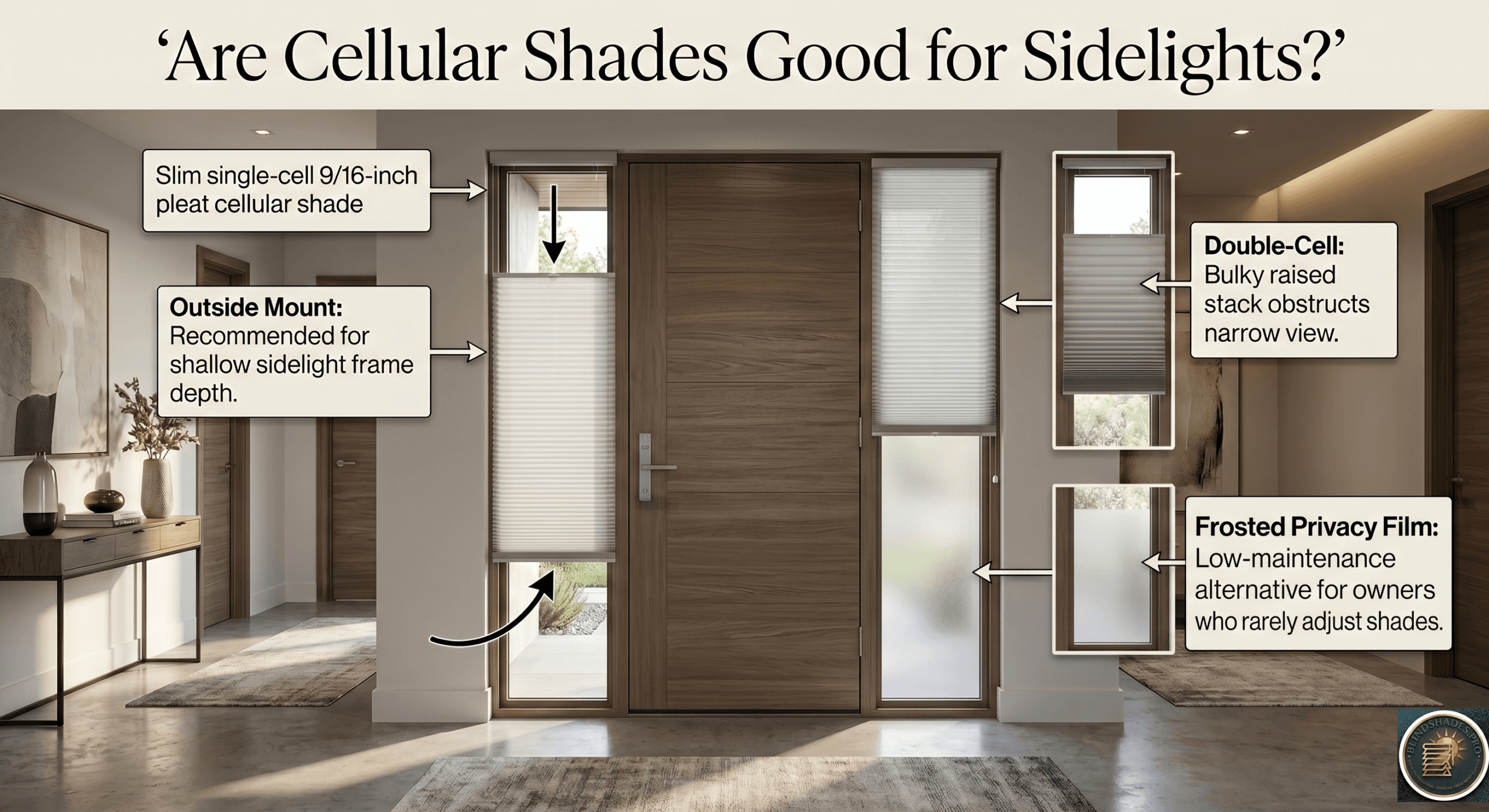
Key Takeaways:
- For sidelights, specify single cell 9/16-inch pleat – NOT double cell; a standard double cell 3/4-inch shade on a 72-inch sidelight has a raised stack of 10 to 14 inches that covers approximately 20 percent of the window even when fully raised; a single cell 9/16-inch shade has a raised stack of only 3 to 4 inches, preserving maximum open glass area
- Side-track cellular shades use channels running down both sides of the shade to capture the fabric edge; they eliminate the 1/8 to 1/4 inch edge light and privacy gaps of standard cellular shades; at the door frame infiltration zone, the side-track also seals the insulating air column, improving the effective R-value addition significantly
- For TDBU cellular shades on sidelights: lower the TOP panel from the headrail to cover the upper privacy zone and leave the BOTTOM section open – the opposite of standard above-grade TDBU advice; the uncovered lower glass transmits substantially more light than any light-filtering cellular fabric in the closed position
- Before ordering cellular shades for sidelights, answer the daily operation question: will you genuinely raise and lower the shade every day? If the shade will stay in one position after initial setting, frosted film provides better per-year economics ($2 to $8 vs $15 to $57 per year), no maintenance, and consistent 24-hour privacy without the operating commitment
- Blackout cellular fabric specification depends on the sidelight type: blackout is appropriate for half-height sidelights positioned at eye level where privacy is the primary function and light is secondary; light-filtering or room-darkening is appropriate for full-height sidelights where daylight preservation matters
⭐ Quick Answer — Are Cellular Shades Good for Sidelights?
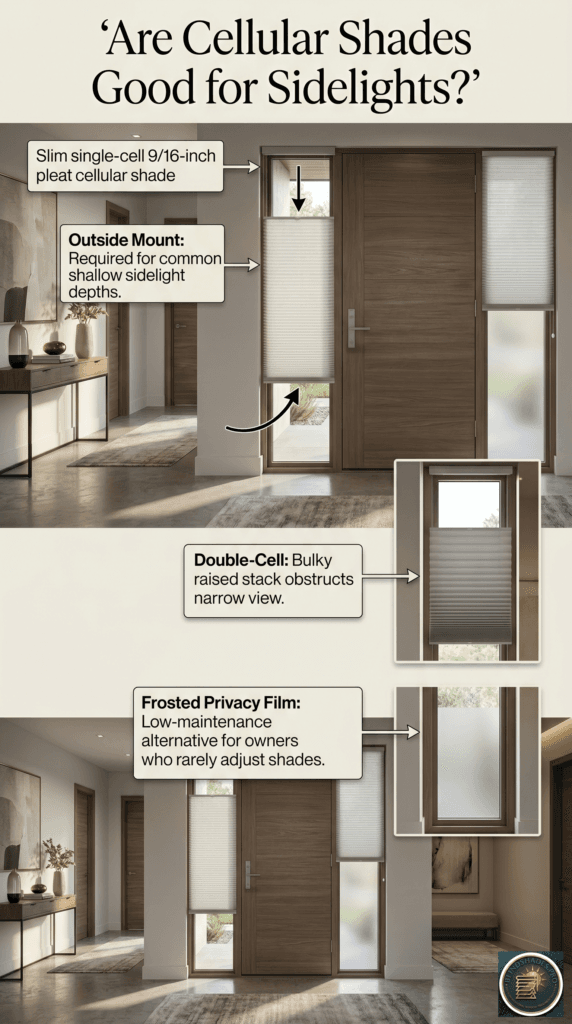
- Yes — With 6 Spec Rules. Rule 1: Single Cell 9/16-Inch Only (Not Double Cell): Cellular shades are good for sidelights when specified correctly. The most important rule: specify single cell 9/16-inch pleat, NOT double cell. Every general buying guide recommends double cell for maximum insulation — this is wrong for sidelights. A double cell 3/4-inch pleat shade on a 72-inch sidelight has a raised stack of 10 to 14 inches, covering approximately 20 percent of the window even when fully raised. A single cell 9/16-inch pleat shade on the same sidelight has a raised stack of only 3 to 4 inches. Since sidelights are often the only daylight source in the foyer, covering 20% of the glass at the headrail undermines the sidelight’s primary function. Single cell 9/16-inch still provides R-3 to R-4 insulation — adequate for the door frame position
- Rules 2–4: Outside Mount, TDBU Top Down, Hold-Downs Mandatory: Three more essential sidelight cellular shade rules. Outside mount default: most sidelights have 1/2 to 1.5 inches of frame depth; TDBU hardware requires 1.5 to 2 inches for inside mount; outside mount on the door casing is the correct default for most installations. TDBU top down: lower the TOP panel from the headrail to cover the upper sightline zone — NOT raise the bottom as standard above-grade TDBU advice states; the visitor approaches at 20–30 degrees downward; the sightline enters the upper window zone; the uncovered lower glass delivers 150–300 lux vs 80–150 lux from light-filtering fabric. Hold-downs mandatory: door-adjacent sidelight shades swing without hold-down clips; with hold-downs, the bottom section stays permanently clipped and only the top panel needs daily operation
- Rules 5–6: 9-Inch TDBU Minimum Width and Blackout vs Light-Filtering by Type: Cellular shade TDBU hardware has a minimum width: most manufacturers (SelectBlinds, Factory Direct Blinds, Linen Avenue) require 9 inches minimum for TDBU. Hunter Douglas Duette 9/16-inch is the exception at 6 inches minimum. For sidelights under 9 inches and not Hunter Douglas: specify a non-TDBU single-cell shade (from approximately 8 inches) or a 1-inch aluminium mini blind (from 6 inches). Fabric selection by sidelight type: full-height front door sidelights (60–80 inches) are the primary foyer daylight source — specify light-filtering or room-darkening. Half-height sidelights at eye level (24–48 inches) are not the primary daylight source and privacy is the priority — specify blackout or room-darkening. South and west-facing sidelights with intense summer sun: room-darkening for glare control without losing all daylight
- The Side-Track Upgrade and the Daily Operation Decision: Standard cellular shades for sidelights have a 1/8 to 1/4 inch edge gap between the fabric and the mounting bracket. At the front door sidelight, this edge gap creates both a privacy gap (approach-angle observer can see around the shade edge) and an insulation gap (air movement through the edge disrupts the insulating air column at the high-infiltration door frame zone). Side-track cellular shades use channels on both sides that capture the fabric edge, eliminating both gaps. Effective R-value at the door frame: R-3 to R-4 with side-track vs R-2 to R-3 with standard cellular. And the daily operation question: cellular shades are worth the cost only if you will genuinely operate them daily. If the shade will be set once and left — frosted film at $2–8 per year vs cellular at $15–57 per year, with no maintenance and 24-hour privacy, is the better specification
- Motorized Cellular Shades — The Reach Solution for 72-80-Inch Sidelights: A 72-inch sidelight cellular shade with TDBU requires reaching from above-shoulder height (top panel at headrail) to near-floor level (bottom panel at sill) — a two-point reach across the full height. Motorized cellular shades eliminate all manual reach: remote, wall switch, smartphone app, or voice command (Alexa, Google Home). Battery-powered motors are available from SelectBlinds and Factory Direct Blinds for sidelight retrofit installations — no hardwired electrical required; battery pack in the headrail, USB rechargeable or annual replacement. Cost: approximately $200–$450 per sidelight motorized vs $100–$250 cordless manual. For elderly occupants or those with limited mobility: motorized is the specification that fully resolves the accessibility concern at tall sidelights
- Best Sources: Single cell 9/16-inch TDBU cellular sidelight shades → SelectBlinds cellular range · Sidelight cellular shades from 9-inch minimum → Factory Direct Blinds sidelight range · Side-track cellular for edge gap elimination → EcoSmart Shades side-track range
⚠️ The Double Cell Stack Table and the Full Comparison Against Frosted Film: Before ordering cellular shades for any sidelight, confirm the raised stack height from the supplier at your specific sidelight height. Reference values for a 72-inch sidelight: Double cell 3/4-inch pleat: 10–14 inch stack (14–19% of window covered when raised). Single cell 3/4-inch pleat: 6–8 inch stack (8–11%). Single cell 9/16-inch pleat (Hunter Douglas Duette or equivalent): 3–4 inch stack (4–6%). Triple cell shades should not be specified for any sidelight — their stack is even larger than double cell and covers an unacceptable portion of the window at the headrail. The complete cellular vs frosted film comparison for front door sidelights: Cellular shade per-year cost: $15–57 (7–10 year lifespan at interior windows; 5–8 years at front door sidelight due to UV and thermal cycling). Frosted film per-year cost: $2–8 (10–15 year lifespan). Cellular shade light output fully lowered (light-filtering): 80–150 lux. Frosted film: 200–420 lux. Cellular TDBU lower half open: 150–300 lux. Cellular wins on adjustability and see-out. Frosted film wins on per-year cost, maintenance, night privacy consistency, and damage resistance at the front door position. For the full frosted film vs blinds head-to-head including the approach-angle test, rental property cost, and the Solyx SX-3006 frosted mini blinds film crossover product, see Is Frosted Film Better Than Blinds for Sidelights. See the full six specification rules below.
💡 The Side-Track R-Value Comparison and the Front Door UV Degradation Factor: Side-track cellular shades provide a meaningful insulation advantage over standard cellular shades specifically at sidelight positions in the door frame infiltration zone. Standard cellular shade (no side tracks): edge gaps of 1/8 to 1/4 inch per side allow air movement around the shade at the positions with highest door frame air infiltration, partially disrupting the insulating air column. Effective R-value addition at the door frame: approximately R-2 to R-3 vs the nominal R-3 to R-4. Side-track cellular shade: side channels seal the fabric edge against the mounting surface; air column is protected even at the door frame infiltration zone; effective R-value addition: R-3 to R-4 (full nominal). The EcoSmart 2.0 cordless TDBU blackout in side-track configuration is available at custom sidelight dimensions. And the front door UV factor: the front door sidelight position exposes the cellular shade fabric to more UV radiation and thermal cycling than any interior window — each door opening admits a brief pulse of exterior temperature and UV. Expected lifespan at a front door sidelight: approximately 5–8 years vs 7–10 years at an interior window. Factor this accelerated replacement cycle into the per-year cost calculation when comparing cellular shades to the 10–15 year lifespan of adhesive frosted film at the same position. For the full narrow sidelight treatment comparison by width category and the 9/16-inch pleat specification including raised stack heights by manufacturer, see What Are the Best Window Treatments for Narrow Sidelights. See the full side-track cellular guide below.
📖 Read the complete guide below for: the six specification rules for cellular shades on sidelights (single cell 9/16-inch / outside mount / TDBU top down / hold-downs / 9-inch minimum width / blackout vs light-filtering by sidelight type), the raised stack comparison table (double cell 10–14 inches / single cell 3/4-inch 6–8 inches / single cell 9/16-inch 3–4 inches on 72-inch sidelight), the side-track cellular shade advantage (edge gap elimination; effective R-3 to R-4 vs standard R-2 to R-3 at door frame), the motorized cellular specification for 72–80-inch sidelights (battery-powered motors $200–$450; USB rechargeable), the front door UV degradation factor (5–8 year lifespan vs 7–10 interior), the daily operation decision framework (cellular only worth it if genuinely operated; frosted film wins for set-and-forget), the TDBU minimum width by manufacturer (Hunter Douglas 6″; most 9″), and the cellular vs frosted film comparison table.
Cellular Shades for Sidelights – The Six Specification Rules
Rule 1 — Single Cell 9/16-Inch Pleat Only (Not Double Cell)
The most commercially important sidelight cellular shade specification — absent from all competitor guides.
Standard cellular shade buying guides universally recommend double cell for maximum insulation performance. For sidelights, this recommendation is incorrect.
The raised stack problem:
| Shade Type | Pleat Depth | Raised Stack on 72″ Sidelight | % of Window Covered When Raised |
|---|---|---|---|
| Double cell 3/4-inch pleat | 3/4 inch | 10 to 14 inches | 14 to 19% |
| Single cell 3/4-inch pleat | 3/4 inch | 6 to 8 inches | 8 to 11% |
| Single cell 9/16-inch pleat | 9/16 inch | 3 to 4 inches | 4 to 6% |
| Hunter Douglas Duette 9/16-inch | 9/16 inch | 3 to 4 inches | 4 to 6% |
The consequence: A double cell 3/4-inch pleat shade specified for a 72-inch sidelight covers approximately 12 inches of the window with its raised stack even when “fully open.” On a 10-inch wide sidelight, this 12-inch stack represents 100% of the glass height in the top zone — the shade appears as a thick obstruction at the headrail even in the raised position.
Why double cell is counterproductive for sidelights: The primary purpose of a sidelight is to bring natural light into the foyer. A treatment that covers a significant portion of the glass even when fully raised defeats the primary function of the sidelight. Single cell 9/16-inch pleat has a 3-4 inch raised stack — barely noticeable at the headrail when raised.
The insulation trade-off: Single cell provides R-3 to R-4 of insulation addition. Double cell provides R-4.5 to R-6. For sidelights specifically, the door frame infiltration zone (Article 45-3) gives cellular shades disproportionate thermal value even at single cell specification — the R-3 to R-4 of single cell cellular at the door perimeter is worth more per square foot than the same R-value addition elsewhere in the home.
Specify: 9/16-inch single cell in room-darkening fabric for full-height front door sidelights.
Rule 2 — Outside Mount Default (Most Sidelights Have 1/2 to 1.5 Inch Frame Depth)
As established in What Are the Best Blinds for Sidelights, most front door sidelight frames have 1/2 to 1.5 inches of usable depth — below the 1.5 to 2 inch minimum required for most inside-mount cellular shade hardware.
The outside mount specification for sidelights:
- Mount on the flat door casing surface adjacent to the glass opening
- Add 1.5 to 2 inches beyond the frame edge on each side (for sidelights under 12 inches wide)
- Ensure the added overlap covers the frame completely, preventing light infiltration at the sides
- Confirm 3/4 inch of flat, level mounting surface is available on the casing
For inside mount: only possible if measured depth exceeds 1.5 inches AND the TDBU mid-rail hardware depth is confirmed with the specific supplier. TDBU hardware is slightly deeper than standard single-rail cellular hardware — verify the inside-mount minimum depth specifically for TDBU configuration.
Rule 3 — TDBU With the TOP Panel Down (Not Bottom Up)
Multiple competitor guides and product listings describe TDBU cellular shades as “lower the top for light while keeping privacy below.” Blinds Chalet’s buying guide specifically states TDBU is “ideal for street-facing rooms, bathrooms, and home offices” with the implication of the standard configuration.
For sidelights, the standard TDBU configuration is reversed:
The visitor approaching the front door looks DOWN at 20-30 degrees toward the sidelight. The primary inward sightline enters through the UPPER zone. The correct sidelight configuration:
- Lower the TOP panel from the headrail to cover the upper privacy zone
- Leave the BOTTOM section open (or permanently clipped at the sill with hold-down brackets)
The light comparison:
- Light-filtering cellular fabric in the closed position: 25-35% of incoming light as filtered illumination (80-150 lux from a standard sidelight)
- Open glass in the uncovered lower section: 100% of incoming light (150-300 lux from the uncovered half)
The correct TDBU configuration delivers approximately twice the foyer lux as the incorrect configuration.
Rule 4 — Hold-Down Brackets Mandatory for Door-Adjacent Sidelights
A cellular shade on a sidelight adjacent to a frequently-used front entry door will swing when the door opens due to air pressure and door-induced air movement, unless hold-down brackets are installed.
The hold-down clip specification for cellular TDBU: For a TDBU shade with hold-down brackets: the bottom section is permanently clipped to the sill. Only the top panel is operated daily. This eliminates the operating reach challenge of the full TDBU — the homeowner only needs to reach to the headrail height (above the head on a full-length sidelight) rather than to the floor-level bottom rail.
Test whether hold-downs are required: open and close the front door vigorously. If the sidelight frame or adjacent wall flex or if air movement is felt at the sidelight position, hold-downs are mandatory.
Rule 5 — TDBU Minimum Width Confirmation Before Ordering
| Manufacturer | 9/16-inch Pleat TDBU | Minimum Width |
|---|---|---|
| Hunter Douglas Duette | YES | 6 inches (cordless) |
| Linen Avenue (Wayfair) | YES | 9 inches |
| Premier / Bali | YES | 9 to 10 inches |
| Factory Direct Blinds | YES | 9 inches |
| SelectBlinds | YES | 9 inches |
The critical implication: For sidelights narrower than 9 inches: TDBU cellular shades are not available from most suppliers. Hunter Douglas Duette 9/16-inch at 6-inch minimum is the exception.
For sidelights 6 to 8 inches wide: Hunter Douglas Duette is the only TDBU cellular option. Alternatively, specify a non-TDBU single-cell 9/16-inch shade (available from approximately 8 inches minimum) or a 1-inch aluminium mini blind (available from 6-8 inches minimum width).
Rule 6 — Blackout vs Light-Filtering by Sidelight Type
The fabric selection guidance absent from all cellular shade buying guides.
| Sidelight Type | Recommended Fabric | Reason |
|---|---|---|
| Full-height front door sidelight (60-80 inches) | Light-filtering or room-darkening | Primary foyer daylight source; blackout eliminates all natural light |
| Half-height sidelight at eye level (24-48 inches) | Blackout or room-darkening | Eye-level privacy priority; not the primary daylight source |
| Basement or below-grade sidelight | Blackout | Light control is the primary function; privacy and insulation secondary |
| Sidelight in a north-facing entry (limited daylight) | Light-filtering | Every lux is valuable; room-darkening unnecessarily reduces limited light |
| Sidelight in a south or west-facing entry (intense sun) | Room-darkening | Controls glare and heat gain without losing all daylight |
The Side-Track Cellular Shade — The Premium Sidelight Solution
The cellular shade upgrade absent from all competitor buying guides.
A standard cellular shade installed in a window frame has a small gap between the fabric edge and the mounting bracket — typically 1/8 to 1/4 inch on each side. At most window positions, this edge gap is inconsequential — the gap is at the far edge of the window, away from the primary sightline.
At a front door sidelight, this edge gap creates two problems:
Problem 1 — The privacy gap: Interior light leaks around the shade edges, and an approach-angle observer looking at the sidelight from the side can see around the shade edge. This privacy gap is most visible from the door-proximate approach angle where visitors stand directly beside the sidelight.
Problem 2 — The insulation gap: The cellular shade’s insulating effect depends on trapping a column of still air between the shade and the glass. Edge gaps allow air movement through the insulating zone, reducing the effective R-value addition. At the door frame infiltration zone — where air movement around the door frame is highest — this edge air movement is more pronounced than at interior windows.
The side-track solution: Side-track cellular shades use a U-channel track running down each side of the installation. The cellular shade fabric is captured in these tracks, pressed against the mounting surface on both sides. The tracks eliminate edge light gaps and seal the insulating air column.
The thermal comparison:
| Installation | Nominal R-value Added | Effective R-value at Door Frame | Notes |
|---|---|---|---|
| Standard cellular shade (no side tracks) | R-3 to R-4 | R-2 to R-3 (reduced by edge infiltration) | Edge gaps allow air movement through insulating column |
| Side-track cellular shade | R-3 to R-4 | R-3 to R-4 (full nominal) | Side tracks seal the insulating column |
Product example: EcoSmart Shades at ecosmartshades.com offers their EcoSmart 2.0 Cordless TDBU Blackout cellular shade in a side-track system. Higher cost than standard cellular shades but appropriate for entry sidelights where the door frame infiltration zone makes every R-value increment significant.
Motorized Cellular Shades — The Operating Reach Solution
Eliminating the floor-level reach problem for 72-80-inch sidelights — absent from all guides.
As established in Article 45-3, a sidelight at 72-80 inches tall positions the bottom rail at near-floor level. A TDBU configuration requires operating both a top panel (above head height) and a bottom panel (near floor level) — a two-point reach across the full height of a tall narrow sidelight.
The motorized specification: A motorized cellular shade eliminates all manual reach. The shade operates via:
- Wall switch (simplest; requires electrical rough-in)
- Battery-powered remote (no wiring; most accessible for sidelight retrofit)
- Smartphone app
- Voice command (Alexa, Google Home, Apple Home)
The sidelight-specific motorization case: For elderly occupants or those with limited mobility for whom daily bending to near-floor level creates a physical barrier: motorized is the only specification that fully resolves the accessibility concern.
Battery-powered motor availability: Factory Direct Blinds and SelectBlinds both offer battery-powered motorized cellular shades at custom sidelight dimensions. No hardwired electrical is required — the battery pack mounts in the headrail and recharges via USB cable or is replaced annually. For most sidelight retrofit applications: battery-powered motorized cellular shade is fully viable.
Cost: Motorized cellular shades cost approximately $200-$450 per sidelight vs $100-$250 for cordless manual TDBU. For homeowners where the accessibility argument applies, the price premium is justified.
The Daily Operation Decision — Cellular Shade vs Frosted Film
The most honest decision framework for the sidelight cellular shade choice.
Cellular shades are the superior specification when daily operation is part of the household routine. They provide:
- Full adjustability (open to blackout)
- Variable privacy levels throughout the day
- See-out capability through the TDBU uncovered zone
- Seasonal adjustment (fully raised in winter for maximum light; positioned for privacy in summer)
But the specification should be questioned if:
- The shade will be set once and left in position indefinitely
- The household will not genuinely operate the shade daily
- Maintenance is a low priority (cellular fabric accumulates dust over the lifespan)
- Children or pets are active at the front door (cellular shade damage at floor level is a recurring issue from Article 45-7)
The frosted film comparison for set-and-forget households:
| Factor | Cellular Shade | Frosted Film |
|---|---|---|
| Per-year cost | $15 to $57 | $2 to $8 |
| Maintenance | Fabric cleaning; hardware wear | Single surface wipe |
| Privacy consistency | Requires correct operation | Permanent at all times |
| Night privacy | Only when correctly lowered | Always active |
| Natural light | 80-150 lux (light-filtering, fully lowered) | 200-420 lux (70-80%) |
| Adjustability | Full range | Zero |
| Lifespan at front door | 5-8 years (UV + cycling accelerates wear) | 10-15 years |
The recommendation: Cellular shade if: genuine daily operation, see-out through uncovered zone is needed, or seasonal light adjustment is important. Frosted film if: zero-maintenance priority, consistent 24-hour privacy, no daily operation commitment, or children/pets active at the front door.
Where to Order
For 9/16-inch single cell TDBU cellular shades (primary sidelight specification): SelectBlinds cellular range at selectblinds.com/cellular-shades — confirm 9/16-inch pleat, single cell, cordless TDBU, room-darkening fabric, hold-down brackets, outside mount. Factory Direct Blinds sidelight shades at factorydirectblinds.com/collections/sidelight-window-shades — 9-inch minimum width TDBU; good range for 8-14 inch sidelights.
For premium side-track cellular shades: EcoSmart Shades side-track cellular at ecosmartshades.com — EcoSmart 2.0 cordless TDBU blackout in side-track system; eliminates edge light and privacy gaps; appropriate for the door frame infiltration zone where insulation performance matters most.
Frequently Asked Questions
Are cellular shades good for sidelights? Yes – cellular shades are good for sidelights when specified correctly. The correct specification is single cell 9/16-inch pleat, cordless TDBU with the top panel lowered for privacy and the bottom section open for light, outside mount on the casing surface, and hold-down brackets. Double cell specification is not appropriate for sidelights because the larger raised stack covers a disproportionate portion of the window even when fully raised. The cellular shade TDBU configuration for sidelights is also the reverse of the standard above-grade advice: lower the top panel to cover the upper sightline zone, not raise the bottom as most guides suggest.
Why is single cell better than double cell for sidelights? Single cell is better than double cell for sidelights because the raised stack of a double cell shade is significantly taller than single cell, covering a disproportionate portion of the sidelight even when the shade is fully raised. A double cell 3/4-inch pleat shade on a 72-inch sidelight has a raised stack of approximately 10 to 14 inches, covering 14 to 19 percent of the window. A single cell 9/16-inch pleat shade on the same sidelight has a raised stack of only 3 to 4 inches. Because sidelights are typically the only daylight source in the foyer, any unnecessary glass coverage in the raised position reduces the primary function of the sidelight. Single cell 9/16-inch pleat still provides adequate R-3 to R-4 insulation at the door frame infiltration zone.
What is a side-track cellular shade for sidelights? A side-track cellular shade uses a channel track running down each side of the installation that captures the fabric edge of the shade. Standard cellular shades have a small 1/8 to 1/4 inch edge gap between the fabric edge and the mounting bracket where light can pass through and where air can move around the shade, partially disrupting the insulating air column. Side-track cellular shades eliminate these edge gaps, which at front door sidelight positions solves two problems: the edge privacy gap that allows an approach-angle observer to see around the shade, and the edge air infiltration that reduces the effective R-value addition at the high-infiltration door frame zone.
What is the minimum sidelight width for TDBU cellular shades? The minimum sidelight width for TDBU cellular shades varies by manufacturer. Most manufacturers including SelectBlinds, Factory Direct Blinds, and Linen Avenue require a minimum width of 9 inches for 9/16-inch pleat TDBU cellular shades. Hunter Douglas Duette 9/16-inch is available as a cordless TDBU from a minimum width of 6 inches, making it the only option for sidelights between 6 and 9 inches wide. For sidelights narrower than 6 inches, no TDBU cellular shade is available and only a non-operable single-cell shade, 1-inch aluminium mini blind, or window film can be specified.
Should I choose cellular shades or frosted film for my sidelights? Choose cellular shades over frosted film for sidelights when daily operation of the shade is part of the household routine, see-out capability through the uncovered TDBU zone is important, or seasonal light adjustment between maximum winter daylight and summer privacy is needed. Choose frosted film over cellular shades when zero-maintenance operation is the priority, consistent 24-hour privacy without daily operation is required, children or pets are active at the front door position, or the per-year cost comparison is the deciding factor. Frosted film costs approximately $2 to $8 per year versus $15 to $57 per year for cellular shades, and provides consistent day-and-night privacy without operation or maintenance.
Related Guides on BlindShades.pro
- The Best Sidelights and Front Door Blinds Buying Guide
- What Are the Best Blinds for Sidelights
- What Are the Best Window Treatments for Narrow Sidelights
- What Is the Best Privacy Treatment for Front Door Sidelights
- Is Frosted Film Better Than Blinds for Sidelights
By Michael Turner | 30 Years Home Improvement Expertise | Updated 2026 | BlindShades.pro
