Panel Track Blinds as a Room Divider

Authored By Michael Turner -30 Years Home Improvement Expertise | Updated 2026 | BlindShades.pro
Updated on June 29, 2026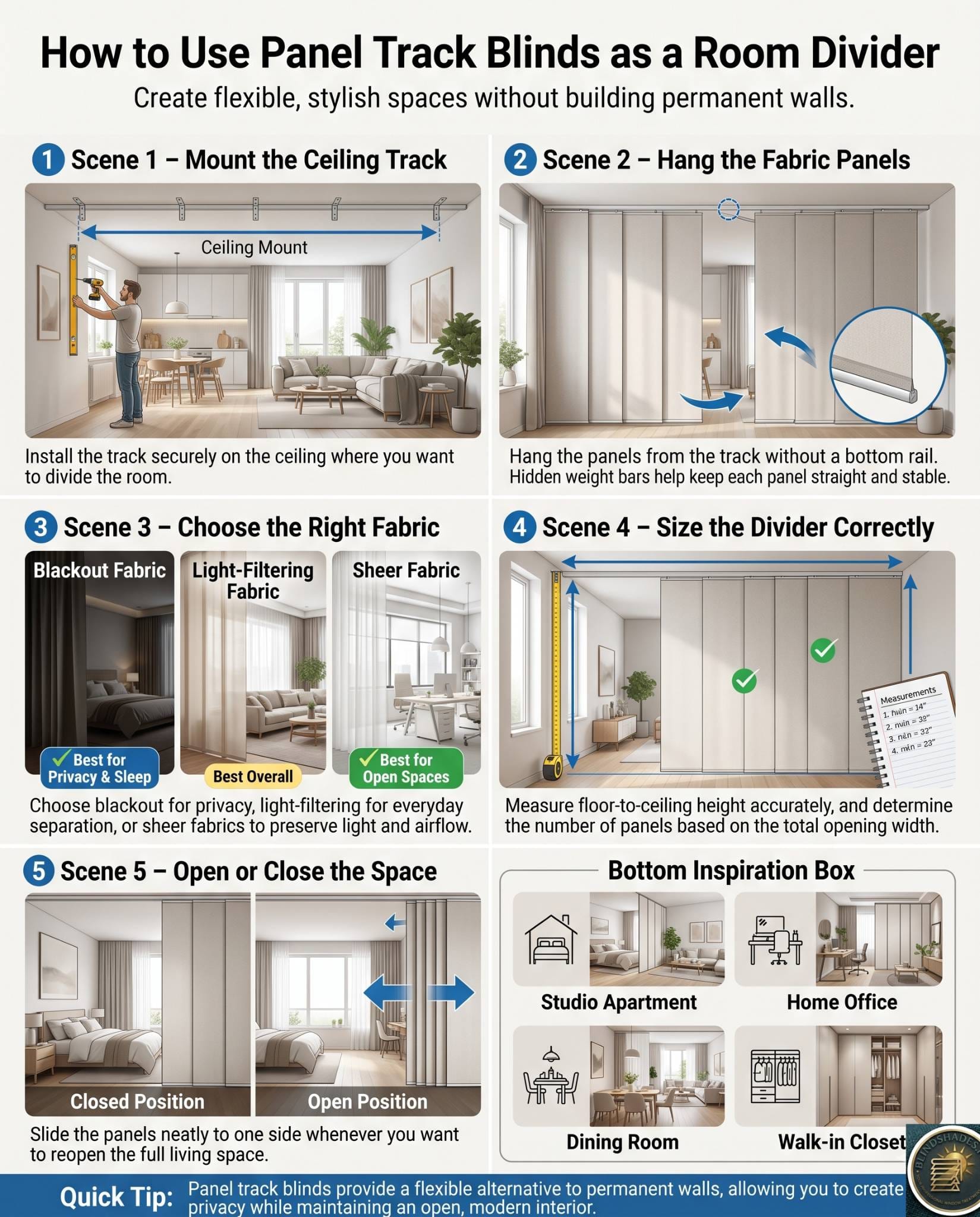
Authored by Michael Turner — 30 Years of Home Improvement Expertise | BlindShades.pro
A panel track blinds room divider is a ceiling-mounted set of wide fabric panels that glide along a track to separate an open space, then slide aside to reclaim it. Because the panels hang from the ceiling with no bottom track, weighted only by small bars at the base, they create a clean, flexible partition that needs no permanent construction, which makes them ideal for studio apartments, home offices, sleeping zones, and concealing storage or closets. You choose the fabric for your goal, blackout for a private sleep zone, sheer for light and airflow, or light-filtering for soft separation, and the panels stack open whenever you want the full space back. This guide covers the mount, the uses, the fabric, and how to plan one.
Key Takeaways
- A panel track divider is ceiling-mounted. The track fixes to the ceiling and the panels hang down, so the divider stands free without walls or floor fixings.
- There is no bottom track. The panels hang freely with small weight bars at the base to keep them straight and steady, leaving the floor clear.
- It is flexible and reversible. Slide the panels across to divide the space, or stack them aside to open it back up, all in seconds.
- The fabric sets the function. Choose blackout for a private sleeping zone, sheer for light and airflow, or light-filtering for soft, modern separation.
- It is renter-friendly. A panel track divider needs no permanent construction and is far less disruptive than building a wall.
⭐ Quick Answer
A panel track blinds room divider is a ceiling-mounted set of wide gliding panels that separates an open space, then stacks aside to reclaim it, with no permanent construction.
- Mount to the ceiling: fix the track along the line you want to divide, the use Blindsgalore highlights for panel track.
- No bottom track: the panels hang freely, with small weight bars at the base keeping them straight and steady.
- Choose fabric by goal: blackout for a private sleep zone, sheer for light and airflow, or light-filtering for soft separation, as The Shade Store notes on opacity.
- Use it anywhere flexible: separate a studio, screen a home office, or conceal storage, a renter-friendly idea Apartment Therapy features.
- Stack open to reclaim the full space any time. Measure floor to ceiling with how to measure for panel track blinds, install it via how to install panel track blinds, or see our best panel track blinds guide.
Why Panel Track Blinds Make Great Room Dividers
They divide a space without committing to a wall.
Open-plan spaces are flexible but sometimes you need separation, a private work nook, a screened sleeping area, a sense of two rooms in one. Building a wall is permanent, expensive, and often not allowed in rentals. Panel track blinds solve this elegantly: the same wide gliding panels that cover a sliding door work beautifully as a movable partition. They give clean, full-height separation with a modern, intentional look, glide smoothly aside when you want the space back, and install with nothing more than a ceiling-mounted track. Compared with folding screens or curtains, panel track looks more architectural and built-in, yet it is entirely removable.
How a Panel Track Room Divider Mounts
Ceiling-mounted, with no bottom track.
The key to using panel track as a divider is the mount: the track fixes to the ceiling along the line where you want the division, and the panels hang straight down from it. Unlike a window installation against a wall, a divider stands in open space, so there is no bottom track or floor channel, which would be a trip hazard and a fixing headache. Instead, the panels hang freely from the ceiling track. This is what makes the divider feel clean and uncluttered, with nothing fixed to the floor, and it is why a solid, level ceiling mount matters: the whole partition hangs from that track. The mounting itself follows the same method as any ceiling install, covered in how to install panel track blinds.
Weight Bars Keep the Panels Straight
Bottom weights replace the missing bottom track.
With no bottom track to guide them, free-hanging divider panels need something to keep them flat and steady, and that is the job of weight bars. Most panel track systems include a weighted bar that slides into a pocket at the bottom of each panel, giving it enough weight to hang straight, resist drafts, and move smoothly without swinging or curling. For a divider, these bottom weights are essential, since the panels are exposed on both sides and have no wall to rest against. When ordering panels for a divider, confirm they include bottom weight bars, and check that both faces of the fabric look good, because unlike a window blind, both sides of a divider are on show.
Room Divider Use Cases
Where a panel track divider shines.
| Space or goal | Divider setup |
|---|---|
| Studio apartment | Separate the sleeping area from the living space |
| Home office | Screen a work nook from the rest of the room |
| Open-plan living | Create two zones that open back into one |
| Sleeping alcove | Blackout panels for privacy and darkness |
| Closet or storage | Conceal an open wardrobe or shelving |
| Laundry or utility | Hide a washer-dryer or utility corner |
A panel track divider is most useful wherever you want flexible, part-time separation rather than a permanent wall. In studios it carves out a bedroom; in a living room it hides a home office at the end of the day; over an open closet it replaces bulky doors. Because it stacks away, you get the division only when you want it.
Panel Track Divider vs a Permanent Wall
Flexibility and cost versus permanence.
| Factor | Panel Track Divider | Permanent Wall |
|---|---|---|
| Construction | Ceiling track only | Framing, drywall, finishing |
| Cost | Lower | Higher |
| Reversible | Yes, stacks open | No |
| Rental-friendly | Yes | Usually not allowed |
| Light and air | Passes through, or blocks by fabric | Fully blocks |
| Sound | Some dampening | Full separation |
A panel track divider will not soundproof a space the way a stud wall does, and it does not add a lockable, fully enclosed room. What it offers instead is flexibility, low cost, and reversibility: division when you want it, open space when you do not, and no construction. For renters, anyone who wants adaptable space, or those avoiding the cost and disruption of building, that trade is well worth it.
Choosing the Fabric for Your Divider
The fabric decides how the divider behaves.
| Divider goal | Best fabric |
|---|---|
| Private sleep zone | Blackout or room-darkening |
| Light and airflow between zones | Sheer or light-filtering |
| Soft visual separation | Light-filtering fabric |
| Natural, warm screen | Woven wood |
| Maximum privacy both sides | Opaque, double-sided fabric |
Because the panels do not tilt, the fabric you choose sets how the divider works. Blackout fabric creates a genuinely private, darker sleeping zone; sheer or light-filtering fabric divides visually while letting light and air pass, keeping both areas bright; and woven wood adds natural texture. Since both sides of a divider are visible, choose a fabric that looks good from each side, and consider how much light you want to share between the two zones before deciding on opacity.
Sizing and Panel Count for a Divider
Measure floor to ceiling, and let the width set the panels.
A divider is sized like a tall, freestanding treatment: measure the ceiling height for the panel drop, allowing a small floor clearance so the weighted panels hang just above the floor and glide freely, and measure the width of the span you want to divide to determine the track length and panel count. Wider spans simply use more panels, with each panel commonly around 15 to 26 inches wide. Decide your stack direction too, which way the panels gather when open, so they stack against a wall or out of the main walkway. Accurate measuring matters as much here as on a window; see how to measure for panel track blinds.
A Renter-Friendly Divider
Adaptable space without construction.
For renters, a panel track divider is especially appealing because it adds the function of a wall without the permanence. The only fixing is the ceiling-mounted track, which leaves small, patchable holes rather than a built and demolished wall, and the whole system comes down and moves with you. Ready-made and adjustable-width panel track kits make this even easier, with some designed to be trimmed to fit and installed with minimal hardware. So you can section off a studio bedroom or screen a home office in a rental, then remove it cleanly when you leave.
Stack Open to Reclaim the Space
Division when you want it, open space when you do not.
The real advantage of a panel track divider over any fixed partition is that it is not always there. Slide the panels across the track to divide the space, then stack them neatly to one side to open the whole area back up, a one-handed move that takes seconds. This makes it perfect for spaces that need to flex through the day: a studio that is one open room by day and a separated bedroom by night, or a living room that hides a home office after work. To explore fabrics and configurations for your divider, see our best panel track blinds guide, and note the same panels work on a sliding glass door elsewhere in the home.
Divider Planning Checklist
Decisions to settle before you order.
| Decision | Guidance |
|---|---|
| Ceiling mount confirmed | Solid, level ceiling to hold the track |
| Bottom weight bars included | Essential for free-hanging panels |
| Fabric and opacity | Match to your privacy and light goal |
| Both sides presentable | Choose a fabric that looks good each side |
| Floor-to-ceiling measurements | Drop and width, plus small floor clearance |
| Stack direction | Stack out of the main walkway |
Working through this checklist before ordering ensures your divider hangs straight, looks good from both sides, divides the space the way you want, and opens cleanly when you need the room back.
Best Sources
- Blindsgalore — on panel track blinds used as ceiling-mounted room dividers, the gliding panels, and the range of fabrics for separating open spaces.
- The Shade Store — on ceiling-mounting panel track, measuring floor to ceiling, and choosing stack direction for a freestanding application.
- GoDear Design — on adjustable-width, trimmable panel track kits with bottom weight bars and cordless operation suited to dividers and rentals.
- Apartment Therapy — on using sliding panels and soft partitions to divide studio apartments and open-plan spaces without permanent walls.
- SelectBlinds — on panel track fabrics, opacity choices, and how light-filtering versus blackout panels behave for privacy and light.
Related Guides
- Best Panel Track Blinds Buying Guide
- How to Install Panel Track Blinds
- How to Measure for Panel Track Blinds
- Panel Track Blinds for Sliding Glass Doors
Frequently Asked Questions
Can you use panel track blinds as a room divider?
Yes, panel track blinds make excellent room dividers and it is one of their most popular non-window uses. The track mounts to the ceiling along the line you want to divide, and the wide fabric panels hang down to create a partition, then glide aside when you want the space back. They separate studio apartments, screen home offices, create sleeping zones, and conceal storage, all without permanent construction. Because they stack open, you get flexible, part-time division rather than a fixed wall, which is ideal for open-plan spaces and rentals.
How do panel track room dividers hang without a bottom track?
Panel track room dividers hang freely from a ceiling-mounted track, with no bottom track or floor channel. To keep the free-hanging panels straight and steady, each panel has a weighted bar that slides into a pocket at its base. These bottom weights give the panels enough heft to hang flat, resist drafts, and glide smoothly without swinging, taking the place of the bottom track used in some other systems. When ordering panels for a divider, confirm they include bottom weight bars, since the panels are exposed on both sides.
What fabric is best for a panel track room divider?
The best fabric depends on what you want the divider to do. For a private sleeping zone, choose blackout or room-darkening fabric to block light and create real separation. For dividing a space while keeping both sides bright and airy, choose sheer or light-filtering fabric that lets light and air pass. Woven wood adds natural warmth. Because both sides of a divider are visible, pick a fabric that looks good from each side, and decide how much light you want to share between the two zones before choosing the opacity.
Are panel track room dividers good for renters?
Yes, panel track dividers are well suited to renters because they need no permanent construction. The only fixing is the ceiling-mounted track, which leaves small, patchable holes rather than a built wall, and the whole system removes and moves with you. Ready-made, adjustable-width kits make installation easy, and some are designed to be trimmed to fit with minimal hardware. This lets renters section off a studio bedroom or screen a work area, then take it down cleanly when they move, without the cost or disruption of building.
Do panel track room dividers block sound?
Panel track room dividers provide some sound dampening but do not soundproof a space the way a solid wall does. The fabric panels absorb and soften sound and reduce the sense of one open room, which is enough to make a sleeping or working zone feel more separate, but sound still passes between the areas. If full sound isolation is essential, a built wall is needed; if flexible visual and partial acoustic separation is the goal, a panel track divider does the job while keeping the space adaptable.
