Roman Shades vs Roller Shades: Which Should You Buy?

Authored By Michael Turner -30 Years Home Improvement Expertise | Updated 2026 | BlindShades.pro
Updated on July 7, 2026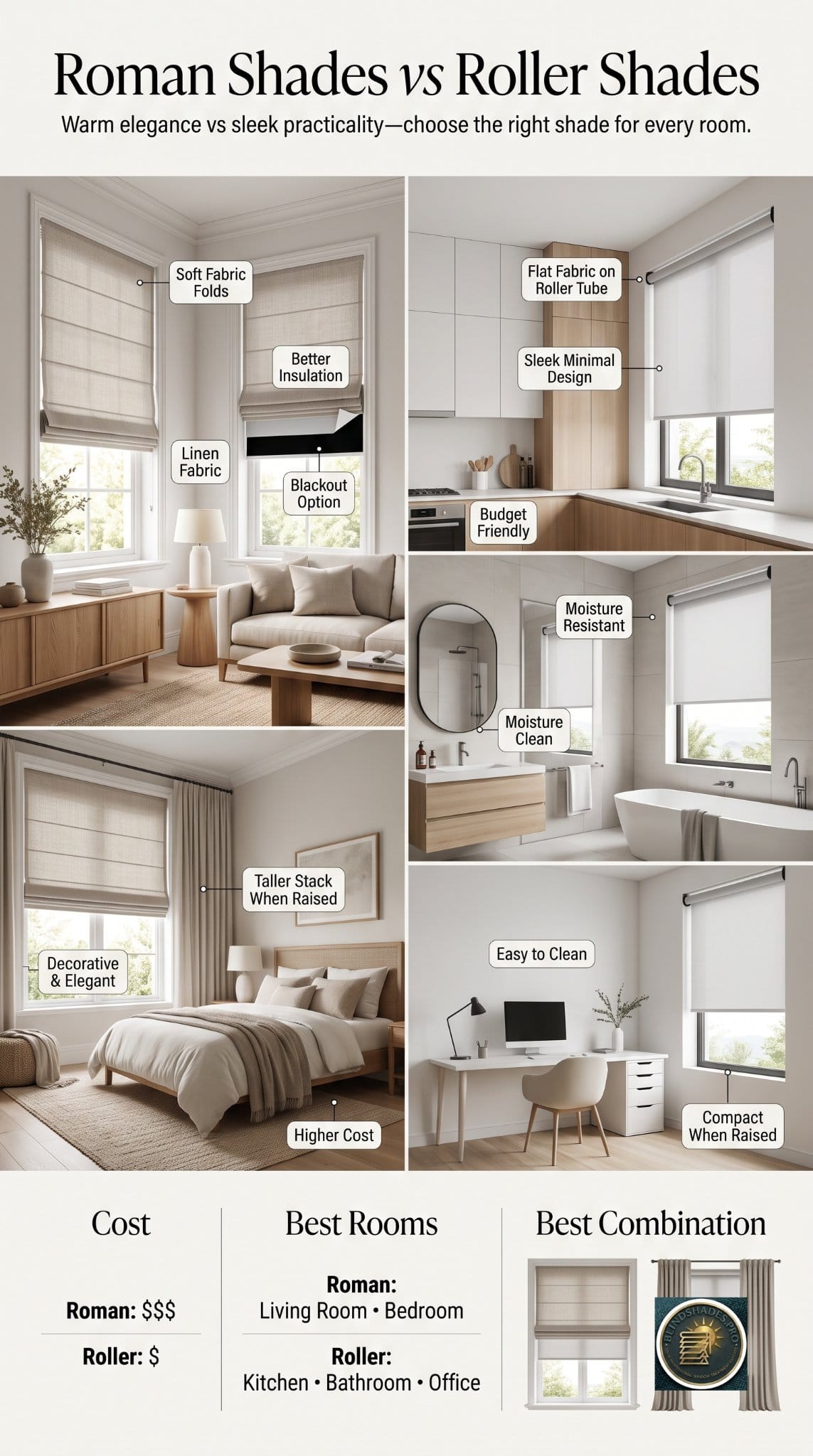
By Michael Turner | 30 years in window treatments
Roman shades vs roller shades comes down to one trade: Roman shades give you soft fabric folds, warmth, pattern, and better insulation, while roller shades give you a sleek, low-cost, wipe-clean, view-preserving profile. Roman shades stack into a decorative fold at the top of the window and suit living rooms and bedrooms; roller shades roll away compactly and suit kitchens, baths, offices, and any room where budget and easy cleaning matter. This guide covers every dimension the comparison pages do — style, light, insulation, durability, and cost — and then adds the trade-offs they leave out, so you can pick the right one the first time.
🎯 5 Key Takeaways
- Roman shades are decorative and insulating; roller shades are sleek and practical. Roman folds add warmth, texture, and pattern with better room-darkening and draft resistance when lined; roller shades roll flat for a minimal look at a lower cost.
- Roller shades win the wet rooms. Their moisture-resistant, wipe-clean materials suit kitchens and bathrooms, where Roman fabric traps dust and can fail in humidity.
- Roman shades cost more — and here is why. The heavier textiles, custom liners, and construction labor make them pricier; roller shades are generally the more budget-friendly option.
- The stack is the hidden trade. A raised Roman shade bunches into a tall fabric stack that can block the top of your view; a roller shade rolls away compactly and preserves it.
- You do not have to choose one for the whole house. Layering rollers on some windows and Romans on others — or a roller plus drapery — is often the smartest answer.
⭐ Quick Answer
Roman shades vs roller shades: choose Roman for a warm, decorative, insulating look, and roller for a sleek, budget-friendly, wipe-clean one. The short version:
- Roman shades give soft fabric folds, better insulation, and stronger room-darkening when lined, but cost more and stack tall when raised, per The Shade Store.
- Roller shades are a sleek flat sheet that rolls away compactly, cheaper and moisture-resistant, which Norman USA calls a simpler, utilitarian look; see the full roller shades guide.
- Cost: roller shades are generally cheaper; Roman shades run higher because of the extra fabric, a custom liner, and sewing labor, a point 3 Day Blinds and other guides echo.
- Wet rooms go roller; keep fabric Romans in drier, decorative rooms like living rooms and the bedroom.
- You can use both: rollers on practical windows, Romans on decorative ones, or a roller plus drapery; the full picture is in our Roman shades guide.
Best Sources: The Shade Store (Roman vs roller comparison); 3 Day Blinds (key differences); Norman USA (which is for you); BoCo Interior Designs (cost comparison); A Shade Above Window Fashions (when to choose each).
What Is the Difference Between Roman Shades and Roller Shades?
Roman shades are fabric shades that fold into soft horizontal pleats and stack at the top when raised; roller shades are a single flat sheet that winds around a tube for a sleek, seamless look.
The biggest difference, as 3 Day Blinds puts it, is simply the look: Roman shades raise and lower with a folded shape, while roller shades are sleek and seamless. But the difference runs deeper than appearance. Roman shades are usually built with thicker fabrics and often a built-in liner, which is why they excel at room-darkening and insulation. Roller shades use a single sheet available in a full range of opacities, from sheer solar weave to blackout, and roll tightly onto a tube so they nearly disappear when open. Norman USA frames it cleanly: roller shades have a simpler, utilitarian appearance and roll up tightly, while Roman shades have a more decorative, layered look with folds of fabric.
So the real question is not which is “better” but which trade fits your room — and that is what the rest of this guide decides.
The Fold-vs-Roll Rule: How to Decide
The Fold-vs-Roll Rule: Roman shades trade compactness and cost for warmth, pattern, and insulation, while roller shades trade decoration for a sleek, cheap, wipe-clean, view-preserving profile — pick by which trade your room needs.
Lay the two side by side across every dimension the comparison pages cover, and the choice becomes mechanical.
| Attribute | Roman shades | Roller shades |
|---|---|---|
| Look | Soft fabric folds, tailored or relaxed | Sleek, flat, minimal |
| Light control | Precise; strong darkening when lined | Precise; opacities from sheer to blackout |
| Insulation | Better — thick fabric plus liner | Lower — single fabric layer |
| Durability / cleaning | Traps dust; spot-clean only | Moisture-resistant; wipes clean |
| Stack when raised | Tall fabric stack at the top | Compact roll |
| Cost | Higher | Lower |
| Best rooms | Living rooms, bedrooms | Kitchens, baths, offices, high-traffic |
The Shade Store’s own comparison lands in the same place: Roman shades offer a softer, more tailored fabric look, while roller shades create a sleeker profile. Everything else flows from that one trade.
Which Insulates and Darkens Better — and What About the Stack?
Roman shades insulate and darken better because of their thick fabric and liner, but that same bulk creates a tall stack that can block the top of your view — a trade roller shades avoid.
On performance, Roman shades have the edge for warmth and darkness. Their thicker fabrics and built-in liners make them excellent for room-darkening in bedrooms and for insulating against drafts, and adding a blackout or thermal liner pushes that further — a decision we break down in our guide on blackout vs light-filtering Roman shades. Roller shades match Roman darkening only with a blackout fabric, and even then may show minor light gaps at the sides because of how they mount.
But there is a cost to all that Roman fabric that the insulation talk hides: the stack. When a Roman shade raises, the fabric bunches into a tall decorative pile at the top of the window, which can block the upper portion of your view — a real drawback on a shorter window. A roller shade rolls into a compact tube and preserves the whole opening. If an unobstructed view when open matters, that trade favors the roller.
Which Is Cheaper, and Why Are Roman Shades So Expensive?
Roller shades are generally cheaper; Roman shades cost more because they use more fabric, add custom liners, and require more construction labor.
Cost is the most-asked follow-up, and the answer is consistent across the comparison pages. BoCo Interior Designs states plainly that roller shades are, on average, more affordable than Roman shades. The reason Roman shades run higher is not markup — it is construction. Here is where the money goes.
| Cost driver | Why it adds to a Roman shade |
|---|---|
| Fabric quantity | Folds and stacking use far more material than a flat roller sheet |
| Liner | A privacy, room-darkening, or blackout liner is a second fabric layer |
| Construction labor | Sewn folds and rings require more skilled labor than a rolled sheet |
| Heavier textiles | Decorative and lined fabrics cost more per yard than roller fabric |
So “why are Roman shades so expensive” has a straightforward answer: you are paying for fabric, a liner, and labor a roller shade does not need. The flip side worth knowing — a lined roller shade, or a light-filtering roller paired with drapery, can approximate a Roman’s warmth and darkness for less, which is the value play if budget leads.
What Are the Drawbacks of Roman Shades and Roller Shades?
Both have honest drawbacks — Roman shades trap dust, cost more, and stack tall, while roller shades look plainer and can leak light at the edges — and knowing them prevents buyer’s regret.
No treatment is all upside, and the “drawbacks of Roman blinds” and “I hate Roman shades” searches deserve a straight answer rather than a sales pitch.
| Roman shade drawbacks | Roller shade drawbacks |
|---|---|
| Fabric folds trap dust; spot-clean only | Plainer, more utilitarian look |
| Higher cost | Minor light gaps at the sides on inside mount |
| Tall stack blocks the top of the view | Less insulation than a lined Roman |
| Poor fit for kitchens and bathrooms | Less decorative warmth and pattern |
| Heavier fabrics can be harder to operate | Blackout needs the right fabric plus mount |
The honest takeaway behind the “I hate Roman shades” threads is usually a mismatch: someone bought a decorative Roman for a high-traffic kitchen where a wipe-clean roller belonged. Match the treatment to the room and most of the regret disappears. For the edge-gap reality that affects roller shades specifically, our guide on roller shades vs roller blinds covers the shared category traits.
Which Should You Choose for Your Room?
Choose by room: Roman shades for warmth and decoration in living rooms and bedrooms, roller shades for practicality and moisture resistance in kitchens, baths, and high-traffic spaces.
Here is the decision mapped to real rooms, which is where the AI Overview and every comparison page ultimately point.
| Room | Better choice | Why |
|---|---|---|
| Living room | Roman shade | Warmth, texture, and a decorative focal point |
| Bedroom | Roman shade (blackout-lined) | Best darkening and insulation for sleep |
| Kitchen | Roller shade | Wipe-clean and moisture-resistant |
| Bathroom | Roller shade | Fabric Romans fail in high moisture |
| Home office | Roller shade | Sleek, glare control, low cost |
| Media room | Either, blackout | Roman for warmth, roller for a clean look |
For darkness-first bedroom setups, see our best Roman shades for a bedroom guide, and for the sleek alternative in its own right, our best roller shades buying guide.
Can You Use Roman and Roller Shades Together?
Yes — using roller shades on some windows and Roman shades on others, or layering a roller with drapery, is often the smartest and most cost-effective approach.
You are not locked into one treatment for the whole home, and interior designers rarely are. The top community answer to this exact question recommends exactly that: light-filtering roller shades on a big bay window where you want the view and easy operation, and Roman shades on the windows near the sofa where warmth and decoration matter. You can also get a Roman-like softness for less by pairing a simple roller shade with drapery panels, which A Shade Above Window Fashions notes gives the layered, textured look Romans are prized for. Mix by function, not by rule, and each window gets the right treatment.
Related Buying Guides
- The Best Roman Shades Buying Guide — the full Roman specification
- The Best Roller Shades Buying Guide — the full roller specification
- Blackout vs Light-Filtering Roman Shades — the Roman liner decision
- The Best Roman Shades for a Bedroom — darkness-first Roman setups
Frequently Asked Questions
Which is cheaper, Roman shades or roller shades? Roller shades are generally cheaper. They use a single flat sheet of durable material with minimal construction, while Roman shades cost more because they use far more fabric, often add a custom liner, and require more sewing labor for the folds. If budget is the priority, a roller shade — or a lined roller paired with drapery — delivers a similar effect for less.
What are the drawbacks of Roman blinds? The main drawbacks of Roman blinds are that their fabric folds trap dust and are usually spot-clean only, they cost more than most other shades, they stack into a tall pile that can block the top of the view when raised, and they are a poor fit for high-moisture rooms like kitchens and bathrooms. Heavier lined fabrics can also be harder to raise and lower.
Why are Roman shades so expensive? Roman shades are expensive because of how they are built: the folds and stacking use much more fabric than a flat roller sheet, most add a privacy, room-darkening, or blackout liner as a second fabric layer, and the sewn folds and rings require more skilled labor. Heavier decorative textiles also cost more per yard. You are paying for fabric, a liner, and labor a roller shade does not need.
Which insulates better, Roman or roller shades? Roman shades insulate better because their thicker fabric and built-in liner create a stronger barrier against heat transfer and drafts, especially with a thermal or blackout liner. A single-layer roller shade insulates less, though a lined roller or a cellular shade closes some of the gap. For a drafty or single-pane window, a lined Roman is the warmer choice.
Are roller shades better than Roman shades for a kitchen? Yes. Roller shades are better for kitchens because their moisture-resistant, wipe-clean materials handle humidity, steam, and grease far better than Roman fabric, which traps dust and can deteriorate in high moisture. Reserve Roman shades for drier, more decorative rooms like living rooms and bedrooms, and use roller shades in kitchens and bathrooms.
Can you use Roman and roller shades in the same house? Absolutely, and it is often the best approach. Many homes use roller shades on practical windows like kitchens, offices, and large view windows, and Roman shades on decorative windows in living rooms and bedrooms. Mixing by function gives each window the right treatment, and pairing a roller with drapery is another way to get a Roman-like look at a lower cost.
