Vertical Blinds Won’t Turn? Here’s How to Fix the Tilt

Authored By Michael Turner -30 Years Home Improvement Expertise | Updated 2026 | BlindShades.pro
Updated on June 23, 2026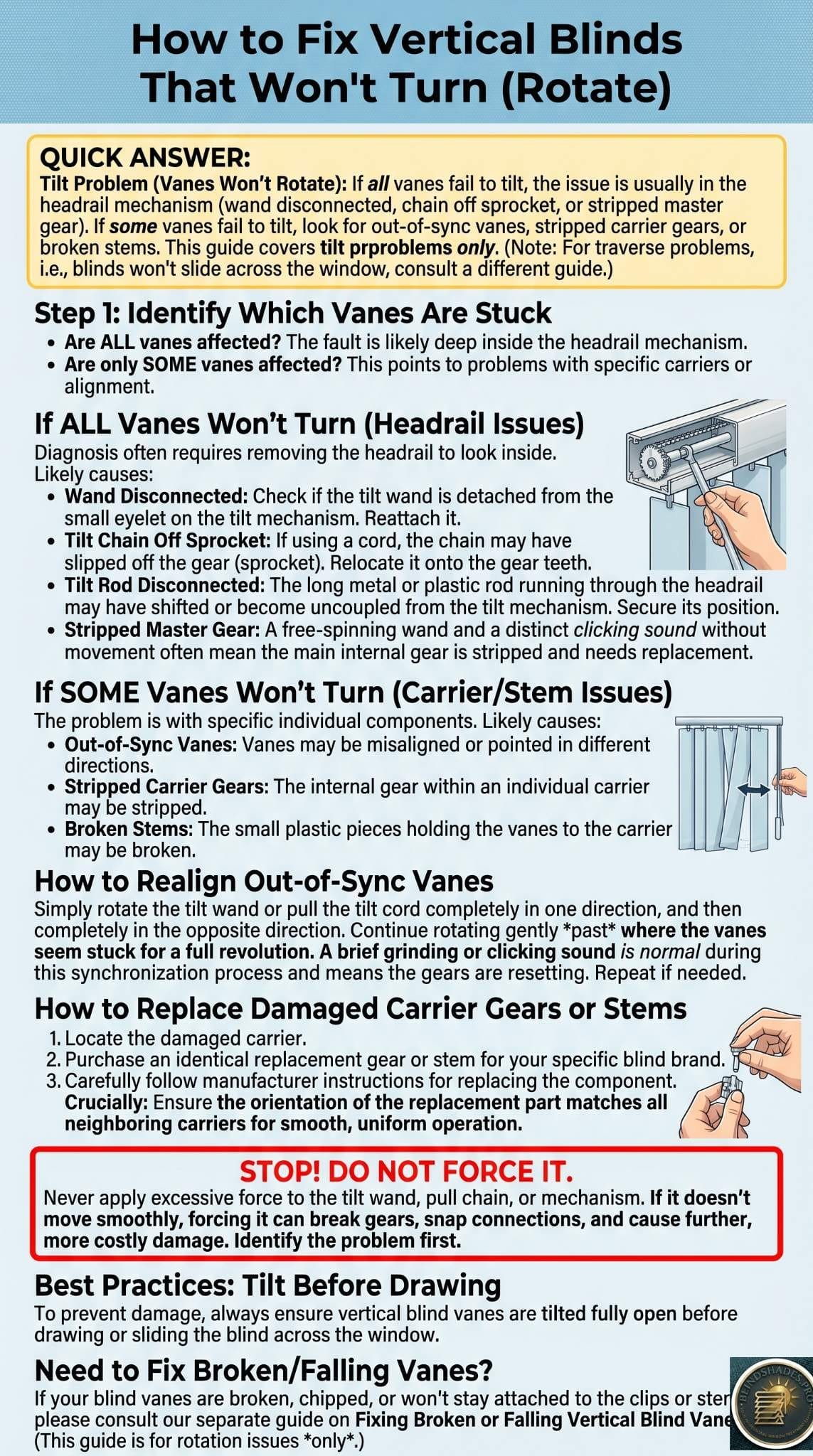
Authored by Michael Turner — 30 Years of Home Improvement Expertise | BlindShades.pro
If your vertical blinds won’t turn, the first question is whether all the vanes fail to rotate or only some, because that single distinction tells you where the fault is. When every vane refuses to turn, the problem is at the headrail end: a wand hook that has popped out, a chain off its sprocket, a disconnected tilt rod, or a stripped master gear. When only one or a few vanes won’t turn, the gear or stem inside those individual carriers has worn out. Many fixes need no tools, such as re-hooking a wand or re-seating a chain, and a stripped carrier is a quick parts swap once you know to orient the new one correctly. This guide diagnoses both, in order.
Key Takeaways
- The fix depends entirely on whether all vanes or only some fail to turn. All vanes failing points to the control mechanism at the headrail end; one or a few failing points to those individual carriers. Establish which before you open anything.
- Listen to the headrail as you operate the control. A rapid, hollow clicking sound as you turn the wand or pull the chain means the master tilt gear is stripped and spinning freely without engaging the vanes. Silence with no resistance often means a disconnected rod or chain off its sprocket.
- On wand blinds, check the wand hook first. The wand clips onto a hook on the rotating carrier, and it pops off more often than it should. Re-hooking it is a 30-second fix with no parts and no tools, so rule it out before assuming the gears have failed.
- When you realign out-of-sync vanes, the grinding noise is normal. Twisting the wand or pulling the chain past the stop to resync the vanes produces a loud grinding that sounds like stripping gears but is not. Do not stop part way; this is the intended way to reset alignment.
- Never force a seized chain or traverse closed vanes. Forcing a jammed chain, or drawing the blind across while the vanes are closed, is exactly what strips the gears in the first place. Always tilt the vanes fully open before drawing the blind.
⭐ Quick Answer
If your vertical blinds won’t turn, the fix depends on whether all the vanes fail to rotate or only some — that one question tells you where the fault is.
- Confirm it is tilt, not traverse. Vanes won’t rotate = tilt (this guide); if they won’t slide across the window, see vertical blinds won’t open or close.
- Diagnose all vs some. Turn the control and listen: a hollow clicking means the master gear is stripped and spinning free, as Engineer Fix explains. All vanes failing = headrail; only some = those carriers.
- If all fail: check the wand hook is seated (a 30-second no-tools fix), then the chain on its sprocket and the tilt rod, before replacing a stripped master gear.
- If only some fail: realign out-of-sync vanes — the loud grinding is normal, per SelectBlinds — or replace the stripped carrier gear, orienting the new stem to match. Vanes falling out? See how to fix vertical blind vanes.
- Never force a seized chain. If the gear is sealed in the carrier and parts are hard to match, Fix My Blinds notes a new headrail may be smarter — see our best vertical blinds guide.
“Won’t Turn” Means Tilt, Not Slide — Confirm Which You Have
Make sure the problem is rotation, not drawing the blind across, because they are different repairs.
As with any vertical blind fault, name the problem before you fix it. “Turn” should mean the vanes will not rotate on their axis from open (flat, perpendicular to the window) to closed, while the blind still slides across the track normally. That is a tilt-mechanism problem, and this guide solves it.
If instead the blind will not slide across the window to clear the opening, that is a traverse problem with the carriers, cord, or track, and it is covered separately in vertical blinds won’t open or close. Some blinds have both faults at once, in which case fix the tilt here first, since aligned, freely tilting vanes are also easier to traverse. Confirm you have a rotation problem, then continue.
Do All the Vanes Fail to Turn, or Just Some?
This one question splits every tilt repair into two paths — start by listening to the headrail.
Operate the tilt control, a wand or a chain, and watch and listen carefully. You are answering one question: do all the vanes fail to rotate, or only one or a few?
| What you see and hear | Where the fault is | Go to |
|---|---|---|
| No vanes turn; rapid hollow clicking | Master tilt gear stripped, spinning free | All-fail section |
| No vanes turn; wand feels loose or unhooked | Wand hook popped off the carrier | All-fail section |
| No vanes turn; chain slips or feels loose | Chain off its sprocket | All-fail section |
| No vanes turn; control feels solid but nothing moves | Tilt rod disconnected from the tilter | All-fail section |
| One or a few vanes stay still while others turn | Stripped gear or broken stem in those carriers | Some-fail section |
| A few vanes are reversed or out of line | Vanes out of sync, need realignment | Some-fail section |
| Vanes cling together and resist | Static build-up | Static section |
The audio cue is the most useful single diagnostic: a rapid, hollow clicking as you turn the control means the master tilt gear inside the headrail is stripped and spinning without engaging, as repair specialists at Engineer Fix describe. Silence with no resistance more often means a disconnected rod or a chain off its sprocket. Use the table to jump to the right section.
If All the Vanes Won’t Turn: Start at the Headrail
When nothing rotates, the fault is the control mechanism at the headrail end — work from the simplest cause outward.
When every vane refuses to turn, the problem is at the control end, not the carriers. Check these in order, easiest first.
1. Re-hook the wand (wand blinds). On wand-operated blinds, the wand hangs from a small hook on the rotating carrier at the control end, and that hook pops out more often than it should, as Home Fair Blinds notes. If your wand feels loose or disconnected, simply re-seat the hook onto the carrier. This is a 30-second fix with no parts and no tools, so always rule it out first.
2. Re-seat the chain on its sprocket (chain blinds). On chain-operated blinds, gently pry off the plastic end cap to expose the control mechanism. The chain should sit securely around the sprocket wheel. If it has jumped off, loop it back around the wheel’s teeth and replace the cap. If the chain has snapped or a link has separated, order a replacement length for your headrail width before doing anything else. Do not force a chain that feels completely locked; forcing a seized chain is how the internal mechanism breaks.
3. Reconnect the tilt rod. A continuous tilt rod runs the length of the headrail, passing through every carrier, and the control end turns it. With the end cap off, check that the metal tilt rod is still seated in the tilter gear. If it has slipped out, slide it back through so it runs through the gear, then reinstall the wand or chain connector and test.
4. Replace the stripped master gear. If the control feels like it turns but you hear that free-spinning clicking and no vanes move, the master tilt gear (also called the control end or tilter) is stripped. Replace the control-end mechanism, matching it to your blind’s brand and model, since gear tooth counts are not universal. Reattach the wand or chain and test the rotation across the full set.
If Only Some Vanes Won’t Turn: It’s the Carrier
When most vanes rotate but one or a few do not, the fault is isolated to those carriers — realign first, then replace if needed.
If the control clearly works because most vanes turn, but one or a few stay still or sit reversed, the problem is in those specific carriers. Do the free fix first.
Realign out-of-sync vanes. Often a vane is simply out of sync rather than broken. To resync the whole set, twist the wand or pull the chain to rotate the vanes toward the closed position, and keep going even after they appear to stop. As SelectBlinds explains, you give a firm, steady tug (or keep twisting the wand) past the stopping point, and you will hear a loud grinding noise as if you are stripping the gears. This grinding is normal and expected when resetting alignment; do not stop part way out of fear. Then operate the blind open and closed normally to confirm all vanes now move together. Many out-of-sync blinds are fixed by this alone, with no parts.
Replace a stripped carrier gear or stem. If a vane spins completely freely when you touch it, or stays put while its neighbours rotate, the small worm gear or plastic stem inside that carrier is stripped or broken. These plastic parts become brittle with age and sun exposure. Replacing the part is straightforward once you know to orient it correctly:
- Rotate all working vanes fully open, perpendicular to the window, to set the alignment reference for the whole blind.
- Remove the affected vane by unclipping it from the carrier hook.
- Remove the broken stem and gear. Use needle-nose pliers to grasp and twist out the broken stem; on some models it pops out. The small internal worm gear behind it can then be extracted.
- Match the replacement precisely. Gear tooth count and stem shape are not universal across brands, so match the new gear and stem to your blind’s manufacturer and model.
- Index the new carrier before fitting. This is the step most people miss: set the new stem to the exact same open orientation as the working vanes before sliding the carrier into the rail, so it synchronizes with the rest. A carrier fitted at the wrong angle will be permanently out of sync.
- Fit, reattach, and test. Slide the carrier into the track (depressing the locking tab if present), clip the vane back on, and operate the blind to confirm it now turns in sync.
If the vanes themselves keep falling off the carriers rather than failing to turn, that is a clip-and-vane problem covered in how to fix vertical blind vanes.
Could It Be Static?
Vanes that cling together and resist turning may just be holding a static charge.
Before assuming a mechanical failure, consider static, an overlooked cause that SelectBlinds highlights. Static build-up can make vanes of PVC, fabric, or even faux wood cling to each other so they do not hang evenly and resist tilting smoothly. The fix is simple: spray the affected vanes lightly with an anti-static spray, or rub them down with a dryer sheet, treating both sides of each vane. If static was the issue, the vanes will separate and turn freely again with no repair at all.
Prevent It: Tilt Open First and Never Force It
The habit that saves your gears: always rotate the vanes open before drawing the blind, and never force a stuck control.
Most stripped gears and snapped stems are caused, over time, by two avoidable habits. The first is drawing the blind across the window while the vanes are still closed, which forces the carriers and gears against resistance. The second is forcing a chain or wand that feels seized. To protect the mechanism, always tilt the vanes fully to the open position before traversing the blind, and if a control will not move, stop and diagnose rather than forcing it. Building the tilt-open-first habit is the single best thing you can do to avoid repeating this repair.
Should You Repair or Replace?
Replace a single carrier or control end cheaply; consider a new headrail when gears are enclosed or parts are discontinued.
A single stripped carrier or a worn control end is usually a cheap, worthwhile repair. The honest complications, which retailers selling parts tend to soft-pedal, are two. First, as Fix My Blinds notes, many carriers are built with the gear fully enclosed, so the entire carrier must be replaced rather than just the gear, and finding a carrier with the same turning ratio as your existing parts can be very difficult. Second, on older or proprietary blinds, matching parts may no longer be available. When several carriers are failing at once, the tilt rod is warped, or parts are discontinued, replacing the headrail or the whole blind is the more sensible route, and it may be the moment to consider whether a different treatment suits the window, as covered in alternatives to vertical blinds. For choosing a replacement, see our best vertical blinds guide.
Make It Child-Safe While You’re There
A repair is a good moment to deal with the control chain hazard.
The continuous chains and cords used to tilt vertical blinds are a recognized strangulation hazard for young children, addressed by the ANSI/WCMA A100.1 safety standard. While you have the blind apart, fit a tension device or cleat to keep the chain taut and out of reach, and if the blind is in a child’s room or a busy family area, consider upgrading to a wand-operated, cordless, or motorized vertical, which removes the hazard. The cordless and motorized options are covered in our best vertical blinds guide.
Best Sources
- Fix My Blinds — on the enclosed-gear problem, matching turning ratios, and when a new headrail beats a piecemeal repair.
- Blindsgalore — on manually rotating a carrier stem to test it, stripped-gear diagnosis, and bracket support affecting operation.
- Engineer Fix — on the worm-gear and stem replacement procedure, the clicking-means-stripped audio cue, and indexing the new carrier.
- Home Fair Blinds — on the wand hook popping off the carrier and not forcing a seized chain.
- SelectBlinds — on the realignment procedure where the grinding noise is normal, and static build-up as a cause.
Related Guides
- Best Vertical Blinds Buying Guide
- Vertical Blinds Won’t Open or Close
- How to Fix Vertical Blind Vanes
- Alternatives to Vertical Blinds
Frequently Asked Questions
Why won’t my vertical blinds turn or rotate?
If all the vanes fail to turn, the fault is at the headrail control mechanism: a wand hook that has popped off, a chain off its sprocket, a disconnected tilt rod, or a stripped master gear. If only one or a few vanes fail to turn, the small gear or stem inside those individual carriers has stripped or broken. Start by checking whether all or only some vanes are affected, then work from the simplest cause, such as re-hooking the wand, outward.
My vertical blind wand turns but the vanes don’t move — what’s wrong?
If the wand turns freely with a rapid clicking sound and no vanes move, the master tilt gear inside the headrail is stripped and spinning without engaging, and the control-end mechanism needs replacing. If the wand feels loose instead, its hook has likely popped off the rotating carrier, which you can simply re-seat in seconds. Check the easy hook first before replacing any gears.
How do I fix one vertical blind vane that won’t turn?
When a single vane stays still while the others rotate, first try resyncing the set by twisting the wand or pulling the chain past the stopping point until you hear a grinding noise, which is normal. If that vane still will not turn or spins freely, the gear or stem in its carrier is broken. Replace that carrier, and crucially, orient the new stem to match the other open vanes before sliding it in, or it will be out of sync.
Is the grinding noise normal when realigning vertical blinds?
Yes. When you twist the wand or pull the chain past the stop to resync out-of-line vanes, a loud grinding noise that sounds like stripping gears is normal and expected. It is the mechanism resetting its alignment. Do not stop part way out of concern; continue until the vanes line up, then operate the blind normally to confirm they all move together.
Should I repair or replace vertical blinds that won’t turn?
Repair if it is a single stripped carrier or a worn control end, since those parts are inexpensive. Replacement of the headrail or blind makes more sense when the gear is fully enclosed in the carrier and a matching turning ratio is hard to source, when several carriers have failed, or when the blind is old and parts are discontinued. At that point, consider whether a panel track or cellular shade would suit the window better.
