Why Won’t My Roller Blind Roll Up Straight?

Authored By Michael Turner -30 Years Home Improvement Expertise | Updated 2026 | BlindShades.pro
Updated on June 17, 2026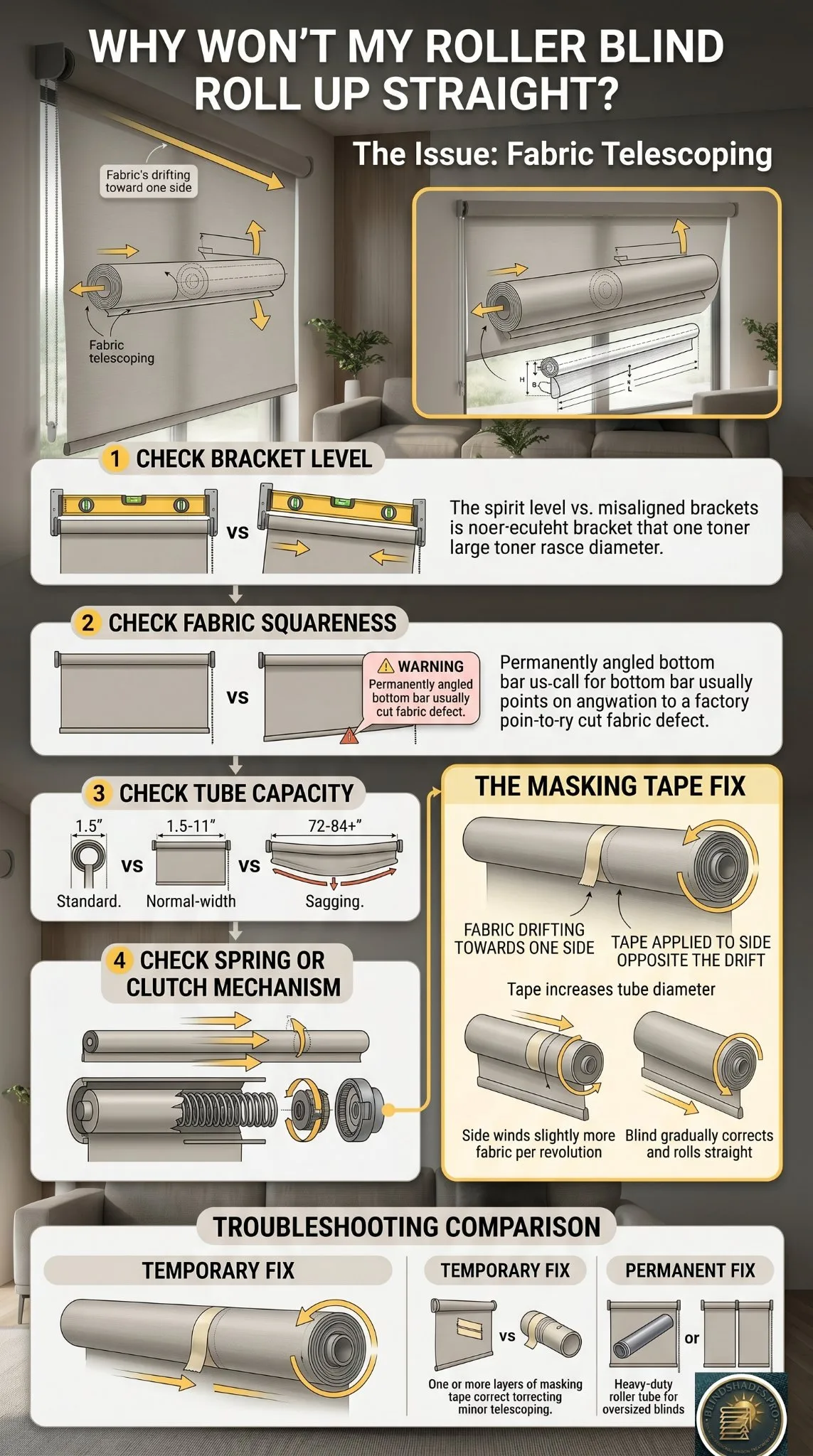
Authored by Michael Turner — 30 Years of Home Improvement Expertise | Updated 2026 | BlindShades.pro
A crooked roller blind is almost always “telescoping” — the fabric creeping sideways on the tube. The masking-tape trick fixes most cases, but only after you rule out the real root cause: a blind too wide for its tube. Here is the full diagnosis, in order.
Key Takeaways
- A roller blind that rolls up crooked is almost always “telescoping” — the fabric drifting sideways on the tube a little more with every turn until the bottom bar hangs at an angle. The fix most repair guides jump to is a strip of masking tape on the tube, and it works for the majority of cases. But tape treats the symptom; before you reach for it, rule out the four root causes in order: out-of-level brackets, fabric cut out of square, a blind too wide for its tube, and incorrect spring or clutch tension.
- The cause that almost no guide mentions is the one that matters most on wide windows: the blind is simply too wide for its tube. A standard 1.5-inch roller tube rolls straight only to roughly 72 to 84 inches; past that the loaded tube deflects in the middle, the fabric is forced toward one end, and it telescopes every single time you raise it. No amount of masking tape permanently fixes an over-width blind — the real fix is a heavy-duty 2-inch-plus tube or splitting the opening into two blinds.
- Diagnose before you fix, in this order: are the brackets level, is the fabric cut square, is the blind within its tube’s width limit, and is the tension correct. Skipping the diagnosis is why so many people tape a blind that actually has an un-level bracket, then wonder why the problem comes back.
- The masking-tape trick works by building up the tube’s diameter on the lagging side, so that side takes up slightly more fabric per revolution and pulls the fabric back into line. Apply the tape to the side opposite the direction the fabric is drifting, start with a single layer, and add more only as needed — over-taping over-corrects and sends the fabric drifting the other way.
- If the fabric was cut out of square at the factory, no tape will ever fix it — that is a manufacturing defect and a warranty replacement. You can tell the difference: a tracking problem can be improved with tape and re-rolling, while a fabric cut on a slant produces a bottom bar that stays angled no matter what you do.
⭐ Quick Answer
A roller blind won’t roll up straight because the fabric is telescoping — creeping toward one end of the tube a little more with every turn until the bottom bar tilts. Work through the causes in order before you fix anything.
- Diagnose in this order: are the brackets level (rest a spirit level on the tube), is the fabric cut square, is the blind within its tube’s width limit, and is the tension correct. Most people skip straight to tape and fix the wrong thing.
- The masking-tape fix for ordinary telescoping: apply a strip of masking tape around the tube on the side opposite the direction the fabric is drifting. It works by building up that side’s diameter so it takes up more fabric per turn and pulls the roll back into line. Start with one layer and add more only if needed. This is the same method published by repair specialists like Fix My Blinds and retailers like SelectBlinds.
- The cause almost no guide mentions: the blind is simply too wide for its tube. A standard 1.5-inch tube rolls straight only to about 72 to 84 inches; past that it sags and telescopes no matter how much you tape. The real fix is a heavy-duty 2-inch-plus tube or a two-blind split — see best roller blinds for large windows.
- Rule out an un-level mount: if the tube itself reads off-level, re-mount one bracket — gravity pulls the fabric to the low end and tape can’t cure it. Manufacturer guides such as Bali stress mounting a roller shade level. Getting this right starts at measuring: see how to measure for roller blinds.
- When tape won’t work: if the bottom bar stays angled no matter what, the fabric was cut out of square at the factory — a warranty replacement, not a DIY fix. If a worn clutch is letting it roll unevenly, see why your roller blind won’t stay up. Full specification is in the Roller Blinds Buying Guide.
What Does It Mean When a Roller Blind Won’t Roll Up Straight?
When a roller blind won’t roll up straight, the bottom bar ends up hanging at an angle instead of level, and one side of the fabric climbs higher than the other as you raise it. The technical name for what is happening is telescoping: the fabric is creeping sideways along the tube a fraction of an inch with every rotation, the same way a roll of wrapping paper walks to one end if it is not wound perfectly evenly. Left alone, a telescoping blind gets progressively more crooked until the fabric edge rubs the bracket and the blind jams.
It helps to separate three different symptoms that all look like “won’t roll up straight,” because each has a different cause and fix:
- Telescoping — the fabric drifts sideways on the tube and the bottom bar tilts. This is the most common, and the one masking tape addresses.
- An un-level bottom bar from day one — the blind tracks fine but the bar was never level, which usually means the brackets are not level or the fabric was cut out of square.
- Binding or jamming — the blind sticks or refuses to turn, which is a fabric jam or a mechanism problem rather than a tracking problem, and is covered in our guide to why a roller blind won’t stay up.
The rest of this guide focuses on telescoping and the un-level bar, because together they account for the large majority of “won’t roll up straight” complaints.
What Are the Real Causes of a Crooked Roller Blind?
There are five root causes, and the reason most quick fixes fail is that people apply the tape trick without first identifying which one they actually have. Work through them in this order.
| Cause | How to spot it | The correct fix |
|---|---|---|
| Out-of-level brackets | Bottom bar tilts the same way the blind was hung; a spirit level on the tube reads off | Re-mount one bracket so the tube is level |
| Fabric cut out of square | Bar stays angled no matter how you re-roll; tape never improves it | Warranty replacement — not a DIY fix |
| Too wide for the tube | Wide window (over ~72-84″); tube visibly sags in the middle; telescopes every raise | Heavy-duty tube or two-blind split |
| Fabric telescoping | Bar starts level but drifts crooked over repeated use | Masking tape on the lagging side |
| Incorrect spring/clutch tension | Rolls unevenly, too fast or too slow, alongside the drift | Adjust tension, then re-roll straight |
The diagnostic sequence matters. Repair specialists such as Fix My Blinds note that an unevenly rolling shade should first be checked for level mounting and correct width before any tape is applied, because taping a blind that is actually over-width or un-level simply masks the problem until it returns.
How Do You Tell Telescoping From an Un-Level Bracket?
Roll the blind all the way up and put a small spirit level on top of the tube. If the tube is not level, your brackets are the problem — re-mount one side. If the tube is level but the bottom bar still hangs at an angle, the issue is in the fabric: either it is telescoping (improvable with tape and re-rolling) or it was cut out of square (not improvable, a warranty case). This thirty-second check saves you from taping a problem that tape cannot solve.
How Do You Fix a Telescoping Roller Blind With Masking Tape?
For ordinary telescoping on a level, correctly sized blind, the masking-tape method is the standard repair, and it is genuinely easy. Window-covering retailers including SelectBlinds publish this same fix in their tech tips, because it works on almost any fabric roller.
- Lower the blind fully so the tube at the top is exposed. You may need to pop off a plastic end stop to unwind it completely.
- Identify the direction of drift. Watch which side the fabric is climbing toward as it rolls up. You will tape the opposite side — the side the fabric is drifting away from.
- Apply a single strip of masking tape around the tube near that end, a few inches in from the edge. One layer is roughly four-thousandths of an inch thick, which is enough to start correcting most drift.
- Re-roll and test. Raise and lower the blind a few times and watch the bar. If it is now level, you are done.
- Add more tape only if needed. If it still drifts the same way, add a second layer over the first. If it now over-corrects and drifts the other way, you have used too much — remove a layer.
The most common mistake is taping the wrong side. If you are unsure, remember the rule below.
Which Side Do You Tape?
Tape the side opposite the direction the fabric is moving toward. If the fabric is climbing to the left, tape the right end of the tube; if it is climbing right, tape the left. You are trying to make the under-fed side take up more fabric, which means thickening the end the fabric is leaving, not the end it is piling onto.
Why Does the Masking-Tape Trick Actually Work?
The reason the tape works — which no troubleshooting guide bothers to explain — is simple geometry. A roller blind winds fabric onto a tube of fixed diameter. Each full turn of the tube takes up a length of fabric equal to the tube’s circumference. If one end of the tube is effectively a slightly larger diameter than the other, that end takes up marginally more fabric per turn, which steers the whole sheet toward the smaller-diameter end.
Telescoping happens when the fabric, the tube, or the way it was last rolled gives one side a fractionally larger effective diameter, so the sheet steadily walks toward the other end. Adding a layer of tape to the lagging side increases that side’s diameter, makes it take up more fabric per turn, and pulls the sheet back into balance. That is also why a little tape goes a long way and why over-taping reverses the drift — you are making a precision adjustment to a difference measured in thousandths of an inch.
Is Your Roller Blind Simply Too Wide for the Tube?
This is the cause that matters most and that almost every guide ignores. If your blind is on a wide window and it telescopes no matter how carefully you re-roll or tape it, the problem is not the fabric — it is that the blind is too wide for its tube to stay rigid.
A roller blind on a standard 1.5-inch tube rolls straight and holds its shape up to roughly 72 to 84 inches wide. Beyond that span, the loaded tube deflects (bows) slightly in the middle under the weight of the fabric. That bow tips the geometry so the fabric is continually pushed toward one end, and the blind telescopes every single time it is raised. Heavier fabrics — foam-backed blackout or vinyl — load the tube more and reach this point sooner.
No amount of masking tape permanently fixes an over-width blind, because tape corrects a fabric-tracking imbalance, not a sagging tube. The real fixes are mechanical:
- Upgrade to a heavy-duty tube of 2 inches or more, which resists deflection across a wider span.
- Split the opening into two blinds with a 2-inch center overlap, halving each tube’s span.
- Choose a lighter fabric to reduce the load if you must stay on a standard tube.
If you are specifying for a wide opening, get the tube right at the order stage rather than fighting telescoping later. Our guide to the best roller blinds for large windows covers the exact width thresholds and the split math, and the full specification process is in the Roller Blinds Buying Guide.
Are the Brackets Level?
A blind hung on out-of-level brackets can never roll up straight, because the tube itself is tilted. Gravity then pulls the fabric toward the low end, producing a permanent crooked roll that tape will not cure. This is the first thing to rule out and the easiest to fix.
Take the blind up, rest a spirit level along the top of the tube, and check it. If it reads off level, mark a corrected position for the high or low bracket, re-drill, and re-mount so the tube sits perfectly horizontal. Manufacturer installation guides such as Bali’s roller and solar shade measuring guide stress that a roller shade must be mounted level to operate correctly, which is why a level is part of every proper measuring and installation kit. While you are at it, confirm both brackets are tight — a loose bracket lets the tube shift under load and mimics telescoping.
Was the Fabric Cut Square at the Factory?
If the bottom bar hangs at an angle from the very first day, the brackets are level, and re-rolling or taping makes no difference, the fabric was almost certainly cut out of square at the factory. This is a manufacturing defect, not a maintenance issue: the fabric is a slight parallelogram rather than a true rectangle, so the bottom bar can never sit level no matter how the sheet is wound.
You can confirm it by lowering the blind fully and measuring the fabric width at the top and at the bottom — if they differ, or if the bottom hem is visibly not perpendicular to the sides, the cut is off. The correct response is not a DIY fix but a warranty claim with the retailer or manufacturer. Reputable sellers replace miscut blinds; this is exactly what mis-measure and accuracy guarantees are for. Trying to tape a miscut blind level only wastes time.
When Is a Crooked Roller Blind Not Worth Fixing?
Sometimes the honest answer is that the blind needs replacing rather than repairing. Consider replacement when:
- The blind is over-width for any standard tube and you cannot retro-fit a heavy-duty tube — re-ordering the correct specification is cheaper than endless adjustment.
- The fabric is cut out of square and is out of warranty.
- The clutch mechanism has failed — when a continuous-chain clutch is worn, it slips and lets the fabric roll unevenly, and on most consumer blinds the clutch is integrated into the tube, so replacing the mechanism costs about the same as a new blind.
- The fabric edge is frayed or curled from repeatedly hitting the bracket, which causes its own tracking problems.
If you are replacing anyway, treat it as a chance to specify correctly — the right tube for the width, a level mount, and a cordless or motorized lift. The Roller Blinds Buying Guide walks through the full specification.
How Do You Stop a Roller Blind From Rolling Up Crooked Again?
Prevention is mostly about specification and habits:
- Size the tube to the width. Order a heavy-duty tube or a two-blind split for any opening wider than about 84 inches, so the tube never deflects.
- Mount dead level. Use a spirit level at installation; a tube that starts level rarely telescopes.
- Raise and lower evenly. Yanking one side of the bottom bar or letting a cordless blind snap up fast encourages the fabric to walk sideways. Lift from the center.
- Keep the fabric edges clean and uncurled. A frayed or curled edge catches and drifts.
- Re-roll occasionally. If you notice the bar starting to tilt, take the blind down and re-roll the fabric by hand, keeping it square, before it becomes a habit.
For inside-mounted blinds, getting the measurement and mount right in the first place prevents most tracking issues — see how to measure for roller blinds.
Frequently Asked Questions
Why does my roller blind roll up crooked all of a sudden?
A blind that suddenly rolls up crooked is usually telescoping after the fabric was last rolled slightly unevenly, or after a knock shifted a bracket. Take it down, re-roll the fabric by hand keeping it square, confirm the brackets are level, and re-hang. If it returns, apply a strip of masking tape to the tube on the side opposite the drift.
What side do I put the tape on to fix a telescoping roller blind?
Tape the end of the tube opposite the direction the fabric is drifting toward. If the fabric climbs to the left, tape the right end; if it climbs right, tape the left. Start with one layer and add more only if the drift persists.
Can a roller blind that is too wide be fixed with tape?
No. Tape corrects a fabric-tracking imbalance, not a sagging tube. A blind wider than about 72 to 84 inches on a standard 1.5-inch tube will keep telescoping because the tube deflects under load. The real fix is a heavy-duty 2-inch-plus tube or splitting the window into two blinds.
How do I know if my roller blind fabric was cut wrong?
Lower the blind fully and check whether the bottom bar is perpendicular to the sides, and measure the fabric width at the top and bottom. If the bar stays angled regardless of re-rolling and the widths differ, the fabric was cut out of square — a manufacturing defect and a warranty replacement.
Why won’t my roller blind stay level even after taping?
Either the brackets are not level (check the tube with a spirit level), the blind is over-width for its tube (it will telescope no matter what), or the fabric was miscut. Tape only fixes ordinary telescoping on a level, correctly sized blind.
This article is part of the Roller Blinds Buying Guide cluster on BlindShades.pro. Related: Why is light coming through the sides of my roller blind? · Why won’t my roller blind stay up? · Best roller blinds for large windows
