Are Blackout Roller Blinds Worth It?

Authored By Michael Turner -30 Years Home Improvement Expertise | Updated 2026 | BlindShades.pro
Updated on July 10, 2026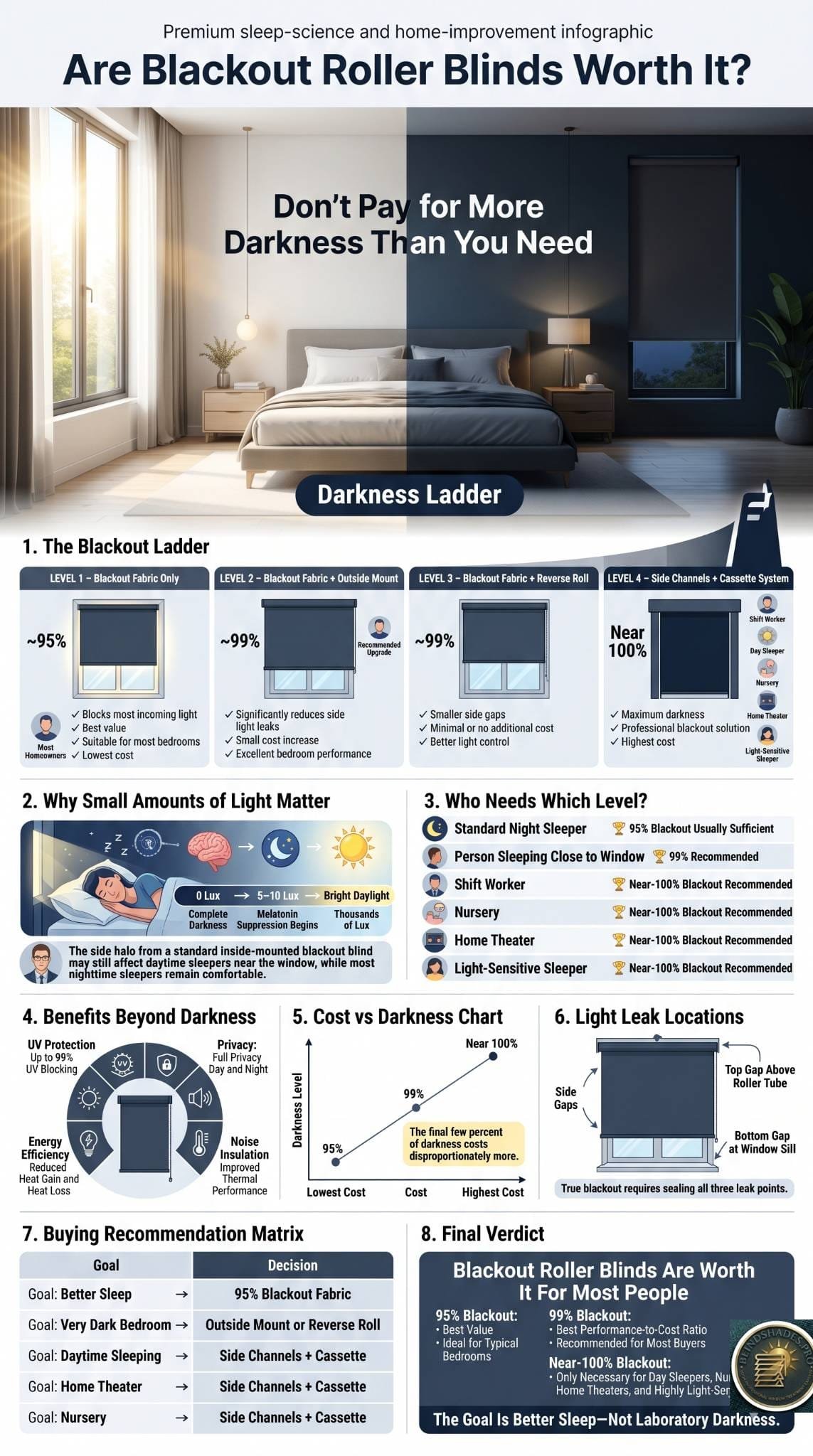
Authored by Michael Turner — 30 Years of Home Improvement Expertise | Updated 2026 | BlindShades.pro
Blackout roller blinds are worth it for almost anyone who wants a darker bedroom — but the expensive side-channel upgrade is only worth it for true day-sleepers. Here’s the honest cost-vs-darkness ladder, so you spend on the level you actually need.
Key Takeaways
- A blackout roller blind is worth it for almost anyone who wants a meaningfully darker room, but “worth it” comes in levels, and most guides quietly push you to the most expensive one. The honest framing is a ladder: the blackout fabric alone, inside-mounted, blocks roughly 95% of light and is worth it for the majority of people; adding an outside mount or reverse roll gets you to about 99% for little or no extra cost; adding side channels and a cassette reaches near-100% but costs real money and is only worth it for specific users. Match the spend to how dark you actually need.
- The jump from 95% to 99% darkness is small on paper but large in the room. Blindsgalore puts it bluntly: an inside-mounted blackout roller blocks most light but leaves small side and top gaps, while an outside mount blocks about 99%, and the perceptual difference between 95% and 99% is huge. That last few percent is the side halo, and whether closing it is worth paying for depends entirely on who is sleeping in the room.
- The science that decides it: melatonin is suppressed at light levels as low as 5 to 10 lux. UBlockout cites research showing melatonin suppression at just 5 to 10 lux, dimmer than normal room lighting, and that edge-gap light can suppress melatonin by over 50%. A 95% inside-mount blind can still let in more than that near the window, which is exactly why a shift worker sleeping in daylight needs the side channels, while someone who sleeps at night well away from the window often does not.
- Side channels are worth the extra cost for true day-sleepers, light-sensitive people, nurseries, and home theaters, and usually overkill for everyone else. If you sleep during the day, are highly light-sensitive, or are darkening a baby’s nap room or a media room, the sealed-track system that gets you to genuine darkness pays for itself in sleep. If you sleep at night and just want the room darker, the fabric plus an outside mount is the sensible stopping point.
- Beyond sleep, a blackout roller earns its keep in ways that apply at every level: it blocks up to 99% of UV to protect furnishings, adds privacy with zero view-through, dampens noise, and improves insulation at the window. These benefits come largely from the fabric itself, so even the entry-level choice delivers them.
⭐ Quick Answer
Are blackout roller blinds worth it? Yes for almost anyone who wants a darker room — but “worth it” comes in levels, and most people overpay by buying darkness they don’t need. Match the spend to how dark you actually need.
- Level 1 — blackout fabric, inside mount (~95%): worth it for most night-sleepers, and it also delivers UV protection, privacy and noise damping. For a normal bedroom, you can stop here. Blindsgalore rates inside mounts around 95% and outside mounts around 99%.
- Level 2 — outside mount or reverse roll (~99%): overlapping the frame by 2 to 3 inches costs little or nothing at order time and closes most of the side halo. If the room is bright, do this. The mechanics are in why light comes through the sides of a roller blind.
- Level 3 — side channels + cassette (~100%): the premium upgrade that seals the edges completely. Only worth it for day-sleepers, shift workers, the light-sensitive, nurseries, and home theaters — the audience SleepyTime Tracks targets. Usually overkill for everyone else.
- The science that decides it: UBlockout cites melatonin suppression at just 5 to 10 lux. A 95% inside-mount halo can stay above that near a bright window during the day, which is why day-sleepers need the channels and night-sleepers don’t.
- Bottom line: most night-sleepers should stop at Level 1 or 2; only specific users should pay for Level 3. Don’t buy laboratory darkness you don’t need. Full fabric, mount and channel spec in the Roller Blinds Buying Guide.
Are Blackout Roller Blinds Worth It? The Honest Answer
Blackout roller blinds are worth it for almost anyone who wants their room darker — but how much you should spend depends on how dark you genuinely need, and that is the part most guides skip. They tend to push everyone toward the full sealed-track system as if total darkness were the only goal. It is not. Blindsgalore is one of the few to admit it plainly: most sleepers do not need laboratory-level darkness.
So the real question is not “are blackout blinds worth it” but “which level of blackout is worth it for me.” A blackout fabric blocks light through the panel itself; the only light left is the perimeter halo around the edges. Closing that halo costs progressively more money for progressively smaller gains. For a night-sleeper who just wants to keep out streetlight glow, the fabric does the job. For a nurse sleeping at noon, the halo is the difference between rest and exhaustion, and the upgrade is absolutely worth it. The ladder below tells you where to stop.
How Dark Do Blackout Roller Blinds Actually Get?
A blackout fabric is engineered to be opaque, so it blocks essentially all the light that hits the panel — the issue is never the fabric, it is the gaps around it. Blindsgalore quantifies the real-world result by mount type: an inside-mounted blackout roller blocks most incoming daylight but leaves small gaps at the sides and top, landing around 95%, while an outside-mounted blackout roller that overlaps the frame blocks about 99% of incoming daylight.
That 95%-versus-99% gap is the whole game, and it sounds trivial until you are lying in the room. The remaining few percent is the side halo and the top gap above the tube. Whether it matters depends on the light outside your window and when you sleep. A north-facing bedroom on a quiet street at night may be perfectly dark at 95%; a west-facing room facing a streetlight, used for daytime sleep, will have a visible glow at 95% that keeps you awake. This is why the honest answer is tiered, not a single product recommendation.
Why the 5-to-10 Lux Threshold Decides It
The reason the last few percent matters for some people and not others comes down to a specific number. UBlockout cites sleep research showing that melatonin, the hormone that regulates sleep, is suppressed at light levels as low as 5 to 10 lux — dimmer than ordinary room lighting — and that the light leaking around edge gaps can suppress melatonin by over 50%. Daylight is tens of thousands of lux, so even a 95% reduction near a bright window can leave the halo above that 5-to-10 lux threshold. For a daytime sleeper, that is enough to disrupt sleep; for a nighttime sleeper, the outside light is already low, so 95% drops it well under the threshold. The science, in other words, is what splits the audience into “fabric is enough” and “you need the channels.”
The Worth-It Ladder: Three Levels of Darkness
Here is the framework no competitor assembles — the cost-versus-darkness ladder, so you can stop at the level that fits your need:
| Level | What you add | Darkness | Added cost | Worth it for |
|---|---|---|---|---|
| 1 | Blackout fabric, inside mount | ~95% | Baseline | Most people; night-sleepers; general room darkening |
| 2 | Outside mount or reverse roll | ~99% | Free to low | Brighter rooms; anyone wanting more, cheaply |
| 3 | Side channels + cassette + sealed hem | ~100% | Premium | Day-sleepers, shift workers, light-sensitive, nurseries, media rooms |
The key insight: Level 2 is nearly free. Choosing an outside mount that overlaps the frame by 2 to 3 inches, or specifying a reverse roll so the fabric sits closer to the glass, costs little or nothing at order time and takes you most of the way to total darkness. You only pay the real premium at Level 3, and only specific users need it. Start at the level your situation demands and move up only if you must.
Is the Blackout Fabric Alone Worth It?
Yes, for most people, Level 1 is the right answer. A quality blackout fabric on an inside-mounted roller blocks around 95% of light, transforming a bright room into a dark one and delivering all the fabric-based benefits — UV protection, privacy, noise damping, and insulation. For a typical bedroom where you sleep at night, this is usually enough: with the outside light already low after dark, a 95% reduction puts the room comfortably below the threshold that disturbs sleep.
VelaBlinds notes that a quality blackout blind blocks nearly all incoming light and offers zero view-through day or night, which is the privacy and UV story most buyers actually care about. So if your goal is “much darker bedroom, more privacy, protect the furniture,” the fabric alone is worth it, and you can stop here. Add Level 2 almost for free if the room is bright.
Are Side Channels Worth the Extra Cost?
This is the real spending decision, and the honest answer is: only for specific users. Side channels — sealed tracks that capture the fabric edges — are the only reliable way to eliminate the side halo and reach near-total darkness, which is why retailers like SleepyTime Tracks market them specifically to day-sleepers. They genuinely work. But they add cost, they are visible tracks on the window jambs, and they solve a problem a night-sleeper does not have.
They are worth the extra cost if you sleep during the day, are unusually light-sensitive, are darkening a baby’s room for naps, or are building a home theater where any glow ruins the screen. In those cases the channels are the difference between functional and frustrating, and they pay for themselves in sleep or usability. They are usually overkill if you sleep at night and simply want the room darker — there, Level 1 or 2 already gets you below the threshold, and the channel budget is better saved. The mechanics of how channels and the other gap fixes work are covered in why light comes through the sides of a roller blind.
Who Actually Needs Full Blackout?
Full Level 3 blackout is genuinely worth it for a defined group:
- Shift workers and day-sleepers — nurses, firefighters, first responders, and anyone sleeping while the sun is up, where the 5-to-10 lux halo is the enemy.
- Highly light-sensitive sleepers — people whose sleep is disrupted by even small amounts of light, including some with insomnia or circadian-rhythm issues.
- Nurseries and children’s nap rooms — where daytime darkness directly determines whether a baby naps.
- Home theaters and media rooms — where any window glow washes out a screen.
- Bedrooms facing bright streetlights or signage — where the outside light at night is high enough to matter even after dark.
If you are not in one of these groups, you can almost certainly stop at Level 1 or 2 and put the channel money elsewhere. For bedrooms, a scheduled motorized blackout roller can also help by closing automatically before sleep — see are motorized roller blinds worth it.
Do Blackout Roller Blinds Have Benefits Beyond Sleep?
Yes, and these apply at every level because they come from the fabric, which strengthens the worth-it case even for non-sleep buyers:
- UV protection — blackout fabrics block up to 99% of UV, protecting flooring, furniture, and artwork from fading.
- Privacy — true blackout fabric offers zero view-through day or night, unlike light-filtering fabrics that show silhouettes after dark.
- Noise reduction — the dense, often multi-layered fabric dampens outside noise, more so with side channels sealing the edges.
- Insulation and energy — by covering the window and, with channels, sealing the edge air gaps, blackout rollers reduce heat transfer and can trim heating and cooling load.
Because these benefits are fabric-based, even the entry-level blackout roller delivers them, which is part of why Level 1 is worth it for so many people regardless of how they sleep.
The Bottom Line: Which Level Is Worth It for You?
Decide by who sleeps in the room and how bright it is:
- Most night-sleepers: Level 1 (blackout fabric, inside mount, ~95%). Worth it. Stop here.
- Bright room or want more, cheaply: add Level 2 (outside mount or reverse roll, ~99%). Nearly free, so do it.
- Day-sleepers, shift workers, light-sensitive, nurseries, media rooms: Level 3 (side channels + cassette, ~100%). Worth the premium for you specifically.
The mistake to avoid is paying for Level 3 when your situation only needs Level 1 — or buying Level 1 when you are a shift worker who truly needs Level 3 and will be disappointed. Match the spend to the need. The full fabric, mount, and channel specification is laid out in the Roller Blinds Buying Guide.
Related guides: For complete buying advice, see our blackout blinds and shades buying guide.
Frequently Asked Questions
Are blackout roller blinds worth it for a bedroom?
For most bedrooms, yes. A blackout fabric on an inside mount blocks about 95% of light, which is enough for a night-sleeper and also delivers UV protection, privacy, and noise damping. If the room is bright, add a nearly free outside mount for about 99%. Only day-sleepers and the light-sensitive need to pay for side channels.
Do blackout roller blinds block all light?
Not on their own. The fabric blocks light through the panel, but an inside-mounted blackout roller leaves side and top gaps that put it around 95%. An outside mount reaches about 99%, and adding side channels plus a cassette gets you to near-100%. True total darkness requires sealing the edges, not just choosing blackout fabric.
Are side channels worth the extra money?
Only for specific users. Side channels are the reliable way to eliminate the side halo and reach near-total darkness, which is worth it for day-sleepers, shift workers, the highly light-sensitive, nurseries, and home theaters. For a night-sleeper who just wants a darker room, the fabric plus an outside mount is usually enough and the channel cost can be saved.
How dark do blackout roller blinds need to be for sleep?
Dark enough to get below roughly 5 to 10 lux, the level at which light starts suppressing melatonin. For night-sleepers the outside light is already low, so a 95% blackout fabric clears this easily. For day-sleepers facing bright daylight, the side halo from a 95% blind can stay above the threshold, which is why they need side channels.
Are blackout blinds worth it for anything besides sleep?
Yes. The fabric blocks up to 99% of UV to protect furniture and floors from fading, gives complete privacy with zero view-through, dampens outside noise, and improves insulation at the window. These benefits come from the fabric itself, so they apply even to an entry-level inside-mounted blackout roller.
This article is part of the Roller Blinds Buying Guide cluster on BlindShades.pro. Related: Why is light coming through the sides of my roller blind? · Are motorized roller blinds worth it? · Best roller blinds for a bathroom
