Vertical Blinds Won’t Open or Close? Here’s How to Fix It

Authored By Michael Turner -30 Years Home Improvement Expertise | Updated 2026 | BlindShades.pro
Updated on June 23, 2026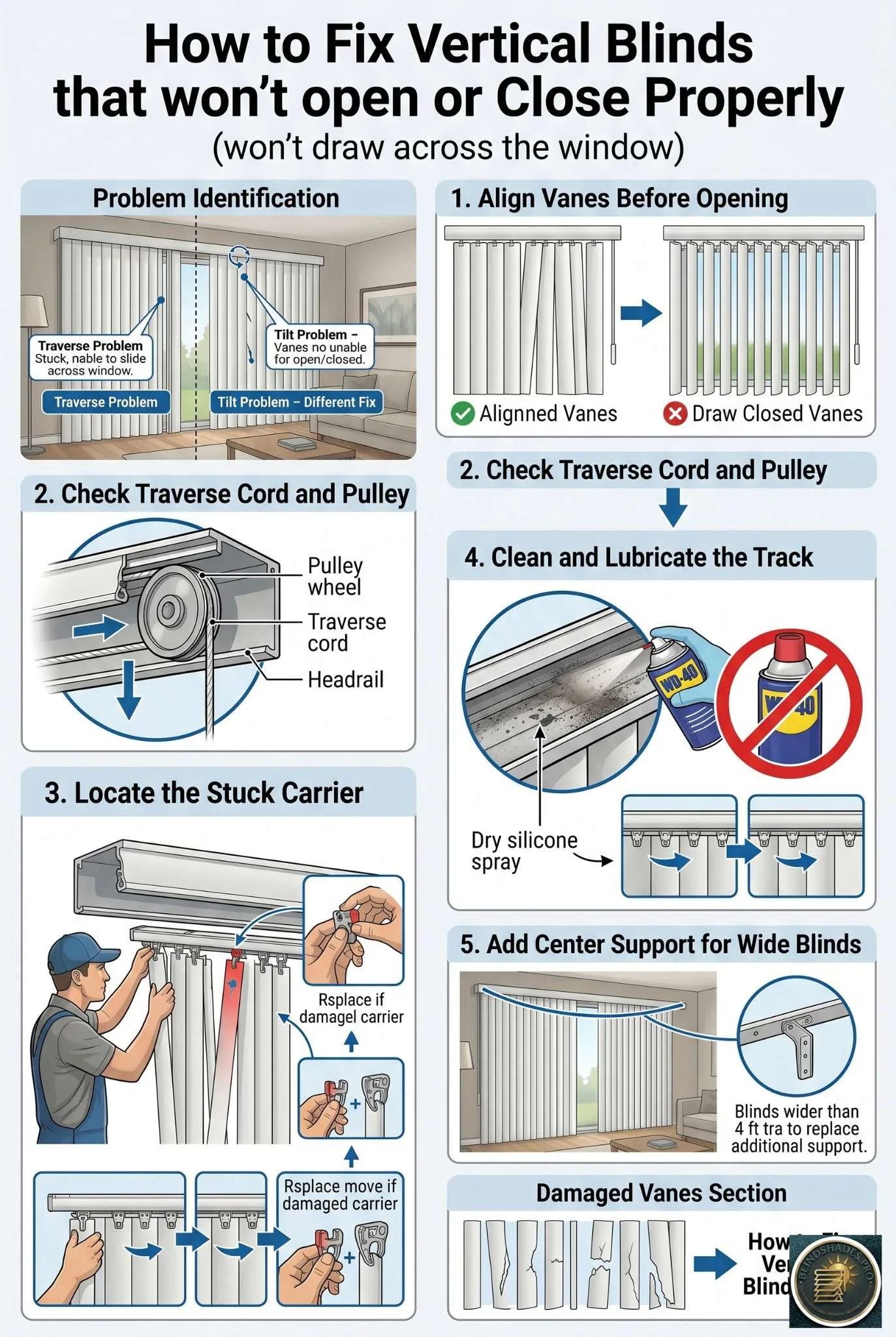
Authored by Michael Turner — 30 Years of Home Improvement Expertise | BlindShades.pro
If your vertical blinds won’t open or close, first work out whether they won’t draw across the window (traverse) or won’t rotate the vanes (tilt), because they are different repairs. For a blind that won’t slide across, the usual causes are a stuck or cracked carrier in the headrail track, a traverse cord that has slipped off its pulley wheel or frayed, a broken spacer chain, or a dirty track. Most fixes take a few minutes and no special tools: open and align the vanes first, find the one jammed carrier and free it, check the cord is on its wheel, and lubricate the track with dry silicone, never WD-40. This guide walks through each cause in order.
Key Takeaways
- “Open or close” means two different things on a vertical blind, and the fix depends on which. It can mean draw the vanes across the window (traverse) or rotate the vanes flat and closed (tilt). This guide covers a blind that won’t draw across; if yours won’t rotate, that is a separate repair.
- Always rotate the vanes to the open position before drawing the blind. Trying to traverse a blind with the vanes closed crushes and crosses them and stresses every carrier, and it is the single most common reason a vertical blind jams. Doing this first is both the fix and the prevention.
- One stuck carrier usually jams the whole blind. Each vane hangs from a carrier that rides in the headrail track, and a single cracked or derailed carrier stops the train. The repair is to find that one carrier and free or replace it, which takes minutes.
- Before assuming the worst, check the cord on its pulley wheel. A very common cause of a blind that won’t pull at all is the traverse cord slipping off the small wheel at the end of the headrail, which you can often pop back on by hand or with a blunt screwdriver, no parts needed.
- Use dry silicone spray on the track, never WD-40 or oil. WD-40 attracts dust and gums up the carriers over time. Dry silicone or PTFE spray lubricates without the build-up.
⭐ Quick Answer
If your vertical blinds won’t open or close, first work out whether they won’t slide across (traverse) or won’t rotate the vanes (tilt) — they are different repairs.
- Identify the problem: won’t slide across = traverse (this guide); won’t rotate the vanes flat = tilt, see vertical blinds won’t turn.
- Open and align the vanes first. Drawing a blind with closed vanes crosses them and jams the carriers — it is the top cause, as Blindsgalore notes, and the easiest prevention.
- Check the cord on its pulley wheel. If it won’t pull at all, the traverse cord has often slipped off the small wheel in the headrail end — pop it back on, no parts needed.
- Find the stuck carrier: remove a few vanes, slide each carrier by hand, and free or replace the one that won’t move — and clear any track obstruction, which Angi flags as a common culprit. If vanes are torn or falling, see how to fix vertical blind vanes.
- Clean and lubricate the track with dry silicone, never WD-40, which Fix My Blinds warns gums up the carriers. Wide blinds over 4 feet need a center support bracket. Choosing a replacement? See our best vertical blinds guide.
“Open or Close” Means Two Things — Which Is Yours?
Decide first whether the blind won’t draw across the window or won’t rotate the vanes, because they are different repairs.
This is the step that saves you an afternoon, and almost no repair guide makes it clearly. On a vertical blind, “open and close” can describe two completely separate actions:
- Traverse — drawing the whole set of vanes across the window or door, gathering them into a stack to one side. This is what this guide fixes.
- Tilt — rotating the vanes on their axis from flat-open to closed for light and privacy, without moving them across.
If your blind won’t slide across the track, you have a traverse problem, and the causes are carriers, cords, the spacer chain, or the track, all covered below. If the blind slides fine but the vanes won’t rotate to open or close the view, that is a tilt-mechanism problem, a different repair covered in vertical blinds won’t turn. Confirm which one you have before going further.
Traverse Triage: What’s Actually Wrong?
Match the symptom to the cause before you start, so you fix the right thing.
Use this quick triage to point yourself at the right fix:
| Symptom | Most likely cause | Go to |
|---|---|---|
| Cord won’t pull at all | Cord off the pulley wheel, or seized carrier | Fix 2, Fix 3 |
| Sticks at one spot along the track | One cracked or derailed carrier | Fix 3 |
| Only some vanes move, others bunch | Broken or disconnected spacer chain | Fix 4 |
| Whole blind stiff and dragging | Dirty track, or worn cord | Fix 5, Fix 4 |
| Sticks near the floor only | Vanes dragging on carpet or sill | Fix 6 |
| Headrail sagging in the middle | Loose or missing center bracket | Fix 6 |
| Vanes crossed and tangled | Drawn while closed | Fix 1 |
Start with the matching fix below. In most cases the problem is a single carrier or a cord off its wheel, both quick to put right.
Fix 1: Open and Align the Vanes First
Rotate the vanes flat-open before you draw the blind — it is both the most common fix and the prevention.
Before touching the headrail, rotate the vanes to their fully open (flat) position using the wand or chain, then try to draw the blind. Drawing a vertical blind while the vanes are closed forces them to overlap, cross, and bunch, which jams the carriers and can tear vanes. As repair specialists like Best Custom Screens note, this commonly happens when someone leaves a patio door open and the breeze pushes closed vanes out of line, or when someone walks through closed vanes.
If the vanes are already crossed or tangled, rotate them all to the same open position and gently straighten any that are out of line, seating each back into the same plane as its neighbours. This alone fixes a surprising number of “stuck” blinds. To prevent it returning, make a habit of always opening the vanes before drawing the blind, and never walking through or forcing closed vanes.
Fix 2: Check the Cord on the Pulley Wheel
If the cord won’t pull at all, it has often just slipped off the small wheel at the end of the headrail — pop it back on.
When the traverse cord feels completely dead and won’t pull, do not assume the mechanism is broken. A very common and easily missed cause is the cord slipping off the small pulley wheel inside the headrail end cap, which happens if the cord was yanked hard or the headrail was knocked loose. Homeowners regularly discover this is the entire problem after fearing an expensive repair.
To check it, take the blind down or open the control-end cap, and look at where the cord enters the headrail. If the cord has come off its wheel, you can usually loop it back over the wheel by hand, or ease it back on with a blunt screwdriver or similar tool. Reseat it, test the pull, and the blind often works perfectly again, with no parts needed. If the cord is on its wheel but still won’t pull, move to the carrier check.
Fix 3: Find and Free the Stuck Carrier
Isolate the one carrier that won’t move, then free it or swap it out.
A single jammed carrier stops the whole train, and the reliable fix is to find it. Work through this:
- Expose the track. Remove a few vanes from their clips near where the blind sticks, giving you a clear view of the carriers in the headrail track. To remove a vane, slide a credit card or similar into the clip and ease the vane out.
- Slide each carrier by hand. Move along the track, sliding each carrier individually. You are looking for one that won’t move, drags, grinds, or visibly tilts or wobbles.
- Identify the fault. A cracked carrier shows a clean fracture line and sits crooked. A carrier that has jumped the track is intact but out of its channel.
- Free a derailed carrier. If it has jumped the track rather than broken, squeeze it slightly to compress its wheel, align it with the channel, and push until it clicks back in.
- Replace a cracked carrier. If it is fractured, remove it and fit a replacement carrier of the same type, then slide it to its position and reattach the vane.
- Test the full travel. Operate the blind slowly end to end, listening for any remaining drag, and space the carriers evenly if they have bunched.
This carrier isolation method resolves the majority of vertical blinds that stick at one spot. If a vane keeps falling off the carrier rather than the carrier jamming, the clip or vane is the issue, covered in how to fix vertical blind vanes.
Fix 4: Worn Traverse Cord or Broken Spacer Chain
If only some vanes move, suspect the spacer chain; if the pull is stiff or fraying, replace the cord.
Two related parts cause traverse trouble. The spacer chain is the set of plastic links that connects the carriers and keeps them evenly spaced; if it disconnects or breaks, only some vanes move while others bunch together. You can often reconnect a popped link, or replace the chain, which is sold by length, with a useful marker being roughly two clips per vane.
The traverse cord itself wears with use. Follow the full cord path and inspect for fraying, especially where it passes through the headrail end. A frayed or stiff cord should be replaced before it snaps; restringing runs the new cord along the exact path of the old one through the pulleys and carriers. Restringing a vertical headrail is fiddly, and many people choose to have it done professionally, but it is doable for a confident DIYer with the blind laid flat off the wall.
Fix 5: Clean and Lubricate the Track
A dirty track makes everything drag — clean it, then use dry silicone spray, never WD-40.
Vertical blinds, especially those over patio doors near a heater vent, collect dust and grime inside the headrail that makes the carriers drag. Take the blind down or open the headrail, clean the inside of the track with a dry or barely damp cloth, and clear any debris or insects from the channel.
Then lubricate, and this is where guidance conflicts and matters: some sources suggest WD-40, but specialists like Fix My Blinds are explicit that you should not use WD-40 on a vertical blind headrail, because it attracts dust and gums up the mechanism over time. Use a dry silicone or PTFE spray instead, applied lightly to the inside edges of the track, then work the blind back and forth to spread it. This frees a stiff, dragging blind without the sticky build-up.
Fix 6: Carpet Drag and Bracket Sag
If it only sticks near the floor, the vanes are catching on carpet; if the headrail sags, add a center bracket.
Two mounting-related causes are easy to miss. If the blind draws fine until it nears the floor and then drags, the bottoms of the vanes are catching on carpet pile or a protruding sill. The fix is to remount the blind slightly higher, or have the vanes trimmed to clear the floor, as Fix My Blinds recommends.
If the headrail sags or pulls away from the wall in the middle, the carriers bind and the blind won’t draw smoothly. Wide blinds need more support than the two end brackets: blinds over about 4 feet wide require a center bracket, with an additional bracket roughly every 3 to 4 feet. Add a center support at the midpoint, check every bracket screw is tight, and use larger screws or wall anchors if any holes have stripped.
Should You Repair or Replace?
Repair a sound blind with cheap parts; replace or switch styles if parts are discontinued or failures keep piling up.
Most traverse problems are worth repairing, because carriers, spacer chains, and cords are inexpensive and the labour is minutes. The honest exception is age: if the blind is old, the headrail or brand is discontinued, and you can’t source matching carriers, or if repairs keep recurring across a worn-out mechanism, replacing the blind is the smarter move. At that point it is also worth considering whether a different treatment suits the window better, such as a panel track or vertical cellular shade, which are covered in alternatives to vertical blinds. For a sound blind, though, the fixes above will keep it running for years.
Make It Child-Safe While You’re There
A jammed blind is a good moment to address the cord hazard.
Vertical blind traverse cords and continuous chains are a recognized strangulation hazard for children, addressed by the ANSI/WCMA A100.1 standard. While you have the blind apart, keep cords and chains tensioned and out of reach with a cleat or tension device, and if the blind is in a child’s room or a busy family space, consider upgrading to a cordless or motorized vertical, which removes the hazard entirely. The motorized and cordless options are covered in our best vertical blinds guide.
Best Sources
- Fix My Blinds — on using dry silicone (not WD-40) in the headrail, carpet-pile drag, self-correcting carrier brands, and bracket spacing.
- Blindsgalore — on isolating and replacing carriers, restringing the traverse cord, and center-support requirements for wide blinds.
- Angi — on track obstructions, master-gear faults, and lubricating the carrier body.
- Home Fair Blinds — on the carrier isolation method for a seized blind and reseating a derailed carrier.
- Best Custom Screens — on crossed and tangled vanes caused by drawing the blind while closed or leaving a patio door open.
Related Guides
- Best Vertical Blinds Buying Guide
- Vertical Blinds Won’t Turn
- How to Fix Vertical Blind Vanes
- How to Clean Vertical Blinds
Frequently Asked Questions
Why won’t my vertical blinds slide open or closed?
The most common reasons a vertical blind won’t draw across are a single stuck or cracked carrier in the headrail track, a traverse cord that has slipped off its pulley wheel or frayed, a broken spacer chain, or a dirty track. Start by rotating the vanes fully open before drawing the blind, since drawing closed vanes is the top cause of a jam, then check the cord and find the stuck carrier.
My vertical blind won’t pull at all — what do I check first?
Check the traverse cord on its pulley wheel. A very common cause of a completely dead pull is the cord slipping off the small wheel inside the headrail end cap. Open the control-end cap, look at where the cord enters the headrail, and if it has come off the wheel, loop it back on by hand or with a blunt screwdriver. This often fixes the blind with no parts needed.
Can I use WD-40 to fix a sticking vertical blind?
No. Avoid WD-40 on a vertical blind headrail, because it attracts dust and gums up the carriers over time. Clean the track first, then use a dry silicone or PTFE spray applied lightly to the inside edges of the track, and work the blind back and forth to spread it. This frees a sticking blind without the sticky build-up that oil-based sprays leave.
Why do only some of my vertical blind vanes move when I pull the cord?
When only some vanes move and others bunch together, the spacer chain that connects the carriers and keeps them evenly spaced has likely disconnected or broken. Open the headrail and check the chain of plastic links between the carriers. You can often reconnect a popped link, or replace the chain, which is sold by length at roughly two clips per vane.
Should I repair or replace vertical blinds that won’t open?
Repair if the blind is otherwise sound, since carriers, spacer chains, and cords are inexpensive and the fixes take minutes. Replace if the headrail or brand is discontinued and you can’t source matching parts, or if failures keep recurring across a worn-out mechanism. At that point, consider whether a panel track or vertical cellular shade suits the window better.
