How to Fix Vertical Blind Vanes That Keep Falling, Tearing, or Breaking.

Authored By Michael Turner -30 Years Home Improvement Expertise | Updated 2026 | BlindShades.pro
Updated on June 23, 2026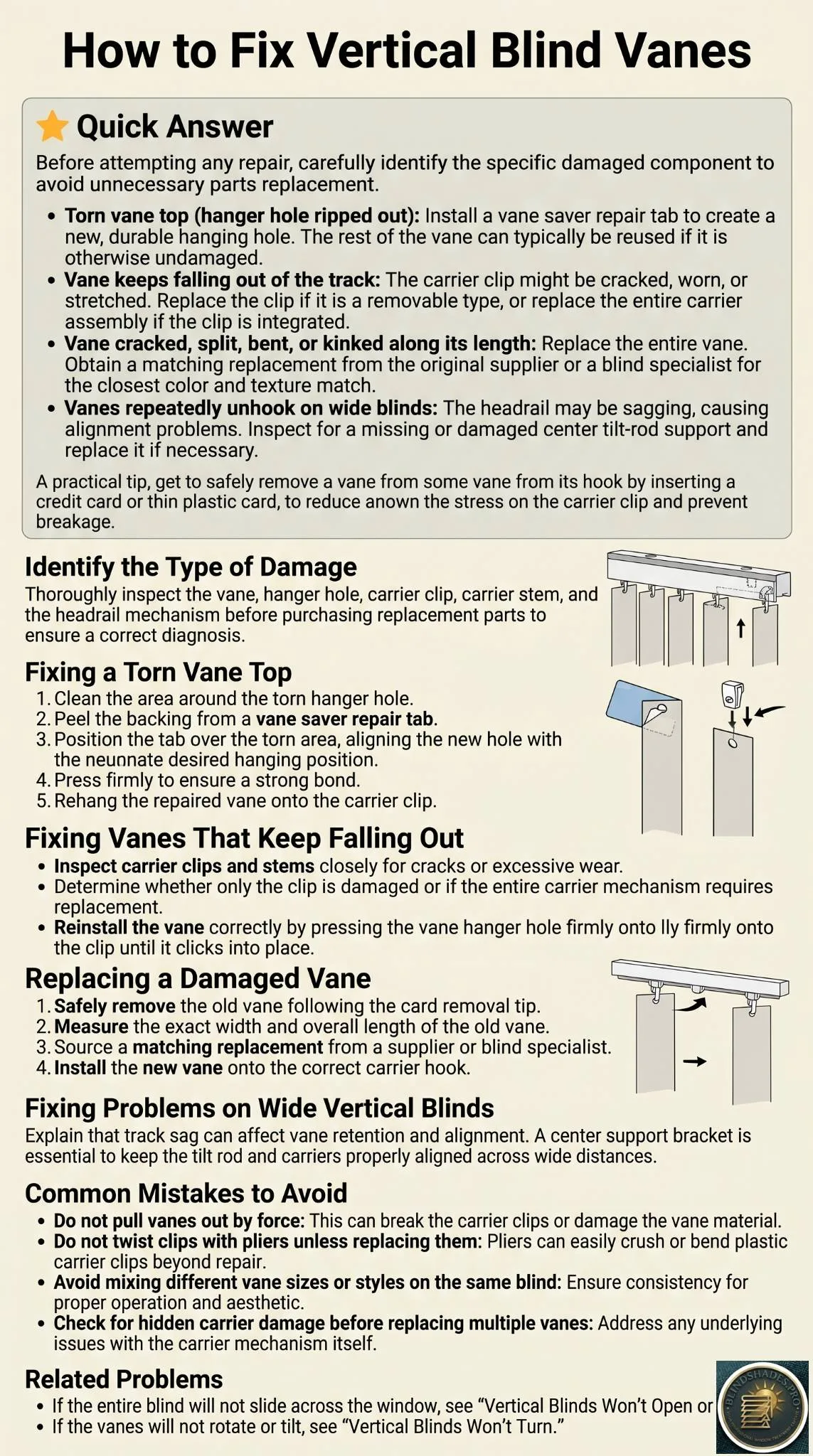
Authored by Michael Turner — 30 Years of Home Improvement Expertise | BlindShades.pro
To fix vertical blind vanes, first work out which of three parts has actually failed: the vane itself, the clip that holds it, or the carrier the clip sits in. A vane that has torn at the top is repaired in minutes with a cheap vane saver, no new vane needed. A vane that keeps falling out usually means a cracked or stretched carrier clip, which you replace if it is removable or swap the whole carrier if it is not. A vane that is cracked or kinked down its body needs replacing. Most of these are inexpensive, tool-light DIY repairs once you have correctly identified the broken part. This guide diagnoses all three and walks each fix step by step.
Key Takeaways
- Identify which part failed before buying anything. Vane top torn, clip broken, or vane body cracked are three different repairs with three different parts. Replacing a vane when the clip is the problem wastes money and fixes nothing.
- A torn vane top is the cheapest fix of all. If the hole at the top of an otherwise-good vane has ripped out, a vane saver, a small adhesive or snap-on tab costing a few dollars, restores the hanging hole without a new vane. It only works if the vane body itself is still sound.
- Whether the clip is removable decides the job. Some carrier clips snap out and replace on their own; on other systems the clip is molded into the carrier, so the entire carrier must be replaced. Check which you have first, because it changes the part and the difficulty.
- Use a credit card to release the vane, not force. Slide a credit-card-sized piece of rigid plastic between the vane and the long prong of the hook to open it. Forcing a vane out is the fastest way to crack the very clip you are trying to keep.
- Three or more failures usually means replace, not repair. A single torn vane or one broken clip is worth fixing. Once you are past three broken vanes or clips, a warped headrail, or parts you cannot source, a new blind costs about the same and comes with matching vanes and a warranty.
⭐ Quick Answer
Knowing how to fix vertical blind vanes starts with one question: which part broke — the vane, the clip, or the carrier? The fix is different for each.
- Torn vane top: if the hanging hole has ripped out but the vane is sound, fit a vane saver, a few-dollar tab that rebuilds the hole, as Fix My Blinds recommends. No new vane needed.
- Vane keeps falling out: the carrier clip is cracked. Replace just the clip if it pops out, or the whole carrier if the clip is molded in.
- Vane cracked down the body: replace it. Slide a credit card between the vane and the hook to release it without cracking the clip, a technique Hunter Douglas advises.
- Mind the color match: new vanes rarely match sun-faded old ones, so Blindsgalore suggests ordering from your original dealer. If the whole blind won’t slide, see vertical blinds won’t open or close.
- Three or more broken? Repairs stop paying off — consider a new set in our best vertical blinds guide, or if vanes won’t rotate, see vertical blinds won’t turn.
What Broke — the Vane, the Clip, or the Carrier?
Three parts can fail, and the repair is completely different for each, so diagnose before you buy.
Almost every “my vanes are broken” problem is really one of three distinct failures. Look closely at a problem vane and match it here, then jump to the matching fix:
| What broke | What you see | The fix | Section |
|---|---|---|---|
| Vane top (hanging hole) | Vane has slipped off; the hole or slot at the top is torn or elongated, but the vane is otherwise fine | Vane saver tab | Fix A |
| Carrier clip | Vane will not stay hooked or hangs crooked; the plastic clip is cracked, stretched, or snapped | Replace clip or carrier | Fix B |
| Vane body | Vane is cracked, kinked, creased, or badly faded | Replace the vane | Fix C |
This single check is what most repair guides skip, and it is why people buy the wrong part. A torn top does not need a new vane; a falling vane does not need a vane saver. Identify the failure, then fix it.
Fix A: Repair a Torn Vane Top With a Vane Saver
The cheapest repair there is — a small tab that rebuilds the hanging hole on an otherwise-good vane.
When a vane drops because the hole at its top has torn out, but the vane itself is still in good shape, you do not need to replace it. A vane saver (also sold as a vane mender, slat saver, or vane tab) is a small plastic or metal piece that attaches to the top of the vane and provides a fresh hole to hang from, as repair specialists at Fix My Blinds and Just Blinds ‘n Curtains both recommend. They cost a few dollars for a pack and are one of the most cost-effective blind repairs available.
It is important to know when a vane saver is the right tool:
| Situation | Vane saver works? |
|---|---|
| Top hanging hole torn, vane body sound | Yes, ideal use |
| Hole stretched and vane slips off | Yes |
| Vane cracked or split down the body | No, replace the vane |
| Vane heavily faded or discolored | No, replace for appearance |
| Fabric vane with a worn fabric hanger | Use a replacement fabric hanger instead |
To repair a vane with a vane saver:
- Remove the damaged vane from its clip (use the credit-card method in Fix C to avoid cracking the clip).
- Trim any jagged edges at the torn top square with sharp scissors so the saver sits flat.
- Fit the vane saver over the trimmed top, either peeling the adhesive backing and pressing firmly, or snapping the tab on, depending on the type. Metal savers are the most durable; plastic ones are cheaper and easier to fit.
- Rehang the vane by hooking the saver’s new hole onto the carrier clip and pushing up until it seats.
- Test by operating the blind to confirm the repaired vane hangs straight and level with its neighbours.
Fix B: Replace a Broken Carrier Clip
If vanes keep falling, the clip is the culprit — and whether it is removable decides the whole job.
When a vane will not stay hooked, the carrier clip (also called the carrier hook, hanger, or vane clip) that grips the top of the vane has cracked, stretched, or snapped, usually from years of sun exposure making the plastic brittle. The first thing to determine is which kind you have, because it changes the repair entirely:
| Clip type | How to tell | Repair |
|---|---|---|
| Removable clip | The clip is a separate piece that snaps into the carrier and can be pried out on its own | Replace just the clip, an easy, inexpensive swap |
| Integral clip (part of the carrier) | The hook is molded into the carrier body and will not separate | Replace the entire carrier, a trickier job |
For a removable clip: gently slide the vane out of the damaged clip, carefully pry the broken clip off the carrier or headrail track, snap the new clip into place until it locks securely, and reinsert the vane by sliding its top into the clip until it clicks. For an integral carrier: you will need to remove the end stop or end cap, slide the broken carrier out of the track, slide a matching replacement carrier in, index it to the same orientation as the working vanes (see vertical blinds won’t turn for the indexing step), and rehang the vane. If several clips are integral and broken, this is the point where replacing the headrail often makes more sense.
Fix C: Replace a Cracked or Broken Vane
When the vane body itself is damaged, swap it — gently, and with an eye on color match.
If a vane is cracked, kinked, creased, or snapped down its body, it needs replacing. The job is straightforward, but two details matter: releasing the vane without breaking the clip, and matching the replacement.
To replace a vertical blind vane:
- Unthread the bottom chain if your blind has one. Many fabric vanes have a small chain or cord linking the vane bottoms; unclip it from the damaged vane and any vanes between it and the end of the row. If there is no chain, skip this step.
- Open the vane hook with a credit card. Slide a credit-card-sized piece of rigid plastic between the vane and the long prong of the carrier hook to ease it open, as Hunter Douglas advises. This releases the vane without cracking the clip.
- Slide the old vane out by pushing it gently upward and out of the clip. Never force it.
- Hook the new vane in. Insert the top of the replacement vane into the clip and push up until it clicks or seats securely.
- Rethread the bottom chain through the new vane and reconnect it to its neighbours.
- Test by opening and closing the blind a few times to confirm the new vane hangs straight and moves with the rest.
A quick honesty note on color: new vanes rarely match sun-faded old ones exactly, so a single replacement can stand out, as Blindsgalore points out. For the closest match, order from your original dealer using your order details; alternatively, move a faded but intact vane to a less visible position and put the new vane where the mismatch shows least, or replace a whole window’s worth at once.
What Is the Chain at the Bottom of the Vanes?
It links the vane bottoms so they swing together — but it is optional, and only fabric vanes have it.
People often panic when the little chain at the bottom of their vanes breaks, but it is less critical than it looks. As Fix My Blinds explains, some vertical blinds with fabric vanes have a chain-and-clip system connecting the vane bottoms, which creates a “sail effect” so all the vanes move together rather than a few swinging independently. It is not a required component and does not affect the blind’s core operation, and plastic, vinyl, and PVC vanes do not use it at all. If yours has broken or gone missing, you can re-thread a replacement length or simply leave it off; the blind will still work.
How Do You Fix Broken Valance Clips?
The valance is held by its own brittle clips, which are a separate, often-overlooked repair.
A complete vane repair often runs into the valance, the decorative top rail that hides the headrail, because its clips become brittle and snap too. Valance clips are a distinct part from carrier clips. To replace them, identify whether you have a flat valance needing an L-shaped clip or one needing a dust-cover clip, then measure the width of the top rail where the clip snaps around so you order the right size. Note that pairing an old valance with a new headrail is often difficult, since the old clips usually will not fit a new rail. Sources like Reslat.com and Fix My Blinds stock valance clips by type and size.
Why Do Vanes Keep Falling on Wide Blinds?
On wide tracks, a sagging headrail tilts vanes unevenly and pops them off — the cure is a center support.
If vanes keep falling specifically on a wide blind, the cause may not be the clips at all but a sagging track. Hunter Douglas notes that on wide vertical blinds, for example a Paramount headrail wider than 70 inches, the track can bow or flex in the middle without enough support, which prevents the vanes from tilting evenly and lets them work loose. The fix is to add a tilt-rod support (also called a swing-arm support) at the center of the track, which reinforces the middle so the tilt mechanism operates smoothly across the full width. This is the same family of problem as the bracket sag covered in vertical blinds won’t open or close.
Where Do You Get Replacement Parts?
Match the part to its name, then source it — and check if your manufacturer sends it free.
Half the battle is knowing what the part is called and where to find it. Here is a sourcing map:
| Part | What it does | Where to get it |
|---|---|---|
| Carrier clip / hook | Holds the vane top to the carrier | Fix My Blinds, blindparts.com, Amazon |
| Vane saver / tab | Rebuilds a torn hanging hole | Fix My Blinds, Amazon, blind-parts retailers |
| Replacement vane / slat | The louvre itself | Original dealer (best color match), Reslat.com, Blinds.com |
| Fabric vane hanger | Top insert for fabric vanes | Manufacturer or blind-parts retailer |
| Valance clip | Holds the top valance | Reslat.com, Fix My Blinds |
| Carrier / stem / gear | The truck the clip rides in | Manufacturer, blindparts.com |
Two tips that save money. First, if you bought from a major brand such as Bali or Hunter Douglas, contact them: many will send replacement clips or vanes free to the original purchaser. Second, if your blind is unbranded and you cannot identify a part, lay the broken piece on a sheet of plain cardboard, photograph it close up with something for scale, and use an image search or send it to a parts retailer to match.
Should You Repair or Replace?
One broken vane is a repair; stacked failures tip the math toward a new blind.
Use this gut check to decide honestly:
| Situation | Verdict |
|---|---|
| One or two torn or broken vanes, blind otherwise sound | Repair |
| A single cracked clip on a working carrier | Repair |
| Three or more broken vanes or clips | Lean replace |
| Warped or sagging headrail, or stripped master gear | Lean replace |
| Parts discontinued or unsourceable | Replace |
| Already repaired this blind twice this year | Replace |
| Vanes are narrow, flimsy, and dated | Replace and upgrade |
Once you cross into the replace column, the cost of parts plus the hours spent hunting and fitting them often meets or beats the price of a new custom set that comes with matching vanes, fresh hardware, and a warranty. At that point it is also worth weighing a different style, such as panel track or vertical cellular, covered in alternatives to vertical blinds, or choosing a sturdier new set in our best vertical blinds guide.
How to Prevent Vane Damage
Most vane failures trace back to a few habits — change them and repairs become rare.
Vanes and clips fail faster than they should for avoidable reasons. Always tilt the vanes fully open before drawing the blind across, since traversing closed vanes crosses and stresses them. Open the vanes before opening a patio door, and if the door stays open in a breeze, leave the vanes open too, so wind does not bend them against their clips. Keep vanes clean, because sun-baked dust embrittles plastic and clips over time; see how to clean vertical blinds. And never force a stuck vane or a seized control. These small habits dramatically extend how long vanes and clips last.
Best Sources
- Fix My Blinds — on vane savers, repairing torn vane tops, removable versus integral carrier clips, the optional bottom chain, and valance clips.
- Blindsgalore — on checking the clips first, the color-match reality of replacement vanes, and the three-or-more-failures replace threshold.
- Hunter Douglas — on the credit-card method for releasing vanes, vane reinforcement clips, and tilt-rod supports for wide Paramount tracks.
- Factory Direct Blinds — on reseating detached slats and replacing valance and carrier clips step by step.
- DIY Chatroom community — on sourcing carrier hooks, free manufacturer parts for original purchasers, and image-matching an unbranded part.
Related Guides
- Best Vertical Blinds Buying Guide
- Vertical Blinds Won’t Open or Close
- Vertical Blinds Won’t Turn
- How to Clean Vertical Blinds
- Alternatives to Vertical Blinds
Frequently Asked Questions
How do I fix vertical blind vanes that keep falling out?
Vanes that keep falling out almost always mean the carrier clip holding the vane has cracked or stretched. Check whether the clip is removable, in which case you pry out the old clip and snap in a new one, or molded into the carrier, in which case you replace the whole carrier. If instead the vane’s own hanging hole has torn, fit a vane saver tab rather than replacing anything. On wide blinds, a sagging track may also be working vanes loose.
What is a vane saver and when should I use one?
A vane saver is a small plastic or metal tab that attaches to the top of a vertical blind vane and rebuilds the hanging hole when the original has torn out. Use it when the vane body is still sound but the top hole has ripped or stretched, which is its ideal job and costs only a few dollars. Do not use one if the vane is cracked or split down its body or badly faded; in those cases, replace the vane instead.
How do I remove a vertical blind vane without breaking the clip?
Slide a credit-card-sized piece of rigid plastic between the vane and the long prong of the carrier hook to gently ease the hook open, then push the vane up and out. This releases the vane without stressing the clip. Forcing a vane out by pulling hard is the most common way people crack the very clip they are trying to keep, so always open the hook first.
Will new vertical blind vanes match my old ones?
Often not exactly. Sun exposure fades the original vanes over time, so brand-new replacements can look noticeably brighter against the rest. For the closest match, order replacements from your original dealer using your order details. Alternatively, move an intact faded vane to a less visible spot and place the new one where any mismatch is least obvious, or replace a full window’s worth of vanes at once for uniform color.
Is it worth repairing vertical blinds or should I replace them?
Repair if you have just one or two broken vanes or a single cracked clip on an otherwise sound blind, since the parts are inexpensive. Replace if you have three or more broken vanes or clips, a warped or sagging headrail, a stripped gear, or parts you cannot source, because the repair cost and effort then approach the price of a new set that comes with matching vanes and a warranty. A new blind is also the moment to consider a more modern style.
