Alternatives to Vertical Blinds for Doors and Wide Windows

Authored By Michael Turner -30 Years Home Improvement Expertise | Updated 2026 | BlindShades.pro
Updated on June 24, 2026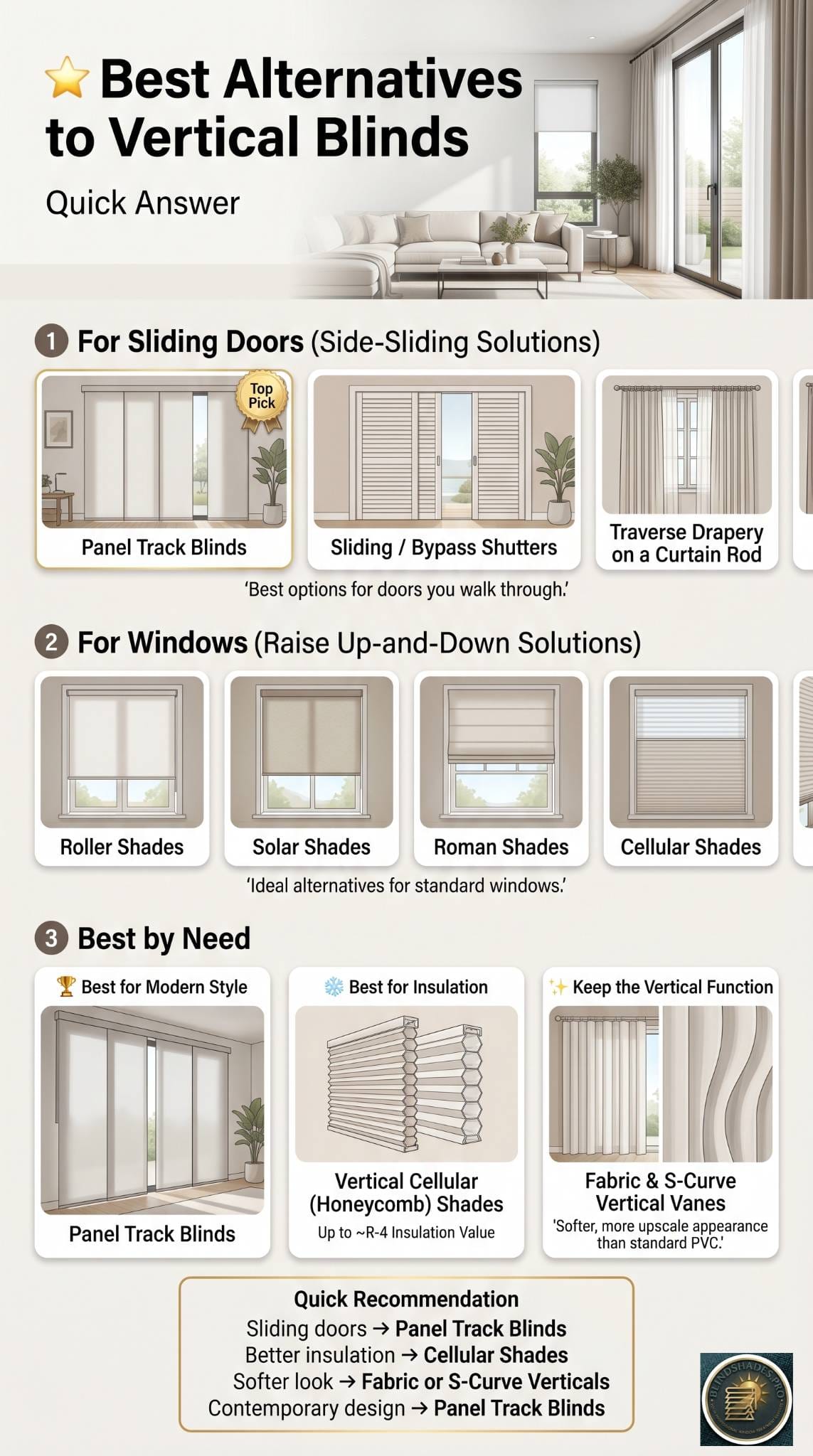
Authored by Michael Turner — 30 Years of Home Improvement Expertise | BlindShades.pro
The best alternatives to vertical blinds depend on whether you are covering a door or a window, because the first thing to settle is how the treatment opens. For a door you walk through, choose something that slides side-to-side like the door does: panel track blinds, sliding shutters, or traverse drapery. For a window, you can also use treatments that raise up-and-down, such as roller, Roman, or cellular shades. Panel track is the most popular modern swap, vertical cellular shades are the best for insulation, and if you like how vertical blinds work but dislike the plastic look, fabric or S-curve vanes keep the function with a softer style. This guide compares every alternative, with honest downsides and a priority-based way to choose.
Key Takeaways
- For a door, operation direction matters most. Treatments that slide side-to-side, like panel track, sliding shutters, and traverse drapery, clear a doorway easily, while roller, Roman, and horizontal cellular shades must be raised fully every time you walk through.
- Panel track is the top modern replacement. Wide fabric panels glide on a track for a clean, contemporary look with no vanes to break, which is why it is the most recommended swap for sliding doors and wide windows.
- Vertical cellular shades are the energy choice. Their honeycomb structure insulates a big glass door, with R-values up to about 4, cutting heat loss in winter and gain in summer.
- You do not have to abandon verticals entirely. If you like the tilt-and-slide function but dislike rigid plastic, fabric or S-curve vertical vanes give the same control with a soft, drapery-like, quieter finish.
- Alternatives are not automatically better. Some cost more, install less easily, or are less durable than budget vertical blinds, so weigh each option’s downside against what you actually need.
⭐ Quick Answer
The best alternatives to vertical blinds depend on one thing first: whether you are covering a door or a window, because that decides how the treatment should open.
- For a door you walk through, choose a side-sliding treatment: panel track blinds (the top modern pick), sliding shutters, or traverse drapery, as Blinds.com recommends for doors.
- For a window, you can also use up-raising shades: roller or solar, Roman, or cellular. On a door, use the two-shades-on-one-headrail trick instead.
- Best for modern style: panel track blinds — see vertical blinds vs panel track blinds. Best for insulation: vertical cellular (honeycomb) shades, up to about R-4, a top pick at Blindsgalore.
- Keep the vertical function, lose the plastic look: switch to soft fabric or S-curve vanes — see fabric vs PVC vertical blinds.
- Be aware: many alternatives cost more or install less easily than budget vertical blinds, as Stoneside notes — name your top priority first. For doors, see best vertical blinds for sliding doors.
Why Replace Vertical Blinds, and When to Keep Them
Common reasons people switch, and the honest case for staying.
People move away from vertical blinds for a handful of recurring reasons: the look can feel dated or office-like, the slats clatter in a breeze, the vanes and carriers break, and they offer little insulation while leaking light at the slat edges. Those are real frustrations. But it is worth being honest that vertical blinds also remain the cheapest option, slide and tilt for genuinely flexible light control, and clear a doorway in a single pull, and modern fabric and S-curve versions fix much of the dated look and noise. So before replacing them, decide whether you want a different treatment entirely or simply a better vertical blind. If the dated reputation is your main worry, see are vertical blinds outdated.
The First Question: Side-to-Side or Up-and-Down?
On a door, how the treatment opens matters more than how it looks.
The single most important factor for a door is operation direction, and it is the one most guides skip. Treatments that open side-to-side, the way the door itself slides, let you clear the opening quickly and partially, which is essential for a patio door you use many times a day. Treatments that raise up-and-down must be lifted all the way up every single time you walk through, which becomes a daily annoyance. Group the options this way first:
| Operation | Treatments | Door-friendly? |
|---|---|---|
| Side-to-side | Panel track, sliding/bypass shutters, traverse drapery, vertical cellular | Yes, ideal for doors |
| Up-and-down | Roller, solar, Roman, horizontal cellular shades | Better for windows |
For a window, either direction works. For a frequently used door, strongly favor a side-sliding treatment, or use the two-shades trick described later.
Alternatives to Vertical Blinds Compared
Every option side by side.
| Alternative | Operation | Insulation | Light control | Style | Best for |
|---|---|---|---|---|---|
| Panel track blinds | Side slide | Low to medium | Open or closed, by fabric | Modern, sleek | Wide doors, modern rooms, room dividers |
| Vertical cellular | Side slide | High (to R-4) | Light-filter to blackout | Soft, modern | Energy efficiency, big glass |
| Roller / solar shades | Up raise | Medium | Sheer to blackout | Minimal, clean | Windows, view, UV control |
| Roman shades | Up raise | Medium | Fabric-dependent | Elegant, classic | Decorative windows |
| Drapery / sheers | Side draw (traverse) | Medium (lined) | Sheer to blackout | Warm, luxurious | Soft layered look |
| Plantation / sliding shutters | Side slide or fold | Medium to high | Adjustable louvers | Timeless, premium | Durability, resale value |
| Sheer vertical shades | Side slide and tilt | Low | Diffused, adjustable | Elegant, drapery-like | Soft style with vertical function |
| Fabric / S-curve vanes | Side slide and tilt | Low | Adjustable tilt | Soft, contemporary | Keeping vertical function |
| Bamboo / woven wood | Up raise or panel | Low | Filtered, textured | Natural, tropical | Organic look |
| Window film | None (fixed) | Low | Fixed tint or frost | Invisible | Glare and UV, no operation |
The Best Alternatives, One by One
A quick look at each, with its honest downside.
Panel track blinds are the most popular modern swap: wide fabric panels glide on a track for a clean, gallery-like look, with no vanes to break and quiet operation, and they double as a room divider. Downside: pricier than vertical blinds, and panels slide one at a time. The full head-to-head is in vertical blinds vs panel track blinds.
Vertical cellular (honeycomb) shades stack to one side like vertical blinds but add honeycomb insulation up to about R-4, the best energy choice for a big glass door. Downside: fabric can soil with pets and kids and is harder to clean than PVC.
Roller and solar shades have a slim profile and roll up completely for a clear view, in any opacity from sheer to blackout, with solar fabric blocking UV while keeping the view. Downside: they raise up-and-down, so on a door you must lift them fully to pass through.
Roman shades bring elegant fabric folds and gradual light control. Downside: they also raise up-and-down, the folds need occasional adjusting, and the stack covers the top of the opening.
Drapery and sheers add warmth and luxury, and on a traverse rod they draw side-to-side like a vertical blind while looking like curtains, with thermal or blackout lining for control. Downside: fabric can drag or pose a trip hazard at a door unless hung to just above the floor.
Plantation and sliding shutters offer a timeless, durable, premium look that can add resale value, with bypass or bifold styles that slide like the door. Downside: among the most expensive options and a bigger installation.
Sheer vertical shades set soft fabric vanes within sheer material, keeping the side-slide-and-tilt function of vertical blinds with a soft, drapery-like elegance. Downside: less room-darkening and a premium price.
Fabric or S-curve vertical vanes keep everything practical about vertical blinds, the side-slide and the adjustable tilt, but swap rigid plastic for soft fabric or curved S-vanes that look like drapery and do not clatter. Downside: fabric needs gentler cleaning than PVC. See fabric vs PVC vertical blinds.
Bamboo and woven wood add natural, tropical texture as roller blinds, sliding panels, or drapes, with cordless versions for doors. Downside: limited room-darkening unless lined, and natural materials vary.
Window film is the one-and-done option: a tinted or frosted film that cuts glare and UV with no operation at all. Downside: it is fixed, offering no adjustable light or privacy and no full blackout.
The Two-Shades Trick for Doors
How to make an up-raising shade work on a slider.
If you love roller or cellular shades but have a sliding door, there is a clever workaround: install two separate shades on one headrail, one covering the fixed glass panel and one covering the sliding door panel. You can leave the fixed-side shade down to block glare while raising only the door-side shade to step outside or let the dog out. It keeps the clean look of an up-raising shade without forcing you to lift the whole thing every time you use the door.
Don’t Want to Ditch Verticals Entirely?
If the function works but the look does not, upgrade the vanes, not the system.
Many people who search for alternatives actually like how vertical blinds work, the way they slide aside and tilt for precise light, and only dislike the cheap plastic appearance. If that is you, the simplest upgrade is to keep the vertical system and change the vanes: soft fabric vanes or curved S-curve vanes deliver the same tilt-and-slide control with a warm, high-end, drapery-like look and no clatter. It is often cheaper and easier than switching to an entirely different treatment, and it solves the two biggest complaints at once. To compare vane materials, see fabric vs PVC vertical blinds, and to choose a quality set, our best vertical blinds guide.
Which Alternative Fits Your Priority?
Decide what matters most, then pick.
| Your top priority | Best alternative |
|---|---|
| Modern look | Panel track blinds |
| Energy efficiency | Vertical cellular shades |
| Unobstructed view | Roller or solar shades |
| Warmth and luxury | Drapery or sheers |
| Durability and resale | Plantation shutters |
| Soft style, keep function | Sheer vertical or fabric vanes |
| Natural texture | Bamboo or woven wood |
| No operation needed | Window film |
| Lowest cost | Modern vertical blinds |
Start by naming your single most important goal, whether that is style, insulation, view, ease of use, or budget, and the right alternative usually becomes obvious. For a sliding door specifically, weigh these against the dedicated picks in best vertical blinds for sliding doors.
Best Sources
- Stoneside — on identifying your top priority first, vertical cellular shades for privacy and efficiency, Roman shade styles, and hanging drapery just above the floor at doors.
- Blindsgalore — on panel track advantages, no vanes to break, and vertical cellular shades up to R-4.
- Blinds.com — on side-sliding versus up-raising treatments for doors, the stack and ducking issue, and traverse curtain rods.
- LazBlinds — on traffic flow, the two-shades-on-one-headrail trick, and fabric and S-curve vanes that keep vertical function.
- Factory Direct Blinds — on honest downsides, that alternatives can be costlier, harder to install, or less durable, and on plantation shutters.
- Hunker — on window film and bamboo blinds as overlooked door options.
Related Guides
- Best Vertical Blinds Buying Guide
- Vertical Blinds vs Panel Track Blinds
- Best Vertical Blinds for Sliding Doors
- Fabric vs PVC Vertical Blinds
- Are Vertical Blinds Outdated?
Frequently Asked Questions
What is the best alternative to vertical blinds for a sliding glass door?
Panel track blinds are the most popular modern alternative to vertical blinds for a sliding glass door, because their wide fabric panels slide side-to-side like the door, look clean and contemporary, and have no vanes to break. For insulation on a big glass door, vertical cellular shades are the best choice. If you like how vertical blinds work but dislike the plastic look, fabric or S-curve vertical vanes keep the function with a softer style.
What can I use instead of vertical blinds that looks more modern?
For a modern look, panel track blinds are the top choice, with wide fabric panels that create a sleek, gallery-like wall of fabric. Vertical cellular shades and roller shades also give a clean, contemporary appearance, and sheer vertical shades offer a soft, drapery-like elegance. If you want to keep the practical tilt-and-slide of vertical blinds without the dated plastic, switch to soft fabric or S-curve vanes instead of replacing the whole system.
What is a good alternative to vertical blinds for insulation?
Vertical cellular, or honeycomb, shades are the best insulating alternative to vertical blinds. Their cell structure traps air in pockets to create an insulating barrier, with R-values up to about 4, which reduces heat loss in winter and heat gain in summer on large glass doors. Thermal drapery with an insulating liner is another energy-efficient option. Standard vertical blinds, by contrast, offer little insulation.
Are alternatives to vertical blinds more expensive?
Often, yes. Vertical blinds are one of the most budget-friendly window treatments, so many alternatives, including panel track, cellular shades, plantation shutters, and custom drapery, cost more, and some are harder to install or less durable. The trade-off is usually better style, insulation, or light control. If budget is the priority, a modern fabric or S-curve vertical blind upgrades the look at a lower cost than switching systems entirely.
Can I use roller or Roman shades on a sliding door?
You can, but they raise up-and-down rather than sliding aside, so you must lift them fully each time you walk through, which is inconvenient on a frequently used door. A practical workaround is to install two shades on one headrail, one over the fixed glass and one over the sliding panel, so you only raise the door side. For frequent access, though, a side-sliding treatment like panel track is usually easier.
