Panel Track Blinds vs Vertical Blinds

Authored By Michael Turner -30 Years Home Improvement Expertise | Updated 2026 | BlindShades.pro
Updated on June 29, 2026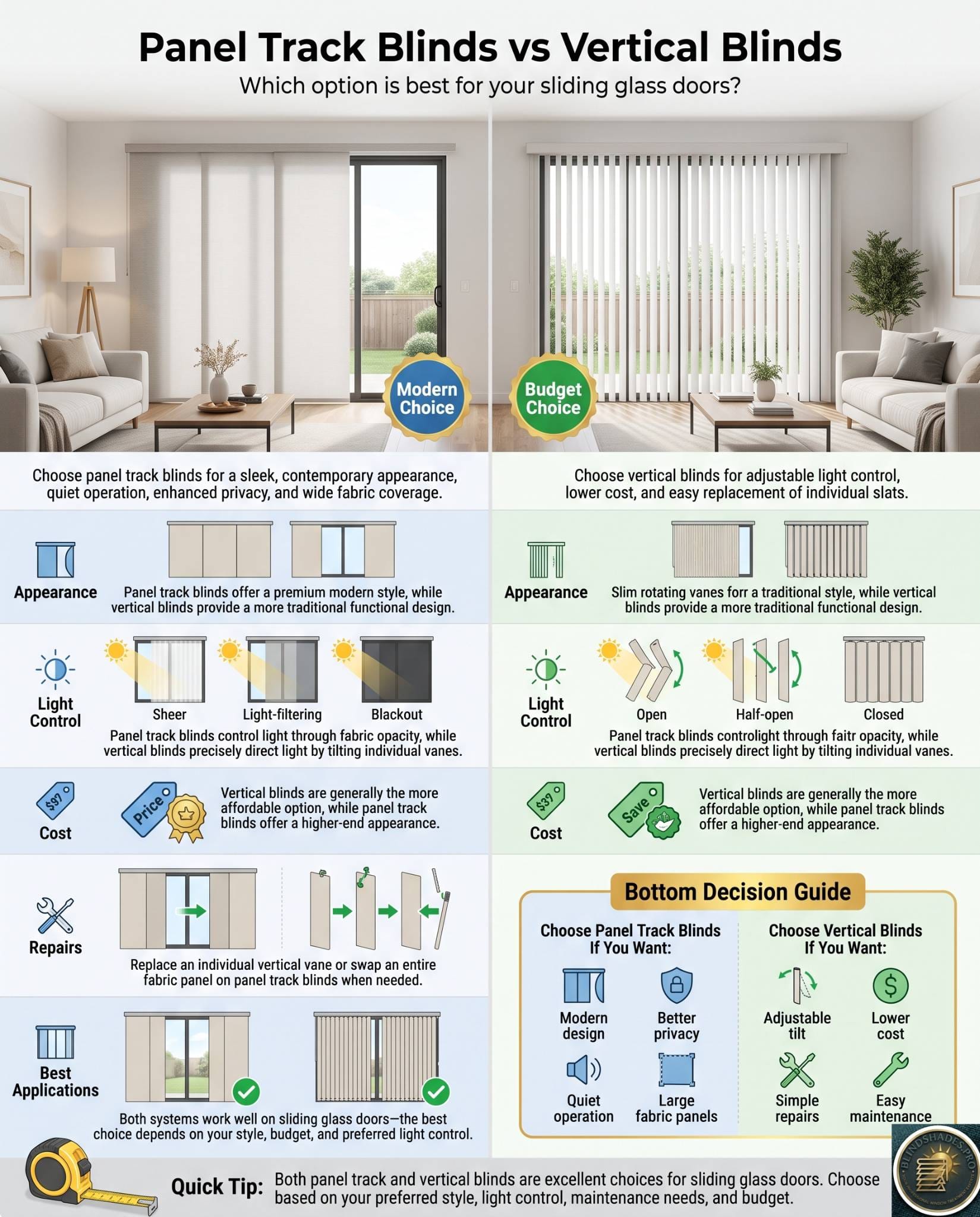
Authored by Michael Turner — 30 Years of Home Improvement Expertise | BlindShades.pro
Panel track blinds and vertical blinds both slide side to side to cover sliding doors and wide windows, but they solve the job differently. Panel track blinds use a few wide fabric panels for a clean, modern look with tighter privacy and quiet operation, but they do not tilt, so the fabric sets the light level, and they cost more. Vertical blinds use many narrow vanes that tilt for precise, adjustable light control at a lower price, with individually replaceable slats, but they can look more traditional and clatter. Choose panel track for a modern, low-fuss look and vertical blinds for adjustable light and value. This guide compares them across every factor that matters.
Key Takeaways
- Both slide; that is the similarity. Panel track and vertical blinds both move horizontally on a track, which is why they are the two main choices for sliding doors and wide windows.
- Panel track is modern; vertical is adjustable. Panel track gives a clean, wide-panel look with tighter privacy, while vertical blinds tilt for precise, directional light control.
- Vertical blinds cost less and repair cheaply. They are the budget choice, and a damaged vane can be swapped individually, whereas panel track means replacing a whole panel.
- Panel track is quieter and more private. Solid panels do not clatter and leave no gaps, while vertical vanes can rattle and allow some visibility when tilted.
- Both can be cordless. Either treatment is available cord-free, so both can be made child- and pet-safe.
⭐ Quick Answer
In panel track blinds vs vertical blinds, both slide side to side on a track, but panel track is the modern, gap-free choice while vertical blinds tilt for adjustable light at a lower cost.
- Same motion: both glide horizontally and stack aside, which is why they are the two main choices for sliding doors, as Hunker notes.
- Panel track: wide fabric panels, modern look, tighter privacy with no gaps, and quiet operation, but no tilt, so fabric sets the light.
- Vertical blinds: narrow vanes that tilt for precise, adjustable light, at a lower price, with replaceable individual slats, as Blinds Chalet explains.
- Cost and repair: vertical blinds are cheaper and you swap a single vane; panel track is premium and you replace a whole panel, per Blindsgalore.
- Choose panel track for a modern, private, quiet look; choose vertical for adjustable light and value. Both suit sliding glass doors; see our vertical blinds guide or best panel track blinds guide.
The Core Difference: Same Motion, Different Strengths
They move the same way but feel completely different.
The reason panel track and vertical blinds are so often cross-shopped is that they share the same basic motion: both glide horizontally on a track and stack to one side, making them natural fits for sliding doors and wide windows. The difference is everything else. Panel track uses a few wide, flat fabric panels, giving a clean, contemporary, almost architectural look with smooth, quiet operation. Vertical blinds use many narrow vanes that not only slide but also tilt, trading the modern look for hands-on, adjustable light control at a lower price. So the choice is rarely about which slides better and almost always about modern simplicity versus adjustable, budget-friendly control.
Panel Track Blinds vs Vertical Blinds: Full Comparison
Every factor side by side.
| Factor | Panel Track Blinds | Vertical Blinds |
|---|---|---|
| Look | Modern, wide fabric panels | Traditional, narrow vanes |
| Light control | Fabric opacity, no tilt | Vanes tilt for precise control |
| Privacy | No gaps when closed | Small gaps when tilted |
| Stack space | Needs more | Stacks compactly |
| Cost | Higher | Lower |
| Repair | Replace a whole panel | Replace individual slats |
| Noise | Quiet | Vanes can clatter |
| Material range | Fabric, solar, woven wood | Fabric and vinyl (PVC) vanes |
| Durability | Few moving parts | More parts, slats can crack |
| Best for | Modern interiors, clean look | Budget, adjustable light |
Light Control: No-Tilt Opacity vs Adjustable Tilt
This is the biggest functional difference.
| Approach | Panel Track Blinds | Vertical Blinds |
|---|---|---|
| How you set light | Choose fabric opacity at purchase | Tilt the vanes any time |
| Adjustability | Open or closed, no in-between tilt | Fully adjustable angle |
| Light quality | Even, diffused through the fabric | Directional, you aim it |
| Privacy with light in | Consistent, no gaps | Some visibility through gaps |
The defining difference is tilt. Panel track panels do not tilt, so you decide your light level when you buy by choosing light-filtering, blackout, solar, or woven wood fabric, and then you simply slide the panels open or closed. Vertical blinds let you tilt the vanes any time to aim light precisely, bouncing it off the ceiling or angling it away from a screen, while still blocking the direct view. So if you like hands-on, all-day light adjustment, vertical blinds win; if you prefer a clean, set-it-and-forget-it fabric look, panel track does.
Privacy: Solid Panels vs Slat Gaps
Panel track seals tighter.
When it comes to privacy, panel track has an edge. Its solid, overlapping fabric panels close with no gaps, giving consistent privacy day and night. Vertical blinds, even when closed, have small gaps between the vanes that can allow some visibility at certain angles, especially at night when interior lights are on and the vanes are only tilted rather than fully closed. For a bedroom, bathroom, or any room where reliable privacy matters most, panel track’s gap-free coverage is the more private choice, while vertical blinds trade a little privacy for their adjustability.
Stack and View
Vertical blinds stack tighter; panel track needs more room.
When open, both treatments stack to the side, but they differ in how much space the stack takes and how much glass it covers. Vertical blinds stack into a relatively compact bundle of thin vanes, leaving more of the window or door clear. Panel track panels, being wide, gather into a larger stack that covers more of the glass unless you extend the track onto the adjacent wall. So if maximizing the clear view through a sliding door is a priority and you lack wall space beside it, vertical blinds have an advantage; if you have wall space to stack the panels onto, panel track can clear the glass just as well.
Durability and Repair
Vertical slats swap cheaply; panel track means a whole panel.
| Factor | Panel Track Blinds | Vertical Blinds |
|---|---|---|
| Common damage | Stained or torn panel | Cracked, bent, or lost vane |
| Repair | Replace the affected panel | Replace the single vane |
| Repair cost | Higher per part | Low, vanes are cheap |
| Moving parts | Few, simple carriers | More vanes and hooks |
The two differ in how you fix them. Vertical blinds have a practical advantage here: if one vane cracks, bends, or goes missing, you replace just that inexpensive slat. With panel track, a damaged panel means replacing the whole panel, which costs more. On the other hand, panel track has fewer moving parts overall and no thin vanes to crack or fall off their hooks, so it can need fixing less often. Vertical blinds are cheaper to repair; panel track is sturdier per part but pricier when a panel does need replacing.
Cost: Which Is Cheaper?
Vertical blinds are the budget choice.
Vertical blinds are generally less expensive than panel track blinds, both to buy and to repair, which is a big reason they remain popular for rentals, large openings, and budget projects. Panel track blinds cost more because of their wide custom panels and track system, but they deliver a more upscale, modern look in return. For the lowest spend or to cover many wide openings affordably, vertical blinds win; for a designer feel on a feature sliding door or window, panel track justifies its higher price. Both are still among the more affordable ways to cover a large opening compared with custom drapery or shutters.
Look and Noise
Modern and quiet, or traditional and adjustable.
Aesthetically, panel track reads as modern, minimal, and architectural, with broad clean lines that suit contemporary interiors, while vertical blinds have a more traditional, utilitarian look long associated with offices and older homes, though modern vane materials have improved this. Noise is another quiet win for panel track: its solid panels glide silently, whereas vertical vanes can clatter against each other and the glass in a draft or when operated. For a serene, modern room, panel track is the calmer choice; vertical blinds trade some of that polish for their adjustability and price.
Child and Pet Safety
Both can be made cord-free.
Safety is not a deciding factor between them, because both panel track and vertical blinds are available in cordless and motorized versions that remove accessible pull cords. Whichever you choose, select a cordless wand or motorized control, and look for the Certified Best for Kids label for independent assurance, especially in homes with children or pets. Panel track’s wand-operated glide and vertical blinds’ wand-and-chain or motorized options both achieve a cord-free, child-safe result.
Which Should You Choose? Winner by Room
Match the treatment to the room’s priority.
| Room or priority | Winner | Why |
|---|---|---|
| Modern living room | Panel track | Clean, architectural look |
| Bedroom | Panel track | Gap-free privacy, blackout fabric |
| Adjustable daytime light | Vertical blinds | Tilt to aim light precisely |
| Tight budget | Vertical blinds | Lower cost to buy and repair |
| Sliding patio door | Either | Both glide on the door’s axis |
| Rental | Vertical blinds | Affordable and replaceable |
| Home office | Vertical blinds | Precise glare control by tilt |
For a modern look, tighter privacy, and quiet operation, panel track wins; for adjustable light, the lowest cost, and cheap repairs, vertical blinds do. Many homes use each where it fits best. To choose panel track, see our best panel track blinds guide and measure with how to measure for panel track blinds; for the other side, see our vertical blinds guide; and if neither fits, browse alternatives to panel track blinds.
Best Sources
- Blinds Chalet — on panel track and vertical blinds both sliding side to side, with panel track offering a modern look and vertical blinds tilt-adjustable light.
- Hunker — on panel track using a few wide fabric panels versus vertical blinds’ many narrow vanes, and the difference in stack and look.
- Boca Blinds — on vertical blinds’ lower cost and individually replaceable vanes versus panel track’s premium, gap-free panels.
- Blindsgalore — on panel track as the modern alternative to vertical blinds for wide windows and sliding doors, and the fabric range.
- House Digest — on panel track shades as a weighted, contemporary upgrade over traditional vertical blinds, with solar and thermal fabric options.
Related Guides
- Best Panel Track Blinds Buying Guide
- Best Vertical Blinds
- Panel Track Blinds for Sliding Glass Doors
- Alternatives to Panel Track Blinds
Frequently Asked Questions
Are panel track blinds better than vertical blinds?
Neither is simply better; they suit different priorities. Panel track blinds offer a cleaner, more modern look with wide fabric panels, tighter privacy with no gaps, and quiet operation, making them ideal for contemporary spaces. Vertical blinds offer precise tilt-adjustable light control, a lower price, and easily replaceable individual vanes, but can look more traditional and may clatter. For a modern, low-fuss look on a sliding door or wide window, panel track wins; for adjustable light and the best value, vertical blinds do.
What is the difference between panel track and vertical blinds?
Both slide horizontally on a track, but panel track uses a few wide fabric panels while vertical blinds use many narrow vanes. The biggest functional difference is that vertical vanes tilt, letting you aim light precisely, while panel track panels do not tilt, so the fabric opacity you choose sets the light level. Panel track looks more modern and seals with no gaps for better privacy and quiet, while vertical blinds cost less, stack more compactly, and let you replace a single damaged vane rather than a whole panel.
Which is cheaper, panel track or vertical blinds?
Vertical blinds are generally cheaper than panel track blinds, both to buy and to repair. Their lower price is a major reason they remain popular for rentals, large openings, and budget projects, and a damaged vane can be replaced individually for very little. Panel track blinds cost more because of their wide custom panels and track system, but they deliver a more upscale, modern look. Both are still relatively affordable ways to cover a large opening compared with custom drapery or shutters.
Do panel track blinds give more privacy than vertical blinds?
Yes, panel track blinds generally give more consistent privacy. Their solid, overlapping fabric panels close with no gaps, so privacy is reliable day and night. Vertical blinds, even closed, have small gaps between the vanes that can allow some visibility at certain angles, particularly at night with interior lights on. For bedrooms, bathrooms, or any room where dependable privacy matters most, panel track’s gap-free coverage is the stronger choice, while vertical blinds trade a little privacy for their adjustable tilt.
Are panel track or vertical blinds better for a sliding door?
Both are excellent for sliding doors, since both glide on the same axis as the door and stack aside for walk-through access, so the choice comes down to style and budget. Panel track gives a modern, quiet, gap-free look and is ideal if you want a contemporary feel and have wall space for the panels to stack onto. Vertical blinds cost less, offer tilt-adjustable light, and stack more compactly, which helps if wall space beside the door is limited. Either can be cordless for safety.
