Mini Blinds vs Cellular Shades

Authored By Michael Turner -30 Years Home Improvement Expertise | Updated 2026 | BlindShades.pro
Updated on June 26, 2026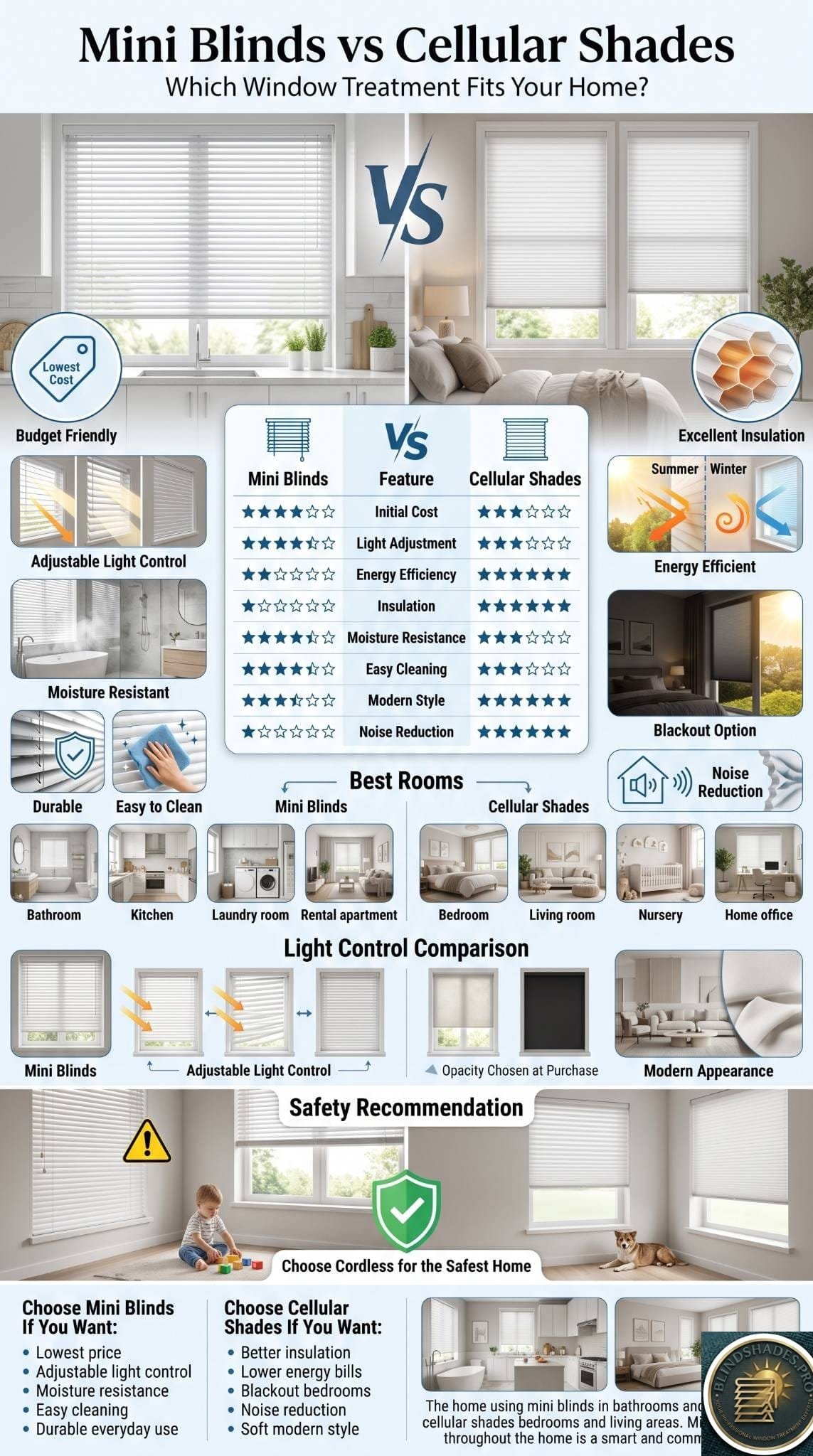
Authored by Michael Turner — 30 Years of Home Improvement Expertise | BlindShades.pro
Mini blinds and cellular shades solve the same problem, privacy and light control, in opposite ways at opposite price points. Mini blinds are cheaper, let you tilt the slats for precise, adjustable light control, and resist moisture, making them ideal for bathrooms, kitchens, rentals, and tight budgets. Cellular shades cost more but their honeycomb cells trap air for real insulation, blackout darkness, and noise reduction, making them the better choice for bedrooms, living rooms, and drafty or extreme-climate windows. The simplest way to decide: choose mini blinds for budget and hands-on light control, and cellular shades for energy efficiency and comfort. Many homes use both, room by room. This guide compares them across every factor that matters.
Key Takeaways
- Mini blinds win on budget and light control. They are the most affordable custom treatment and let you tilt the slats to redirect light at any angle, something cellular shades cannot do.
- Cellular shades win on energy and comfort. Their honeycomb cells trap air to insulate the window, and the U.S. Department of Energy notes tightly installed cellular shades can cut window heat loss by 40 percent or more in heating season.
- Moisture is decisive. Aluminum and vinyl mini blinds shrug off humidity, while fabric cellular shades can grow mildew in steamy rooms, so mini blinds clearly win bathrooms and kitchens.
- They control light differently. Mini blinds adjust light any time by tilting; cellular shades fix the opacity when you buy them and diffuse light softly, with blackout fabric blocking nearly all of it.
- Mixing the two is the smart play. Mini blinds in kitchens, baths, and rentals, cellular shades in bedrooms and living rooms, gets you value and performance where each matters most.
⭐ Quick Answer
The mini blinds vs cellular shades choice comes down to budget and control versus insulation and comfort: they solve the same problem in opposite ways.
- Choose mini blinds for the lowest price, precise tilt-adjustable light, and moisture resistance, the strengths Blindsgalore highlights for budgets and wet rooms.
- Choose cellular shades for energy efficiency, insulation, blackout darkness, and noise reduction in bedrooms and living rooms.
- Energy: cellular honeycomb cells insulate, cutting window heat loss by around 40 percent per the Department of Energy, while mini blinds barely insulate, as AOSKY notes.
- Moisture: mini blinds win bathrooms and kitchens decisively, since cellular fabric can develop mildew in steamy rooms.
- Mix by room: mini blinds in baths, kitchens, and rentals; cellular shades in bedrooms and living rooms, as SmartWings suggests. Compare materials in aluminum vs vinyl mini blinds, see other upgrades in alternatives to mini blinds, or pick a set in our best mini blinds guide.
The Core Trade-Off: Budget and Control vs Insulation and Comfort
Mini blinds give affordability and hands-on control; cellular shades give energy efficiency and comfort.
At heart this is a simple decision once you know what each does best. Mini blinds, with their slim 1-inch slats, are the most affordable custom window treatment, and their great strength is precise, adjustable light control: you tilt the slats to let light in or shut it out at exactly the angle you want. Cellular shades, made of pleated fabric that forms honeycomb air pockets, cost more and trade tilt control for a different benefit: real insulation that lowers energy bills, plus blackout options and noise reduction. So the question is rarely which is better overall, but which strength matters more in a given room, stretching a budget or improving comfort and efficiency.
Mini Blinds vs Cellular Shades: Full Comparison
Every factor side by side.
| Factor | Mini Blinds | Cellular Shades |
|---|---|---|
| Upfront cost | Lowest | Higher |
| Light control | Precise, adjustable by tilting | Fixed opacity, diffused |
| Blackout | Light leaks between slats | Up to near-total with blackout fabric |
| Energy efficiency | Minimal insulation | Excellent, honeycomb insulates |
| Moisture resistance | Excellent | Poor, fabric can mildew |
| Durability | Durable, repairable | Fabric, more delicate |
| Cleaning | Easy wipe, but dust shows | Vacuum gently, cells trap dust |
| Noise reduction | Little | Good, dampens sound |
| Privacy | Varies with slat angle | Consistent when closed |
| Style | Classic, structured | Soft, modern, minimal |
| Features | Tilt and lift | Top-down/bottom-up, cell options |
| Best rooms | Baths, kitchens, rentals | Bedrooms, living rooms, drafty windows |
Light Control: Adjustable vs Diffused
The clearest difference: adjust any time, or decide once.
The two handle light in fundamentally different ways, and this is often the deciding factor:
| Approach | Mini Blinds | Cellular Shades |
|---|---|---|
| How you set light | Tilt slats any time | Choose opacity at purchase |
| Light quality | Directional, you aim it | Soft, even, diffused |
| Adjustability | Fully adjustable daily | Fixed, raise or lower only |
| Glare control | Bounce light off the ceiling | Diffuses glare evenly |
With mini blinds you have hands-on, directional control: tilt the slats to bounce daylight off the ceiling, block a beam hitting your screen, or let in a soft glow, all without raising the blind. With cellular shades you decide the light level when you buy, choosing sheer, light-filtering, or blackout fabric, and the shade then diffuses light softly and evenly; to change the amount, you raise or lower the whole shade. If you like adjusting light through the day, mini blinds win; if you want a consistent, calming glow, cellular shades win.
Energy Efficiency: Where Cellular Pulls Ahead
Cellular shades insulate; mini blinds barely do — but the savings depend on your climate.
This is cellular’s headline advantage. The honeycomb cells trap a layer of air that acts as insulation between the window and the room, reducing heat transfer in both winter and summer. The U.S. Department of Energy notes that tightly installed cellular shades can reduce heat loss through windows by around 40 percent or more during heating season, which translates to meaningful savings on heating and cooling. Mini blinds, with their rigid slats and the gaps between them, provide almost no insulation. The honest caveat: how much you save depends on your climate. In extreme winters or brutal summers, cellular shades can pay back their higher cost over a few seasons through lower bills; in mild climates, the energy upgrade pays off more slowly, and mini blinds’ low cost may make more sense. You can also use cellular shades only on your draftiest or sunniest windows.
Which Is Better for Moisture?
Mini blinds win bathrooms and kitchens, decisively.
This one is not close. Aluminum and vinyl mini blinds resist moisture and humidity, shrugging off the steam of bathrooms and the splashes of kitchens without damage. Cellular shades are made of fabric, which can absorb moisture and develop mildew or staining in consistently steamy rooms, shortening their life. For any high-humidity room, mini blinds are the clear and decisive choice, and it is one of the strongest reasons to keep mini blinds in the mix even in a home that otherwise favors cellular shades. Save the cellular shades for the dry rooms.
Which Is Better for Darkness and Privacy?
Cellular shades make the better bedroom and nursery choice.
For total darkness, cellular shades pull ahead. Blackout cellular fabric can block nearly all incoming light, up to around 99 percent, making rooms genuinely dark for sleep or naps. Mini blinds, by contrast, let light leak between the slats even when fully closed, so they cannot deliver true blackout. Privacy follows the same pattern: a closed cellular shade gives consistent privacy because the fabric stays shut even as light passes through, whereas mini blind privacy depends on the slat angle, and small gaps can allow visibility at certain angles, especially at night with interior lights on. For bedrooms and nurseries, where darkness and reliable privacy matter most, cellular shades in a blackout fabric are the stronger pick.
Cleaning and Maintenance
Mini blinds are easier per clean; cellular shades need it less often.
The maintenance story is more balanced than it first appears. Mini blinds are easy to clean in the moment, a quick wipe or dust does the job, but dust settles visibly on every horizontal slat, so they need attention more often, with the full method in how to clean mini blinds. Cellular shades are harder to deep clean, since the honeycomb cells trap dust and the fabric can stain, requiring gentle vacuuming with a brush attachment, but they need it less frequently. So neither is simply lower-maintenance; mini blinds trade easier cleaning for more frequent dusting, while cellular shades trade less frequent care for fussier cleaning when it is due.
Durability and Repair
Mini blinds are more repairable than cellular sellers admit.
You will often read that mini blinds are hard to repair, usually on pages selling cellular shades, but that is misleading. Aluminum mini blinds are quite repairable: a bent slat can be straightened or swapped, as in how to fix bent mini blind slats, and a frayed cord can be replaced, as in how to restring mini blinds. Cellular shades, by contrast, are fabric, so a torn or stained cell usually cannot be repaired and the shade is replaced. Mini blinds also handle high-traffic rooms, kids, and pets better than delicate cellular fabric. So on durability and repairability in demanding spaces, mini blinds hold up well, while cellular shades reward gentler use.
Cellular’s Feature Edge: Top-Down, Bottom-Up
Cellular shades offer options mini blinds do not.
Cellular shades bring a few features mini blinds lack. The standout is top-down/bottom-up operation, which lets you lower the shade from the top or raise it from the bottom, so you can get privacy at eye level while still letting daylight in above, ideal for street-facing windows. Cellular shades also come in single-, double-, and triple-cell constructions, where more cells mean more trapped air and greater insulation, letting you dial in energy performance. Mini blinds keep it simpler with tilt and lift. If these extra options appeal, they tilt the decision toward cellular; if you value simple, adjustable slats and a low price, mini blinds suffice.
Cost: Upfront vs Lifetime
Mini blinds cost less to buy; cellular shades can earn it back in energy savings.
| Factor | Mini Blinds | Cellular Shades |
|---|---|---|
| Upfront cost | Lowest custom option | Higher |
| Energy savings | Minimal | Can lower utility bills |
| Payback | None needed | Faster in extreme climates |
| Best value for | Budgets, rentals, wet rooms | Long-term comfort, harsh climates |
Mini blinds are the most affordable custom window treatment, which is why they dominate rentals and budget projects. Cellular shades cost more upfront, but in demanding climates the energy savings can offset that difference over a few years, making them a long-term value rather than just a higher price. For a short stay, a rental, or a mild climate, mini blinds are the economical choice; for a long-term home with high energy bills, cellular shades can be the smarter investment.
Which Should You Choose? Winner by Room
Match each treatment to the room’s priorities.
| Room | Winner | Why |
|---|---|---|
| Bathroom | Mini blinds | Moisture resistance |
| Kitchen | Mini blinds | Moisture, easy cleaning |
| Rental | Mini blinds | Lowest cost, portable |
| Bedroom | Cellular shades | Blackout and insulation |
| Living room | Cellular shades | Comfort, light diffusion |
| Nursery | Cellular shades | Darkness for naps |
| Drafty or extreme-sun window | Cellular shades | Insulation and energy savings |
| Home office | Either | Mini for tilt, cellular for even glare control |
The smartest approach for many homes is to mix the two: mini blinds in the kitchen, bathrooms, and rentals, and cellular shades in the bedrooms, living room, and any drafty or sun-baked window. To choose mini blinds, see our best mini blinds guide and compare materials in aluminum vs vinyl mini blinds; for other upgrade options, see alternatives to mini blinds.
Best Sources
- Blindsgalore — on mini blinds for budget and precise light versus cellular shades for insulation, the Department of Energy 40 percent figure, blackout fabric blocking up to 99 percent, and mixing both room by room.
- SmartWings — on mini blinds’ adjustable slats versus cellular shades’ diffused light, honeycomb insulation, top-down/bottom-up operation, and cordless safety.
- AOSKY — on the Department of Energy heat-loss reduction and roughly 10 percent heating savings, and cellular shades paying for themselves over a couple of years.
- EcoSmart Shades — on cellular shades diffusing light softly, top-down/bottom-up styles, and being a longer-term investment.
- MITS Eastern Shore — on single-, double-, and triple-cell constructions, thermal performance, and consistent fabric privacy versus slat-gap visibility at night.
- SelectBlinds — on cellular shades leading for energy savings while blinds give more precise light control and easier cleaning.
Related Guides
- Best Mini Blinds Buying Guide
- Aluminum vs Vinyl Mini Blinds
- Alternatives to Mini Blinds
- Best Cordless Mini Blinds
Frequently Asked Questions
Are cellular shades better than mini blinds?
Neither is better overall; they excel at different things. Cellular shades are better for energy efficiency, insulation, blackout darkness, and noise reduction, making them ideal for bedrooms, living rooms, and drafty or extreme-climate windows. Mini blinds are better for budget, precise adjustable light control, and moisture resistance, making them ideal for bathrooms, kitchens, and rentals. The right choice depends on whether a given room needs affordability and light control or insulation and comfort, and many homes use both.
Are cellular shades worth the extra money over mini blinds?
It depends on your climate and how long you will stay. Cellular shades cost more upfront, but the U.S. Department of Energy notes they can cut window heat loss by around 40 percent or more, so in extreme winters or summers the energy savings can offset the higher price within a few years. In mild climates or short-term situations like rentals, the payback is slower and the lower cost of mini blinds often makes more sense. They are worth it most where energy bills are high.
Which is better for bathrooms, mini blinds or cellular shades?
Mini blinds are clearly better for bathrooms. Aluminum and vinyl mini blinds resist moisture and humidity, handling steam and splashes without damage. Cellular shades are made of fabric, which can absorb moisture and develop mildew or staining in a steamy bathroom, shortening their lifespan. For bathrooms, kitchens, and laundry rooms, mini blinds are the decisive choice, while cellular shades are best kept to dry rooms like bedrooms and living rooms.
Do cellular shades block more light than mini blinds?
Yes, cellular shades block more light. Blackout cellular fabric can block nearly all incoming light, up to around 99 percent, making rooms genuinely dark for sleep. Mini blinds let light leak between the slats even when fully closed, so they cannot achieve true blackout. Cellular shades also give more consistent privacy, since the fabric stays closed, while mini blind privacy varies with the slat angle and can allow some visibility at night. For bedrooms and nurseries, cellular shades are the better choice.
Can you use both mini blinds and cellular shades in one home?
Yes, and it is often the smartest approach. Using mini blinds in kitchens, bathrooms, guest rooms, and rentals keeps costs down where moisture resistance and budget matter, while using cellular shades in the primary bedroom, living room, and any drafty or sun-baked windows delivers insulation and comfort where it counts. This room-by-room mix stretches your budget while still getting the performance upgrade in the rooms that benefit most from it.
