Alternatives to Mini Blinds

Authored By Michael Turner -30 Years Home Improvement Expertise | Updated 2026 | BlindShades.pro
Updated on June 26, 2026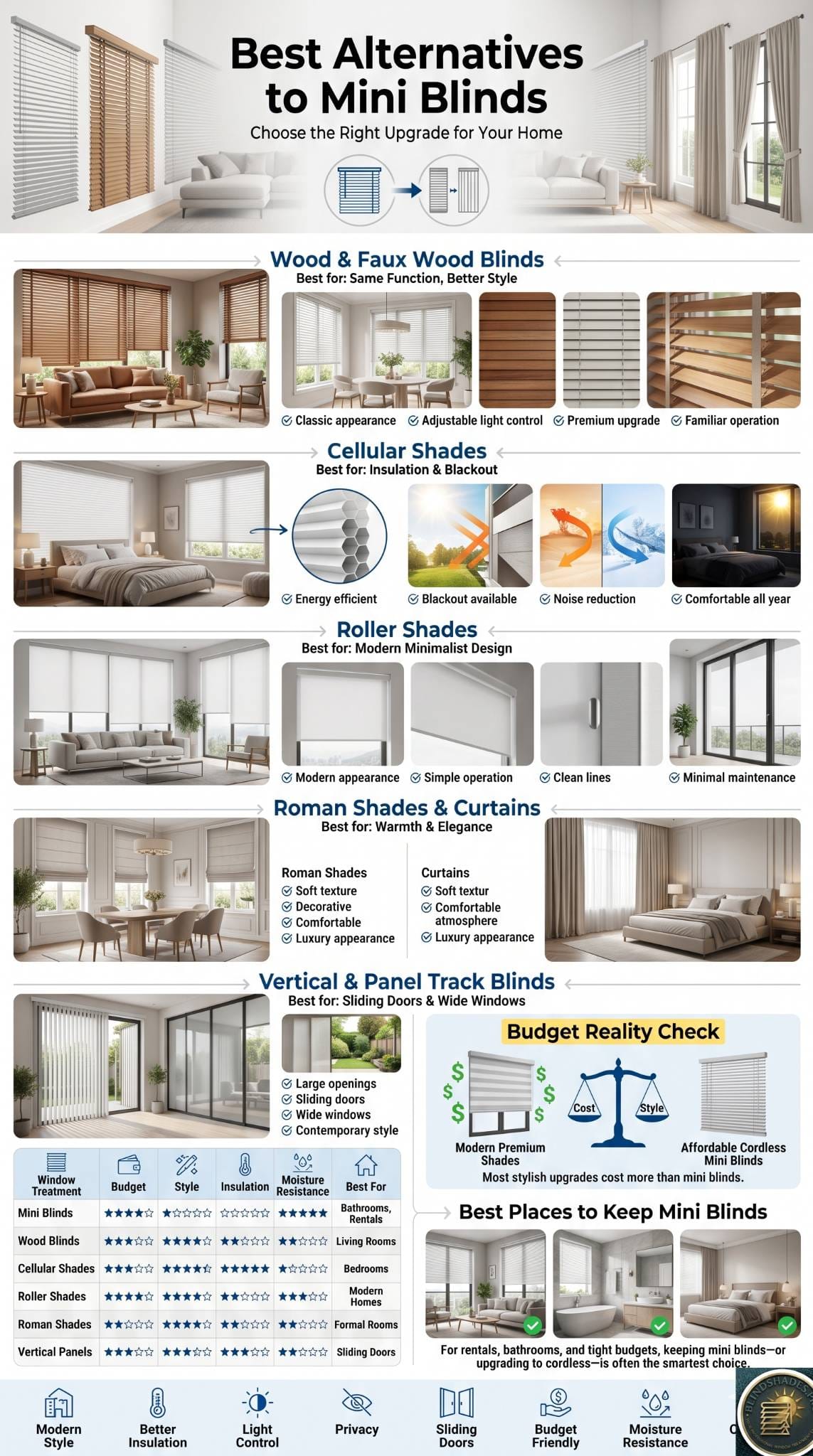
Authored by Michael Turner — 30 Years of Home Improvement Expertise | BlindShades.pro
The best alternatives to mini blinds depend on what you want to improve. If you want a warmer, more upscale version of the same tilt-and-lift function, wood or faux wood blinds are the closest upgrade. For insulation, cellular shades win; for a clean modern look, roller shades; for warmth and elegance, Roman shades or drapes; for sliding doors and wide windows, vertical or panel-track blinds; and for lasting value, plantation shutters. The honest catch is that almost every alternative costs more than mini blinds, so for rentals, tight budgets, and wet rooms, keeping your mini blinds, or simply switching to cordless, may still be the right call. This guide matches each alternative to the problem it solves, room by room.
Key Takeaways
- Start with what mini blinds lack. Decide whether you want better insulation, true blackout, more style, large-window coverage, or lower maintenance, then match the alternative to that gap.
- Wood and faux wood blinds are the closest upgrade. They keep the familiar tilt-and-lift function while adding warmth and wider slats, with faux wood handling moisture for kitchens and baths.
- Cellular shades are the performance upgrade. Their honeycomb cells insulate and offer blackout fabric, making them the top pick for bedrooms and energy savings.
- Mini blinds still win on price. Almost every alternative costs more, so for rentals, budgets, and humid rooms, keeping mini blinds or going cordless can be the smarter choice.
- Match the alternative to the room. Moisture rules out fabric in bathrooms, large windows need vertical or panel solutions, and bedrooms want blackout, so the room decides the best swap.
⭐ Quick Answer
The best alternatives to mini blinds depend on what you want to fix, so start with the gap, insulation, blackout, style, or large windows, then match the option.
- Same function, but warmer: wood or faux wood blinds are the closest upgrade, keeping tilt-and-lift, which SelectBlinds calls the common next step.
- Insulation and blackout: cellular shades win; see mini blinds vs cellular shades.
- Modern or elegant: roller shades for a clean look, Roman shades or drapes for warmth, among the alternatives Norman USA highlights.
- Sliding doors or wide windows: vertical or panel-track blinds, where mini blinds struggle.
- The honest catch: most alternatives cost more, so for rentals, budgets, and bathrooms, keeping mini blinds or going cordless can be smarter, a point Affordable Blinds echoes. Compare picks in our best mini blinds guide.
Why Look for Alternatives to Mini Blinds?
Mini blinds do a few things well, and a few things poorly.
Mini blinds are affordable, easy to install, and give adjustable light control through their 1-inch tilting slats, which is why they remain so common, especially in rentals. But they have real limits that send people looking for alternatives: they provide almost no insulation, they cannot deliver true blackout because light leaks between the slats, they collect dust on every slat, they look utilitarian in design-forward rooms, and they struggle on large windows and sliding doors. The trick to choosing a good alternative is to first pin down which of these limits actually bothers you, because the right replacement depends entirely on the problem you are solving.
What Do You Want to Fix?
Match the gap to the alternative.
| What you want to fix | Best alternative |
|---|---|
| Poor insulation | Cellular shades |
| No true blackout | Cellular or blackout roller shades, drapes |
| Utilitarian look | Roman shades, roller shades, drapes |
| Same function, but warmer | Wood or faux wood blinds |
| Large windows or sliding doors | Vertical or panel-track blinds |
| Lots of dusting | Roller shades, shutters |
| Lasting value | Plantation shutters |
| Eco-friendly materials | Bamboo or woven wood shades |
The Best Alternatives to Mini Blinds
Each option, and what you give up to get it.
Wood and faux wood blinds are the closest upgrade, keeping the same tilt-and-lift control but with warmer, wider slats. Faux wood resists moisture for kitchens and baths; real wood is lighter and richer but for dry rooms only. What you give up: little, though they cost more and are heavier. See aluminum vs vinyl mini blinds for how faux wood compares on material.
Cellular (honeycomb) shades are the performance upgrade, insulating the window and offering blackout fabric and top-down/bottom-up options. What you give up: the tilt adjustment of slats, and fabric does not suit humid rooms. The full head-to-head is in mini blinds vs cellular shades.
Roller shades roll a single panel of fabric up and down for a clean, minimal, modern look with fewer dust-catching surfaces. What you give up: slat-style directional light control.
Roman shades fold soft fabric into elegant pleats, adding warmth and a custom-drapery look. What you give up: precise light adjustment, easy cleaning, and moisture tolerance.
Plantation shutters mount adjustable louvers permanently to the window for a classic, durable, value-adding look; composite shutters resist moisture. What you give up: a much higher cost and permanence.
Vertical and panel-track blinds are the answer for sliding doors and wide, wall-to-wall glass, where they slide aside easily. What you give up: nothing for those windows, where mini blinds simply do not work well. See our vertical blinds guide.
Zebra and dual shades layer alternating sheer and opaque stripes you can align for light or privacy, with a modern look suited to larger windows. What you give up: some simplicity and a higher price.
Curtains and drapes soften a room, absorb noise, and can be layered, sheer by day and blackout by night. What you give up: precise daytime light control and tidy operation.
Solar shades block heat and glare while preserving the outside view, ideal for sunny rooms and offices. What you give up: nighttime privacy, since they remain somewhat see-through.
Bamboo and woven wood shades bring natural, renewable texture and warmth. What you give up: full blackout and moisture resistance, unless lined.
Window film frosts the glass for permanent bathroom privacy while letting light through. What you give up: any adjustability, since it is fixed.
Full Comparison of Alternatives
The alternatives side by side.
| Alternative | Best for | Beats mini on | Cost tier |
|---|---|---|---|
| Faux wood blinds | Kitchens, baths, upgrade | Style, warmth, moisture | Low to mid |
| Wood blinds | Living, dining rooms | Style, warmth | Mid |
| Cellular shades | Bedrooms, energy savings | Insulation, blackout | Mid |
| Roller shades | Modern rooms, large windows | Clean look, low dust | Low to mid |
| Roman shades | Living rooms, bedrooms | Elegance, texture | Mid to high |
| Plantation shutters | Long-term value | Durability, resale | High |
| Vertical / panel track | Sliding doors, wide glass | Wide coverage | Mid |
| Zebra shades | Modern, large windows | Light and privacy mix | Mid |
| Curtains / drapes | Warmth, noise, blackout | Softness, sound | Low to high |
| Solar shades | Sunny rooms, offices | Glare with a view | Mid |
The Upgrade Ladder: Closest Swaps First
From the smallest change to the biggest.
If you like mini blinds but want better, it helps to think of alternatives as rungs on a ladder from least to most change. The smallest step is wood or faux wood blinds, which keep the exact tilt-and-lift operation you are used to while looking far nicer. The next step is cellular or roller shades, which change how the window operates, raising and lowering rather than tilting, in exchange for insulation or a clean modern look. The biggest step is soft treatments like Roman shades, drapes, or plantation shutters, which transform the room’s whole style and feel. Decide how big a change you actually want, and the ladder points you to the right rung.
Best Alternatives by Room
The room often decides the best swap.
| Room | Best alternatives |
|---|---|
| Bedroom | Cellular shades, blackout roller, drapes |
| Living room | Roman shades, wood blinds, roller shades |
| Bathroom | Faux wood, composite shutters, window film |
| Kitchen | Faux wood blinds, roller shades |
| Sliding door | Vertical or panel-track blinds |
| Home office | Solar shades, roller shades |
| Large window | Vertical, panel track, zebra shades |
One firm rule: in bathrooms and other humid rooms, avoid fabric alternatives like Roman shades, cellular shades, and drapes, which can grow mildew, and stick to moisture-safe faux wood, composite shutters, vinyl, or window film, the same lesson covered in mini blinds vs cellular shades.
Should You Keep Your Mini Blinds?
Sometimes the best alternative is no alternative.
Before spending on a replacement, it is worth asking whether you need one at all, because mini blinds still win in several situations:
| Situation | Verdict |
|---|---|
| Rental or short-term home | Keep mini blinds, low cost |
| Tight budget | Keep mini blinds or go cordless |
| Bathroom or kitchen | Mini blinds resist moisture well |
| Secondary or rarely seen window | Not worth upgrading |
| Cords are the concern | Switch to cordless mini blinds |
| Want insulation, blackout, or style | Upgrade to an alternative |
Mini blinds’ unbeatable advantage is price, so for rentals, budgets, and wet or low-priority windows, keeping them, cleaning them with how to clean mini blinds, or simply switching to cordless mini blinds is often smarter than replacing them. Upgrade when you genuinely need insulation, blackout, large-window coverage, or a more refined look. Whether mini blinds themselves are dated is weighed in are mini blinds outdated.
Best Sources
- SelectBlinds — on cellular shades, roller shades, and wood or faux wood blinds as the most popular replacements for mini blinds, with faux wood the closest upgrade and shades having fewer dust-catching surfaces.
- Norman USA — on shutters, honeycomb shades, roller shades, Roman shades, and drapery alternatives, plus composite shutters for moisture resistance.
- Stoneside — on zebra shades, cellular shades, roller shades, and layering roller shades with sheer drapes.
- Affordable Blinds — on faux wood and Venetian blinds as alternatives, the limits of mini blinds for insulation and large windows, and natural materials like bamboo.
- Midwest Blind and Shade — on cellular shades, interior shutters, roller shades, and Roman shades, and composite shutters for kitchens and bathrooms.
- BlindMaster — on roller shades, Roman shades, shutters, solar shades, frosted window film, and sheer curtains as blind alternatives.
Related Guides
Frequently Asked Questions
What is the best alternative to mini blinds?
It depends on what you want to improve. For the same tilt-and-lift function with a warmer, more upscale look, wood or faux wood blinds are the closest upgrade. For insulation and blackout, cellular shades win; for a clean modern look, roller shades; for warmth and elegance, Roman shades or drapes; and for sliding doors or wide windows, vertical or panel-track blinds. Start by identifying what mini blinds lack in your space, then choose the alternative that solves that specific problem.
What has replaced mini blinds in modern homes?
In design-forward homes, the most common replacements are cellular shades for insulation, roller shades for a clean modern style, and wood or faux wood blinds for warmth and an upgraded look. Many homeowners also choose Roman shades or drapes for softness, and plantation shutters for lasting value. That said, mini blinds remain very common in rentals and budget settings, and modern cordless mini blinds address the safety concern that pushed some people to switch.
What can I use instead of mini blinds in a bathroom?
In a bathroom, choose a moisture-safe alternative and avoid fabric. Faux wood blinds, composite plantation shutters, vinyl blinds, and frosted window film all handle humidity well and resist mildew. Avoid Roman shades, cellular shades, and drapes in a steamy bathroom, since fabric can absorb moisture and develop mildew over time. Vinyl mini blinds themselves are also an excellent, inexpensive bathroom choice, so an upgrade is not always necessary there.
Are alternatives to mini blinds more expensive?
Usually, yes. Mini blinds are the most affordable custom window treatment, so almost every alternative, from cellular and roller shades to Roman shades, shutters, and custom drapes, costs more, sometimes considerably more for premium options like plantation shutters. That is why mini blinds remain popular for rentals and budgets. The extra cost can be worth it when you gain insulation, blackout, durability, or a more refined look, but for low-priority windows, keeping mini blinds is the economical choice.
What is the closest upgrade from mini blinds?
Wood and faux wood blinds are the closest upgrade, because they keep the same horizontal tilt-and-lift operation you already know while looking warmer and more substantial with their wider slats. Faux wood adds moisture resistance for kitchens and bathrooms, while real wood offers richer texture for dry living spaces. Because the function is identical, the transition feels natural, making wood-look blinds the easiest step up for anyone who likes how mini blinds work but wants a better appearance.
