What Percentage Solar Shade for a Living Room? Decided

Authored By Michael Turner -30 Years Home Improvement Expertise | Updated 2026 | BlindShades.pro
Updated on July 23, 2026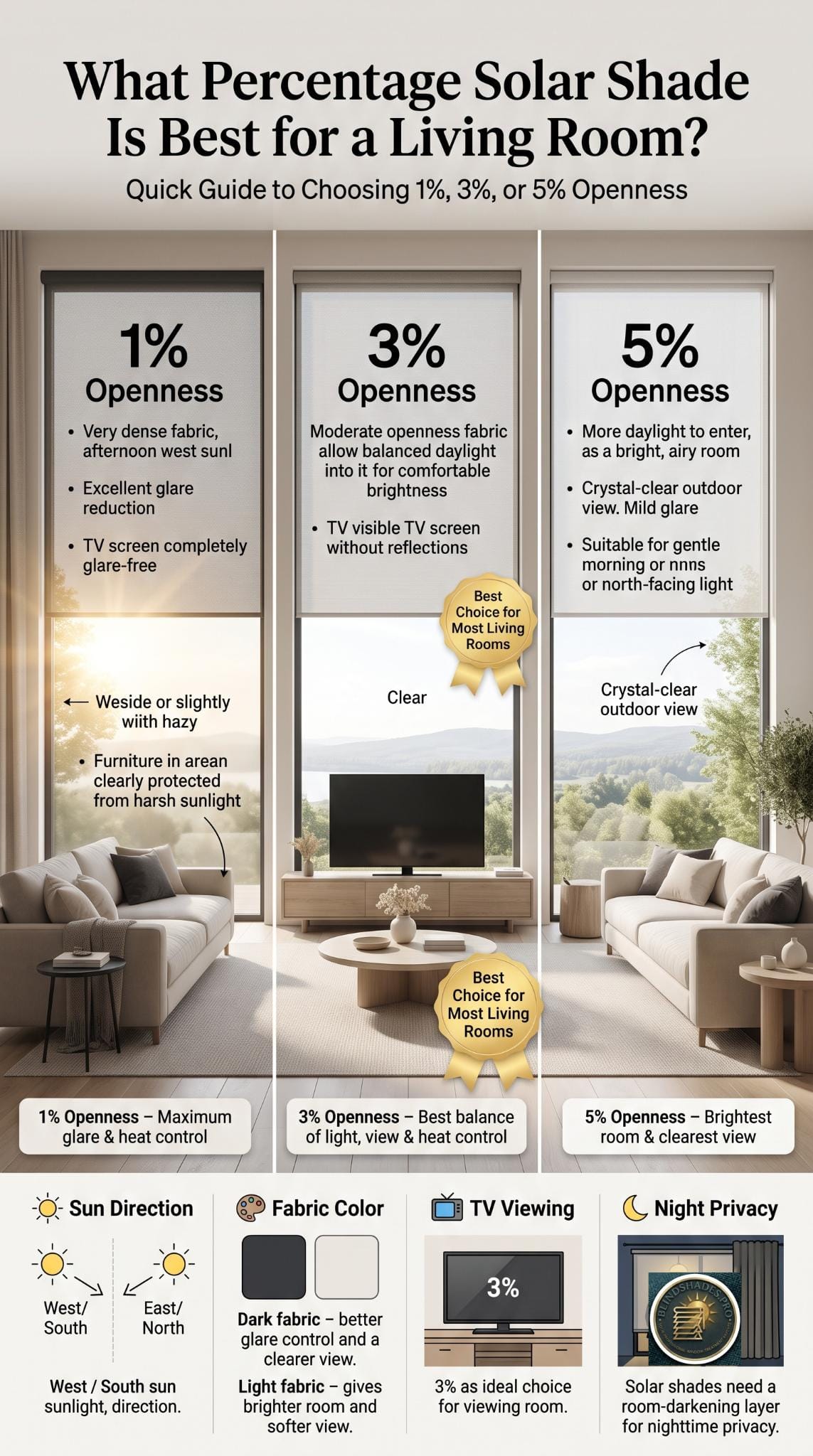
By Michael Turner — 30 years in window treatments
What percentage solar shade for a living room? Five percent — unless your room gives you a named reason to move. The industry’s own record backs the default: 5% is the most common all-around living-room choice, 3% exists where glare or hard sun earns the drop, 10% where the view earns the climb. Where every guide stops is where a living room actually gets decided: which reasons justify a move, how to break the 3-versus-5 tie the whole field straddles, what strong-sun regions do differently, and how fabric color rescues half the hard cases. This guide is the interview nobody else conducts.
Key Takeaways
- The default is 5%, on the record. Blindsgalore (May 4, 2026) calls a 5% solar shade the most common all-around choice for living rooms; North Solar Screen (January 21, 2026) puts the living-area sweet spot at 3–5%; JC Licht (June 17, 2024) widens the balance band to 5–7%.
- Moves need reasons. Drop to 3% only for a stated glare reason — hard south or west sun, a television on the bright wall; climb to 10% only for a stated view reason. No reason, no move.
- The tiebreak the field straddles has a procedure. Nearly every source says “3 to 5” and stops; the decision runs on two questions — where the TV sits, and what the window does at its worst regular hour.
- Color is the lever most percentage guides forget. A dark 5% recovers most of a light 3%’s glare control while keeping the view — which quietly dissolves half the tiebreaks before they happen.
- The decade of forum debate proves the method. The standing reply in a ten-year-old Houzz thread on 1-versus-3-versus-5 is a question: which direction does the window face? That question, not a universal number, is the answer — and this page turns it into a procedure.
⭐ Quick Answer — What Percentage Solar Shade for a Living Room?
Five percent — unless a named reason moves it. That is the honest answer to what percentage solar shade for a living room, and the rule runs in both directions:
- The default is on the record: Blindsgalore calls 5% the most common all-around living-room choice, and North Solar Screen brackets the living-area sweet spot at 3–5%.
- Drop to 3% for a stated glare reason — hard south or west sun through your prime hours, or a television on the sunny glass wall.
- Climb to 10% for a stated view reason on mild or northern glass — the full ladder math lives in our 5% vs 10% decision guide.
- Try the color lever before conceding: a dark 5% recovers most of a light 3%’s glare control while keeping the view — the mechanism is in our color guide, and JC Licht’s 5–7% balance band shows how far view-first rooms can stretch.
- No percentage gives night privacy in a lamplit room — plan the evening layer — and the verified picks across every openness live in the complete solar shades guide.
What Percentage Solar Shade for a Living Room?
Default Five, Move for Reason: the living-room answer is 5% unless a named reason moves it — down to 3% for glare, up to 10% for view. No reason, no move.
The consensus is real and worth crediting. Blindsgalore (May 4, 2026) states it flat: 5% is the most common all-around choice for living rooms and general-purpose windows. North Solar Screen (January 21, 2026) brackets the living-area sweet spot at 3–5%; Bringnox (March 11, 2026) calls 3–5% the safe middle with 1–3% for glare-first rooms and 10% for view-first; Blinds Chalet (July 7, 2026) endorses 3% or 5% for the living-room balance; JC Licht (June 17, 2024) alone widens the band to 5–7%. The attributed UV math behind the ladder:
| Openness | UV blocked (attributed) | View + light | The living-room verdict |
|---|---|---|---|
| 1% | Highest interception + max daytime privacy, per Made in the Shade Kearney | Muted, dim | Almost never — the “clinical” weave belongs to media rooms, not living rooms |
| 3% | ≈97% per the Houzz-sourced record | Softened view, strong glare kill | The stated-reason drop: hard sun or a TV on the glass |
| 5% | ≈90–95% per Blinds Chalet’s figures | Comfortable daylight, soft view | The default — balanced, and the record’s most-common pick |
| 10% | ≈90% | Near-clear view, maximum daylight | The stated-reason climb: mild or north exposure, view-first rooms |
The pattern in the table is the framework: every percentage answers a reason. Sense Blinds’ south-facing guide (June 23, 2025) makes the logic explicit — 1 for maximum shade, 3 the happy medium, 5 for daylight and view: orientation deciding, not fashion. So the real question is whether your room holds a moving reason — an interview, and here it is.
How Do You Know If Your Living Room Is the Exception?
Seven questions decide every living room I have ever specced — the same interview the decade-old Houzz thread began with its famous reply, which direction does this window face?, promoted here from forum wisdom to method:
① Direction — south/west glass takes hours of direct load; north/east rarely does. ② Television position — on the glass wall, opposite it, or out of the light path entirely? ③ The view — is there scenery worth paying daylight for? ④ Screen hours — when do you actually sit there, and is the sun on the glass then? ⑤ Street sightlines — can pedestrians see in by day? ⑥ Region — ordinary summers or desert-class sun? ⑦ Color plan — dark, light, or dual-sided fabric (the lever that moves glare without moving the percentage)? The answers produce the verdict:
| Your living room (orientation × job) | Percentage | Color completing it |
|---|---|---|
| North or east glass, view worth keeping | 10% | Dark — crisp panorama |
| North or east, no real view, brightness-first | 5% | Light or greige |
| South or west, TV in the light path | 3% | Dark — both levers on glare |
| South or west, view room, no screens | 5% | Dark — the view survives the sun |
| South or west, brightness-first, moderate sun | 5% | Light, haze accepted |
| Street-facing at sidewalk level | 5% | Dark face by day + an evening layer — daytime opacity, honest night plan |
| Desert-class exposure, any layout | 3% — or escalate | Light or dual-sided; the escalation path lives in the heat guide |
| Open-plan room facing two directions | Split by wall | One color family across the facade |
3% or 5% for a Living Room: The Tiebreak
This is the zone the entire field straddles — “3 to 5” appears in nearly every treatment, and none of them resolves it — so here is the procedure:
| The tiebreak question | Take 3% | Stay at 5% |
|---|---|---|
| Does a TV sit on or opposite the sunny glass? | Yes — screens hold the house’s lowest glare threshold | TV out of the light path |
| Does hard south/west sun land on seating at the worst regular hour? | Yes, through your prime hours | The hard light misses your occupied hours |
| Have you tried the color lever first? | Both answers above still say yes | A dark 5% recovers most of the glare kill while keeping view and daylight |
The color lever deserves its sentence: dark fibers — charcoal, bronze, graphite — absorb the light that would otherwise scatter into your eyes, which is why a dark 5% dissolves half of all 3-versus-5 deadlocks in 5%’s favor (the color decision guide carries the mechanism). The honest residue: rooms with both a TV and hard prime-hour sun still take 3%, and no living room outside a media-room conversion should take 1% — the aquarium regret is permanent. The deeper pairings live in the full openness decision guide; this page’s job is the living-room verdict, and the table above is it.
Is 5% or 10% Solar Shade Better for a View Room?
For a genuine view room — mild or northern exposure, scenery the window exists to frame — 10% is better, and the record agrees: Aprilsmart (February 28, 2026) assigns living rooms the medium 5% band precisely because most living rooms balance jobs, while the maximum-daylight, clear-view case belongs to the looser weave. The 100-minus math prices the upgrade honestly: roughly five points of UV interception traded for a near-clear panorama — a fair price on glass that never takes punishing sun, a poor one on a west wall. Two guardrails keep the climb honest. First, 10% amplifies whatever the sun does: on a bright exposure it admits real glare, so view rooms with even occasional harsh light do better with a dark 10% than a light one — absorption keeps the panorama crisp while taming the shine. Second, the view advantage is a daytime asset only; after lamps-on, a 10% weave is the most transparent thing in the room, which matters on ground floors (the night physics is its own guide). If your “view room” fails either guardrail, you are back at the 5% default — which is the framework working as designed.
What About Strong-Sun Regions Like California?
Tighten one step, or move the fight to the fabric — the strong-sun living room is the one case where the national default bends. A California, Texas, or Arizona west wall takes low-angle load for hours, and three honest routes exist:
| Route | The move | When it is the right one |
|---|---|---|
| Drop one step | The room that takes 5% elsewhere takes 3% here | Glare is the complaint; the interview’s other answers still govern |
| Keep the percentage, change the fabric | Dark 5% for view rooms; dual-sided (dark out, reflective in) where heat leads — per the color guide | You refuse to dim or veil the room |
| Escalate past the weave | Exterior screens or glass-level treatment intercept before the glass — the heat guide carries the ladder | Desert-class exposure — not a percentage problem |
The tell for route three: if you are considering 1% “to survive the afternoon,” the window has outgrown interior mesh — escalate instead of dimming the room you live in.
Which Fabric Color Completes the Percentage?
Every percentage above assumed a color, because the two are one decision: dark fabrics (charcoal, bronze, graphite) absorb light — crisp view, strong glare kill, dimmer room; light fabrics reflect — brighter room, better heat rejection, hazier view. For living rooms specifically, dark wins more often than buyers expect, because view and glare are the room’s usual leads and the haze of a light weave is most visible exactly where scenery matters. The exceptions run light: brightness-first rooms, no-view walls, and hot exposures fighting heat more than glare. Dual-sided fabrics buy both columns on conflict windows at a premium. The complete color decision — the haze mechanism, the middle tones, the facade rule — is its own guide; the point here is sequencing: pick the percentage by the interview, then let the color carry whatever the percentage left unsolved.
Who Should Buy 3%, 5%, or 10%?
✔ 3% fits you if: your living room takes hard south or west sun through the hours you actually use it, a television shares the light path, or your region runs strong-sun — you accept a softer view and a dimmer room for the glare kill. ✔ 5% fits you if: you are most living rooms — mixed jobs, moderate exposure, daylight worth keeping — and remember a dark 5% before conceding to 3%. ✔ 10% fits you if: the view leads, the exposure is mild or northern, and daytime is when the room lives. ✖ None of them fit if: you are buying the percentage for night privacy or insulation — both are layering questions no weave answers, and the honest limits live in the disadvantages guide.
Avoid These Mistakes
- Buying the popular number instead of your number. 5% is the default because most rooms are average; the interview exists for the rooms that are not.
- Speccing 1% “to be safe.” The tightest weave in a living room buys permanent dimness against a problem the interview would have solved at 3% — or with a dark 5%.
- Breaking the 3-vs-5 tie without the TV question. Screen position is the strongest single mover in the room; answer it first.
- Ignoring the color lever. Half the hard percentage calls dissolve when dark fabric enters the decision — percentage and color are one choice.
- Judging by the worst solstice minute. Spec for the worst regular hour; layer or accept the two extreme weeks.
- Expecting the daytime privacy to survive sunset. The 190-comment forum record on that betrayal is unambiguous — a lamplit living room shows through every percentage; plan the evening layer on street-facing glass.
The Bottom Line
What percentage solar shade for a living room? Five — unless a named reason moves it. Hard sun or a TV in the light path drops you to 3% (after the dark-5% rescue gets its chance); a genuine view on mild glass climbs you to 10% (dark fabric if the sun ever bites); strong-sun regions tighten a step or move the fight to fabric and, past a point, to exterior hardware. Percentage and color are one decision, night privacy belongs to a second layer, and the interview beats the averages every time. The full openness ladder lives in the 5% vs 10% guide, and the verified picks across every percentage and tone are in the complete solar shades guide.
FAQ
What openness do most people choose for a living room? Five percent — the industry’s own record calls it the most common all-around living-room choice, with the balance band running 3–5% and one voice stretching it to 5–7%. Popularity is a fine starting point and a poor finish: the default earns its place only in rooms without a moving reason.
Should I get 1% or 5% solar shades for a living room? Five, almost always — 1% belongs to media rooms and brutal exposures, and in an ordinary living room it buys permanent dimness against problems that 3%, or a dark 5%, would solve. If glare is pushing you toward 1%, run the TV question and the color lever first; the full pairing logic lives in our openness guide.
Can I mix percentages in an open-plan living room? Yes — and you should when the space faces two directions: the sunny wall takes the tighter weave, the view wall takes the looser one, and one fabric color family keeps the whole run reading uniform. The combo method — percentage per window, color per facade — is covered fully in our openness decision guide.
Are Bali or other brand solar shades different for living rooms? The physics is identical — openness percentage and fabric color behave the same in every brand’s mesh, from big-box lines to custom houses. Brands differ on fabric ranges, sizing, lifts, and warranty, not on what 5% means. Pick the percentage and color first; then shop the brand lanes for that spec.
Do living-room solar shades give privacy at night? No — the daytime one-way effect reverses at lamps-on, and a lit living room is visible from outside at every percentage; a 190-comment community record exists precisely because sellers skip that caveat. Street-facing rooms plan an evening layer from day one; our night privacy guide carries the physics and fixes.
What percentage is best for a living room with a TV? Three percent when the television sits on or opposite sunny glass — screens hold the lowest glare threshold in the house. If the TV sits out of the light path, the 5% default usually survives, and a dark fabric buys extra glare control without surrendering the view or the daylight.
Related Guides
- Best Solar Shades — the complete guide
- 5% vs 10% Solar Shades
- How to Choose Solar Shade Color
- Best Solar Shades for Blocking Heat
- Can You See Through Solar Shades at Night?
- What Are the Disadvantages of Solar Shades?
