Reverse Roll Roller Shades: What They Are and When to Choose Them

Authored By Michael Turner -30 Years Home Improvement Expertise | Updated 2026 | BlindShades.pro
Updated on July 6, 2026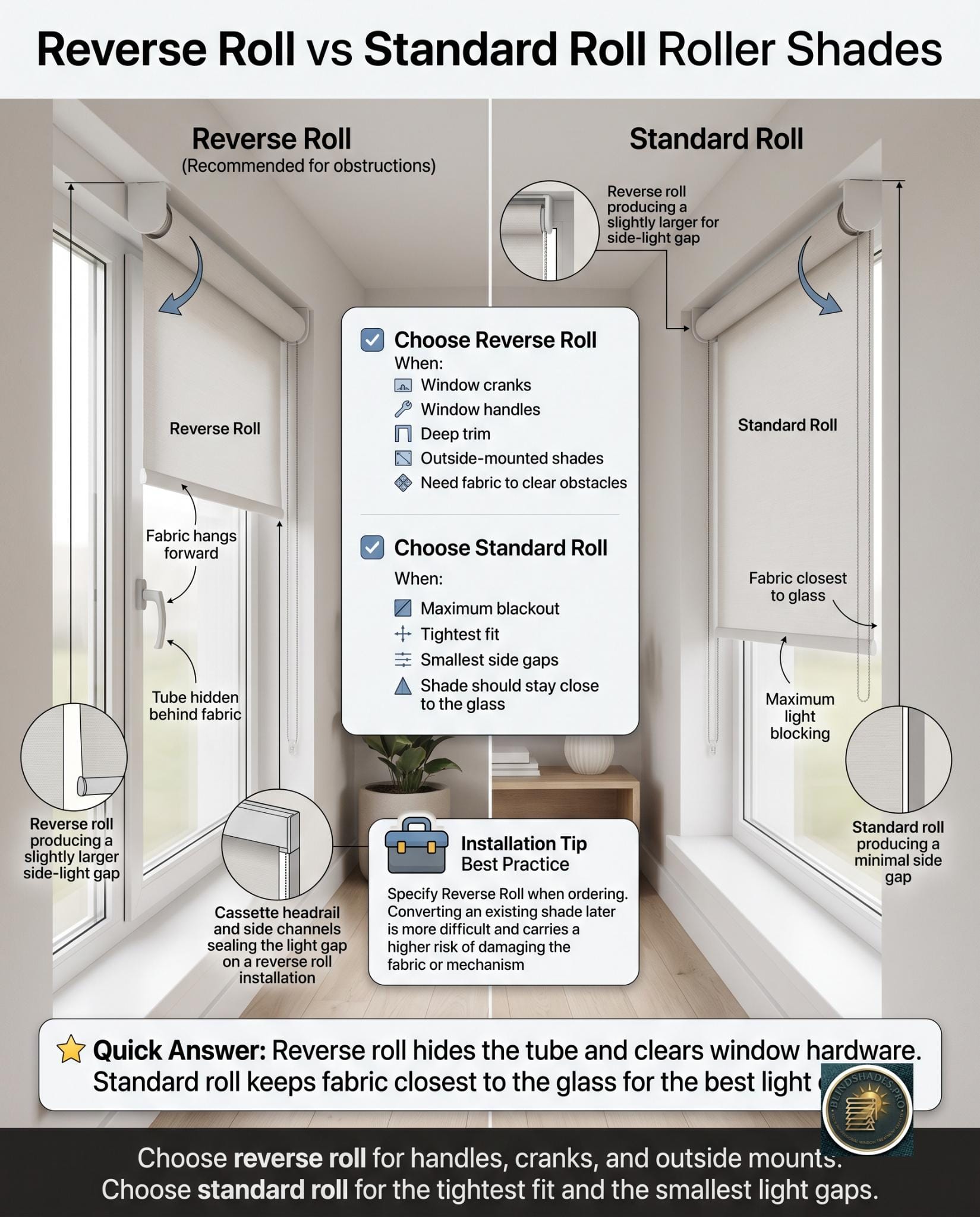
By Michael Turner | 30 years in window treatments
Reverse roll roller shades hang the fabric off the front of the tube instead of the back, so the fabric drops forward of the window in a clean “waterfall” that hides the roller tube — and the right time to choose it is whenever the fabric needs to clear an obstruction or hug the wall. Every guide will tell you what reverse roll is. Almost none tell you when you actually need it, how to know it will fit your window, or what it costs you in side-light leak. This guide gives you the definition, the decision, and the measurement — so you specify the right roll direction the first time.
🎯 5 Key Takeaways
- Reverse roll drops the fabric off the front of the tube, hanging it forward of the glass in a waterfall that conceals the roller tube and hardware — no valance needed.
- Choose it to clear obstructions or hug the wall. Window cranks, handles, deep trim, and outside mounts are the situations that call for reverse roll; closest-to-glass jobs call for standard roll.
- It costs you a little side light. Because the fabric sits further from the glass, reverse roll allows a slightly larger side gap where light can leak — a real trade-off, not a myth.
- A cassette or side channel cancels the light trade-off. If darkness matters, pair reverse roll with a cassette headrail or side tracks to seal the gaps it opens.
- Specify it at purchase, don’t convert if you can help it. Ordering reverse roll is usually free and foolproof; converting an existing shade means motor reprogramming or a fiddly manual reflip that risks crooked tracking.
⭐ Quick Answer
Reverse roll roller shades hang the fabric off the front of the tube instead of the back, creating a waterfall that hides the tube. The short version:
- What it is: the fabric rolls off the front and drops forward of the window, concealing the roller tube, as The Shade Store and ShadeMonster describe.
- Choose reverse roll to clear window cranks, handles, or deep trim, or to hug the wall on an outside mount; it is one spec within our roller shades guide.
- Choose standard roll when the fabric should sit closest to the glass with the smallest side-light gap and darkness is the priority.
- The trade-off: reverse roll allows a slightly larger side gap, which a cassette headrail or side channels seals, since no inside-mount roller fully blocks all light anyway.
- Best practice: specify reverse roll when you order, usually free; converting an existing shade is fiddlier, though Blindsgalore confirms it can be done.
Best Sources: The Shade Store (standard vs reverse roll); ShadeMonster (reverse and standard roll blinds); Blindsgalore (reverse roll difference); Bali Blinds (roller shade roll options); coeurwindowcoverings (reverse vs standard guide).
What Is a Reverse Roll on a Roller Shade?
A reverse roll is a mounting orientation where the shade fabric unwinds from the front of the roller tube, dropping forward of the window rather than close against the glass.
Here is the plain definition. On a standard, or regular, roll, the fabric unwinds from the back of the tube and hangs close to the glass, leaving the tube itself visible at the top from inside the room. On a reverse roll, the fabric unwinds from the front and drops forward, covering the tube completely and creating what the industry calls a waterfall effect. As The Shade Store frames it, “reverse roll” and “standard” simply refer to how the shade is hung and which side of the roll the material comes off. ShadeMonster adds the two consequences that matter: the fabric rolls over the tube to hide the hardware, and it allows a greater gap between the fabric and the window.
So the difference is not the shade — it is the direction the same fabric comes off the same tube, and that direction changes how the shade looks, what it clears, and how much light sneaks past the sides.
What Is the Difference Between Reverse Roll and Standard Roll?
The Clearance-First Rule: choose reverse roll whenever the fabric needs to clear an obstruction or hug the wall, and standard roll whenever sitting closest to the glass is the priority — the window’s hardware and depth decide it, not the look.
This is the frame every ranked page skips in favor of pure definition. Once you know the two trade the same three things in opposite directions, the choice is mechanical.
| Attribute | Standard (regular) roll | Reverse roll |
|---|---|---|
| Fabric position | Off the back, close to the glass | Off the front, forward of the glass |
| Roller tube | Visible at the top from inside | Hidden by the fabric (waterfall) |
| Obstruction clearance | Can catch on cranks or handles | Clears protruding hardware |
| Side-light gap | Smaller, fabric near glass | Larger, fabric set forward |
| Best for | Closest-to-glass, minimal light gap | Clearing hardware, outside mounts, clean face |
Blindsgalore describes reverse roll’s signature as fabric that rolls off the front of the tube for that distinctive waterfall, while coeurwindowcoverings notes the same fabric drops further away from the windowpane. Both are describing the exact trade in the table: you gain a clean, obstruction-clearing drop and lose a little proximity to the glass.
Which Should You Choose — Reverse or Standard Roll?
Match the roll direction to your window’s job — reverse roll for hardware, depth, and outside mounts; standard roll for maximum darkness and closest-to-glass fit.
Rather than a vague “it depends,” here is the decision mapped to real situations.
| Your situation | Choose |
|---|---|
| Window has a crank, handle, or tilt latch | Reverse roll |
| Deep trim the fabric must hang in front of | Reverse roll |
| Outside mount where fabric should hug the wall | Reverse roll |
| You want the tube hidden for a clean face | Reverse roll |
| Maximum darkness with the smallest side gap | Standard roll |
| Fabric should sit closest to the glass | Standard roll |
| Shallow inside mount with no obstructions | Standard roll |
The pattern: reverse roll solves physical clearance and looks, standard roll solves proximity and light control. If your window has nothing to clear and darkness is the goal, standard roll is the quiet default. If anything protrudes, reverse roll earns its place.
This roll-direction decision is one of the under-explained specs we flag in our best roller shades buying guide, and it applies to the rigid category too, covered in roller shades vs roller blinds.
When Do You Actually Need Reverse Roll?
You need reverse roll when something on or near the window would catch a standard-roll fabric — cranks, handles, deep trim — or when an outside mount should sit flat and forward.
The most common real-world trigger is a casement or awning window with a crank handle: a standard-roll fabric drops right onto the crank, while a reverse roll clears it by hanging forward. Here is the obstruction checklist.
| Window feature | Recommendation |
|---|---|
| Crank or awning handle | Reverse roll — fabric clears the handle |
| Protruding tilt or lock hardware | Reverse roll — fabric hangs in front |
| Deep or proud window trim | Reverse roll — fabric drops past the trim |
| Outside mount on a flat wall | Reverse roll — fabric hugs the wall forward |
| Shallow reveal, nothing protruding | Standard roll is fine |
One measurement caveat worth knowing, because forum posters ask it constantly: reverse roll needs enough bracket projection for the fabric to hang forward cleanly. On a shallow window with deep trim, confirm the bracket projects far enough that the fabric clears the trim without rubbing — a quick measurement from the mounting surface to the front of any obstruction tells you. When in doubt, an outside mount with reverse roll sidesteps the depth question entirely.
Does Reverse Roll Leak More Light?
Yes, slightly — because the fabric sits forward of the glass, reverse roll allows a larger side gap where light can leak, but a cassette headrail or side channels seals it.
This is the honest trade-off the sales pages soft-pedal. With the fabric set forward, there is more space between it and the window at the sides, so a bit more daylight can travel down that gap. For most rooms this is negligible. For a bedroom or media room where darkness is the whole point, it matters — and the fix is the same edge-sealing you would use anyway. A cassette headrail closes the top, and side channels close the sides, which together neutralize reverse roll’s light penalty entirely. The broader reality is that no inside-mounted roller shade, reverse or standard, fully darkens a room on its own, as our guide on whether blackout roller shades block all light explains, and the cassette headrail is the cleanest seal for either roll direction.
Can You Reverse an Existing Roller Shade?
Yes, an existing shade can usually be reversed, but it is far easier to specify reverse roll at purchase than to convert one afterward — conversion means motor reprogramming or a manual reflip that risks crooked tracking.
The best answer to “can roller blinds be reversed” is: yes, but plan ahead. Ordering reverse roll is usually a free option at checkout and guarantees a clean, straight result. Converting an existing shade is possible but fiddlier, and the method depends on the shade.
| Method | Effort | Risk |
|---|---|---|
| Specify at purchase | None — a checkout option | None; factory-set and straight |
| Reprogram a motorized shade | Moderate — reset the motor limits | Low, if you follow the manual |
| Manually reflip a corded shade | High — take down, unroll, flip, reattach | Crooked tracking if not perfectly straight |
For a motorized shade, the motor limits can typically be reprogrammed to drop the fabric off the front, but the exact button sequence is model-specific, so follow your manufacturer’s manual rather than a generic procedure. For a manual shade, you take it down, unroll it fully, flip the fabric to roll off the front, and reattach it perfectly straight — the tracking will drift if it is even slightly off. Whether the shade is motorized at all is a separate decision covered in our guide on whether motorized roller shades are worth it. The takeaway: decide roll direction before you buy, and you never have to convert.
Related Buying Guides
- The Best Roller Shades Buying Guide — where roll direction fits the full spec
- Roller Shades vs Roller Blinds — roll direction applies to both
- Do Blackout Roller Shades Block All Light? — sealing the side gaps
- What Is a Cassette Headrail? — the cleanest edge seal for either roll
Frequently Asked Questions
What is a reverse roll on a roller shade? A reverse roll is a mounting orientation where the fabric unwinds from the front of the roller tube and hangs forward of the window, rather than from the back close to the glass. This creates a waterfall look that conceals the roller tube and hardware, clears obstructions like window cranks, and removes the need for a separate valance. The trade-off is a slightly larger side-light gap.
What is the difference between a reverse roller shade and a regular roller shade? The only difference is which side of the tube the fabric rolls off. A regular or standard roll drops the fabric off the back, close to the glass, leaving the tube visible; a reverse roll drops it off the front, forward of the glass, hiding the tube. Reverse roll clears protruding hardware and looks cleaner, while standard roll sits closer to the glass with a smaller side-light gap.
Can roller blinds be reversed? Yes. Most roller blinds can be reversed, and the easiest way is to specify reverse roll when you order, which is usually a free option. An existing shade can also be converted: a motorized shade can have its motor limits reprogrammed, and a manual shade can be taken down, flipped, and reattached, though the manual method risks crooked tracking if the fabric is not reattached perfectly straight.
What is a reverse roll? In roller shades, a reverse roll means the fabric rolls off the front of the tube so it hangs forward of the window in a waterfall that hides the tube, as opposed to a standard roll where the fabric comes off the back and hangs close to the glass. Reverse roll is chosen to clear window hardware, hang in front of deep trim, or hug the wall on an outside mount.
Does reverse roll roller shade leak more light? Slightly, because the fabric sits forward of the glass, which opens a larger gap at the sides where light can travel down. For most rooms this is minor, but for a bedroom or media room it can matter. A cassette headrail seals the top and side channels seal the sides, which cancels the light penalty and gets the room as dark as a standard roll would.
Is reverse roll worth it? Reverse roll is worth it whenever your window has hardware to clear, deep trim to hang past, or an outside mount that should sit flat against the wall, and it gives a cleaner tube-hiding look for no real extra cost when ordered new. If the window is a plain inside mount with nothing protruding and darkness is the priority, standard roll is the simpler choice.
