Flat vs Relaxed vs Hobbled Roman Shades: Fold Styles Explained

Authored By Michael Turner -30 Years Home Improvement Expertise | Updated 2026 | BlindShades.pro
Updated on July 7, 2026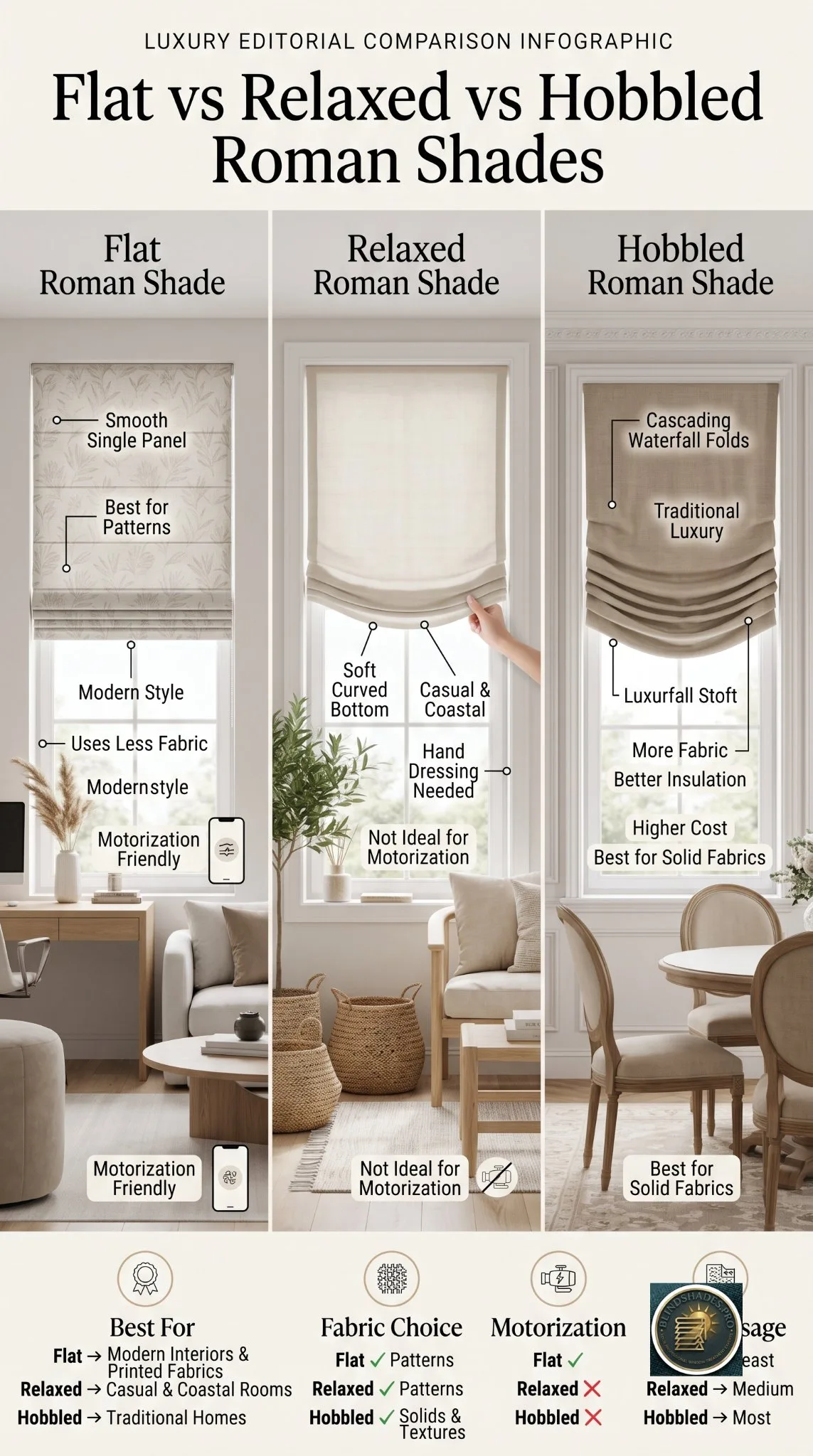
By Michael Turner | 30 years in window treatments
Flat vs relaxed vs hobbled Roman shades differ in how the fabric hangs and folds: flat shades lie crisp and tailored, relaxed shades curve into a soft bottom “smile,” and hobbled shades keep permanent cascading folds even when lowered. But the look is only half the decision. Each fold trades three things you cannot see in a photo — how well it shows a pattern, how much fabric and depth it needs, and whether it works with a motor. This guide covers everything the comparison pages do, then adds the trades that decide which fold actually belongs on your window.
🎯 5 Key Takeaways
- Flat folds are the pattern choice. They lie as a smooth single panel when lowered, showing a print or a clean modern line, and use the least fabric — but the folds are not permanently sewn, so they occasionally need hand-dressing to sit straight.
- Relaxed folds add a soft “smile” — and a catch. The gentle bottom curve suits casual and coastal rooms, but relaxed shades need occasional hand-dressing and are generally not recommended for motorized lifts.
- Hobbled folds are the luxury and insulation choice. Their permanent cascading folds add richness, texture, and better room-darkening, but they use more fabric, cost more, need a deeper sill, and shine in solids rather than prints.
- Fabric decides the fold as much as looks do. Flat and relaxed folds display patterns cleanly; hobbled folds break up a print, so reserve them for solids and subtle textures.
- Only some folds motorize cleanly. Flat and pleated folds work well with motors, while relaxed and hobbled folds are generally not recommended for motorized lifting.
⭐ Quick Answer
Flat vs relaxed vs hobbled Roman shades: flat lies crisp and tailored, relaxed curves into a soft bottom smile, and hobbled keeps full cascading folds. The short version:
- Flat (plain): a smooth single panel when down, best for patterns and modern rooms with the least fabric, though its unsewn folds occasionally need dressing, as Laura U Design Collective notes.
- Relaxed (soft wave): a gentle bottom smile for casual, coastal rooms; it works with most fabrics but needs hand-dressing and is not recommended for motors, per TWOPAGES Curtains.
- Hobbled (soft-fold): permanent cascading folds for a traditional, insulating look that shines in solids, per Blinds.com, but it uses more fabric, costs more, and needs a deeper sill.
- Fabric rule: choose flat or relaxed for prints and hobbled for solids and textures; the full picture is in our Roman shades guide.
- Motorizing? go flat, since relaxed and hobbled are not recommended for motorized lifts; for the best bedroom fold and liner see the bedroom guide.
Best Sources: Blinds.com (Roman fold styles); TWOPAGES Curtains (fold style guide); Laura U Design Collective (designer selection guidance); Blindsgalore (fold styles explained); Cozy Giraffe (pros and cons of Roman styles).
What Is the Difference Between Flat, Relaxed, and Hobbled Roman Shades?
The three differ in how the fabric hangs: flat lies as a smooth panel with neat horizontal folds when raised, relaxed drapes into a soft curved “smile” at the bottom, and hobbled keeps permanent overlapping folds down the whole shade even when lowered.
Here is each fold, defined the way the comparison pages describe it. A flat or plain Roman shade forms a single, smooth piece of fabric when lowered and folds into neat, flat horizontal sections when raised, giving a crisp, tailored, modern look. A relaxed Roman shade — also called a soft wave or European fold — removes the bottom stiffener so the fabric drapes naturally in the center into a gentle, curving smile at the hem. A hobbled Roman shade, also known as a soft-fold or waterfall shade, features cascading, overlapping folds or loops that run the entire length of the shade and stay folded even when fully lowered.
So the difference you see is the fold, but the difference that matters when you buy is the set of trades hiding behind each fold — which the next section lays out.
The Fold-Trade Rule: How to Choose
The Fold-Trade Rule: every fold style trades pattern-display, fabric volume, and stack bulk in a fixed way — flat maximizes pattern and minimizes fabric, hobbled maximizes texture and insulation at the cost of fabric, depth, and motorization, and relaxed sits between with a hand-dressing catch.
Lay the three side by side across every dimension the ranked pages cover, and the choice stops being about taste alone.
| Attribute | Flat (plain) | Relaxed (soft wave) | Hobbled (soft-fold) |
|---|---|---|---|
| Look | Crisp, tailored, modern | Soft curved “smile” | Full cascading folds |
| Best for | Patterns, contemporary rooms | Casual, coastal, farmhouse | Traditional, formal, luxurious |
| Fabric pairing | Prints and solids | Most fabrics | Solids and subtle textures |
| Fabric used / bulk | Least | Moderate | Most (needs deeper sill) |
| Insulation / darkening | Standard | Standard | Best (voluminous folds) |
| Cost | Lowest | Middle | Highest |
| Motorized | Works well | Not recommended | Not recommended |
Blinds.com notes that hobbled shades shine best in solid colors or subtle textures because their folds break up a print, while flat shades suit bold or intricate fabric designs. Cozy Giraffe puts relaxed shades as “nearly the same as flat” but with the added bottom smile. Every row is a trade, and the winning fold is the one whose trades match your window.
Which Fold Style Is Best for Your Fabric?
Match the fold to the fabric: flat and relaxed folds display patterns and prints cleanly, while hobbled folds are best for solids and subtle textures because the folds interrupt a large print.
This is the pairing the design pros insist on, and it is the fastest way to avoid a mismatch.
| Your fabric | Best fold | Why |
|---|---|---|
| Bold print or pattern | Flat | Shows the pattern uninterrupted when lowered |
| Solid color | Hobbled or flat | Solids let the folds be the feature |
| Subtle texture / weave | Hobbled | Cascading folds enhance the texture |
| Sheer or light fabric | Flat with a liner | Clean panel plus the liner you need |
| Casual linen | Relaxed | The soft smile flatters an airy weave |
The rule behind the table: a hobbled fold turns the fabric itself into the design, so it competes with a print, while a flat fold gets out of the way and lets a pattern show. Horizons Window Fashions makes the same point — relaxed folds work with most fabrics, while hobbled works best with solids or textures. If your fabric decision is really a liner decision, our guide on blackout vs light-filtering Roman shades covers that layer.
Which Fold Style Is Best for Your Room?
Flat suits modern living rooms and kitchens, relaxed suits casual and coastal spaces, and hobbled suits formal dining rooms and traditional bedrooms where richness and insulation matter.
Room and style point to a fold as reliably as fabric does, because the same qualities that make a fold right for a fabric — crispness, softness, or fullness — also make it right for a room’s overall feel. Here is the mapping.
| Room / style | Best fold | Why |
|---|---|---|
| Modern living room | Flat | Clean tailored lines, shows a feature fabric |
| Casual / coastal room | Relaxed | The soft smile reads relaxed and inviting |
| Formal dining / traditional | Hobbled | Full folds add richness and warmth |
| Primary bedroom | Hobbled or flat + blackout liner | Insulation and darkening for sleep |
| Kitchen | Flat | Least fabric to trap dust; keep away from moisture |
For darkness-first bedroom setups where the fold and liner work together, see our best Roman shades for a bedroom guide, and the full specification picture is in our best Roman shades buying guide.
Which Fold Styles Work With Motorized Roman Shades?
Flat and pleated folds motorize cleanly because they raise in a straight, linear fold, while relaxed and hobbled folds are generally not recommended for motorization because their non-linear folds need hand-dressing.
This is the compatibility issue nobody flags clearly, and it can override every other preference. TWOPAGES Curtains is explicit that relaxed shades are generally not recommended for motorized lifting due to the non-linear fold, and the same logic applies to hobbled shades, whose voluminous folds do not stack predictably under a motor and need occasional hand-dressing to fall correctly. A flat or pleated fold, by contrast, raises in tidy horizontal sections that a motor handles perfectly, which is why the “Motorized” row in the comparison table above marks flat as the recommended choice. So if a hands-off motorized shade is a must, your fold choice is effectively made for you — go flat. The full cordless-versus-motorized decision is in our guide on cordless vs motorized Roman shades.
What Are All the Roman Shade Fold Names?
The fold names overlap and confuse buyers — flat is also called plain, relaxed is also called soft wave or European fold, and hobbled is also called soft-fold, waterfall, or teardrop — so here is the decoder.
The People Also Search list is full of alias confusion, so this table untangles it.
| Fold name | Also called | What it is |
|---|---|---|
| Flat | Plain | Smooth single panel; folds only when raised |
| Relaxed | Soft wave, European fold | Gentle curved smile at the bottom |
| Hobbled | Soft-fold, waterfall, teardrop | Permanent cascading folds full length |
| Pleated | Front-slat, tailored pleat | Structured, evenly spaced sewn pleats |
Laura U Design Collective adds the honest note behind the flat fold’s clean look: because a flat shade’s folds are not permanently sewn in place, they can occasionally clump, tilt, or shift and may need dressing, whereas a hobbled shade’s folds are sewn and hold their shape. Once you know the aliases and that trade, the marketing language stops being confusing.
Related Buying Guides
- The Best Roman Shades Buying Guide — where fold fits the full spec
- Blackout vs Light-Filtering Roman Shades — the liner decision
- Cordless vs Motorized Roman Shades — which folds motorize
- The Best Roman Shades for a Bedroom — fold and liner for sleep
Frequently Asked Questions
What is the difference between flat and hobbled Roman shades? A flat Roman shade lies as a smooth, single panel when lowered and folds into neat horizontal sections only when raised, giving a crisp, modern look that shows patterns cleanly. A hobbled shade keeps permanent overlapping folds down its entire length even when lowered, for a fuller, traditional look with better insulation. Flat uses less fabric and suits prints; hobbled uses more fabric, costs more, and suits solids.
What is the difference between relaxed Roman blinds and standard Roman blinds? A standard, or flat, Roman blind hangs as a smooth panel with a straight bottom, while a relaxed Roman blind removes the bottom stiffener so the fabric drapes into a gentle, curving “smile” at the hem. Relaxed blinds read more casual and coastal, work with most fabrics, and need occasional hand-dressing, whereas flat blinds are more tailored and structured.
What are the different types of Roman window shades? The main Roman shade fold styles are flat (plain), relaxed (soft wave or European fold), hobbled (soft-fold or waterfall), and pleated (front-slat). They differ in how the fabric folds and hangs: flat is crisp and modern, relaxed adds a soft bottom smile, hobbled keeps full cascading folds, and pleated has structured, evenly spaced sewn pleats. Fabric, room, and whether you want motorization determine which fits best.
Which Roman shade fold is best for patterns? A flat fold is best for patterns because it lies as a smooth panel when lowered, showing a print uninterrupted, and a relaxed fold also displays most patterns well. Avoid a hobbled fold for bold prints, because its permanent cascading folds break up and hide the pattern; reserve hobbled for solid colors and subtle textures where the folds themselves are the feature.
Which Roman shade fold is best for a bedroom? For a bedroom, a hobbled fold adds the most insulation and room-darkening thanks to its extra fabric, while a flat fold paired with a blackout liner also darkens well and takes up less depth. Both work; choose hobbled for a rich, traditional feel and maximum warmth, and flat for a cleaner look, a shallower window, or if you want a motorized lift.
Can you motorize hobbled or relaxed Roman shades? It is generally not recommended. Relaxed and hobbled folds are non-linear and do not stack predictably under a motor, so they need occasional hand-dressing to fall correctly, which defeats the point of motorization. If you want a motorized Roman shade, choose a flat or pleated fold, which raises in a clean, linear stack that a motor handles reliably.
