Interior vs Exterior Blinds for Heat

Authored By Michael Turner -30 Years Home Improvement Expertise | Updated 2026 | BlindShades.pro
Updated on July 24, 2026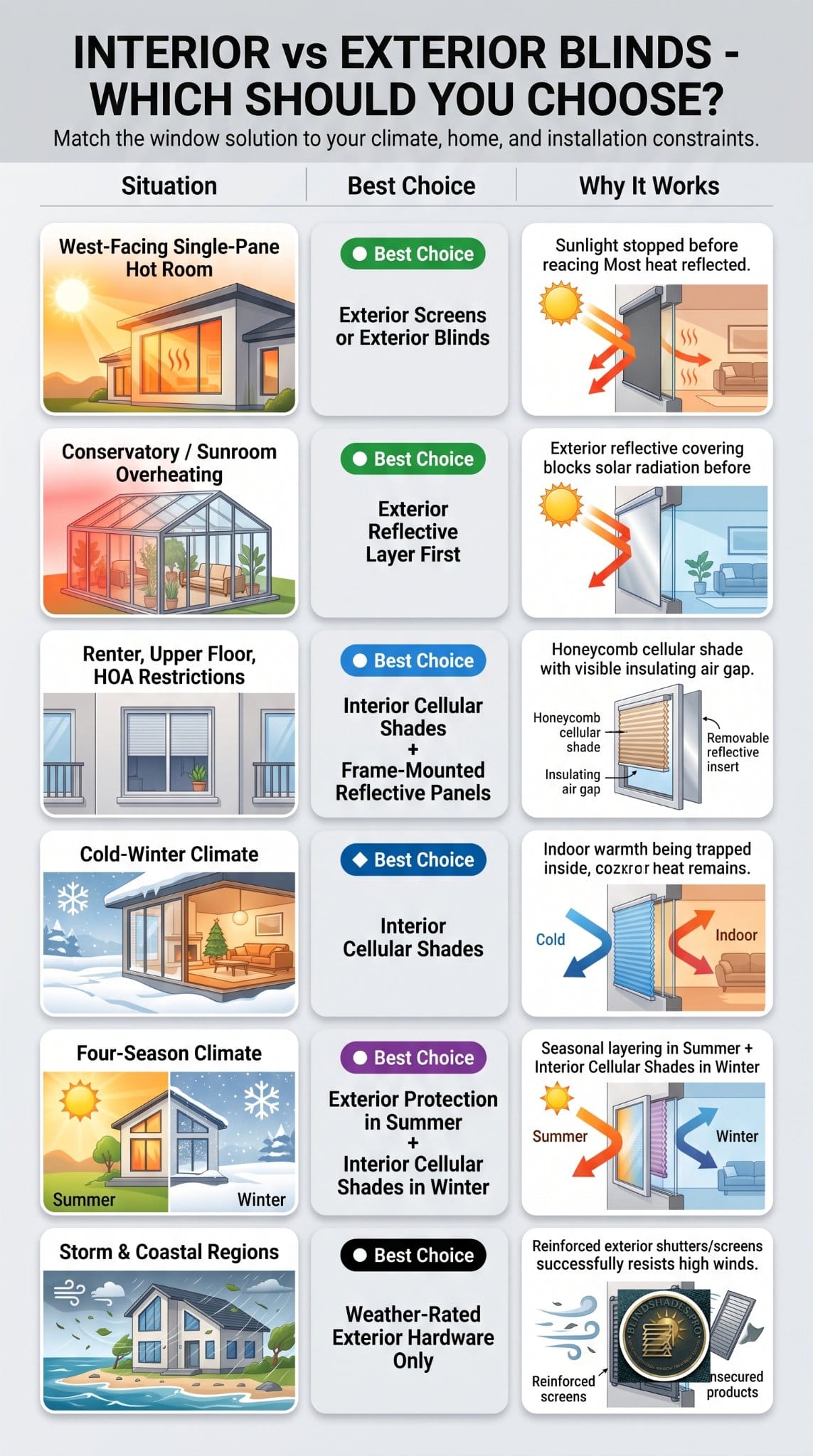
By Michael Turner — 30 years in window treatments
For summer heat, exterior blinds win — and it isn’t close. Mounted outside the glass, they intercept 65 to 80 percent of solar radiation before it enters the building envelope, while an interior blind can only manage heat that has already crossed the glass. But the comparison flips in January: exterior shading does nothing for winter warmth, and the trapped-air layer of an interior cellular shade does everything. Placement is a season strategy, not a loyalty — stop heat outside in July, keep heat inside in December.
Key Takeaways
- The consensus is one-sided for summer: exterior blinds block significantly more heat — 65 to 80 percent of solar radiation intercepted outside the envelope, the glass staying cool — and Hartley’s summary still holds: studies consistently show exterior shading significantly more effective at reducing solar heat gain.
- The mechanism is a one-way valve. Glass passes shortwave sunlight in; once absorbed indoors it re-radiates as longwave heat, which glass traps. Where absorption happens decides everything: an exterior blind re-radiates to the sky, an interior blind re-radiates to your sofa.
- The honest interior maximum: insulating cellular shades are the best inside performer — trapped air pockets, the Department of Energy’s forty-percent-plus winter figure — and, in the field’s own words, they still lag far behind outdoor options for summer interception.
- Winter reverses the verdict: exterior shading is a July tool; the December job — holding room heat against cold glass — belongs entirely to interior trapped-air layers. The complete answer for four-season climates is both.
- Exterior placement has a secret second win: external blinds keep the pane warm on winter nights, and warm glass is dry glass — the documented single-glazing household running external metal blinds reports next to no condensation.
⭐ Quick Answer — Interior vs Exterior Blinds for Heat
The interior vs exterior blinds for heat question splits by season — and the physics decides it:
- Exterior wins summer, decisively: mounted outside the glass, exterior blinds intercept 65 to 80 percent of solar radiation before it enters the building envelope — the glass stays cool, and the U.S. Department of Energy ranks exterior shutters and shades among the most effective summer measures.
- The greenhouse gate explains why: glass passes shortwave sunlight in, but traps the longwave heat that absorbed sunlight becomes — the mechanism Blindsgalore’s screens explainer states. An exterior blind re-radiates to the sky; an interior blind re-radiates into a room the glass won’t let the heat leave.
- Interior wins winter: exterior shading blocks the solar gain you want and holds no room heat — the December job belongs to interior trapped-air layers, where insulating cellular shades cut window heat loss by forty percent or more. Even the field’s own concession stands: honeycombs are the best inside performers and still lag far behind outdoor options for summer interception.
- Exterior’s secret second win: external blinds keep the pane warm on winter nights — and warm glass is dry glass, per the documented single-glazing household reporting next to no condensation. Passive House design treats exterior shading as standard equipment, as the GreenBuildingAdvisor discussion notes.
- Build your ladder: the exterior budget route lives in do reflective foil window covers work, the summer gap rule in do thermal blinds keep heat out, and the interior maximums in our Thermal & Insulated Blinds guide.
Interior vs Exterior Blinds for Heat: Which Side of the Glass Wins?
Stop It Outside, Keep It Inside: summer heat is best intercepted before the glass, winter warmth is best trapped after it — placement is a season strategy.
Start with the paragraph that explains the entire comparison, because the field buries it in a single snippet. Window glass is a one-way valve for heat: sunlight arrives as shortwave radiation, which glass passes freely; when it lands on something — a floor, a sofa, a blind — it’s absorbed and re-emitted as longwave radiation, which glass doesn’t pass. That’s the greenhouse effect, and it’s why placement decides the outcome before any product spec: a blind outside the glass absorbs the sun and re-radiates to open air; an identical blind inside absorbs the same sun and re-radiates into a room the glass won’t let it leave. The interior blind hasn’t failed — it has moved the heat from the window to itself, a few feet into your living space.
The consensus follows from the physics. The exterior side intercepts 65 to 80 percent of solar radiation outside the envelope, keeping the glass cool; Passive House design culture treats exterior blinds and shutters as standard equipment, as the GreenBuildingAdvisor discussion notes; and the Houzz testimony is typical — big single-pane west windows pouring heat into a house, solved with exterior screens. Even the interior side’s best case concedes the point: insulating honeycombs are the finest inside performers and still lag far behind outdoor options at summer interception. This cluster’s documented conservatory case resolved the same way — scalding panes cured by about twenty pounds of reflective layer moved outside the glass.
One decode before the ledger, because two results on this subject answer a different question. Retailer advice that “outside mount blinds block heat gain better,” attributed to the Department of Energy, is about mounting style — an interior blind hung on the wall outside the recess, covering the full opening — not exterior placement. Outside-mount is still an indoor product; the DOE line belongs to the fit doctrine (full coverage beats recessed gaps), not the placement question.
And then January, where the verdict reverses. An exterior blind intercepts sun — which in winter you want pouring in — and does nothing to slow room heat escaping through cold glass at night. That job belongs to the interior layer: still air trapped against the window, the mechanism behind the forty-percent figure. The complete four-season answer is both sides of the glass, each in its season.
The Placement Ledger
| Factor | Exterior blinds | Interior blinds |
|---|---|---|
| Summer interception | 65–80 percent of solar radiation stopped before the envelope; glass stays cool | Manages heat already inside; dark fabrics re-radiate indoors |
| Winter retention | Little to none — and you’ll want them open for solar gain | The whole game: cellular trapped-air cuts window heat loss forty percent-plus |
| The greenhouse position | Absorbs and re-radiates to the sky | Absorbs and re-radiates to the room |
| Materials and install | Weather-rated aluminum and PVC-coated mesh; harder install, higher upfront | Cheaper, simpler, DIY-friendly |
| Durability | Built for wind, rain, and UV — or shouldn’t be outside | Protected indoors; delicate fabrics allowed |
| Renter, upper-floor, HOA fit | Often impossible or forbidden | Always available — the maximums live indoors |
| Cost, in words | The premium route — hardware plus weather-rating plus install | Pocket change to premium, your choice |
| The condensation bonus | External blinds keep the pane warm overnight — warm glass is dry glass, per the single-glazing household | Interior insulation cools the glass; humidity management required |
Which Should You Choose?
| Your situation | The call | Why |
|---|---|---|
| West-facing single-pane hotbox | Exterior screens or blinds | The Houzz case exactly — intercept before the envelope |
| Conservatory or sunroom cooking | Exterior reflective layer first | The documented resolution: outside placement took scalding glass to room temperature |
| Renter, upper floor, HOA territory | The interior maximums | Light-faced cellular with the gap rule, plus frame-mounted panels from do reflective foil window covers work |
| Cold-winter climate, mild summers | Interior cellular, full stop | Winter is a retention game — the picks live in our Thermal & Insulated Blinds guide |
| Four-season extremes | Both, by season | Exterior for July interception, interior for December retention — the layered complete answer |
| Storm and coastal regions | Rated exterior hardware only | Weather-rating is the spec; anything else becomes debris |
Avoid These Mistakes
Buying exterior shading for winter warmth. It intercepts the sun you want and ignores the heat you’re losing. Winter belongs to the interior trapped-air layer.
Confusing outside-mount with outside-placement. Outside-mount is an interior blind covering the full window opening — a fit upgrade, not a placement change. The decode above settles which advice applies where.
Sealing an interior blind tight on hot glass. The indoor consolation prize comes with the gap rule attached — trapped pockets warp slats and stress sealed units, per do thermal blinds keep heat out.
Hanging indoor products outdoors. Weather-rating isn’t marketing; aluminum and PVC-coated mesh exist because wind, rain, and UV destroy everything else.
Skipping the interior maximum when exterior is impossible. Light-faced cellular, snug fit, the choreography from should blinds be up or down — the indoor ceiling is real even if it isn’t the outdoor one.
Who Should Buy Which?
Exterior blinds and screens ✔
- Brutal-sun glass: west faces, conservatories, single-pane hotboxes
- Owners who can mount weather-rated hardware — and Passive House aspirants
Exterior blinds ✖
- Winter warmth seekers; renters and HOA-bound households
Interior blinds ✔
- Every winter household — retention is an indoor game
- Renters, upper floors, and anyone wanting the cheap, simple, protected route
Interior blinds ✖
- As the only answer on severely sun-hammered glass — intercept outside first
The Bottom Line
Interior vs exterior blinds for heat is a season question wearing a product question’s clothes. Exterior wins summer — 65 to 80 percent of solar radiation stopped before the glass, the greenhouse valve never engaged — and interior wins winter, where trapped air against the pane cuts heat loss forty percent or more. Four-season homes want both; everyone else picks the side of the glass their climate argues for. The interior maximums live in our complete Thermal & Insulated Blinds guide, with the honest drawbacks ledger in disadvantages of thermal blinds.
FAQ
What are the pros and cons of interior vs exterior blinds for heat? Exterior: unmatched summer interception, cool glass, a winter condensation bonus — against harder installs, weather-rated hardware costs, and zero winter-warmth contribution. Interior: cheap, simple, renter-friendly, and the whole winter-retention game — against managing heat only after it’s through the glass.
What do exterior blinds cost compared to interior? In words: exterior systems carry the premium of weather-rated materials and mounting, typically running well above comparable interior products; interior options span pocket-change film and panels to made-to-order cellular. The budget path to exterior-grade summer results is a removable reflective layer outside the glass.
Do exterior blinds help in winter? Two small ways and one big miss: lowered on winter nights they add a windbreak and keep the pane warmer — the documented single-glazing household reports next to no condensation behind external metal blinds — but they block the daytime solar gain you want and don’t hold room heat. Winter’s main work is interior.
Are solar screens the same as exterior solar shades? Same family, different builds: solar screens are fixed or seasonal mesh panels mounted over the glass; exterior solar shades are retractable roller-style fabric on weather-rated hardware. Both intercept shortwave radiation before the envelope, both carry the 65-to-80-percent class performance, and both belong to the exterior column of this page’s ledger.
Related Guides
- The Best Thermal & Insulated Blinds — the interior maximums, ranked
- Do Reflective Foil Window Covers Work? — the exterior budget route
- Do Thermal Blinds Keep Heat Out? — the summer gap rule
- Thermal Blinds and Condensation — the moisture side of cold glass
