Should Blinds Be Up or Down?

Authored By Michael Turner -30 Years Home Improvement Expertise | Updated 2026 | BlindShades.pro
Updated on July 24, 2026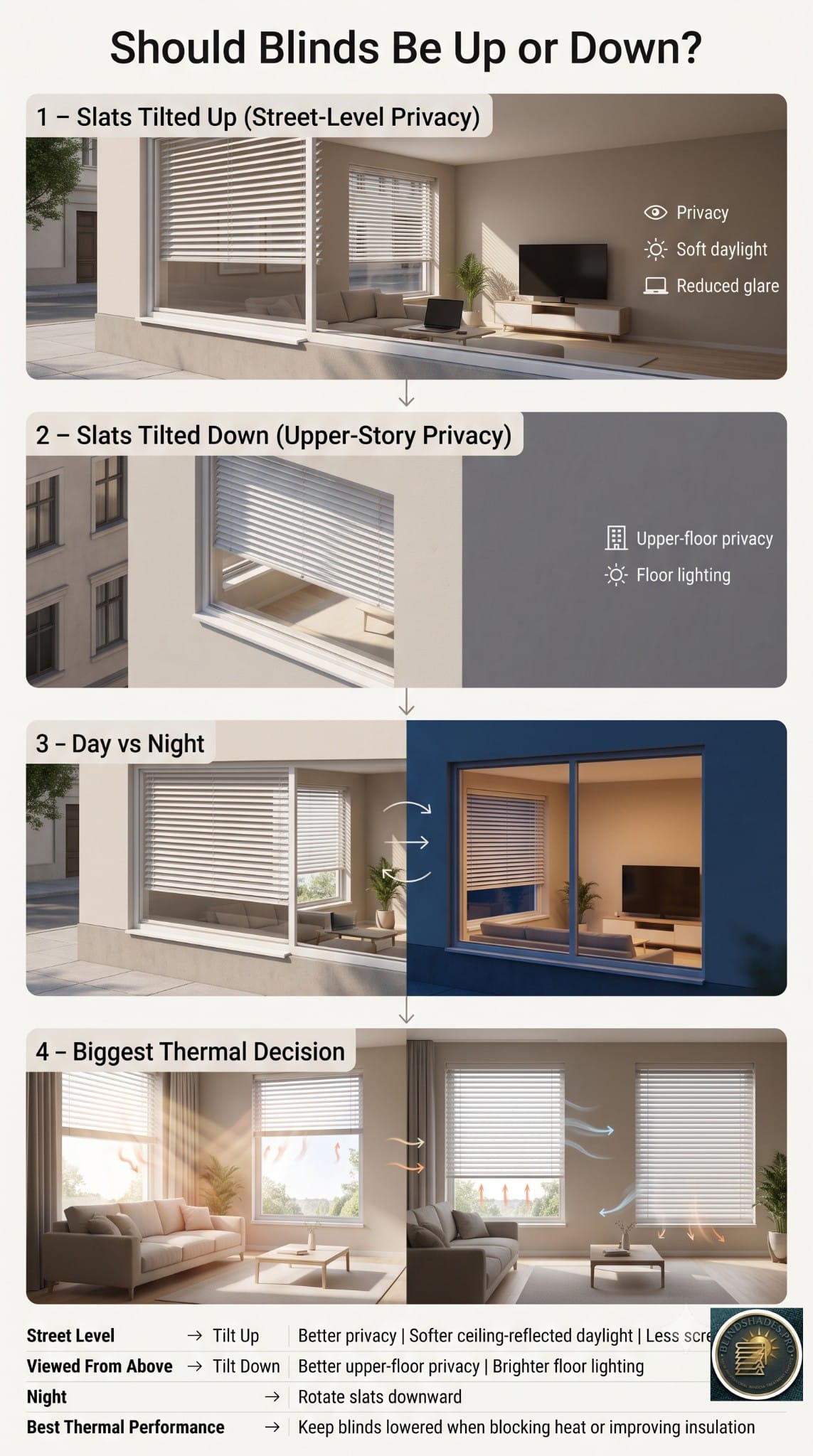
By Michael Turner — 30 years in window treatments
“Should blinds be up or down” is two questions wearing one phrase, and almost every answer online covers only the first. Question one is slat tilt — which way the curve faces — governing privacy, glare, and where light lands. Question two is shade position — raised or lowered at all — governing heat, energy, and the seasons. Tilt up for daytime privacy and summer heat, flip down at night with the lights on, and run the position by the sun: the full schedule below is the part no other guide assembles.
Key Takeaways
- Tilt up (slat tops toward the ceiling) is the daytime default: sightlines deflect upward — the most secure setting for ground-floor windows — light bounces softly off the ceiling, furniture is shielded from UV, and summer sun reflects back out.
- The day/night privacy flip is real: per JMR Blinds, upward-facing slats protect privacy by day, but after dark with interior lights on, downward-facing slats give stronger coverage. One wand twist at dusk.
- Position is the half everyone skips: closed on sun-facing glass through summer days, open on it through winter days for free solar heating, sealed everywhere at winter dusk — the schedule matters as much as the angle.
- Winter nights get a specific setting: closed with the slats tilted up to hold warmth against the glass — Blind Master’s winter rule, and the one most households never hear.
- The concave convention explains the argument at your window: slats are curved, and “down usually puts the concave side out” — but the better rule from the community’s top answer is viewer height: angle the closed side away from wherever eyes are.
⭐ Quick Answer — Should Blinds Be Up or Down?
Asking should blinds be up or down is really two questions — slat tilt and shade position — and both answer cleanly:
- Tilt up by day: slat tops toward the ceiling deflect sightlines upward — the secure setting for ground-floor windows — bounce light softly off the ceiling, shield furniture from UV, and reflect summer sun back out, the maximum-protection close in Budget Blinds’ guidance.
- Flip down at dusk: with interior lights on, your room becomes the bright side and downward-facing slats cover the reversed viewing angle — one wand twist, and the detail the whole debate forgets. Down also wins for upper stories overlooked from above.
- Run the position by the sun: lowered and closed on sun-facing glass through summer days (with an air path), raised on sun-facing glass through winter days for free solar heating, and sealed everywhere at winter dusk with slats tilted up to hold warmth — the schedule backed by the U.S. Department of Energy’s window-covering guidance.
- The “meant to” argument has a real answer: the convention puts the concave side out when closing downward, but the rule that settles cases is viewer height — angle the closed face away from wherever the eyes are, as JMR Blinds’ day-night guide implies.
- Choreograph something worth choreographing: the insulating picks live in our Thermal & Insulated Blinds guide, the summer gap rule in do thermal blinds keep heat out, and the condensation reset in thermal blinds and condensation.
Should Blinds Be Up or Down?
Tilt Is Not Position: one question is which way the slats curve, the other is whether the shade is up at all — and privacy, light, and heat each answer both halves differently.
The tilt half is well argued, if scattered. Up — slat tops toward the ceiling — is the security orientation: passersby at street level see slat backs, not your living room. It’s also the gentle-light setting, bouncing daylight off the ceiling instead of into eyes and screens, and Budget Blinds adds the glare case: closing in the up position gives maximum protection under direct sun. Down earns its keep in two places: upper-story rooms overlooked from above (the sightline reverses, so the shield should too) and rooms wanting brighter, floor-lit warmth — tilted down, light lands on the room’s lower half, as Yahoo’s home guidance notes.
Then there’s the flip nobody remembers at 9 p.m. By day, up-tilted slats hide a dim interior from a bright street; after dark the optics invert — your room is the bright side — and downward-facing slats cover the new viewing angle. JMR’s guide states it plainly; it costs one wand twist at dusk. As for which way blinds are “meant” to go: the documented convention is that down usually puts the concave side facing out, but the community’s top answer gives the rule that decides cases — it depends on the window’s height relative to the person looking. Angle the closed face away from the eyes.
The position half is where this page goes beyond the field: a blind’s biggest thermal decisions aren’t angles — they’re whether it’s up at all.
The Tilt Table: Which Way Should Slats Face?
| Your goal | Tilt | Why |
|---|---|---|
| Ground-floor or street-facing privacy, daytime | Up | Sightlines forced upward; passersby see slat backs |
| Upper-story privacy (overlooked from above) | Down | The viewing angle reverses; so does the shield |
| Privacy at night, lights on | Down | The flip — your room is now the bright side |
| Soft, glare-free light | Up | Light bounces off the ceiling; screens and eyes thank you |
| Bright, open room | Down | Light lands on the floor and the room’s center |
| Summer heat on sun-facing glass | Up, closed | Reflects sun back out — light-colored slats do this best |
| Winter day | Open or up | Let light work; see the position schedule for the bigger wins |
| Winter night | Closed, tilted up | Blind Master’s rule — holds warmth against the glass |
| Maximum darkness | Fully closed either way; down directs leakage floorward | The real fix for edge glow is side channels, per blackout vs thermal blinds |
The Position Schedule: Up, Down, and When
Two named routines cover the year. The Heat-Wave Protocol: on sun-facing glass, lower and close before the sun arrives and hold through the hot hours — with an air path left so the covering intercepts heat without incubating it, the gap rule from do thermal blinds keep heat out. The Winter Solar-Gain Protocol: raise sun-facing blinds through winter daylight — free heating — then close everything at dusk and let the trapped-air layer work the night.
| Season · time | Sun-facing glass | Shaded sides | Why |
|---|---|---|---|
| Summer day | Down, closed, vented | Down or as light demands | Intercept radiation before it soaks the room |
| Summer night | Up, windows venting where safe | Up | Dump the day’s absorbed heat |
| Winter day | Up — collect the free heat | Down, closed | Sun in where it lands; insulation where it doesn’t |
| Winter night | Down, closed, slats tilted up | Same | The trapped-air layer earns its keep; the up-tilt seals warmth |
| Condensation-prone rooms | Raise at the sunniest hour; overnight bottom crack | Per humidity | The daily pocket reset — full routine in thermal blinds and condensation |
One honest limit from the community record: on brutal sun, an interior blind manages heat that has already crossed the glass — closed-and-down lowers the gain, exterior shading prevents it. Deciding what to hang rather than how to angle it? The rankings live in our Thermal & Insulated Blinds guide and the ladder in which blinds insulate best.
Avoid These Mistakes
Leaving the daytime tilt on after dark. The up position that hid your room at noon showcases it at nine with the lamps on. One wand twist.
Parking the blinds one way all year. A blind that never moves collects neither winter sun nor summer relief. The schedule is the product’s second half.
Sealing tight over hot glass. Closed-and-down on a blazing west window still needs an air path — trapped pockets warp slats and stress sealed glazing.
Sleeping through winter sun. Sun-facing blinds left down through a bright January day decline hours of free heating — the commonest position mistake.
Fighting the curve without knowing the convention. If the wand seems to close “backwards,” it’s the concave-out default. Use the viewer-height rule and ignore the argument.
Who Should Do What?
Tilt up by default ✔
- Ground-floor and street-facing rooms by day
- Screen-heavy rooms fighting glare
- Sun-facing glass in summer, closed
Tilt down by default ✔
- Upper stories overlooked from above
- Any room after dark with lights on
- Rooms that want bright, floor-lit warmth
Run the full schedule ✔
- Energy-first households — the position half is where the bills move
- Condensation-prone homes — the daily raise is the reset
Skip the fuss ✖
- Rooms with no sightlines and no sun exposure — set once, revisit seasonally
The Bottom Line
Should blinds be up or down? Tilt up by day for privacy, soft light, and summer reflection; flip down at dusk when the lights come on; run the position by the sun — closed against summer heat, open to winter daylight, sealed with slats tilted up through winter nights. The routines take ten seconds a day and beat any single “correct” setting, because the correct setting changes with the clock. The blinds worth choreographing are ranked in our complete Thermal & Insulated Blinds guide — and if daily wand duty sounds like a chore, that’s the case for automation.
FAQ
Should my blinds be up or down for privacy? Up during the day — sightlines deflect toward the ceiling, the most secure setting for ground-floor windows. Down after dark with interior lights on, and down for upper-story rooms watched from above. The rule underneath both: angle the closed face away from wherever the eyes are.
Are blinds meant to be up or down? There’s a manufacturing convention — closing downward usually puts the concave side facing out — but no mandate. The functional answer beats the convention: choose by viewer height, time of day, and season. Both directions exist because both are correct somewhere.
Which direction is best for blinds? Up for daytime privacy, glare control, UV protection, and reflecting summer heat; down for overlooked upper floors, nighttime coverage, and brighter floor-level light. If one default must rule, up wins the most hours — but the dusk flip and the seasonal schedule beat any single direction.
Is a room darker with blinds up or down? Fully closed, both directions block most light; upward presses the slats toward the frame for the tightest face, downward directs remaining leakage floorward. Either way, the light that matters escapes at the edges — side channels, not tilt direction, are the real darkness upgrade.
Related Guides
- The Best Thermal & Insulated Blinds — the complete guide
- Do Thermal Blinds Keep Heat Out? — the summer gap rule
- Thermal Blinds and Condensation — the daily-reset routine
- Why Do Rich People Leave Their Windows Uncovered? — the dusk-close culture piece
