Which Blinds Insulate Best? The Material Ladder, Ranked

Authored By Michael Turner -30 Years Home Improvement Expertise | Updated 2026 | BlindShades.pro
Updated on July 24, 2026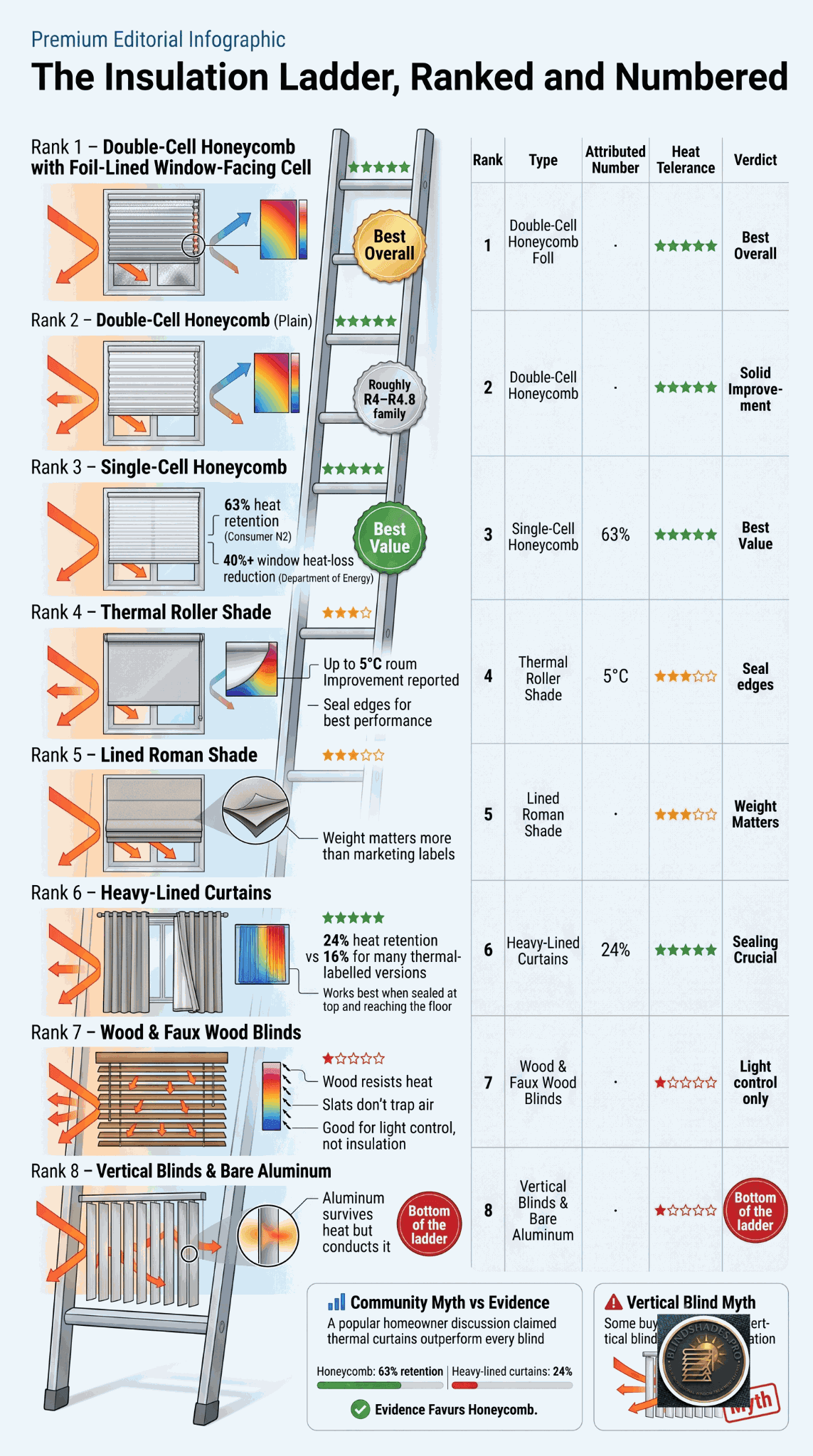
By Michael Turner — 30 years in window treatments
Cellular honeycomb blinds insulate best — and among them, a double-cell blind whose window-facing cell carries an internal foil layer, fitted snugly or run in side tracks, sits at the very top. That direct answer is where most guides stop; this one proves it. Which blinds insulate best is really three questions stacked together — which construction traps the most air, how much fit multiplies or destroys that trapping, and whether winter and summer even share the same ranking — and every rung on the ladder below carries an attributed number: comparative retention testing, the U.S. Department of Energy’s figures, and the community’s own R-value reports. The ladder also names the worst offenders, because two of the types some lists recommend barely insulate at all.
Key Takeaways
- Cellular honeycomb wins, with numbers. Consumer NZ’s comparative testing put honeycomb blinds at sixty-three percent heat retention — against twenty-four percent for heavy-lined curtains and sixteen for thermal-labeled ones — and the U.S. Department of Energy credits insulated cellular shades with cutting window heat loss by forty percent or more.
- Construction beats cell count. Community head-to-heads report single-to-double cell moves roughly R4 to R4.8 — a modest step — while a window-facing cell with an internal foil layer is the specification owners single out as the one that moves heat performance.
- Fit multiplies everything. A snugly fitted single-cell outperforms a gappy double-cell; edge gaps bleed the trapped air pocket that the entire ranking depends on. Side tracks and exact inside-mount measurement are ranking moves, not accessories.
- Winter and summer rank differently. Cells win winter outright; in summer, reflective backings help but no interior blind fully stops heat already through the glass — hard-sun rooms pair with exterior shading.
- Two popular picks barely insulate. Slatted wood, faux wood, and vertical blinds leak air between the vanes, and bare aluminum actively conducts heat — light control products, not insulation.
⭐ Quick Answer — Which Blinds Insulate Best?
Cellular honeycomb blinds — that’s the direct answer to which blinds insulate best, and the ladder beneath it is numbered, not asserted:
- The crown, with figures: honeycombs retained sixty-three percent of heat in Consumer NZ testing — against twenty-four for heavy-lined curtains — and the U.S. Department of Energy credits cellular shades with cutting window heat loss by forty percent or more.
- The true top rung: a double-cell with a foil-lined, window-facing cell — construction beats cell count, and community head-to-heads put the plain single-to-double step at only R4 to R4.8.
- Fit multiplies everything: a snugly fitted single-cell beats a gappy double-cell; side tracks and exact inside-mount sizing are ranking moves, not accessories — even Hunter Douglas, whose cellular shades claim the most-insulating title, sells the fit story second.
- The bottom rungs, named: slatted wood, vertical blinds, and bare aluminum barely insulate — air moves between the vanes — whatever the listicles say.
- Choose your rung: the ranked current models live in our Thermal & Insulated Blinds guide and our cellular shades guide — and whether the top rungs pay back in your rooms is settled in are thermal blinds worth it.
Which Blinds Insulate Best?
The ranking runs on three forces — Trap · Seal · Mass: how much still air the construction traps, how well the fit seals that air in place, and how much material mass backs the trap. Labels rank last; a tag that says “thermal” moves nothing.
Cellular honeycomb blinds insulate best because they are the only mainstream blind built as an insulator first: rows of hollow cells hold still air against the glass, and still air is a poor conductor — the same principle behind double glazing. The industry and the community agree for once. Hunter Douglas states plainly that cellular shades are the most insulating shades on the market; the community’s version is a 193-answer r/AusRenovation thread reporting honeycombs making a huge difference at minus seven degrees overnight, and a buy-it-for-life thread putting the best available honeycomb constructions near R4.
But “cellular wins” is the start of a useful answer, not the end of one. The gap between the best cellular blind and a mediocre one is wider than the gap between types — and the gap between a well-fitted blind and a gappy one is wider still. Whether the top rungs pay back in your rooms is a separate question with its own full verdict in are thermal blinds worth it; this page settles the ranking itself, with a numbered ladder, a construction decoder, and a fit rule. In that order.
The Insulation Ladder, Ranked and Numbered
Every rung below carries its attribution — retention testing, Department of Energy figures, or the community’s own reports — plus a heat-tolerance column, because summer failure modes are part of ranking honestly:
| Rank | Type | The attributed number | Heat tolerance | Verdict |
|---|---|---|---|---|
| 1 | Double-cell honeycomb, foil-lined window-facing cell | Community spec singled out as the detail that moves heat performance; the R4-class family’s crown | High — cells shade the fabric itself | The harsh-climate and west-glass pick |
| 2 | Double-cell honeycomb, plain | Roughly R4 to R4.8 over single-cell per community head-to-heads | High | A modest step over single — pay for the foil first |
| 3 | Single-cell honeycomb | The sixty-three-percent retention class in Consumer NZ testing; forty-percent-plus window heat-loss cut per the Department of Energy | High | The value sweet spot for most rooms |
| 4 | Thermal roller, reflective or blackout backing | Up to a five-degree-Celsius room gain reported from one large unit | Medium — keep sealed systems off hot glass | The budget rung with real results |
| 5 | Lined roman shade | Mass-driven; the thermal label adds little over a thick lining | Medium | Choose weight, not wording |
| 6 | Heavy-lined curtains (for comparison) | Twenty-four percent retention — and sixteen for thermal-labeled versions | High | Sealed and floor-length, they compete; loose, they lose |
| 7 | Slatted wood and faux wood | No meaningful trapped air — vanes leak at every gap | Wood insulates itself, but the slats don’t seal | Light control, not insulation |
| 8 | Vertical blinds and bare aluminum | Air moves freely between vanes; aluminum conducts heat | Aluminum shrugs off heat that melts vinyl — the one thing it does well here | The bottom of the ladder, whatever some lists say |
Two rungs need defending. Curtains appear on a blinds ladder because the most-endorsed answer in a 51-answer r/HomeImprovement thread claims thermal curtains hold heat better than any blind — a claim the retention numbers answer directly: honeycombs at sixty-three percent nearly triple heavy-lined curtains at twenty-four, and the curtain case survives only on very large openings with floor-length, top-sealed panels. The full fight has its own coverage coming. And vertical blinds appear because at least one circulating best-of list ranks them as top insulators — the vane gaps say otherwise. With the ladder set, the next question is what separates rung one from rung three.
What Makes a Cellular Blind Insulate Best?
The decoder below is the section the crown-cellular consensus never writes — the constructions, ranked by what actually moves performance:
| Construction feature | What it does | Worth paying for? |
|---|---|---|
| Foil-lined, window-facing cell | Reflects radiant heat inside the cell — the specification a widely endorsed owner report calls the important one | First — this beats adding cell count |
| Double cells | A second trapped-air layer; roughly R4 to R4.8 over single per community reports | For harsh climates and big glass, after the foil |
| Side tracks or U-channels | Seal the edge gaps that bleed the air pocket | Yes on drafty and cold-climate windows — a ranking move |
| Blackout cell interiors | Denser cell walls; light control plus a small thermal gain | Buy for the darkness; take the warmth as a bonus |
| Exact inside-mount sizing | The cells only work where the air can’t route around them | Always — it’s free at order time |
The one-line rule: construction beats count. Mild climates do fine at single-cell; harsh climates and west-facing glass buy the foil-lined cell first, the second cell second, and the side tracks where drafts live. The complete R-value mathematics — what the numbers mean, single versus double cell in depth — is its own guide in this cluster, and the current models carrying these constructions are ranked in our Thermal & Insulated Blinds buying guide; here, the buying rule is enough. Except that none of it survives a bad fit, which is the rung-shifting force nobody prices.
Does Fit Matter More Than Fabric?
Often, yes — and this is the multiplier the type lists skip. The trapped air pocket that powers the whole ladder only exists where air cannot route around the blind:
| Fit factor | Effect on the ladder | The rule |
|---|---|---|
| Edge gaps at inside mount | A gappy double-cell can fall below a sealed single-cell | Measure to the millimeter; order to the maker’s inside-mount tolerance |
| Side tracks | Recover the edge losses on drafty glass | The premium spec the community endorsed years before the industry began marketing it |
| Sill landing | A blind that stops short leaves a convection outlet | Land the bottom rail on the sill, or overrun on outside mounts |
| Width overrun (outside mount) | Coverage past the frame stops the sideways leak | Three to four inches past each edge is the working standard |
| The hot-glass caveat | On sun-hammered glass, a perfectly sealed pocket traps damaging heat | Keep the manufacturer’s specified gap on hard-sun windows, or shade outside |
The sealed-single-beats-gappy-double rule is worth stating twice, because it reverses buying instincts: money spent on exact measurement and side tracks routinely outranks money spent on a construction upgrade. And the last row is the honesty clause — the same seal that wins winter can stress sealed glazing units on west-facing summer glass, a failure mode with its own full coverage in this cluster. Which raises the seasonal question directly.
Which Blinds Are Warmest for Winter — and Coolest for Summer?
The winter ranking and the summer ranking are cousins, not twins. Thermal window coverings for winter reward trapped air and sealed edges; summer rewards reflection and, above all, stopping heat before the glass:
| Season | Best performers | The honest note |
|---|---|---|
| Winter — keeping heat in | Foil-cell and double-cell honeycombs, sealed tight; heavy floor-length curtains on big openings | The sixty-three-percent retention class; raise sun-facing blinds by day for free solar gain, drop them at dusk |
| Summer — keeping heat out | Light-colored or reflective-backed cells and rollers, paired with exterior shading | Interior blinds reduce but cannot fully stop heat already through the glass — the exterior-first consensus is the community’s strongest summer finding |
| Both seasons, one buy | Double-cell with foil-lined window-facing cell, light room-side color | The construction that ranks top-three in both columns |
Winter is where this ladder’s top rungs earn their price — the minus-seven honeycomb report and the five-degree roller gain are both winter results. Summer demands humility from every interior product: reflective backings and pale colors reject part of the load, slats tilted up bounce light to the ceiling, and the rest of the summer playbook — including when up-or-down actually matters — belongs to its own pages in this cluster.
Avoid These Mistakes
- Buying the label. Thermal-labeled curtains retained sixteen percent against twenty-four for ordinary heavy linings in Consumer NZ’s testing. On tags, “thermal” is decoration; on constructions — cells, foil, linings — it’s physics.
- Paying for a second cell before the foil. The community’s own head-to-heads put the single-to-double step at roughly R4 to R4.8; the foil-lined window-facing cell is the upgrade owners actually notice.
- Ignoring the gaps. Edge leaks bleed the air pocket that the entire ranking measures. A sealed cheaper blind beats a gappy dearer one.
- Sealing tight against hard-sun glass. Trapped-heat pockets have warped slats and cracked sealed glazing units — keep the specified gap on west and south glass, or shade from outside.
- Ranking verticals or slatted wood as insulators. Vane gaps move air continuously; buy them for light control and looks, then add an insulating layer if the room needs one.
- Forgetting bare aluminum’s one virtue and one vice. It won’t warp in a heat pocket the way vinyl does — and it conducts winter cold straight through.
Who Should Buy Which Blind?
✔ Match the rung to the room:
- Cold-climate bedrooms, offices, and drafty older glass — foil-cell or double-cell honeycomb, side-tracked
- Most living spaces in most climates — single-cell honeycomb, exactly measured
- Budget rooms and rentals — thermal-backed rollers; real results at the lowest spend
- Very large openings and sliders — heavy sealed curtains compete here, and wide spans have their own coverage coming
✖ Don’t buy for insulation:
- Slatted wood or faux wood, vertical blinds, bare aluminum — light control products
- Any product chosen by its “thermal” tag rather than its construction
- Sealed frame-fit systems for sun-hammered glass without the specified air gap
The Bottom Line
Which blinds insulate best? Cellular honeycombs — proven by retention testing at sixty-three percent, the Department of Energy’s forty-percent figure, and the community’s own minus-seven winters — with the foil-lined window-facing cell as the true crown and fit as the multiplier that can promote or demote any rung. Buy construction first, seal second, mass third, and never the label. The ranked current picks live in our Thermal & Insulated Blinds buying guide and the honeycomb family’s own cellular shades guide — and check current sale pricing before ordering, because this category discounts deeply and often.
FAQ
What are the best insulated cellular shades? Rank by construction, not brand: a double-cell with a foil-lined, window-facing cell first, plain double-cell second, single-cell as the value pick — side-tracked on drafty glass, exactly measured always. Brands share the physics; the ranked current models live in our cellular shades guide, refreshed against sale cycles.
Are honeycomb blinds worth it for insulation? Yes — the strongest yes on the ladder. A 193-answer community thread reports honeycombs making a huge difference at minus seven degrees overnight, buy-it-for-life reports put the best constructions near R4, and Consumer NZ’s testing measured sixty-three percent heat retention — nearly triple heavy-lined curtains.
What are the best thermal window coverings for winter? Sealed cellular honeycombs first — the trapped-air construction winter rewards most — then thermal-backed rollers on a budget, then heavy floor-length curtains sealed at the top on large openings. Raise sun-facing coverings by day for free solar warmth and drop them at dusk as the insulating layer.
Do curtains insulate better than blinds? The most-endorsed forum answer says yes; the measured numbers say mostly no. Honeycomb blinds retained sixty-three percent in comparative testing against twenty-four for heavy-lined curtains — and fitted blinds win outright over radiators. Curtains compete on very large openings, floor-length and top-sealed. The full head-to-head has its own guide.
Which blinds insulate best in the USA? The same physics, with a market note: big-box stock runs single-cell — the value rung — while foil-cell and side-tracked constructions come made-to-order. The Department of Energy’s forty-percent heat-loss figure is the domestic benchmark, and deep, frequent sale cycles reward checking current pricing before any custom order.
Do wooden or vertical blinds insulate at all? Barely. Wood insulates as a material, but slatted designs leak air at every vane, and verticals move air continuously; both sit at the ladder’s bottom with bare aluminum, which conducts heat outright. Buy them for light control, then layer an insulating covering where the room needs one.
Related Guides
- Best Thermal & Insulated Blinds — the complete guide
- Best Cellular Shades — the complete guide
- Are Thermal Blinds Worth It? — the honest numbers verdict
- Cheapest Ways to Insulate Windows — the ranked ladder
- Best Blackout Blinds & Shades — the complete guide
