The Cheapest Ways to Insulate Windows, Ranked

Authored By Michael Turner -30 Years Home Improvement Expertise | Updated 2026 | BlindShades.pro
Updated on July 23, 2026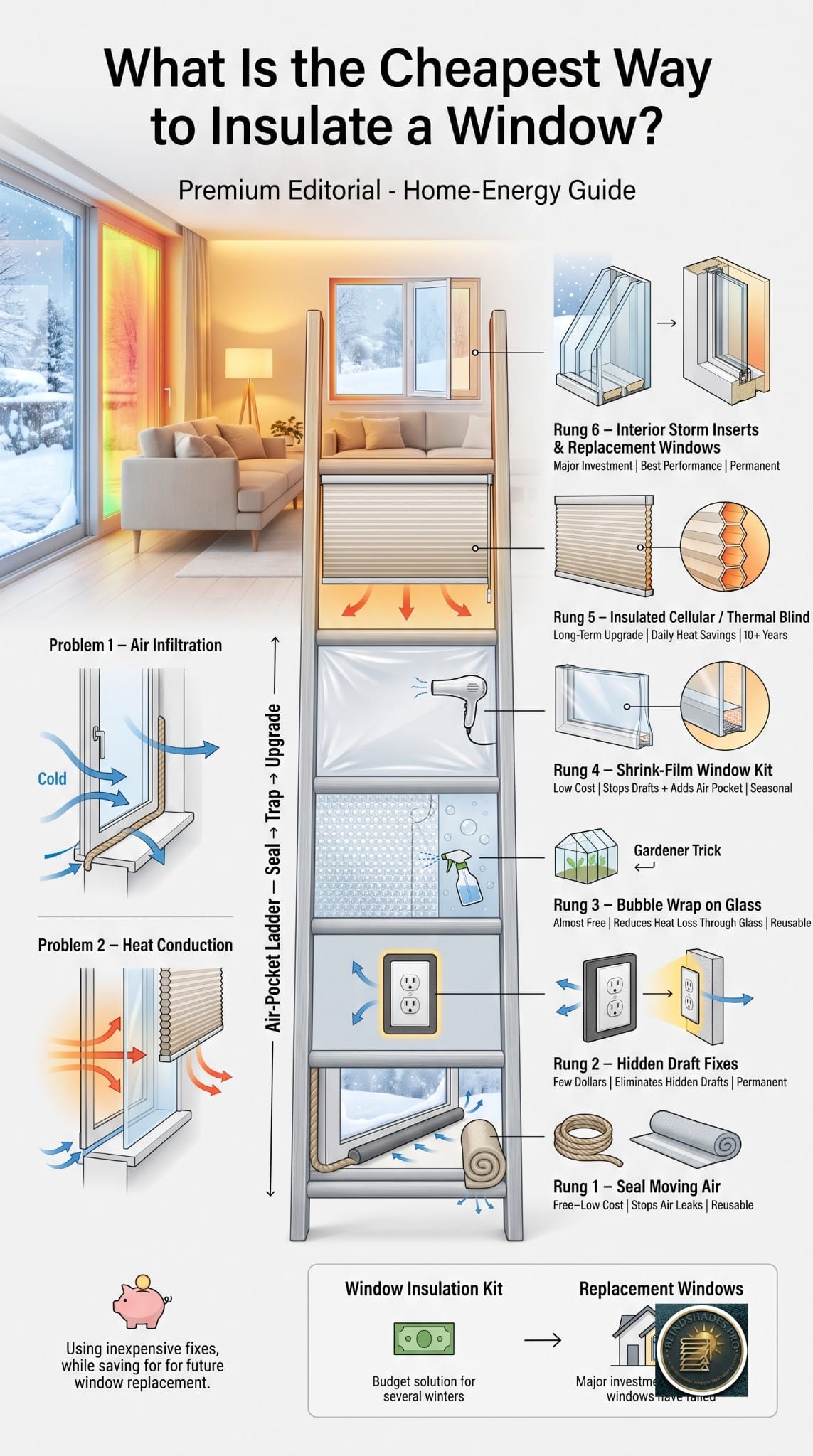
By Michael Turner — 30 years in the window treatment industry
The cheapest ways to insulate windows, ranked from free upward: stop moving air first with rope caulk, draft snakes, and outlet gaskets; trap a still-air pocket over the glass second, with bubble wrap or a shrink-film kit at a few dollars per window; and only then spend real money — on insulated cellular blinds, or on replacement windows if the frames themselves have failed. The U.S. Department of Energy attributes roughly twenty-five to thirty percent of residential heating and cooling energy use to windows, which is why these cheap fixes punch far above their price. Below: the full cost ladder, the install rules that decide whether a ten-dollar kit lasts one week or one winter — including the half-inch rule almost nobody explains — and the point where a proper thermal blind becomes the better spend.
Key Takeaways
- Seal drafts before you buy anything. Moving air is the biggest thief; rope caulk, a rolled towel at the sash lock, and foam outlet gaskets fix what film and blinds cannot.
- Shrink-film kits genuinely work. An HVAC professional’s summary from a 985-comment homeowner discussion: all insulation is trapped air pockets, and the plastic creates one over your window.
- Real households report real numbers. That discussion logged a roughly twenty-degree gain in a sealed porch room, a winter electric bill cut by a third, and a furnace running three fewer hours a day.
- Installation quality decides everything. Alcohol-prepped frames, tape on the trim’s outer edge, and a roughly half-inch air gap separate a kit that holds all winter from one that peels off in the first wind.
- Cellular blinds are the permanent rung. The Department of Energy credits insulated cellular shades with cutting window heat loss by forty percent or more — and you can still open the window in March.
⭐ Quick Answer — Cheapest Ways to Insulate Windows
The cheapest ways to insulate windows climb a five-rung ladder — seal the moving air first, trap a still-air pocket over the glass second, and upgrade the covering before you ever price new glazing:
- Seal drafts for pennies: rope caulk, draft snakes, and foam outlet gaskets attack infiltration — the part of the problem no film or blind can fix — and the U.S. Department of Energy attributes roughly a quarter to a third of heating and cooling energy use to windows.
- Bubble wrap is the near-free rung: mist the glass, press the bubble side in — a standard greenhouse practice that peels clean and re-sticks next season.
- Shrink-film kits genuinely work: an HVAC professional’s summary — all insulation is air pockets, and the plastic builds one over your window — matches the guidance This Old House has given for years; prep with rubbing alcohol and respect the half-inch air gap, with 3M’s kit as the category reference.
- Real results, reported: rooms about twenty degrees warmer, winter bills cut by a third, a furnace running three fewer hours a day — the draftier the window, the bigger the payoff.
- The permanent rung is a blind: insulated cellular shades cut window heat loss by forty percent or more per the Department of Energy — the year-round fix ranked in our thermal and insulated blinds guide, with rental-safe options in the temporary blinds guide.
What Is the Cheapest Way to Insulate a Window?
Our framework is the Air-Pocket Ladder — Seal, Trap, Upgrade: seal moving air first, trap a still-air pocket over the glass second, and upgrade the covering or the window itself only when the first two rungs stop paying.
Every rung works on one of two problems: infiltration — air leaking through gaps in the sash, frame, or even exterior-wall outlets — or conduction, heat passing straight through cold glass. Cheap fixes mostly attack the first; blinds and better glazing the second. Climb in order and you never pay twice for the same job.
| Rung | Method | Typical cost (in words) | What it actually fixes | Survives spring? |
|---|---|---|---|---|
| 1 | Rope caulk, draft snakes, rolled towels at the lock | Free to a few dollars | Air infiltration through gaps | Yes — peels off and re-packs |
| 2 | Foam outlet and switch gaskets, exterior walls | A few dollars a room | Hidden wall drafts most people never check | Yes — permanent |
| 3 | Bubble wrap misted onto the glass | Near free | Pane conduction; the greenhouse growers’ trick | Yes — peel, store, re-stick |
| 4 | Shrink-film window insulation kit | Under ten dollars per small window | Infiltration and conduction together — a sealed air pocket | No — one season, then re-buy |
| 5 | Insulated cellular or thermal blind | Mid two-figures per window and up | Conduction, daily, with the window still usable | Yes — a decade-class purchase |
| 6 | Interior storm inserts, then replacement windows | Hundreds per window and up | Failed frames, seals, and sashes | Yes — the last rung |
One homeowner framed the economics perfectly: about eight dollars for a kit against a couple of thousand for replacement windows. The kit will not make old windows new — but it buys the winters you need to save for the bigger job. First, though: why a sheet of plastic works at all.
Do Window Insulation Kits Actually Work?
Yes — and the clearest explanation on record comes from an HVAC professional in a 985-comment r/Home homeowner discussion: “All insulation involves air pockets; this plastic creates a pocket over your window. Of course it works and everyone should do it.” This Old House has long recommended shrink-film kits for drafty windows for the same reason.
The physics is the trick double glazing plays: still air conducts heat poorly, which is why sealed panes hold a gas layer between them. A taut sheet of film turns a single-pane window into a rough double, and a double into a rough triple. It also stops infiltration outright — several homeowners described watching the plastic billow like a sail on windy days, holding back air that used to move the curtains with the window shut.
Two honest limits. First, gains scale with how bad your windows are — on well-sealed modern glazing the improvement is modest, and the film’s own R-value is close to nil; its job there is draft-stopping and condensation control. Second, it is seasonal: the tape comes down in spring, and the window stays shut while the film is up. If either bothers you, skip to the blinds rung. If not, the next section separates the kits that last from the kits that fail.
How Do You Install Window Film So It Lasts All Winter?
This is the Install Clinic — the craft nine hundred homeowners converged on, and that almost nobody selling the kits writes down.
The kits fail at the tape, not the plastic. Every rule traces to a reported failure and its fix:
- Prep with rubbing alcohol, never glass cleaner. Spray cleaners leave a greasy film that ruins the adhesive; a high-strength isopropyl scrub and a dry frame is the season-long hold.
- Tape the trim’s outer edge, not its face. A thirty-year user of these kits reports the tape is nearly invisible there, grips better, and any lifted paint is out of sight.
- The two-tape trick, with its catch. Painter’s tape down first, the kit’s double-sided tape on top — spring removal becomes painless. The catch: months of window sunlight can yellow and embrittle painter’s tape, so treat it as a one-season sacrifice layer.
- Respect the half-inch rule. The pocket insulates best at roughly half an inch to an inch deep — enough still air to resist heat flow, not enough for convection to circulate inside it. Film stretched a foot from a recessed window still stops drafts, but the deep cavity gives most of the insulation back.
- Never install in deep cold. Below roughly freezing the adhesive will not bond. Install on a mild day, ahead of the weather.
- Shrink with care. A hair dryer works; a heat gun on low works in a quarter of the time — with a real risk of melting a hole. Patch any puncture with clear packing tape; a single pinhole bleeds the pocket.
- Cats and toddlers: plan for patches. Claw punctures were the single most-reported failure. Packing tape works — one homeowner ended the season with a window that was ninety-five percent packing tape.
Brand matters more than the marketing suggests — the repeated head-to-head reports:
| Kit route | Film clarity | Tape quality | Value verdict |
|---|---|---|---|
| 3M Window Insulator Kit | ★★★★★ clearest reported | ★★★★★ holds all season | The repeat-buyers’ pick; worth the premium |
| Duck Brand roll kits | ★★★★ | ★★★★ removes cleanest per an eight-year user | Strong middle path; rolls cut waste |
| Frost King kits | ★★★ hazier per multiple reports | ★★ the most-reported failure point | Works, but budget extra tape |
| DIY: painter’s plastic plus your own tape | ★★ translucent | Depends on your tape | Cheapest by far; best where the view doesn’t matter |
Master the install and the payoff shows up on the thermostat — here is what households actually reported.
What Results Can You Expect From Cheap Window Insulation?
The evidence base here is unusually good: hundreds of households reporting before-and-after outcomes in one place, per the 985-comment r/Home discussion:
| Reported outcome | Situation |
|---|---|
| About twenty degrees Fahrenheit warmer | Seven-window former porch, all sealed with film |
| Winter electric bill cut by about a third | Older home, whole-house film install |
| Furnace runtime down about three hours a day | Leaky windows filmed before a cold snap |
| Mid-fifties up to low sixties in sub-zero weather | Drafty second floor, film plus rolled-pillowcase draft blocking |
| No condensation or ice at twenty below zero | DIY wood-framed film panels over double panes |
| Heating bills down twenty to forty dollars a month | One of the coldest inhabited regions, per the homeowner |
Every row is a homeowner report from that same r/Home discussion. Treat them as directional — the biggest wins came from the draftiest windows; newer glazing saw modest change. The worse the starting point, the bigger the cheap fix pays. The trick is matching the fix to the actual fault — where most window budgets go wrong.
Which Cheap Fix Solves Your Actual Problem?
Diagnose before you spend — each symptom has a different cheapest cure:
| What you notice | What it means | Cheapest effective fix |
|---|---|---|
| Moving air with the window shut | Infiltration through sash, frame, or trim gaps | Rope caulk; draft snake at the lock rail; film over the whole opening if leaks are everywhere |
| Cold radiates off the glass, but no draft | Conduction through the pane itself | Bubble wrap or shrink film for the season; a cellular blind for good |
| The wall outlets on exterior walls feel cold | Hidden wall-cavity drafts | Foam outlet and switch gaskets under the cover plates |
| Water beads on the inside of the glass | Indoor humidity meeting a cold pane — a moisture problem | Film raises the glass-side temperature and homeowners report it stops the beading; manage humidity too |
| Room cold even with new windows | The windows were never the main leak | Check attic insulation and door seals before spending more on glass |
Two of these — stopping cold air at its source, and condensation behind a thermal blind — deserve their own deep treatments, coming soon to this cluster. For the fix that lives on your window every day, the ladder points one rung up.
Where Do Thermal Blinds Fit on the Cost Ladder?
Film is a season; a blind is a decade. Once drafts are sealed, an insulated cellular blind fixes conduction permanently with the window still usable — no teardown, no tape residue, no view through plastic.
The numbers case is attributed. The U.S. Department of Energy credits insulated cellular shades with cutting window heat loss by forty percent or more — worth roughly ten percent of heating energy in the right house. Consumer NZ’s widely circulated retention testing puts honeycomb blinds at sixty-three percent heat retention against twenty-four percent for heavy-lined curtains and sixteen percent for thermal-labeled curtains. And in the same discussions that praise ten-dollar film, cellular blinds keep appearing as the graduation move — what finally replaced the annual film ritual.
The honest comparison: a quality blind costs many seasons of film, and earns it daily — raised for free solar gain on sunny winter days, lowered as insulation at night, still there next July working against summer heat. Our Thermal & Insulated Blinds buying guide ranks the current options, and our cellular shades guide covers the honeycomb constructions behind the numbers. Renters who cannot drill should start with our temporary blinds and shades guide — the no-damage rung of this ladder.
Whichever rung you stop at, the failures below are the ones that cost real money.
Avoid These Mistakes
- Prepping the frame with glass cleaner. The residue kills the adhesive. Alcohol, then a fully dry frame, is the reported fix.
- Sealing over a damp frame or glass. Trapped moisture behind film can quietly rot a wooden frame over a winter. Dry everything first, ideally with a hair dryer.
- Pressing foil or foam board against double-pane glass. A window-tinting business owner’s against-interest warning circulates widely: trapped heat stresses sealed dual panes and can crack them. Solid materials belong on single panes only, or behind an air gap.
- Tightening a combustion-heated home without a carbon-monoxide detector. A caution homeowners in severe-cold regions repeat every winter: seal a small home well enough and ventilation, not warmth, becomes the safety issue.
- Installing on the first brutally cold day. The tape will not bond. Watch the forecast and install ahead of the front.
- Skipping the removal plan. The kit tape can lift paint to bare wood. Outer-edge placement, a sacrificial painter’s-tape layer, or a hair dryer at removal are the three known outs.
Who Should Buy a Window Insulation Kit?
✔ Best for:
- Old, drafty, or single-pane windows that need this winter fixed for pocket change
- Households bridging the gap while saving for replacement windows or quality blinds
- Windows nobody opens between November and March
- Sealed porches, sunrooms, and rooms the furnace never quite reaches
✖ Not ideal for:
- New, well-sealed double or triple glazing — expect marginal gains
- Windows you open through winter, or homes with determined cats and toddlers
- Anyone unwilling to re-do the job every autumn — that is the cellular-blind buyer
- Damp rooms with unresolved humidity, where sealing the window invites bigger problems
The Bottom Line
The cheapest ways to insulate windows follow one ladder: seal the drafts for pennies, trap an air pocket for a few dollars, and upgrade to an insulated blind when you are done paying every autumn for plastic. The evidence for the cheap rungs is overwhelming — an HVAC professional’s air-pocket physics, This Old House’s endorsement, hundreds of households reporting warmer rooms and smaller bills. When you are ready for the rung that works daily for a decade, start with the current picks in our Thermal & Insulated Blinds buying guide — and check current sale pricing before you buy, because this category discounts deeply and often.
Frequently Asked Questions
Do window insulation kits work on double-pane windows? Yes, but expect smaller gains than on single panes — the dramatic reports almost all involve old or drafty windows. The film still stops infiltration and condensation. Never press foil or solid foam directly against sealed dual panes, though; trapped heat can stress and crack them.
Can I leave window film up all year? Some households do — several report multi-year installs that also blunt summer heat gain. The trade-offs: a window you cannot open, and adhesive that removes less cleanly over time. Most treat film as a November-to-March fixture and use blinds for year-round control.
What is the cheapest window insulation for renters? Bubble wrap misted onto the glass and rope caulk pressed into gaps — both remove without a trace, protecting the deposit. A shrink-film kit works too over a painter’s-tape base layer. For a rental-safe covering that installs without drilling, see our temporary blinds and shades guide.
Does bubble wrap really insulate windows? Yes — it is standard greenhouse practice for exactly this purpose. Mist the glass with water, press the bubble side against the pane, and it holds for months, peels clean, and re-sticks next season. You lose the view but keep the light — ideal for bathrooms and basements.
How do I remove the kit tape without peeling paint? Warm the tape with a hair dryer, work a plastic scraper behind it, then scrub residue with high-strength rubbing alcohol. Next season, place the tape on the trim’s outer edge or over a sacrificial painter’s-tape layer — the two placements homeowners report removing cleanest.
Are thermal blinds cheaper than replacing windows? Dramatically — a room of quality cellular blinds typically costs less than one mid-range replacement window. The Department of Energy’s forty-percent heat-loss figure for insulated cellular shades is why the ladder puts blinds before glazing: exhaust covering upgrades first, then price replacement only for genuinely failed frames.
Related Buying Guides
- The Best Thermal & Insulated Blinds Buying Guide
- The Best Cellular Shades Buying Guide
- The Best Temporary Blinds & Shades Buying Guide
