Best Temporary Blinds & Shades (2026): The No-Damage Guide to Renting, Moving, and Making Do

Authored By Michael Turner -30 Years Home Improvement Expertise | Updated 2026 | BlindShades.pro
Updated on July 21, 2026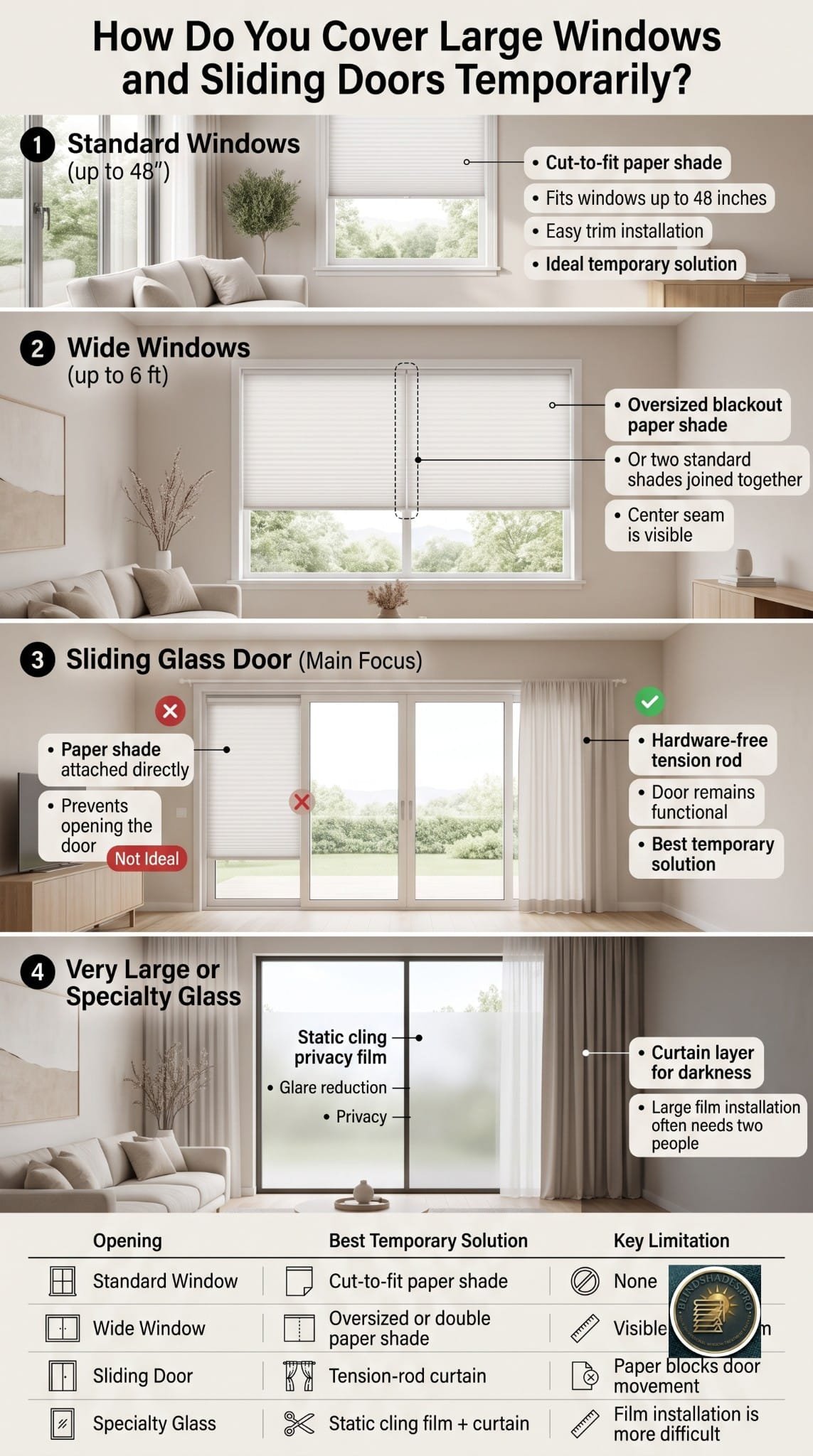
By Michael Turner — 30 years in window treatments
The best temporary blinds and shades install without tools, hold for anywhere from one night to several years, and come down without costing you a security deposit — and the proven core of the category is the cut-to-fit paper shade from around seven dollars, with cordless cellular upgrades taking over when a short stay turns into a long one. This guide organizes the whole temporary market — paper, adhesive, tension, suction, cling, and cheap mini blinds — around the only three questions that matter: how long you need it, what it attaches with, and what it leaves behind.
Key Takeaways
- Paper shades are the category’s backbone. Cut-to-fit pleated paper from Redi Shade installs with a built-in adhesive strip in minutes, costs around seven dollars at Home Depot, and carries some of the largest review bases in the temporary market — over four thousand six hundred ratings on the light-filtering version alone.
- “Temporary” is six different products, not one. Paper, peel-and-stick cellular, tension-mounted, suction-mounted, static cling film, and cheap hardware-mounted mini blinds each attach differently, last differently, and leave different marks at takedown.
- The deposit question decides more than the price question. Adhesive residue, screw holes, and paint pull are what landlords bill for — this guide’s Deposit Ledger scores every attachment method on what it leaves behind.
- Renters asking about blackout have real answers. A blackout paper shade rated four point one across roughly eight hundred fifty reviews, a tension-rod blackout curtain, and peel-off blackout panels each solve the rental blackout problem without a single drill hole.
- Cheap does not mean corded. Under the window covering industry’s ANSI/WCMA A100.1 safety standard, stock blinds sold in the United States have shipped cordless since late 2018 — even the budget end of this guide is safe around children by default.
⭐ Quick Answer — The Best Temporary Blinds & Shades
The best temporary blinds and shades install with no tools and remove with no damage — chosen with the Tenure Test: Time (how long you need them), Tack (what they attach with), and Takedown (what they leave behind):
- The proven baseline: the Redi Shade Original cut-to-fit pleated paper family from around seven dollars — light filtering at three point nine across forty-six hundred reviews, blackout at four point one across roughly eight hundred fifty-seven — at Home Depot; the paper product itself is decoded in the paper blinds and shades guide.
- The budget benchmark: the IKEA Schottis at around five dollars, four point four across more than forty-two hundred reviews — the rating champion of the entire temporary class.
- The upgrade when temporary stops being temporary: a no-tools cordless top-down bottom-up cellular at four point eight across twenty-one hundred reviews — the mechanism explained in the top down bottom up blinds guide.
- The rental blackout answer: layer a blackout paper shade on the glass with a tension-rod curtain over the frame — the permanent-tier picks named by Wirecutter and The Spruce belong in your next apartment; the deep coverage is in the blackout blinds and shades guide.
- The deposit rule: photograph the trim before installing, warm adhesive strips before peeling, and never scrape dry — the full Deposit Ledger scores every attachment method on what it leaves behind.
Quick Specification Reference
| Specification | Typical range for temporary blinds & shades |
|---|---|
| Price class | Around four to twenty-five dollars per window (words-only pricing; see retailer table) |
| Install time | Two to ten minutes per window, no tools |
| Attachment | Adhesive strip, peel-and-stick, tension, suction cup, static cling |
| Honest lifespan | One night (foil, cardboard) to several years (quality paper, adhesive cellular) |
| Light control | Light filtering, room darkening, and true blackout versions all exist |
| Sizing | Cut-to-fit widths trimmed with scissors or utility knife |
| Removal | Peel, pop, or lift out — the Deposit Ledger below scores residue by method |
| Safety | Cordless by default under the ANSI/WCMA A100.1 stock-product standard |
Read the complete guide below for: what actually counts as a temporary blind, the Tenure Test framework, our six picks with verified ratings, the Deposit Ledger of what each attachment method leaves behind, the honest rental blackout answer, sizing for large windows and sliding doors, the aluminum foil verdict, the graduation path from paper to permanent, and the retailer-by-retailer buying map.
What Counts as a Temporary Blind or Shade?
Six different products all sell under the word “temporary” — and the differences between them decide everything downstream, so name your product before you compare prices.
The search results and store shelves blur them together, but temporary window coverings split cleanly into six families. Each attaches differently, and the attachment is the product.
| Type | How it attaches | Honest lifespan | Best single use case |
|---|---|---|---|
| Cut-to-fit paper shade | Built-in adhesive strip on the header | Months to a few years | Move-ins, dorms, new construction |
| Peel-and-stick cellular shade | Adhesive brackets, no drilling | One to several years | Renters who want a “real” shade |
| Tension-mounted blind or rod | Spring pressure inside the frame | As long as the spring holds | Rentals where adhesive is banned |
| Suction-cup blackout panel | Suction cups on the glass | Nightly, reapplied as needed | Travel, nurseries, shift workers |
| Static cling window film | Static adhesion to glass | One to three years | Privacy and glare without hardware |
| Cheap hardware-mount mini blind | Two small screws | Years | “Temporary” stays that allow two holes |
That last row matters more than it looks: the top-voted advice in an eight-year-running Reddit r/homeowners thread on temporary paper blinds is to hang cheap mini blinds “for the time being,” pointing to Lowe’s Project Source line at under ten dollars a window — fully functional, and only two screw holes to patch. When a landlord permits small holes, the cheapest permanent product often beats the dearest temporary one; the full case for that route is in our mini blinds guide.
Static cling film sits at the other extreme — zero hardware, zero adhesive, pure glass contact — and it overlaps heavily with privacy film; the film-versus-shade decision, including the double-pane warranty caution, is covered in the window tint shades guide.
The Tenure Test: Time · Tack · Takedown
Every temporary window covering decision reduces to three questions — how long, attached how, and removed leaving what — and answering them in that order picks your product for you.
Time. Be honest about the horizon. One week before curtains arrive is a different purchase than a two-year lease. The market punishes dishonesty here in both directions: buying a one-night solution for a one-year stay means living with sagging paper and tape marks, while buying a seventy-dollar cordless shade for a two-week gap wastes sixty dollars.
Tack. The attachment method is the real product decision. Adhesive strips are fastest but interact with paint. Tension needs a square, sound frame. Suction needs clean glass and patience for morning reapplication. Two screws need permission.
Take-down. Work the ending backward from day one. The question is never “will it come off” — everything comes off — it is “what does the surface look like after,” and that is the Deposit Ledger’s whole subject below.
| Your tenure | Buy this class | Skip this class |
|---|---|---|
| One night to two weeks | Suction blackout panel, basic paper shade | Anything requiring adhesive cure time |
| Two weeks to six months | Cut-to-fit paper (light filtering or blackout) | Hardware mounts; not worth the patching |
| Six months to two years | Peel-and-stick cordless cellular, quality paper | Bottom-tier paper that sags by month four |
| Two years or “indefinitely temporary” | Cheap mini blind (if two holes allowed) or adhesive cellular | Paper — you have graduated past it |
| New construction awaiting real treatments | Contractor packs of paper shades | Per-window retail buying; use multipacks |
That new-construction row answers a question asked verbatim on Houzz — Home Depot or IKEA for temporary window covering in a new build — and the answer is both: Home Depot for cut-to-fit paper multipacks, IKEA for the Schottis when the windows are close to stock sizes.
Best Temporary Blinds & Shades — Our Picks
Six picks, all verified against live retail listings and review bases as of July 2026, with the weak spots flagged in the table rather than hidden.
| Pick | Product | Rating and review base | Price class (words) | Why it wins |
|---|---|---|---|---|
| Best Overall | Redi Shade Original Room Darkening pleated paper | Three point nine across roughly seven hundred seventy-five reviews at Home Depot | Around seven dollars | The category-defining cut-to-fit paper shade; trims to any width, installs in minutes |
| Best Budget | IKEA Schottis pleated shade | Four point four across more than four thousand two hundred reviews | Around five dollars | The highest-rated large-base product in the entire temporary class |
| Best Blackout | Redi Shade Original Blackout pleated paper | Four point one across roughly eight hundred fifty-seven reviews at Home Depot | Under eleven dollars for the oversized version | True blackout material in the same no-tools format |
| Best Upgrade | Blindster No-Tools Cordless Top Down Bottom Up cellular | Four point eight across two thousand one hundred reviews | Around twenty-one dollars on promotion | The bridge product — a real cellular shade with temporary-grade installation |
| Best Fabric / Longer Stay | Redi Shade fabric pleated line (including the arch version) | Four point three across one thousand two hundred reviews at Home Depot | Around twenty-five dollars | Non-woven fabric outlasts paper for the second year of a “temporary” stay |
| Best Cut-to-Size Roller | Mainstays Blackout Tear-to-Fit roller shade | Three point four across roughly one hundred fifty-nine reviews at Walmart — a below-average rating buyers should weigh | Around ten dollars | The only tear-to-width roller format at this price; the rating reflects real fit frustrations |
Two honesty notes on that table. First, the Mainstays rating is flagged because it deserves flagging — tear-to-fit rollers are fussier to size cleanly than pleated paper, and the review base says so. Second, the Blindster cellular carries the strongest rating-to-base ratio in the class, which is exactly why it anchors the graduation path later in this guide; its top-down bottom-up format is the same mechanism covered in depth in the top down bottom up blinds guide.
The paper picks here stay deliberately consistent with our deeper paper coverage — what paper shades are made of, how long each grade honestly lasts, and the cost-per-month ledger live in the complete paper blinds and shades guide, which is the parent guide for everything pleated-paper on this page.
The Deposit Ledger: What Each Method Leaves Behind
Landlords do not bill for blinds — they bill for surfaces, so the smartest temporary purchase is the one scored on its removal day, not its install day.
No competitor page in this market scores attachment methods on takedown damage, which is strange, because takedown damage is the entire reason renters search for temporary blinds in the first place. Here is the ledger.
| Attachment method | What it can leave behind | Deposit risk | Removal protocol |
|---|---|---|---|
| Built-in adhesive strip (paper shades) | Adhesive residue; paint pull on flat or builder-grade paint | Low to moderate | Warm the strip with a hair dryer for thirty seconds, peel slowly at a flat angle, lift residue with a citrus-based remover on a cloth — never scrape dry |
| Peel-and-stick brackets (cellular) | Residue outline; occasional paint pull at corners | Moderate | Same heat-and-peel method; test one bracket first |
| Tension mount | Faint pressure marks at the frame contact points; possible scuffing | Very low | Release tension fully before lifting out; buff marks with a melamine sponge |
| Suction cups | Rings on glass | Effectively zero | Glass cleaner; done |
| Static cling film | Nothing on paint; faint edge lines on glass if aged in sun | Effectively zero on frames | Peel from a corner; film releases clean |
| Two-screw mini blind mount | Two small holes per bracket | Low if patched | Spackle, sand flush, touch up — a ten-minute repair |
Two rules travel with that table. Photograph the window trim before installing anything — a dated photo is the cheapest deposit insurance that exists. And read the lease’s alterations clause before choosing adhesive: some leases ban adhesives on painted surfaces specifically, which routes you straight to the tension and suction rows. Tension-based systems get their own full treatment — including why they outlast their reputation — in our no drill blinds guide, the permanent-grade cousin of everything on this page.
What Is the Best Temporary Blackout Solution for a Rental?
A blackout paper shade for the glass plus a tension-rod blackout curtain for the gaps beats any single product — that layered answer is what the highest-voted community responses converge on.
This exact question — the best temporary blackout solution at a rental property — ran to more than sixty comments in a Reddit r/toddlers thread within the past year, and the vote pattern is instructive: the top answer, at sixteen votes, was a blackout curtain on a sturdy tension rod; a stick-on blackout shade drew seven votes with the note that they last years or pull straight off; and eleven votes went to the aluminum foil trick, which gets its own verdict two sections down.
The product data supports layering. Blackout material stops light through the glass, but paper and cellular shades mount inside the frame, which leaves an edge glow around the perimeter — the same physics that produces light gaps on permanent blinds. The fix is the same as ours everywhere: a curtain layer over the frame, or an oversized blackout paper shade mounted proud of the opening.
| Rental blackout option | Format | Verified signal | Best for |
|---|---|---|---|
| Redi Shade Original Blackout | Cut-to-fit paper, adhesive strip | Four point one across roughly eight hundred fifty-seven Home Depot reviews | The glass itself; the forty-eight by seventy-two inch size covers sliders’ side lites |
| Blackout curtain on a tension rod | Fabric over the whole frame | Sixteen-vote top answer in the r/toddlers rental thread | Killing edge glow; zero surface contact |
| Suction or stick-on blackout panels | Peel-off panels | Seven-vote community answer — “they last years or you just pull it off” | Nurseries and shift-sleep rooms needing total darkness on demand |
| Full blackout shade sets | Wide-format panels | Around sixteen dollars for a seventy-eight by fifty-seven inch panel at Walmart, rated four point three across forty-five reviews | Oversized and odd windows |
For readers whose blackout need is permanent rather than temporary, the deep coverage — cordless blackout picks, the blackout-versus-room-darkening distinction, and the light-gap physics — lives in the complete blackout blinds and shades guide. It is worth noting that the major testing publications point the same direction for permanent purchases: Wirecutter’s blackout roundup, updated May 2025, named the Select Blinds Classic Cordless Blackout Shade its best-looking and among its most light-effective picks, and The Spruce’s April 2026 update crowned the ChrisDowa blackout roller its overall pick — both excellent shades, and both mounted purchases that belong in your next apartment, not this one.
How Do You Cover Large Windows and Sliding Doors Temporarily?
Go oversized-paper or go vertical-alternative — large glass is where temporary products hit their honest limits, and knowing the limit beats fighting it.
The related searches around this topic name the two hard cases directly: temporary shades for large windows, and temporary blinds for sliding doors. Here is the sizing reality.
| Opening | Temporary answer | The catch |
|---|---|---|
| Standard windows to forty-eight inches wide | Any cut-to-fit paper shade, trimmed | None — this is the products’ home territory |
| Wide windows to six feet | Redi Shade forty-eight by seventy-two inch blackout, or two standard shades seamed at a mullion | Two-shade installs show a center line |
| Sliding glass doors | One oversized paper shade per door panel, or a tension-rod curtain across the full opening | Paper on a sliding door blocks the door; curtains keep it usable |
| Very large or specialty glass | Static cling film for glare and privacy, curtain layer for darkness | Full-height film installs want two people |
The sliding door row deserves its one extra sentence: a shade that blocks a door you use daily fails within a week regardless of price, which is why the tension-rod curtain — hardware-free and traversable — wins that opening, and why anyone staying past a year should read the sliding glass door blinds guide for the vertical and panel-track solutions the opening actually wants.
Renters in mobile situations have a parallel problem set — vibration, non-square frames, and weight limits — and the temporary market serves them surprisingly well; the overlap cases are mapped in our RV blinds and shades guide.
The Foil Verdict: Hacks vs. a Seven-Dollar Shade
The aluminum foil trick works on light and fails on everything else — and the honest math says the hacks stopped making sense the day paper shades dropped under ten dollars.
Eleven votes in that same rental blackout thread went to the spray-the-window-and-stick-foil-to-it method, and it deserves a straight verdict rather than a sneer, because it does block light completely.
| Criterion | Aluminum foil on glass | Cardboard in frame | A blackout paper shade |
|---|---|---|---|
| Light blocking | Total | Total | Total on the glass; edge glow manageable |
| Heat behavior | Reflects heat at the glass; can concentrate heat against the pane | Insulating, traps moisture | Pleats trap an air layer; safe for the glass |
| Condensation and mold | Traps condensation against glass and sill | Wicks moisture, molds | Breathes; no trapped surface |
| Curb and lease appearance | Unmistakably foil; some leases and HOA rules prohibit visible foil coverings | Visibly cardboard | Reads as a normal shade from the street |
| Cost | Nearly free | Free | Around seven to eleven dollars |
| Removal | Residue and water marks | Clean | Heat-and-peel protocol above |
The verdict: foil is a one-night tool for a night-shift emergency, and a liability at week two. The moment the horizon passes a weekend, the seven-dollar shade wins every row that isn’t the cost row — and it wins the deposit row, which is the expensive one.
The Graduation Path: From One Night to Forever
Temporary products are a sequence, not a destination — the smart renter’s windows graduate through three stages, and each stage has a defined trigger to move up.
| Stage | Product class | Trigger to graduate | What you spend (words) |
|---|---|---|---|
| Night one | Suction blackout panel or basic paper shade | You unpacked; you can see the horizon now | Four to eight dollars per window |
| Month one | Cut-to-fit paper in the correct light grade, properly trimmed | The stay confirms itself past six months | Seven to eleven dollars per window |
| Year one | Peel-and-stick cordless cellular (the Blindster class) or a permitted mini blind | You sign a renewal, or you buy the place | Twenty to twenty-five dollars per window |
| The keeper windows | Measured, mounted, or custom treatments | The windows are yours | Custom starts around twenty-five dollars |
Read the last row again, because it contains the category’s best-kept secret: custom-measured blinds now start at roughly the same price as the best temporary cellular shades. The measuring protocol, maker tiers, and the deduction question that prevents remakes are all in the complete made to measure blinds guide — the graduation ceremony, when you get there.
The cost-per-month logic underneath this table — why a seven-dollar shade used for eighteen months is the cheapest window covering ever sold, and when it stops being cheap — is worked in full in the Lifespan Ledger inside the paper blinds and shades guide.
Where to Buy Temporary Blinds & Shades
Every major retailer stocks this category, but each one owns a different corner of it — this is the map.
| Retailer | What they own | Verified signal |
|---|---|---|
| Home Depot | The Redi Shade paper family in every light grade, including arch and oversized formats | Temporary shades category rated four point six across three thousand nine hundred store reviews; free in-store returns |
| Walmart | The budget floor — tear-to-fit rollers, multipacks, wide blackout panels | Temporary shades page rated four point three across three thousand seven hundred reviews; free ninety-day returns |
| Lowe’s | Cut-to-fit paper positioned for move-ins, plus the Project Source cheap mini blinds the forums recommend | Paper window shades category rated four point six across one thousand six hundred reviews; free delivery over twenty-five dollars |
| IKEA | The Schottis — the class’s rating champion | Four point four across more than four thousand two hundred reviews |
| Blindster and online specialists | The cordless cellular upgrade tier with promotional pricing | Four point eight across two thousand one hundred reviews on the no-tools TDBU cellular |
| Target and marketplaces | Paper multipacks by the count | Per-count pricing near six to seven dollars per shade in six-packs |
One brand-side note for completeness: Redi Shade’s own site — the top organic result for this search — frames its range as running “from temporary solutions to permanent fixtures” with free delivery over seventy-five dollars, and manufacturer-direct buying makes sense for bulk new-construction orders; for single windows, the big-box rows above beat it on returns.
Which Guide Do You Actually Need?
“Temporary” is a situation — this guide — while paper is a product and no-drill is a method, and the three pages divide the territory cleanly.
If you searched for temporary blinds because you rent, you just moved, or the windows are only yours for a while, you are in the right place. If your question is really about paper shades as a product — materials, grades, how long paper honestly lasts — that is the paper blinds and shades guide. If your question is about installation method — tension, magnetic, and clip-in systems built to permanent quality without drilling — that is the no drill blinds guide. And if you need dark more than you need temporary, start at the blackout blinds and shades guide. Adhesive cellular shades, the upgrade tier here, get their deep product treatment in the cellular and honeycomb shades guide.
Related Buying Guides
- The Best Paper Blinds & Shades Buying Guide — the product deep-dive behind this page’s paper picks
- The Best No Drill Blinds Buying Guide — tension, magnetic, and clip-in systems
- The Best Blackout Blinds & Shades Buying Guide — when dark is the requirement
- The Best Mini Blinds Buying Guide — the two-screw budget route
- The Best Top Down Bottom Up Blinds Guide — the mechanism behind the upgrade pick
- The Best RV Blinds & Shades Buying Guide — mobile and non-square situations
- The Best Sliding Glass Door Blinds Guide — the permanent answer for big glass
- The Best Made to Measure Blinds Guide — graduation day
Frequently Asked Questions
What are the best temporary blinds and shades?
The best temporary blinds and shades are cut-to-fit paper shades — the Redi Shade Original family at Home Depot, from around seven dollars — for most windows and stays, the IKEA Schottis at around five dollars for the tightest budgets, and the Blindster no-tools cordless cellular, rated four point eight across two thousand one hundred reviews, for temporary stays that stretch past a year.
How long do temporary paper blinds last?
Quality pleated paper shades honestly last six months to a few years indoors, with sun exposure and humidity as the deciding factors; bottom-tier paper can sag within months. Community experience matches the spec sheets — stick-on shade users in rental forums report multi-year service with clean removal at the end.
How do you install temporary blinds without drilling?
Trim a cut-to-fit shade to your inside-frame width with scissors or a utility knife, peel the backing on the built-in adhesive strip, press it to the top of the frame for thirty seconds, and clip the pleats to height. Tension, suction, and static cling versions install without even the adhesive — no tools in any case.
Will temporary blinds damage paint or cost me my deposit?
Handled correctly, no: warm adhesive strips with a hair dryer before peeling, pull slowly at a flat angle, and lift any residue with a citrus-based remover rather than scraping. Tension, suction, and static cling methods carry effectively zero deposit risk, and two small screw holes from a mini blind patch in ten minutes with spackle.
What is the best temporary blackout solution for a rental?
Layer a blackout paper shade on the glass — the Redi Shade blackout version rates four point one across roughly eight hundred fifty-seven reviews — with a blackout curtain on a tension rod over the frame to kill edge glow. That layered approach mirrors the top-voted answer in recent rental blackout discussions and requires zero holes.
Are temporary blinds safe for kids’ rooms?
Yes, and structurally so: stock window coverings sold in the United States have been cordless by default since late 2018 under the ANSI/WCMA A100.1 safety standard, so the paper and cellular products in this guide have no accessible cords. Suction blackout panels add a further advantage in nurseries — nothing within a child’s reach at all.
