The Best Paper Blinds & Shades Buying Guide (2026)

Authored By Michael Turner -30 Years Home Improvement Expertise | Updated 2026 | BlindShades.pro
Updated on July 20, 2026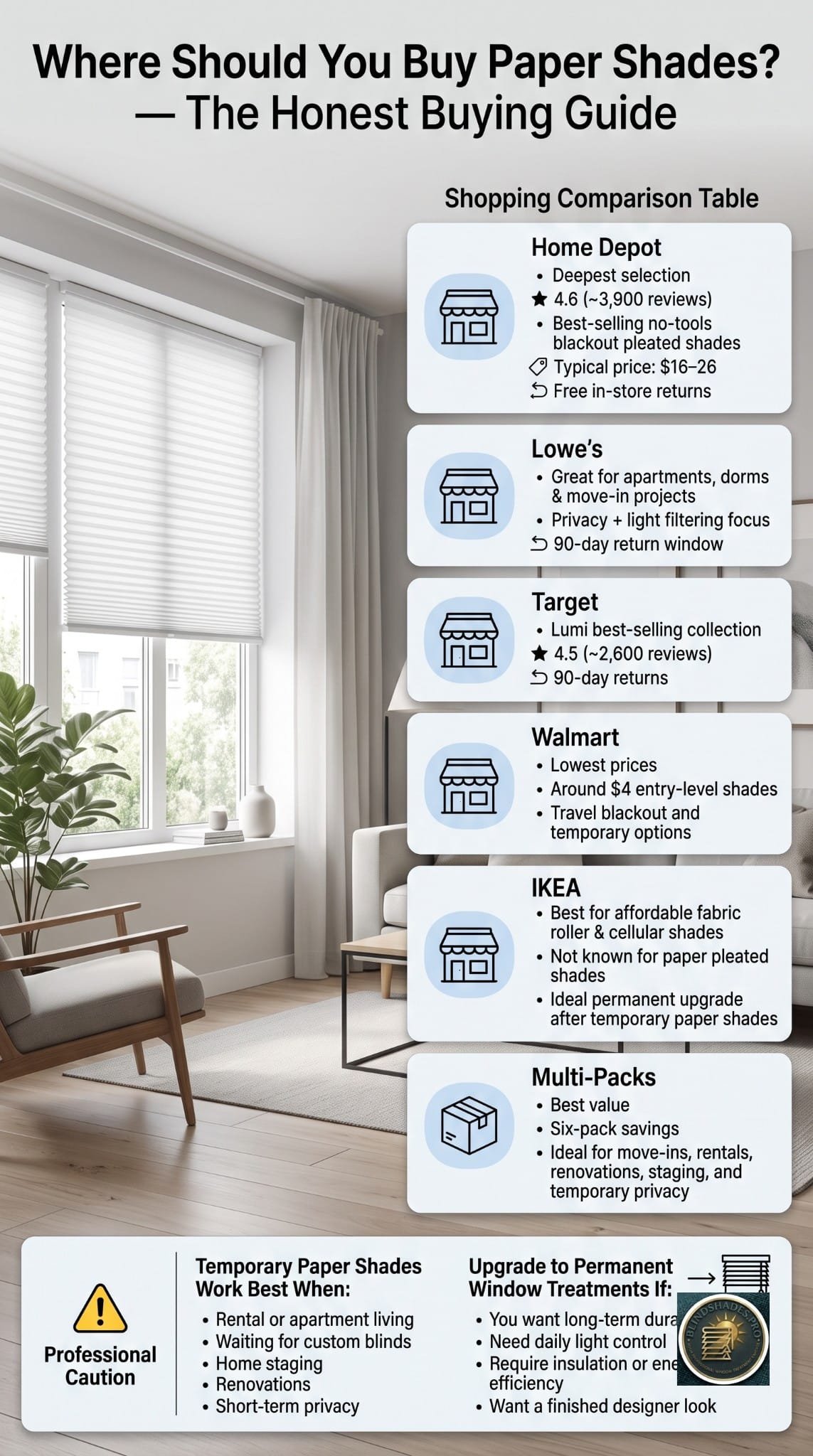
By Michael Turner — 30 years in the window treatment industry
Best Overall Paper Blind: Eclipse Blackout Paper Pleated Shade — 99% material opacity, peel-and-stick, cut-to-size, cordless, widely available at Walmart. That verdict holds for 2026 — and around it, this update adds the two things no seller of six-dollar shades can print: the lifespan ledger (paper is a TIME product, and its honest service life decides whether it’s the cheapest light control ever sold or a false economy), and the naming split (a six-dollar pleated temporary and a hundred-dollar rice-paper decorative share one word and nothing else). Run the Paper Test — Tenure, Task, Type — and this humble category becomes what it actually is: the smartest bridge purchase in the entire window world, bought correctly.
Key Takeaways
- Paper shades are graded like furniture and built like tissue — on purpose. The industry standard scores three point nine across forty-six hundred reviews because disposable infrastructure always will; judge it on cost-per-month, where nothing else comes close.
- The duopoly is real: Redi Shade’s pleats (light-filtering and room-darkening) and Eclipse’s blackout multi-packs own the temporary category, with Lumi’s cordless line carrying the child-and-pet-safety flag at Target.
- “Paper” names two products. Pleated temporaries at five-to-fourteen dollars and rice-paper or woven-cane decoratives at fifty-to-one-thirty are different purchases — the routing table below keeps you out of the wrong aisle.
- The graduation path is the plan, not the failure: move-in paper today, measured replacements tomorrow — and the paper shade itself becomes the sizing template for whatever succeeds it, its trimmed width penciled on the back before it comes down.
- Cut-to-size is the superpower and the trap: trim with a straightedge and a fresh blade, never scissors — and past ninety-six inches of drop, the honest answer stops being paper.
⭐ Quick Answer — The Best Paper Blinds & Shades
The best paper blinds are chosen by the Paper Test — Tenure (weeks-to-months is paper’s honest life), Task (blackout, filter, or decor), Type (pleated temporary vs rice-paper decorative) — and the verdicts hold:
- Best Overall: the Eclipse Blackout Paper Pleated Shade — 99 percent material opacity, peel-and-stick, cut-to-size, cordless — about thirteen in the multi-pack class at Walmart and JCPenney.
- The industry standard: Redi Shade’s Original pleats — three point nine across roughly forty-six hundred reviews from about six — with the maker’s own no-yellow, no-crack durability claim at Redi Shade.
- The deepest shelf: the temporary-shades aisle at The Home Depot (best-seller: the No-Tools blackout pleat) and the ninety-day return window at Lowe’s.
- The graduation path: paper today, measured replacements tomorrow — the first rung is the mini blinds guide, the comfort step is the cellular and honeycomb shades guide, and the outgoing paper shade is the pencil-marked sizing template.
- The honest darkness note: 99 percent blocks the material, not the edges — expect a glow frame, and when the assignment is a true cave, graduate to the blackout blinds guide.
Quick Specification Reference
| Specification | Paper shade reality (2026) |
|---|---|
| What it is | Pleated paper on peel-and-stick adhesive — no tools, no drills, no screws |
| The honest lifespan | Months of good service; a year-plus with gentle handling — a bridge, not a destination |
| The price floor | About four to eight per shade; multi-packs near six per unit |
| The install time | Seconds, per the market’s own summary — trim, peel, stick, clip |
| Light control | Light-filtering, room-darkening, and 99-percent-class blackout versions |
| The safety default | Cordless by construction — the child-and-pet case built in |
| The decorative cousin | Rice-paper and woven-cane rollers at fifty to one-thirty — a different product entirely |
| The size ceiling | Standard drops to about seventy-two inches; extra-long is the category’s known gap |
| The graduation rule | Keep the outgoing paper shade as the measuring template for its permanent replacement — trimmed width, penciled on the back |
Read the complete guide below for: the six picks led by the returning Best Overall, the Paper Test (Tenure · Task · Type), the lifespan ledger with real cost-per-month math, the two-products routing split, blackout claims decoded, the install-and-trim method done right (including the extra-long answer), every buying lane with the IKEA question answered honestly, and the warning table.
What Are the Best Paper Blinds & Shades in 2026? — Our Picks
Review volumes are stated exactly as the market shows them — and this category’s modest grades get the explanation they deserve one section down.
| Pick | Product | Rating / reviews | Price (words) | The lane |
|---|---|---|---|---|
| Best Overall | Eclipse Blackout Paper Pleated Shade | 3.8 across 50 | About thirteen, multi-pack class | 99% material opacity, peel-and-stick, cut-to-size, cordless — the verdict holds |
| The Industry Standard | Redi Shade Original Light Filtering | 3.9 across ~4,600 | About six to eight | The market’s own phrase — the default temporary blind in America |
| Best-Rated in Family | Redi Shade Original Blackout Pleated | 4.1 across 852 | About seven | The family’s strongest score — darkness done in paper |
| Best Safety Pick | Lumi Home Furnishings Cordless Pleated | 4.4 across 304 (Target bestseller line) | About seven | The child-and-pet cordless flag |
| Best Whole-House Play | Redi Shade Room-Darkening Multipack | 3.9 across ~1,900 | About six twenty-five per shade | The move-in classic: every window, one box |
| The Decorative Crossover | Chicology Belmon Natural | 4.4 across 508 | About eighty-three | The bridge INTO the rice-and-cane tier — routing note below |
Best Overall, Restated
Best Overall Paper Blind: Eclipse Blackout Paper Pleated Shade — 99% material opacity, peel-and-stick, cut-to-size, cordless, widely available at Walmart. The reasons the verdict survives another year: it is the rare paper shades blackout product sold in convenient multi-packs (the market’s own summary calls them excellent for renters and new construction needing a quick 99-percent light-blocking solution), its three point eight across fifty reviews sits exactly where honest disposable goods score, and at about thirteen for the cut-to-width multi-pack class it darkens a bedroom for less than a pizza. The runner-up story is the same one told twice: Redi Shade’s family is, in the market’s own phrase, the industry standard for temporary blinds — room-darkening and light-filtering versions, peel-and-stick adhesive, no drills or screws — and its blackout member out-scores the flagship because darkness is what buyers actually grade paper on.
The maker’s durability claim, cited as the maker’s: Redi Shade states its pleats are made of durable paper that will not yellow and crack from sun exposure — a fair claim over paper’s honest tenure, and exactly the timescale question the next section prices out. And the adjacent authority for the darkness-first buyer: the New York Times’ Wirecutter blackout roundup (May 27, 2025) crowns a fabric cordless shade its best-looking tested pick — the graduation path’s north star, not paper’s competitor.
The Paper Test: Tenure · Task · Type
Three questions in order — how long it will hang, what job the light needs, which product family — and the first one decides whether paper belongs in your cart at all.
| Paper Test step | The question | The failure it prevents |
|---|---|---|
| Tenure | Weeks, months, or years? | The three-year paper shade — a false economy against a thirty-dollar cellular |
| Task | Blackout, filter, or decor? | Light-filtering paper on a night-shift bedroom |
| Type | Pleated temporary or rice-paper decorative? | The hundred-dollar shade bought for a six-dollar job — and vice versa |
How Long Do Paper Shades Last? The Lifespan Ledger
Paper is a TIME product — and priced by the month, it is either the best deal in this catalog or the worst, depending entirely on your calendar.
The community priced it years ago: five to ten per blind, multi-packs like six for nineteen — and the eight-year-old thread’s pros-and-cons still hold, pets included (claws and paper have a short relationship). Here is the ledger the category deserves:
| Your tenure | The verdict | The math |
|---|---|---|
| Move-in gap (weeks to 3 months) | Paper, without hesitation | A six-dollar shade over eight weeks: under a dollar a week for privacy on day one |
| New construction / awaiting customs (3–9 months) | Paper — the Houzz question’s answer | The whole house covered for the cost of ONE custom shade’s deposit |
| Rental year | Paper or the upgrade fork | About fifty cents a month per window — but a year is where fabric starts winning on feel |
| Two years plus | Graduate | The same six dollars yearly forever loses to a thirty-dollar cellular that outlives the lease — the honeycomb case is in our cellular and honeycomb shades guide |
| Staging / photography / events | Paper’s secret market | Clean lines for the weekend, gone by Monday |
And the graduation path, formalized from the community’s own arc — the RV forum’s paper-shade replacement thread runs the whole ladder in three answers: metal mini blinds ordered custom, blackout blinds from the home center, cheap-and-easy roller shades. The path this site maps: paper → mini blinds for the slatted budget step, rollers for the clean-line step, cellular for the comfort step — and the RV-specific version of the whole decision lives in our RV blinds and shades guide, where those factory day/night shades the thread is replacing get their repair-or-replace hearing. The one trick that makes graduating painless: your paper shade is a perfect sizing template — before it comes down, its trimmed width IS your measured width, written on the back in pencil where the next order can read it.
One more ledger entry the arithmetic insists on: the whole-house comparison at scale. Ten windows in paper runs about sixty to seventy dollars and one Saturday hour; the same ten in entry-level permanent shades runs three-to-six hundred and a weekend of brackets. If your end date is real, the four-hundred-dollar difference is a moving-fund line item paper just returned to you; if your end date is imaginary — the “temporary” solution entering year three, which the eight-year Reddit thread’s veterans describe with rueful familiarity — you have paid rent on light control that a one-time fabric purchase would have retired. The ledger doesn’t judge either choice; it just insists you know which story you’re in before the multi-pack goes in the cart.
Who Are Paper Shades Actually For? Five True Stories
The tenure table in the abstract; here it is in lives — because this category’s buyers are situations, not demographics.
The move-in couple, day one: the truck is half unloaded, the streetlight owns the bedroom, and a multi-pack from the home-center run covers every window before midnight for less than the pizza that fed the movers. The new-construction family, month four: sixteen windows, custom shades on a nine-week quote, and the Houzz question — temporary coverings until the real ones land — answered for under a hundred total, with the paper coming down window by window as the customs arrive. The dorm parent, August: one shade, one trim, one adhesive strip, and a room-darkening pleat that survives exactly one academic year, which is exactly the assignment. The landlord between tenants: staged privacy for the listing photos, gone before the walkthrough, no holes to patch on the deposit ledger. And the night-shift renter, the category’s most grateful customer: a seven-dollar blackout pleat plus the glow-frame honesty from the darkness table equals real daytime sleep this week — not after a custom quote, not after a landlord negotiation, this week. What unites all five is the calendar doing the choosing: every one of them has an end date, and paper is the only product in this catalog that treats an end date as a feature. The moment a buyer’s story has no end date — the owned home, the forever bedroom — the same six dollars becomes the wrong spend, and the graduation ladder above is waiting with the pencil template already written. A last practical grace note the category earns: disposal is part of the design. A retired paper shade folds flat into the recycling bin — no hardware to unscrew, no cords to cut, no landfill guilt beyond an adhesive strip — which makes it the only window treatment on this site whose entire life cycle, purchase to parting, fits inside a single season and a single blue bin. Temporary, done honestly, all the way down.
Pleated Paper or Rice Paper? Two Products, One Word
The six-dollar temporary and the hundred-dollar decorative share a noun and nothing else — here is the routing split.
| You want | The product | The tell | The lane |
|---|---|---|---|
| Instant, temporary, trimmable privacy | Pleated paper shades (this guide’s core) | Peel-and-stick top, accordion pleats, five-to-fourteen dollars | Redi/Eclipse/Lumi world |
| The warm shoji-style diffusion, permanently | Rice paper cordless shades and rollers | Cassette or roller hardware, fifty to one-thirty | The Oriental-decor tier; hung like real shades because they are |
| Natural texture with paper’s lightness | Woven cane paper rollers | Cane-and-paper weaves, seventy-plus | The crossover into our woven wood and bamboo shades guide |
| The Chicology-class natural pleat | The decorative crossover | Real cordless hardware, five-hundred-review base | Where temporary construction meets permanent intent |
The routing sentence, plainly: if it installs with adhesive in seconds, it is a temporary; if it hangs on hardware, it is a shade that happens to be made of paper — and the second family is judged by shade rules (mounting, cords, cassettes), not by this guide’s tenure math.
How Dark Do Paper Blackout Shades Get? Claims, Decoded
The 99-percent class is real material opacity — and the gaps around the material are where the light actually comes in.
| The claim | What it means | The honest note |
|---|---|---|
| 99% light-blocking (Eclipse class) | The PAPER passes almost nothing | Edges and the pleat-stack top leak — expect a glow frame, not a cave; hang wider than the glass to shrink it |
| Room-darkening (Redi class) | Meaningful dimming, not blackout | The nap-room grade |
| Light-filtering | Privacy plus glow | The daytime default |
| 99.99% magnetic roman claims | A marketing decimal | Flagged in the warning table — no consumer material meaningfully beats the 99 class |
| True cave darkness | Not paper’s job | Side-channel fabric systems — the full science is in our blackout blinds guide |
How Do You Install Redi Shade Paper Blinds? The Method
Seconds is the honest install time — IF the trim is right. The how to install Redi Shade paper blinds search deserves the full sequence, extra-long answer included.
| Step | The method | The mistake it prevents |
|---|---|---|
| Measure the inside width | Steel tape, three spots, smallest wins | The gap stripe on out-of-square frames |
| Trim BEFORE peeling | Straightedge + fresh utility blade through the compressed stack — never scissors | The ragged accordion edge scissors always cut |
| Peel and stick high | Adhesive strip to the frame top, pressed firm for thirty seconds | The Tuesday sag |
| Set the height | Included clips pinch the pleats at your chosen drop | The all-the-way-down default nobody wants |
| Doors and sliders | Two shades side-by-side beat one wide one on paper blinds for sliding glass doors; a single narrow one handles paper blinds for door glass — with the honest note that every open-close flexes the stack | The torn-in-a-month door shade — hardware products win moving glass, per our french door blinds guide |
| The extra-long problem | Standard drops top out near seventy-two inches; a few lines reach longer, and two shades can stack vertically with a clip-line seam | Past ninety-six inches, stop — the honest answer is a roller, not more paper |
| Removal day | Warm the adhesive strip with a hair dryer, peel slow, template the width first | Paint pulled off with the tape |
Two upgrades the community invented and the boxes never mention. First, the DIY cord retrofit — the craft-blog classic: thread a light cord vertically through the pleat stack with a large needle, anchor it at the headrail, and the clip-adjusted shade becomes a genuinely raisable one, corded like its fabric ancestors for about a dollar of string. (The child-safety rule travels with it: any added cord follows the same tension-and-cleat discipline as every corded product, and households with small children should keep the clips instead.) Second, the longevity kit, for anyone whose bridge is running long: a strip of clear packing tape along the bottom edge doubles the life of the pleat most likely to tear, a dab of glue-stick re-tacks a lifting adhesive corner without residue, and rotating shades between sunny and shaded windows at mid-tenure evens the fade that would otherwise retire the south-facing ones first. None of this makes paper permanent — it makes the bridge reach the far bank with dignity, which is the whole assignment.
Where Should You Buy Paper Shades — and the Warning Table
| The lane | The honest answer |
|---|---|
| Home depot paper shades | The deepest shelf: store 4.6 across ~3,900, best-seller is the No-Tools blackout pleat, sixteen-to-twenty-six range, free in-store returns |
| Lowe’s | The best category framing — quick privacy and light filtering for apartments, dorms, and move-in projects — with a NINETY-day return window |
| Target | The Lumi bestseller lane; store 4.5 across ~2,600, ninety days |
| Walmart | The four-dollar floor and the travel-blackout oddities |
| Paper window shades IKEA | The honest answer: IKEA’s strength is inexpensive FABRIC rollers and cellulars, not paper pleats — the first-permanent-shade stop AFTER paper’s job is done |
| Multi-packs, anywhere | The move-in cheat code — six-per-unit economics on temporary paper shades, and temporary shades for windows generally answer to the same tenure math |
| Warning | The listing | The rule |
|---|---|---|
| The one-star singleton | 1.0 across 1 at a marketplace seller | An anecdote in the wrong direction — skip |
| The decimal claim | 99.99% blackout marketing | A marketing decimal, not a material class |
| Discount theater | Fifty-five to fifty-nine percent “off” on ten-dollar goods | The recurring sale price is the real price — doubly silly at this price floor |
| Extra-long listings | Thin, scattered, often mislabeled | Verify the actual drop in the spec line, not the title |
| Per-count pricing | Multi-packs shown per-shade | The same divide-before-comparing rule as every category |
Related Buying Guides
- Best Mini Blinds — the graduation path’s first rung
- Best Cellular & Honeycomb Shades — the comfort step paper points toward
- Best Blackout Blinds & Shades — when 99 percent isn’t the assignment
- Best No Drill Blinds — paper’s whole philosophy, in permanent hardware
- Best RV Blinds & Shades — the rolling version of the replacement question
- Best Woven Wood & Bamboo Shades — where the cane-paper tier belongs
- Best Pleated Shades — the permanent pleat paper imitates
- Best Sliding Glass Door Blinds — moving glass, hardware answers
- Best French Door Blinds — the door-glass lane
- Best Arched & Specialty Windows — where the trim-to-fit arch pleat rules
FAQ
What is the best paper blind? Best Overall Paper Blind: Eclipse Blackout Paper Pleated Shade — 99% material opacity, peel-and-stick, cut-to-size, cordless, widely available at Walmart — with Redi Shade’s Original pleats as the industry standard (three point nine across roughly forty-six hundred reviews from about six) and its blackout version the family’s best-rated at four point one across eight hundred fifty-two.
How long do paper blinds last? Months of good service, a year-plus with gentle handling — paper is a bridge product, and that is its virtue: under a dollar a week during a move-in gap, the whole house covered for one custom shade’s deposit during construction, and a planned graduation to minis, rollers, or cellular when the calendar says so.
Are paper blackout shades really blackout? The 99-percent class genuinely blocks light through the material; the leaks are around it — edges and the pleat-stack top produce a glow frame, not a cave. For true darkness, side-channel fabric blackout systems are the honest answer; for naps and shift sleep, room-darkening paper earns its seven dollars.
How do you install paper blinds? Measure the inside width in three spots (smallest wins), trim the compressed stack with a straightedge and fresh blade before peeling, stick the adhesive strip firmly to the frame top, and set your height with the included clips — seconds of work after one careful minute of trimming.
Can you use paper blinds on doors and sliders? Yes, with the honest caveat: every open-close flexes the pleat stack, so door-glass paper is the shortest-tenure use in the category. Two side-by-side shades beat one wide one on sliders, and moving glass ultimately wants hardware products built for it.
Where can you buy paper window shades? Home Depot has the deepest shelf and the best-selling blackout pleat, Lowe’s and Target both carry ninety-day return windows, Walmart holds the four-dollar floor, and multi-packs everywhere are the move-in play — while IKEA’s lane is inexpensive fabric rollers rather than paper pleats, the first-permanent-shade stop after paper’s job is done.
The Bottom Line
Buy paper by the calendar and it never disappoints. Tenure: weeks and months are its kingdom — under a dollar a week, privacy on day one, gone without a trace and recycled without a screwdriver; years are fabric’s, and the ledger says so without sentiment, at single-window scale and at whole-house scale alike. Task: filter for daylight dignity, room-darkening for naps, the 99 class for real darkness minus a glow frame — and the honest handoff when the assignment is a cave. Type: adhesive means temporary, hardware means shade — two products, one word, zero confusion from here on. The Best Overall keeps its title, the industry standard keeps its throne and its C-plus, and the graduation path — template in pencil on the back of the outgoing shade — is this humble category’s real genius: paper doesn’t just cover the window; it measures the window for whatever deserves it next.
