Are Thermal Blinds Worth It? The Honest Numbers Verdict

Authored By Michael Turner -30 Years Home Improvement Expertise | Updated 2026 | BlindShades.pro
Updated on July 24, 2026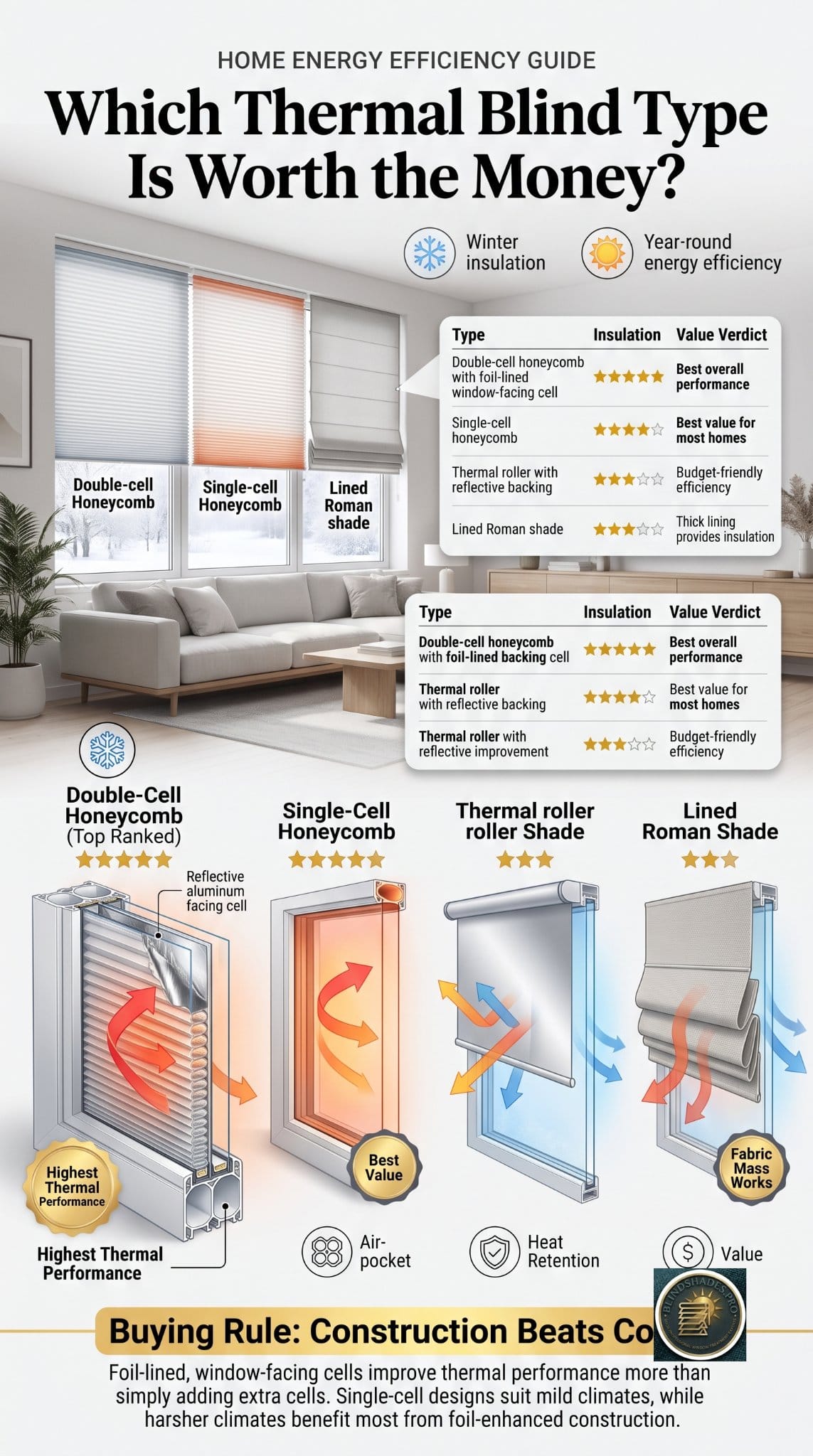
By Michael Turner — 30 years in window treatments
Yes — are thermal blinds worth it has a yes answer for most homes, but not the unconditional yes the sales pages give it. The real verdict depends on three things almost nobody prices together: which savings number is true for your situation (four different percentages circulate, measuring different things), which rooms you are covering (a drafty single-pane bedroom and a new triple-glazed one are different purchases), and which of three buying routes your money takes — the same honeycomb blind can cost four times more down one route than another. This guide runs all three columns, attributes every figure, and states plainly when the honest answer is to spend elsewhere first.
Key Takeaways
- The verdict is yes, with conditions. On drafty, older, or single-pane glass in a real winter or a hard-sun summer, the value case is strong. On new, well-sealed glazing in a mild climate, the gains are marginal — and the honest move is to fix drafts first and buy for looks, not payback.
- The circulating numbers measure different things. Forty percent refers to heat loss through the covered window itself — the U.S. Department of Energy’s cellular-shade figure — not your whole bill. Whole-home claims run near ten to twelve percent, and one instrumented household measured fifteen to twenty percent less gas in covered rooms.
- Construction decides performance. Consumer NZ’s retention testing puts honeycomb blinds at sixty-three percent heat retention — nearly triple heavy-lined curtains — and a window-facing cell with an internal foil layer matters more than cell count alone.
- Route decides cost. One community order landed ten oversized made-to-order honeycombs for about nine hundred sixty dollars factory-direct — against roughly seventeen hundred through a retail marketplace and multiples of either locally. Capital cost, and therefore payback, varies fourfold.
- Real winters, real reports. Community installs run from a five-degree-Celsius gain in one office from a single thermal roller to honeycombs holding rooms comfortable at minus seven overnight.
⭐ Quick Answer — Are Thermal Blinds Worth It?
Yes — are thermal blinds worth it has a yes answer for most homes, but the honest verdict runs on three columns the sales pages skip:
- Name the number’s denominator: the famous forty percent is heat loss through the covered window, per the U.S. Department of Energy — whole-bill reality is a ten-to-twenty-percent band, and one instrumented household measured fifteen to twenty percent less gas in covered rooms.
- Construction beats the label: Consumer NZ testing put honeycomb blinds at sixty-three percent heat retention against twenty-four for heavy-lined curtains and just sixteen for thermal-labeled ones.
- The rooms decide: drafty, older, and single-pane glass pays back fastest; new well-sealed glazing in mild climates is the honest skip — and radiator-under-window layouts are the quiet case where a fitted blind beats any curtain.
- The route changes everything: one documented order landed ten oversized made-to-order honeycombs for about a quarter of local retail — the seller-side yes from velablinds gets much stronger when the capital cost drops fourfold.
- Start on the right rung: the ranked picks live in our Thermal & Insulated Blinds guide, the honeycomb constructions in our cellular shades guide — and if payback is the whole point, run the free-to-cheap rungs in our window insulation cost ladder first.
Are Thermal Blinds Worth It?
The Worth-It Ledger (Numbers · Room · Route): the verdict is the product of three columns — the attributed savings numbers, the actual rooms you are covering, and the buying route your money takes. Run all three and the answer stops being a slogan.
The short answer is yes, and the physics is the reason: a fitted thermal blind traps a layer of still air against the glass, and still air is a poor conductor — the principle that makes double glazing work. The industry says yes, of course; velablinds put it flatly in August 2025 — worth it, with a full return in a reasonable timeframe. What makes the yes credible is that the community record, with no stake in the sale, points the same way: a home office gaining up to five degrees Celsius from one large thermal roller in a widely read r/AskUK installer thread, and honeycombs reported making a huge difference at minus seven degrees overnight in an r/AusRenovation thread with over three hundred endorsements.
What the yes-pages skip are the conditions, and this guide will not. Interior blinds reduce, but cannot fully prevent, summer heat already through the glass — a limitation the home-improvement Q&A record states bluntly — so hard-sun rooms pair an interior blind with exterior shading. And on new, tightly sealed glazing, the window already does most of the job a blind would add. Those two carve-outs shape everything that follows, starting with the numbers.
What Do the Savings Numbers Actually Mean?
Four different percentages circulate for this one product, and they cannot all describe the same thing — because they don’t. The audit below names each figure, its source, and the quantity it actually measures:
| Figure in circulation | Source and date | Percent of what? | The honest reading |
|---|---|---|---|
| Forty percent or more | U.S. Department of Energy, for insulated cellular shades; widely repeated in community discussions | Heat loss through the covered window | The best-attributed figure — window-level physics, not your whole bill |
| Up to thirty-three percent | Joey’z Shopping guide, June 2026 | “Heat loss” — denominator unstated | Plausible at window level for lesser constructions; not a bill figure |
| Up to twelve percent per year | Smartblinds | Whole-home energy | A seller’s whole-bill estimate — but its direction matches the measured report below |
| Fifteen to twenty percent less gas | An instrumented household with room-by-room heating data, January-to-January comparison | Measured gas use in the covered rooms | The only measured, whole-home-adjacent figure in circulation |
| Sixty-three percent retention | Consumer NZ comparative testing | Heat retained at the window versus bare glass | The construction anchor — heavy-lined curtains held twenty-four percent, thermal-labeled curtains sixteen |
Here is the worked example the claims never show. Start with the Department of Energy’s window share: roughly twenty-five to thirty percent of heating and cooling energy moves through windows. Cover the main heat-losing rooms with honeycombs that cut window loss by about forty percent, and the arithmetic ceiling is roughly ten to twelve percent of the heating bill — precisely the band where the seller’s twelve-percent estimate and the household’s measured fifteen-to-twenty-percent gas reduction both land. The numbers reconcile the moment you name their denominators. The practical rule: the worse your glass, the closer you get to the ceiling; tight modern glazing should expect the bottom of every range. Which is why the next question matters more than any percentage — which rooms are you covering?
Which Rooms Make Thermal Blinds Worth It?
Industry guidance converges on two triage questions: does the glass face hard sun or leak drafts, and do you want maximum insulation or a particular look? Here is both questions answered as one table:
| Your situation | Verdict | Why |
|---|---|---|
| Drafty, older, or single-pane glass in real winters | Strongly worth it | The window share of your energy loss is mostly yours to claw back; the five-degree office and minus-seven reports come from rooms like this |
| New double or triple glazing, mild climate | Marginal | The glass already does the job; buy for light control and looks, and spend the payback money on drafts elsewhere |
| West- or south-facing summer glass | Worth it, with a caveat | Interior blinds reduce but cannot fully block heat already through the glass; hard-sun rooms pair the blind with exterior shading |
| Radiator under the window | Worth it — blinds specifically | A fitted blind seals the glass above the radiator without smothering its output the way floor-length curtains do |
| Rental | Worth it via no-drill mounts | Tension and frame-fit systems install without holes; see our temporary blinds and shades guide for the no-damage routes |
| Conservatory or glass room | Conditional | An insulating layer stabilises the climate — but frame-sealed systems tight against hot glass trap a heat pocket; leave an air gap or shade from outside |
Two rows deserve a sentence each. The radiator row is the quiet pro-blind scenario nobody advertises: in radiator-under-window homes a blind beats a curtain outright, insulating the glass without redirecting the heating’s output into the window gap. The conservatory row carries the reverse caution — sealed perfect-fit systems on sun-hammered glass can trap enough heat to stress sealed glazing units, so glass rooms follow the gap rule or shade externally. With the rooms decided, the last column is what you actually pay — and that varies more than any performance number.
What Do Thermal Blinds Cost? The Three Routes
The same product reaches your window down three routes at radically different prices — stated here in words, as reported, because this category’s pricing shifts with every sale cycle:
| Route | What you get | Cost reality, as reported | Payback logic |
|---|---|---|---|
| Big-box ready-made | Stock-size cellular and thermal roller blinds | Low tens of dollars per window | Fastest payback on drafty glass; fit is approximate, and light gaps tax performance |
| Custom retail, made-to-measure | Exact-fit honeycombs, warranty, professional install | Low-to-mid hundreds per window before sale cycles | Best performance per window — exact fit seals the air pocket — but the slowest payback |
| Factory-direct import | Made-to-order honeycombs direct from the manufacturer | One documented community order: about nine hundred sixty dollars for ten oversized blinds — versus roughly seventeen hundred through a retail marketplace, and multiples of either locally | Transforms whole-house payback — but you own every mis-measure, warranty support is thin, and freight takes weeks |
Why does made-to-order cost what it does everywhere? Construction: honeycomb cells run on internal cords, so the blind cannot be trimmed to size like a basic roller — every one is cut to your window at the factory, whichever route it travels. That’s also why the direct route exists, and why its discount is real rather than a quality tell. The honest guidance: the direct route suits a confident measurer covering a whole house; a single difficult window belongs with custom retail and its warranty; and drafty starter rooms are exactly what the big-box rung — and the film-and-caulk rungs below it in our cheapest ways to insulate windows guide — exist for.
Which Thermal Blind Type Is Worth the Money?
The types rank cleanly once you score construction rather than labels:
| Type | Insulation | Value verdict |
|---|---|---|
| Double-cell honeycomb with a foil-lined, window-facing cell | ★★★★★ | The construction that earns a premium on harsh glass — the foil layer matters more than the cell count |
| Single-cell honeycomb | ★★★★ | The value sweet spot for most rooms, and the community’s default recommendation |
| Thermal roller with reflective backing | ★★★ | The budget route with real results — a single unit gained one office five degrees Celsius |
| Lined roman shade | ★★★ | Mass does the work; the “thermal” label adds little over a genuinely thick lining |
The one-line buying rule from the community’s own head-to-heads: construction beats count. A plain double-cell over a single-cell buys a modest gain; a window-facing cell with an internal foil layer is the detail that moves heat performance — the specification one widely endorsed owner report called the important one. Mild climates do fine at the single-cell rung; harsh climates and west glass pay for construction first. The full material ladder, from honeycombs down through every other category, lives in our complete Thermal & Insulated Blinds buying guide, with the cellular family’s own deep guide in our cellular shades rankings.
Avoid These Mistakes
- Buying the label instead of the construction. Thermal-labeled curtains retained sixteen percent in Consumer NZ’s testing; ordinary heavy-lined curtains retained twenty-four. The word “thermal” on a tag is the one thing on this page with no attributed value.
- Sealing a frame-fit blind tight against hot glass. Trapped heat pockets have warped slats and, in documented cases, cracked sealed double-glazing units. On sun-facing glass, keep the manufacturer’s specified gap or shade from outside.
- Ignoring fit. Gaps at the edges bleed the trapped air pocket that does all the work — measure inside-mount dimensions exactly, and on curtain-style coverings, seal the top and land the hem.
- Expecting the forty-percent figure on your bill. That number is window-level physics. Bill-level reality is the ten-to-twenty-percent band — real money, but only if you knew which number you were buying.
- Treating condensation as a defect. Moisture appearing on newly insulated glass is your home’s humidity made visible — manage ventilation rather than removing the blind, a subject with its own deep coverage coming to this cluster.
- Paying whole-house custom-retail rates without pricing the routes. Fourfold capital spreads change every payback conclusion on this page.
Who Should Buy Thermal Blinds?
✔ Best for:
- Homes with older, drafty, or single-pane glass in real winters — the strongest payback case on this page
- Radiator-under-window layouts, where a fitted blind beats any curtain
- Cold-climate bedrooms and home offices chasing comfort as much as savings
- Whole-house buyers willing to price all three routes before committing
- Renters, via tension and frame-fit no-drill mounts
✖ Not ideal for:
- New, well-sealed double or triple glazing in mild climates — marginal gains
- Hard-sun rooms unwilling to add exterior shading or keep the air gap
- Buyers expecting a whole bill to fall by forty percent
- Homes with unmanaged humidity, until ventilation is addressed
The Bottom Line
Are thermal blinds worth it? Run the ledger: the numbers say yes inside a ten-to-twenty-percent band once denominators are named; the rooms say yes loudest for drafty glass, radiator windows, and cold bedrooms, quietest for new glazing in mild climates; and the route decides whether payback takes two winters or eight. That’s a stronger yes than the slogan version — it tells you when to buy, what construction to insist on, and when to spend on rope caulk instead. When you’re ready to choose the blind itself, start with the ranked picks in our Thermal & Insulated Blinds buying guide — and check current sale pricing before you order, because this category discounts deeply and often.
FAQ
Do thermal blinds actually work? Yes — the physics is trapped still air against the glass, and the community record confirms it without a sales stake: a five-degree-Celsius office gain from one thermal roller in a widely read installer thread, and honeycombs holding rooms comfortable at minus seven degrees overnight in another. Results scale with how much the bare glass was losing.
Are thermal blinds better than curtains? For insulation at the window, generally yes: Consumer NZ’s testing put honeycomb blinds at sixty-three percent heat retention against twenty-four percent for heavy-lined curtains — and a fitted blind wins outright over radiators. Well-sealed, floor-length heavy curtains close the gap on large openings; the full head-to-head has its own coverage.
Is it worth buying thermal curtains? Buy the weight, not the word: in comparative testing, ordinary heavy-lined curtains actually out-retained thermal-labeled ones, twenty-four percent to sixteen. If curtains suit the room, choose thick, lined, floor-length panels sealed at the top — the label itself is the one part with no attributed value.
How much do thermal blinds save on energy bills? Name the denominator first: forty percent is window-level heat loss per the Department of Energy, not your bill. Whole-home reality is roughly ten to twelve percent by arithmetic, and one instrumented household measured fifteen to twenty percent less gas in covered rooms — the band honest planning should use.
Do thermal blinds keep heat out in summer? They reduce it meaningfully — reflective backings and light-colored cells reject part of the load — but interior coverings cannot fully stop heat already through the glass. West- and south-facing rooms get the best results pairing an interior blind with exterior shading, and by keeping sealed systems off hot glass.
What are the disadvantages of thermal blinds? Three honest ones: condensation can appear on well-insulated glass in humid homes (a ventilation problem made visible), sealed frame-fit systems can trap damaging heat against sun-hammered glazing, and quality construction costs real money unless you price all three buying routes. Each has a fix, and each gets full coverage in this cluster.
Best Sources on Thermal Blind Value
- U.S. Department of Energy (energy.gov): the cellular-shade heat-loss reduction figure and the window share of home energy use this page’s arithmetic runs on.
- Consumer NZ: the comparative retention testing — honeycomb sixty-three percent, heavy-lined curtains twenty-four, thermal-labeled curtains sixteen — that settles the construction-versus-label question.
- r/AskUK and r/AusRenovation installer threads: the five-degree office report and the minus-seven honeycomb report — the category’s most-endorsed lived results.
- The r/AusRenovation factory-direct order record (198 comments): the documented fourfold capital spread behind the three-route cost ledger.
- velablinds (August 2025): the industry’s own worth-it verdict and R-value primer, cited here as the seller-side position.
Related Guides
- Best Thermal & Insulated Blinds — the complete guide
- Best Cellular Shades — the complete guide
- Cheapest Ways to Insulate Windows — the ranked ladder
- Best Temporary Blinds & Shades — the no-damage guide
