Blackout vs Thermal Blinds: What’s the Real Difference?

Authored By Michael Turner -30 Years Home Improvement Expertise | Updated 2026 | BlindShades.pro
Updated on July 24, 2026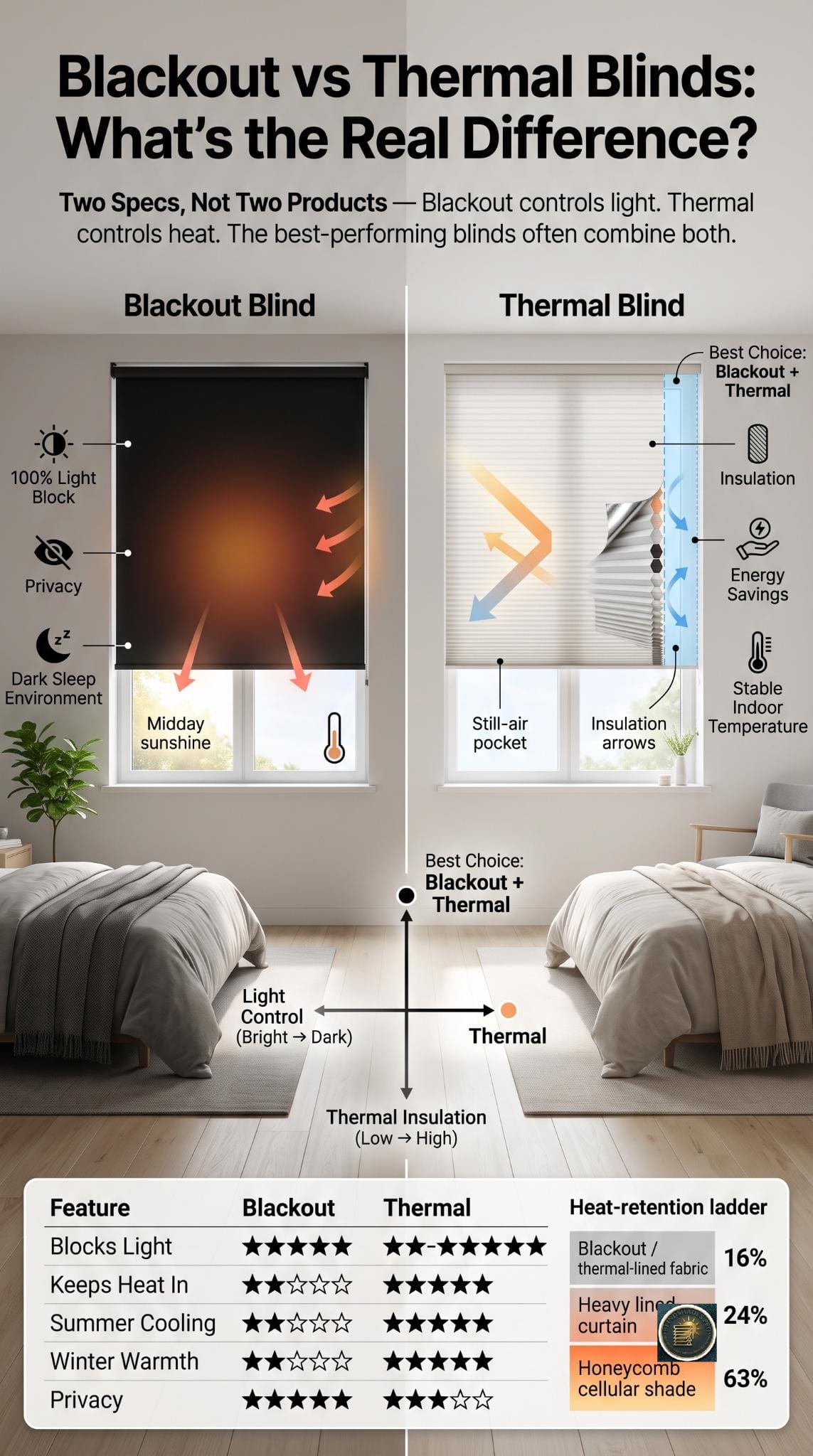
By Michael Turner — 30 years in window treatments
Blackout and thermal aren’t two rival products — they’re two different specifications that one blind can carry at once. Blackout answers a light question: how dark does this room get? Thermal answers a heat question: how much energy does this window stop? A blackout blind with no insulating construction leaves you cold; a thermal blind with no opaque layer leaves you squinting at dawn. The buying answer the comparison pages only gesture at: the blackout cellular shade carries both specs in one product, and it currently tops the only ranking on this subject.
Key Takeaways
- Different axes, different questions. Blackout is a light spec — multi-layered opaque fabric engineered toward total darkness. Thermal is a heat spec — trapped-air construction engineered toward insulation. Retail uses the words interchangeably; the products solve entirely different problems.
- The number that settles the fabric side: in Consumer NZ’s retention testing, the thermal-labeled fabric tier — which is largely the blackout-lined tier — retains just 16 percent of heat, against 24 for plain heavy lining and 63 for honeycomb blinds. A blackout lining is not insulation.
- The one-product answer exists: blackout cellular shades use coated cell fabric to block light through the honeycomb while the cells trap air — Sleepout’s mechanism explanation and Loconsolo’s week-old ranking (blackout cellular first, lined curtains second, ordinary blackout blinds a distant third) both land there.
- The “stuffy room” warning has real physics. Dark single-layer blackout fabric absorbs solar load and re-radiates it indoors — it darkens a summer room while quietly heating it.
- Never stack the two products over hot glass. The documented melted-blinds case was exactly that: a blackout curtain added over an existing blind on a west window built the oven.
⭐ Quick Answer — Blackout vs Thermal Blinds
The blackout vs thermal blinds decision is a two-axis question, not a product rivalry:
- Blackout is a light spec: multi-layered opaque fabric engineered toward total darkness — the pick for sleep, screens, and privacy, with the honest caveat that dark fabric absorbs summer sun and re-radiates it indoors.
- Thermal is a heat spec: trapped-air honeycomb construction engineered toward insulation — the U.S. Department of Energy credits insulated cellular shades with cutting window heat loss by forty percent or more.
- An opaque lining is not insulation: in Consumer NZ’s retention testing the thermal-labeled fabric tier — largely the blackout-lined aisle — held just sixteen percent of heat, losing to plain heavy curtains at twenty-four while honeycombs towered at sixty-three.
- The one-product answer carries both specs: blackout cellular shades block light through coated cells while the honeycomb traps air — the mechanism Sleepout’s comparison explains, and the top pick in the field’s only published ranking.
- Shop by spec, not label: the light side’s picks live in our Blackout Blinds & Shades guide, the heat side’s in the Thermal & Insulated Blinds guide, and the full material ladder in which blinds insulate best.
Blackout vs Thermal Blinds: What’s the Real Difference?
Two Specs, Not Two Products (Light Axis · Heat Axis): blackout answers how dark, thermal answers how warm — and the right buy is often one shade carrying both.
The definitional field is unusually united. velablinds states the split cleanly — blackout blinds block 100 percent of light; thermal blinds are engineered to insulate. Family Interiors routes by priority: light and privacy → blackout; insulation and bills → thermal. Curtarra is bluntest: blackout curtains do not insulate your room. Even the confusion has a documented origin — in a 50-comment efficiency-group thread, a homeowner reported a fabric-shop employee claiming blockout and thermal were the same thing, while “freezing to death.” The top answer holds the trade wisdom the shop floor missed: a thermal lined fabric is never as good as a good thermal loose lining — bonding an opaque layer onto fabric adds darkness, not warmth.
We can put a number on that answer. In Consumer NZ’s retention testing, the thermal-labeled fabric tier — the aisle where blackout-lined products live — retained 16 percent of heat, losing to plain heavy-lined curtains at 24, while honeycombs towered over both at 63. Read that ladder against the definitions and the comparison snaps into focus: opacity is cheap to add and does nothing thermal; trapped air is structural and does everything. The full category verdict is worked through in blinds vs curtains for insulation.
One doubt deserves its answer before the table, because a ten-year-old frugality thread put it perfectly: won’t the sun just hit the fabric and heat the room anyway, without an airtight seal? Half right. Dark blackout fabric does absorb solar load and re-radiate it indoors — the honest mechanism behind the “stuffy room” warning. But the seal half has a fix: fit is the airtightness. A snug inside mount or side channels make any covering a still-air pocket, and light or reflective-backed fabrics bounce rather than absorb.
The Two Axes — and the Product That Carries Both
| Factor | Blackout blind (light spec only) | Thermal cellular (heat spec only) | Blackout cellular — the combo |
|---|---|---|---|
| The job | Total darkness | Insulation | Both, one product |
| Construction | Single tightly-woven opaque fabric, often foam-backed | Honeycomb cells trapping still air | Coated cell fabric blocks light through the cells while the cells trap air |
| The numbers | The 16-percent fabric tier — darkness, not warmth | 63 percent retained; DOE credits insulated cellular shades with forty percent-plus less window heat loss | Inherits the cellular numbers with the light spec added |
| Summer behavior | Dark fabric absorbs and re-radiates — the stuffy-room mechanism | Reflective and light-colored faces intercept gain | Choose light-faced versions for sun-facing rooms |
| Sleep darkness | Excellent fabric, but blind formats leak a light halo at the edges | Cells filter light unless coated | Coated cells plus side channels approach true dark |
| The ranking | “Moderate” in the field’s only published ranking | The insulation champion | “Best” — Loconsolo’s fresh verdict, Sleepout’s mechanism |
| Cost, in words | The budget path | The made-to-order premium | A modest step above plain cellular — one product replacing two |
Which Does Your Room Need?
| Room | The pick | Why |
|---|---|---|
| Bedroom or nursery | Blackout cellular | Sleep darkness plus the warmth cold nights demand — one install |
| Media room | Blackout, either format | Darkness is the whole job; insulation optional |
| Drafty living room | Thermal cellular | Light can stay; the heat can’t keep leaving — picks in our Thermal & Insulated Blinds guide |
| West glass in summer | Light-faced thermal first | Dark blackout fabric on hot glass heats the room it darkens — the physics live in do thermal blinds keep heat out |
| Shift-sleeper’s daytime bedroom | Blackout cellular plus side channels | The halo is the enemy; channels close it |
| Tight budget, cold winter | Thermal first, film behind | Warmth is the bill; darkness can wait |
Avoid These Mistakes
Buying blackout for warmth. The 16-percent tier is the receipt: an opaque lining darkens beautifully and insulates barely. If the room is cold, buy construction — cells — not coating.
Stacking blackout over a blind on hot glass. The documented melted-blinds case was a blackout curtain added over an existing covering on a west window — the “upgrade” sealed a heat pocket that warped the slats. The full failure file is in disadvantages of thermal blinds.
Expecting a thermal cell to be dark. Uncoated honeycombs glow pleasantly at dawn. Sleepers need the coated blackout-cell version, named as such.
Ignoring the halo. Blind-format blackouts leak light at the edges — the gap between fabric and frame. Side channels or an outside mount with generous overlap close it.
Living in permanent blackout. Round-the-clock darkness costs daylight and free winter solar gain. Open by day, close for sleep — the choreography matters as much as the fabric.
Who Should Buy Which?
Blackout (light spec) ✔
- Media rooms, day-sleepers, glare-killed screens
- Anyone whose only complaint is brightness
Blackout (light spec) ✖
- Cold rooms hoping fabric opacity will warm them
Thermal (heat spec) ✔
- Drafty, bill-heavy, cold-glass rooms — the material ladder is in which blinds insulate best
Thermal (heat spec) ✖
- Nurseries needing true dark from an uncoated cell
Blackout cellular (both specs) ✔
- Bedrooms, nurseries, shift-sleepers, and every room that needs dark and warm — the one-product answer
The Bottom Line
Blackout vs thermal blinds is a false rivalry between a light spec and a heat spec. Buy blackout when darkness is the job, thermal when warmth is, and the blackout cellular when the room needs both — it tops the field’s own ranking for a reason, and the retention numbers explain everything the retail labels blur. The ranked blackout picks live in our Blackout Blinds & Shades guide, with the insulation side’s champions in the Thermal guide above — and if the budget is the constraint, the nearly-free rungs start in cheapest ways to insulate windows.
FAQ
Is blackout the same as thermal? No — and the confusion is common enough that shop-floor staff repeat it. Blackout is light-blocking opacity; thermal is heat-holding construction. A product can be either, both, or neither — and the tested numbers show an opaque lining adds almost nothing thermally.
What are the disadvantages of blackout blinds? The light halo at the edges of blind formats, the stuffy-room effect when dark fabric absorbs summer sun, minimal insulation from single-layer versions, and the daylight cost of leaving them closed around the clock. Most have fixes — channels for the halo, light faces for summer, choreography for daylight — and the full honest ledger for the thermal side sits in our disadvantages guide.
Do blackout curtains help with heat in winter? A little — any fabric layer slows air movement — but the tested gap is stark: blackout and thermal-labeled linings retain around 16 percent of heat; plain heavy-lined curtains manage 24, honeycombs 63. For winter warmth, buy weight and cells, not opacity; the curtain-side seal rules are in the blinds-vs-curtains guide.
What about blackout vs thermal blinds cost? In words, because pricing shifts with sale cycles: plain blackout rollers are the budget path; thermal cellulars carry the made-to-order premium; blackout cellulars sit a modest step above plain cells — and one combined product usually costs less than buying darkness and warmth separately.
Related Guides
- The Best Blackout Blinds & Shades — the light spec, ranked
- The Best Thermal & Insulated Blinds — the heat spec, ranked
- Blinds vs Curtains for Insulation — the category verdict
- Disadvantages of Thermal Blinds — the honest ledger
