Blinds vs Curtains for Insulation: Which Actually Wins?

Authored By Michael Turner -30 Years Home Improvement Expertise | Updated 2026 | BlindShades.pro
Updated on July 23, 2026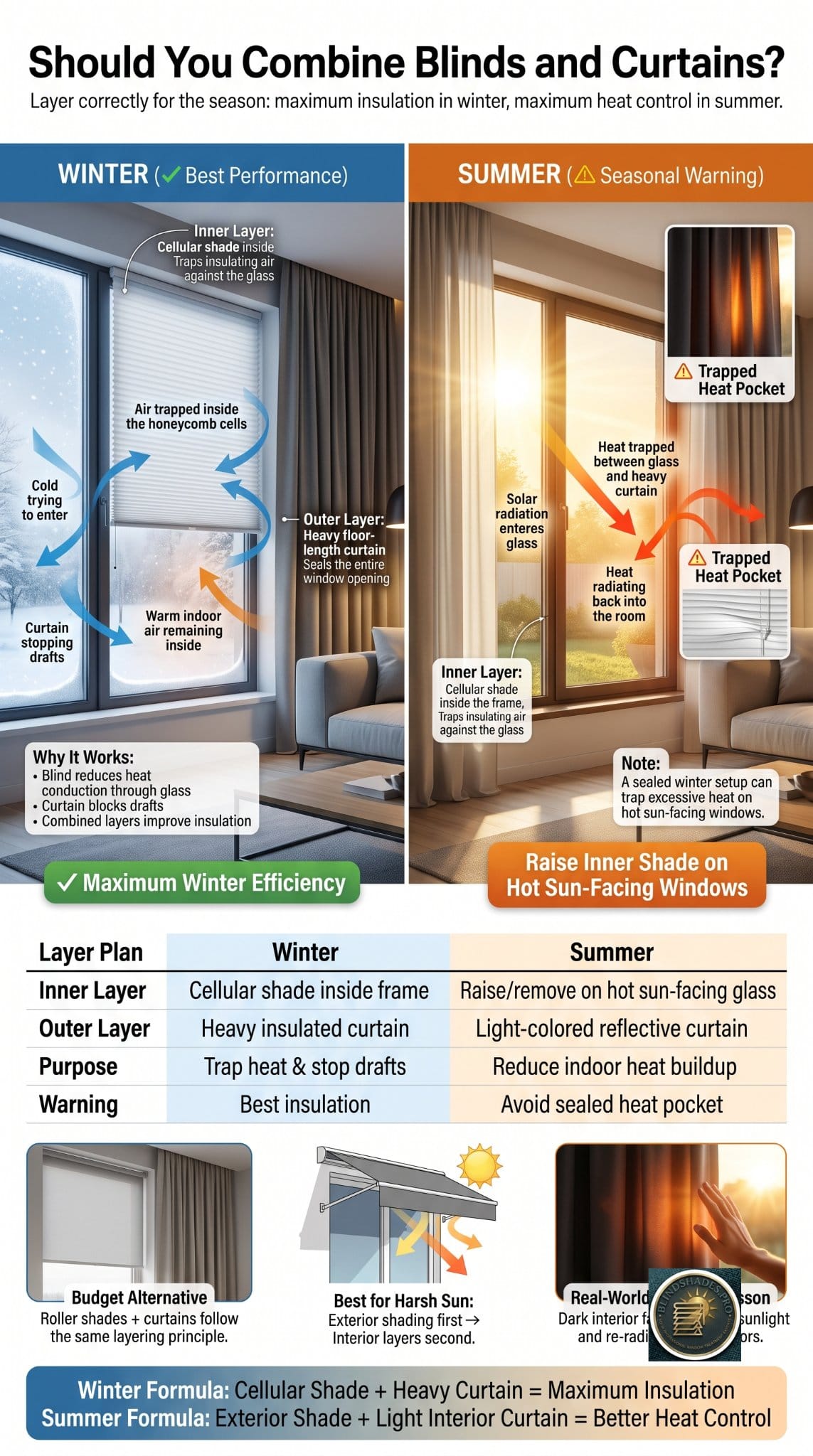
By Michael Turner — 30 years in window treatments
Cellular blinds beat every curtain at insulation, ordinary slatted blinds lose to almost any decent curtain, and expensive “thermal” curtains lose to plain heavy-lined ones — which means the blinds vs curtains question can’t be answered until you say which blind and which curtain. The word “blinds” covers products separated by a factor of ten in real performance, and most published verdicts quietly compare the worst blind to the best curtain. Split the categories honestly and the ranking is stable: honeycomb cells first, heavy mass second, marketing labels last.
Key Takeaways
- The three-number ladder that settles it: Consumer NZ’s retention testing puts honeycomb blinds at 63 percent of heat retained, heavy-lined curtains at 24 percent, and thermal-labeled curtains at just 16 percent — the label loses twice.
- Every “curtains win” verdict you’ve read is a slats verdict. Bob Vila’s comparison says blinds insulate worse “because the slats allow heat to escape” — true for venetians, which Cornell’s extension research calls ineffective against heat loss, and false for cellular shades, which the U.S. Department of Energy credits with cutting window heat loss by forty percent or more.
- Fit beats fabric. A plain curtain sealed at the top, sides, and hem outperforms an expensive thermal curtain hung six inches short — because an unsealed curtain runs a convection loop that drains warm air down the glass all night.
- There’s one layout where curtains actively backfire: a radiator under the window. Floor-length fabric funnels the heating output into the glass gap; a fitted blind seals the glass above the radiator and lets the heat enter the room.
- The combine-both advice is right — in winter. Cellular inside the frame plus a heavy curtain over it stacks two barriers; just unstack it in summer, because the same sandwich on hot glass is how blinds warp and melt.
⭐ Quick Answer — Blinds vs Curtains for Insulation
The blinds vs curtains for insulation contest is decided by category, not by the two words in the question:
- Cellular blinds beat every curtain: honeycomb air pockets fight the conduction that bleeds heat into cold glass, and the U.S. Department of Energy credits insulated cellular shades with cutting window heat loss by forty percent or more.
- The retention ladder isn’t close: Consumer NZ’s testing puts honeycomb blinds at sixty-three percent of heat retained, heavy-lined curtains at twenty-four, and thermal-labeled curtains at just sixteen — the label loses twice.
- Every “curtains win” verdict is a slats verdict: comparisons like Bob Vila’s fault blinds because slats leak heat — true for venetians, false for cells, and the reason this question stays confused.
- Fit beats fabric: a plain curtain capped at the top, sealed at the sides, and landed at the hem outperforms an expensive thermal curtain hung six inches short — and one layout (a radiator under the window) flips the verdict to blinds outright.
- See the rankings: the insulating picks live in our Thermal & Insulated Blinds guide, the material ladder in which blinds insulate best, and the honeycomb shortlist in the Cellular Shades guide.
Blinds vs Curtains for Insulation: Which Actually Wins?
The Category Test (Mass · Fit · Cells): mass beats label, fit beats fabric, and cells beat both.
Ask this question in a room full of homeowners and you get two camps. In a long-running discussion of whether thermal curtains are a waste of money — more than a hundred and sixty comments deep — the top answer argued that thick, heavy, standard-lined curtains insulate as well as anything sold with a thermal or blackout lining: the lining is marketing. The opposing camp defended the physics: mass, layers, and trapped air do real work at a window. Read the whole thread and the two camps turn out to agree on everything except the word. Nobody successfully defends the label; everybody concedes that weight, coverage, and seal deliver the result.
That resolution — the label loses, the category doesn’t — is the key to the entire blinds-vs-curtains argument, because the same trick runs on the other side of the question. When The Shade Store writes that curtains are “often better suited to insulation,” or velablinds concludes that heavy thermal-lined curtains beat standard blinds, or Bob Vila explains that in cold weather blinds lose “because the slats allow heat to escape” — every one of those verdicts is comparing curtains to slatted blinds. And on slats, they’re right: Cornell’s extension research states plainly that standard venetian blinds are not effective in preventing heat loss. Air pours straight through the vanes.
But “blinds” also includes the cellular shade — the category our complete Thermal & Insulated Blinds guide is built around — and the comparison flips. A honeycomb’s air pockets are a fundamentally different machine from a set of tilting slats — closer to double glazing than to a venetian. Freshine Curtains, writing from the curtain side, quietly concedes exactly this: blinds offer minimal insulation “compared to drapes or cellular shades.” Even the strongest curtain case on record excludes the honeycomb from the loss column.
So the honest answer runs three ways, and the numbers below make the ranking hard to argue with.
The Retention Ledger: Every Category, One Table
Consumer NZ’s window-covering research is the only published test that puts the main categories on one scale — percent of heat retained. Here is the whole field, with the two American institutional figures alongside.
| Category | Heat retained / performance | Source and note |
|---|---|---|
| Cellular (honeycomb) blinds | 63 percent retained; DOE credits insulated cellular shades with forty percent-plus reduction in window heat loss | Consumer NZ; U.S. Department of Energy — the category champion |
| Heavy-lined curtains (plain lining) | 24 percent retained | Consumer NZ — mass and coverage doing honest work |
| Thermal-labeled curtains | 16 percent retained | Consumer NZ — the label loses to plain heavy lining |
| Thick curtains generally | Heat-loss reduction “up to 10 percent” | Boca Blinds’ published estimate — the modest end of the curtain claims |
| Venetian / slatted blinds | Not effective in preventing heat loss | Cornell extension research — air moves freely through the vanes |
| Standard roller blinds | Weak insulators — a single flat layer | Covered in our cellular vs thermal roller comparison |
Two readings of that table matter. First, the gap at the top is enormous: the honeycomb retains more than two and a half times what the best curtain tier manages. Second — and this is the finding almost nobody repeats — the thermal-labeled curtain finishes below the plain heavy-lined one. Paying the thermal premium on fabric buys the word, not the result. The full material ranking, rung by rung, lives in our guide to which blinds insulate best.
Why Do Curtains Leak Heat at the Hem?
The Cold Waterfall: an unsealed curtain doesn’t just underperform — it runs a machine that actively drains your heat all night.
Here is the mechanism the pelmet advice hints at but almost never explains. Room air is warm; the glass behind your curtain is cold. Warm air slips over the curtain top into the gap, touches the glass, chills, sinks — and spills out under the hem into the room as a steady cold draft. The loop then pulls more warm air in at the top. All night, every night, the gap behind an unsealed curtain works as a heat exchanger running in exactly the wrong direction. People feel the result at ankle height and blame the window; half of it is the curtain’s geometry.
Killing the waterfall is a fitting job, not a fabric purchase — which is why fit beats fabric, and why a plain curtain sealed right beats an expensive thermal curtain hung six inches short. Four seals, in order of payoff:
| Seal | What it does | How |
|---|---|---|
| Cap the top | Stops warm room air entering the loop — the single biggest fix | Pelmet, cornice box, or a shelf-style top the curtain tucks under |
| Land the hem | Blocks the cold spill at the floor | Floor-length fabric that touches or puddles; never hem-short over a radiator gap |
| Seal the sides | Closes the vertical light gaps at the curtain’s edges — the same gaps that leak light leak air | Wrap-around track or rods returning to the wall; fabric hugging the wall |
| Overrun the window | Reduces edge leakage the way an oversized lid seals a pot | Fifteen to twenty centimeters of overlap past the frame each side |
A curtain sealed on all four counts starts behaving like the tested heavy-lined tier. A curtain failing all four behaves like decoration. The same seal logic is why a snug frame-fitted cellular shade posts the numbers it does — the product ships with its seal built in. And if your windows are so leaky that sealing fabric feels hopeless, fix the cheap layer first: our window insulation cost ladder starts at nearly free.
Which Fits Your Room?
| Your situation | The pick | Why |
|---|---|---|
| Radiator or heater under the window | Fitted blind — curtains backfire here | Floor-length fabric funnels heating output into the glass gap; a blind seals the glass above the radiator and releases heat to the room |
| Curtains or blinds for the living room | Curtains (sealed) or both — comfort and looks align | Big fabric mass suits the room; add cells behind on the coldest glass |
| Curtains or blinds in the bedroom | Cellular — dark, quiet, warm in one product | Air pockets also muffle street noise; blackout cell fabrics exist |
| Drafty, older, leaky windows | Heavy sealed curtains first | Coverage blocks moving air a frame-mounted blind can’t reach |
| Newer, well-sealed windows | Cellular | No drafts to block — conduction is the remaining enemy, and cells fight it best |
| Floor-to-ceiling glass, sliders, big openings | Curtains — the practical win | Fabric scales to openings where cellular sizing gets difficult and pricey |
| Rental | Either, lightly mounted | Tension-fit cells or existing-rod curtains; nothing structural |
Should You Combine Blinds and Curtains?
Yes — the widely-circulated combine-both advice is genuinely the maximum-performance answer for winter, and it’s the layered setup owners of both report settling into. But it comes with an order and a season, and the season part is the warning nobody attaches.
| Layer plan | Winter | Summer |
|---|---|---|
| Inner layer | Cellular shade inside the frame — traps air against the glass | Raise or remove the inner layer on hot sun-facing glass |
| Outer layer | Heavy floor-length curtain, sealed per the checklist above | Light-colored or reflective covering; heavy dark fabric absorbs sun and re-radiates it indoors |
| Why this order | The blind owns conduction at the glass; the curtain owns drafts and adds mass over the whole opening | A sealed winter stack on hot glass becomes an oven — trapped-pocket heat is how vinyl blinds warp and melt |
| Pairing note | Roller shades with curtains work the same way for budget setups — the roller seals the glass, the curtain adds mass | Same un-stack rule applies |
The summer caveat deserves its own sentence. In one widely-shared Texas account of a west-facing room, the blackout curtain doing the “insulating” was hot to the touch by afternoon — the fabric was absorbing the solar load and re-radiating it into the room. Interior fabric manages summer heat; it does not stop it. For genuinely punishing sun, shade the glass outside first, then use interior layers for the remainder.
Avoid These Mistakes
Paying the thermal-curtain premium for the word. The tested plain heavy-lined tier beats the thermal-labeled tier, 24 percent to 16. Buy weight, lining, and length — not the adjective. Our full audit of what the industry’s labels are worth is in are thermal blinds worth it.
Hanging any curtain six inches short. A hem hovering above the sill or floor is a spillway for the cold waterfall. Length and landing beat fabric spec every time.
Leaving the winter stack up all summer. The cellular-plus-curtain sandwich that saves heat in January traps it in July — on sun-blasted glass that trapped pocket softens cheap slats and stresses sealed glazing. Un-layer the hot side of the house.
Believing a venetian is insulation. Tilting slats control light beautifully and insulate almost not at all, per Cornell. If a seller pitches ordinary slatted blinds as an energy upgrade, walk.
Ignoring the radiator layout. If heat rises from under the window, floor-length curtains put your heating bill into the glass gap. That one layout flips the whole verdict toward a fitted blind.
Who Should Choose Which?
Cellular blinds ✔
- Cold-climate homes on well-sealed windows — the conduction fight, which cells win
- Bedrooms wanting warm, dark, and quiet from one product
- Radiator-under-window layouts
Cellular blinds ✖
- Very large or floor-to-ceiling openings where cell sizing gets impractical
- Steamy rooms — fabric cells dislike constant moisture
Curtains ✔
- Drafty older windows needing coverage and mass
- Big openings, sliders, and rooms where the soft look matters
- Budget fixes using fabric you can seal properly
Curtains ✖
- Anyone buying the “thermal” label instead of weight, length, and seal
- Radiator-under-window layouts
The Bottom Line
Blinds vs curtains for insulation is a category question wearing a two-word disguise. Split it honestly: cellular blinds beat every curtain tested; heavy, sealed, floor-length curtains beat every other blind; the thermal label loses on both sides of the aisle. Fit is the multiplier — cap, sides, hem, overrun — and the radiator layout is the one honest reversal. In winter, run both layers; in summer, unstack the sunny side. The ranked honeycomb picks live in our complete Thermal & Insulated Blinds guide, with the cellular-specific shortlist in the Cellular Shades guide — both maintained as retail lines change.
FAQ
Are curtains more insulating than blinds? Only against slatted blinds. Heavy-lined curtains retain around 24 percent of heat in Consumer NZ’s testing, which beats venetians handily — but honeycomb blinds retain 63 percent, more than double the best curtain tier. Against cellular products, curtains lose; against slats, they win.
Are blinds or shades better for insulation? The insulating champions — cellular and honeycomb products — are technically shades: soft fabric constructions rather than hard slatted blinds. In everyday use the words blur, but the distinction matters here, because the air-pocket shade construction is exactly what slatted blinds lack. If insulation is the goal, shop the shade family.
Do blinds or curtains keep a room warmer? A fitted cellular blind keeps a room warmest at the glass, and the DOE’s forty-percent heat-loss figure backs it. A heavy sealed curtain adds mass and blocks drafts across the whole opening. The warmest rooms in cold climates run both — blind inside the frame, sealed curtain over it.
Is it better to use blinds or curtains overall? For pure insulation, cellular blinds. For drafty old windows, big openings, and looks, curtains — sealed top, sides, and hem. For maximum winter performance, both in layers. The only clear reversal is a radiator under the window, where curtains funnel heat into the glass and a blind wins outright.
Blinds vs curtains for insulation vs blackout — which matters more? They’re separate jobs that one product can share. Blackout is about light; insulation is about heat; a blackout cellular shade does both, and our Blackout Blinds & Shades guide covers the light side. A blackout label alone adds little warmth — the 16-percent thermal-labeled tier includes plenty of blackout-lined fabric.
What about blinds vs curtains cost? Stated in words because pricing moves with sale cycles: basic curtains and basic blinds start comparably cheap; quality cellular shades run to a meaningful premium because most are made to order; heavy custom drapery can cost more than any blind. The budget-honest path is plain heavy curtains sealed well, upgraded to cells on the coldest glass first.
Related Guides
- The Best Thermal & Insulated Blinds — the complete guide
- Which Blinds Insulate Best? — the full material ladder, rung by rung
- Cellular vs Thermal Roller Blinds — the season test
- Cheapest Ways to Insulate Windows — the cost ladder from nearly free upward
