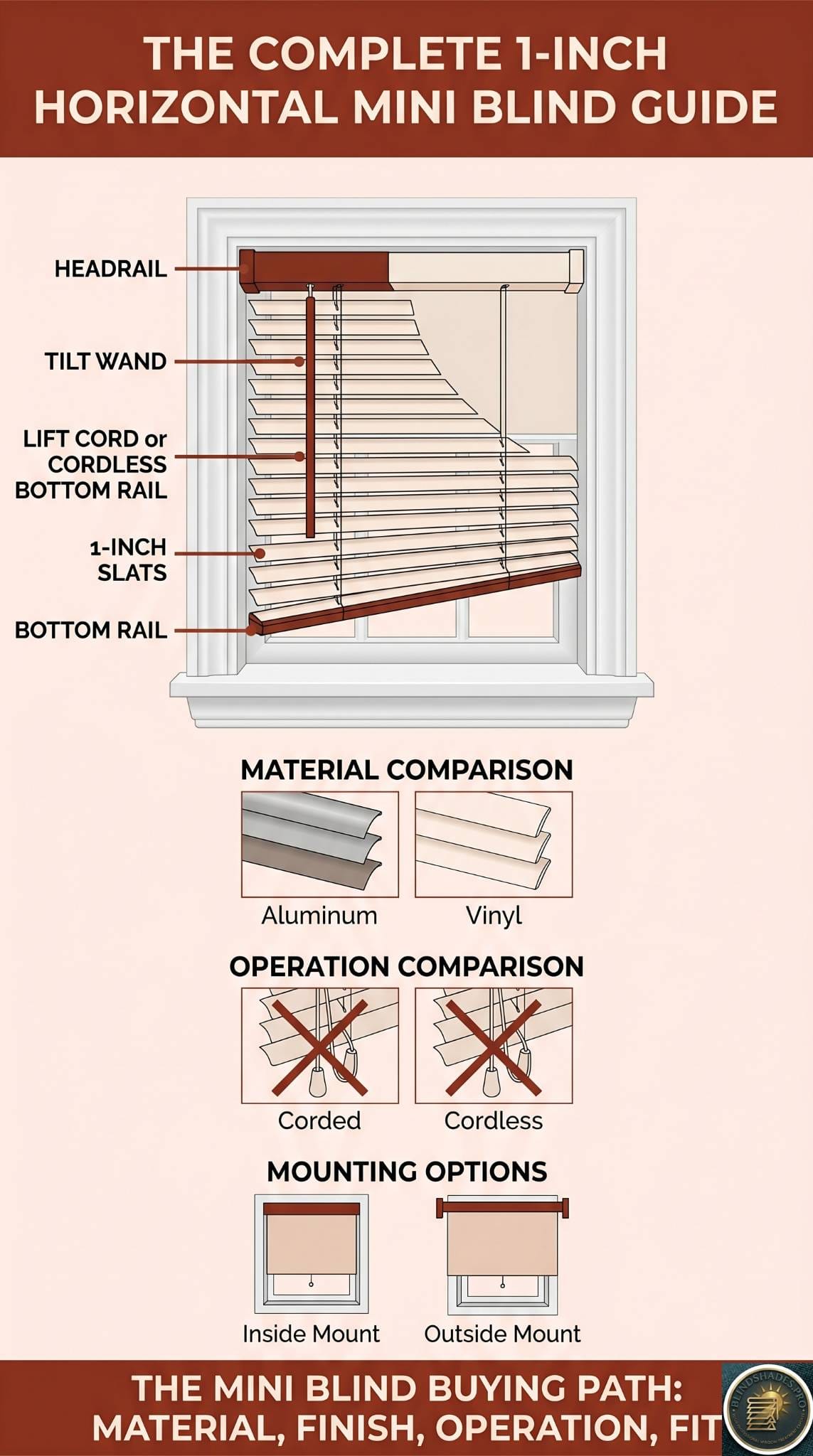
The Best Mini Blinds Buying Guide
Mini Blinds Are the Most Underestimated Window Covering in America — Here Is What 30 Years Taught Me About Getting Them Right
By the Editorial Team at BlindShades.pro | Updated 2026 | 30 Years of Home Improvement Expertise
⭐ Quick Answer — Best Mini Blinds for Most Homes
- Best Overall: Levolor 1-Inch Cordless Aluminum Mini Blinds — 8-gauge slats that hold shape, smooth cordless lift, available at Home Depot & Lowe’s (~$20–$60)
- Best Budget: SelectBlinds 1-Inch Economy Cordless Aluminum Mini Blinds — custom-sized online, MeasureSafe measurement guarantee (~$12–$40)
- Best Premium: Norman CityLights Cordless Aluminum Mini Blinds — valance-free modern headrail, tighter privacy slats, Best for Kids certified (~$50–$120)
- Best for Bathrooms: Bali 1-Inch Cordless Aluminum Mini Blinds — fully waterproof, wipe-clean, available at Lowe’s (~$15–$50)
- Best for Rental Properties: Hampton Bay 1-Inch Aluminum Mini Blinds — lowest cost custom-sized option, same-day at Home Depot (~$10–$35)
- Best for Kids’ Rooms: Levolor Cordless Aluminum Mini Blinds — WCMA-certified child safety, no dangling cords (~$25–$65)
⚠️ Quick Safety Note: If you have vinyl mini blinds installed before 2001, replace them immediately — especially in homes with young children. Pre-2001 vinyl blinds may contain lead. All blinds sold in the USA after 2001 are lead-free. Read the full safety section below.
📖 Before you spend a dollar — read the complete guide below. Covers slat gauge specs (the number nobody tells you about), 5 product types, 7 brand reviews, the Home Depot cut-to-size secret, correct cleaning method, lead paint history & 10 FAQs.
Want the full picture before spending a dollar? The complete guide covers all material types, slat widths, slat gauge specs, brand reviews, measurement guide, lead paint safety history, and 10 FAQs below.
Here is something I almost never say about any window covering: mini blinds are genuinely underrated.
I know — that sounds wrong. Mini blinds are the window covering that launched a thousand renovation videos showing people ripping them out and throwing them in the dumpster. They are the symbol of cheap apartments and dated offices. They clatter in the wind. They bend when you look at them wrong. They collect dust like it is their job.
And yet. After 30 years in home improvement — measuring windows in thousands of American homes, from beachfront condos in Florida to farmhouses in Minnesota — I keep coming back to aluminum mini blinds as the right answer for more situations than most people admit.
When someone needs a bathroom window covered in a high-humidity environment where fabric would mildew. When a landlord needs to cover 40 windows in a rental property without losing the deposit. When a home office needs precise glare control for a computer screen. When a kitchen window needs a wipe-clean, waterproof covering that can handle cooking splatter.
Mini blinds. Every time.
The problem is not the product — it is that Americans consistently buy the wrong specification of mini blind for their application, or buy the cheapest possible version and are surprised when it performs cheaply.
This guide will fix that.
What Are Mini Blinds? The Direct Answer
Mini blinds are horizontal window blinds with narrow slats — typically 1 inch wide — made from aluminum, vinyl, or PVC. They are a subcategory of venetian blinds, distinguished primarily by slat width. The “mini” refers to the narrow 1-inch slat compared to the wider 2-inch or 2.5-inch slats of standard venetian blinds.
The term is sometimes extended to include 2-inch aluminum blinds — which are technically standard venetian blinds but are colloquially grouped with mini blinds in the American retail market. For the purposes of this guide, “mini blinds” covers all aluminum and vinyl horizontal slat blinds in the 0.5-inch to 2-inch slat width range.
Why mini blinds remain one of the most purchased window coverings in America:
- Lowest cost per window of any quality window covering — starting under $10 for stock sizes
- Completely waterproof aluminum material — unlike any fabric alternative
- Precise light control through slat tilting — better directional control than most alternatives
- Extremely slim profile — fits in shallow window frames where nothing else will
- Easy wipe-clean maintenance — critical for kitchens and bathrooms
- Custom sizing available at most major US retailers from the same day
The 5 Types of Mini Blinds You Need to Understand
1. Standard 1-Inch Aluminum Mini Blinds
The classic. A single-layer of horizontal aluminum slats at exactly 1-inch width, suspended on a cord ladder from a metal headrail. Available corded or cordless, in hundreds of colors from stark white through metallics through warm neutrals.
This is the mini blind most Americans picture — and the one most often bought wrong. The critical variable is slat gauge — the thickness of the aluminum. Budget 1-inch aluminum mini blinds use 6-gauge (0.006-inch thick) aluminum. Quality 1-inch aluminum mini blinds use 8-gauge (0.008-inch thick) aluminum. That extra 0.002 inches is the difference between slats that bend when touched and slats that hold their shape for 10 years of daily use.
When to choose: Bathrooms, kitchens, home offices, utility rooms, rental properties — anywhere moisture resistance and precise light control matter more than aesthetics. Price range: $10 – $80 per window (retail)
2. Micro / Half-Inch Aluminum Mini Blinds (0.5-Inch Slats)
The slimmest profile available in the mini blind category. Half-inch slats create an even more compact stacking bundle when raised — making them ideal for windows where stack height is a concern, such as French doors, sidelight windows, and double-hung windows with limited headroom above the glass.
The micro mini blind is also the right specification for windows where you want maximum visibility through the glass when the blind is raised — fewer slats in the bundle means a smaller, less obtrusive stack. Available from specialty retailers and select online sources — not commonly stocked in big-box stores.
When to choose: French doors, sidelight windows, narrow windows, anywhere minimal stack height matters. Price range: $15 – $90 per window Top brands: Norman, American Blinds, SelectBlinds (online)
3. 2-Inch Aluminum Mini Blinds
Technically a standard aluminum venetian blind — but widely sold and searched under the “mini blind” umbrella in the USA market. The wider 2-inch slat provides a more substantial appearance, better light blocking per slat, and a less visually busy appearance on larger windows.
If you are covering windows wider than 36 inches or taller than 48 inches, the 2-inch aluminum blind is almost always a better aesthetic choice than the 1-inch version — fewer slats in the stack, cleaner sightlines, more substantial look.
When to choose: Larger windows in offices and living rooms, anywhere you want the aluminum blind aesthetic with a less busy appearance. Price range: $15 – $100 per window Top brands: Levolor, Bali, Graber, SelectBlinds
4. Vinyl / PVC Mini Blinds
Made from PVC rather than aluminum — typically slightly heavier and available in a more limited color range. Vinyl mini blinds are almost always the budget-tier option at major retailers. They share the moisture-resistance advantage of aluminum but are more prone to discoloration over time under UV exposure.
The honest truth about vinyl mini blinds: Quality has improved significantly since the late 1990s when vinyl mini blinds were found to contain lead in their surface coating — an issue that caused a massive product recall in the USA and permanently damaged the reputation of vinyl mini blinds. Modern vinyl mini blinds sold in the USA are lead-free and compliant with current safety standards. However, if you have vinyl mini blinds manufactured before 2001 in your home, replacement is strongly recommended.
When to choose: Budget-priority applications where aluminum is not available at the right price or size. Price range: $8 – $40 per window Top brands: Mainstays (Walmart), Hampton Bay entry-level
5. Cordless Mini Blinds
Cordless operation is available across all mini blind material types. Rather than a hanging lift cord, cordless mini blinds use a spring-balanced mechanism inside the headrail — you push the bottom rail up to raise and pull it down to lower. The slat tilt is controlled by a small wand rather than a dangling cord.
Cordless mini blinds are now the default recommendation for virtually every residential application. Since 2018, WCMA and ANSI standards have required all corded window coverings to meet strict child safety requirements. Almost two children per day are treated in US emergency rooms for window cord-related injuries. For any home with children under 6, cordless is non-negotiable — not a preference, a safety requirement.
From an aesthetic standpoint, cordless mini blinds also simply look better. No dangling cord against the window. No cord clutter on the sill. A cleaner, more intentional appearance.
Limitation: Cordless mini blinds require you to reach the bottom rail. For very tall windows where the fully extended blind puts the bottom rail out of comfortable reach — corded may be the more practical choice for daily operation.
Price range: $15 – $80 per window (cordless premium of approximately $5–$15 over corded equivalent)

What to Look For When Buying Mini Blinds — The Complete Checklist
✅ 1. Slat Gauge — The Specification That Determines Everything
This is the single most important technical specification in the mini blind category — and the one that zero retailers prominently advertise because budget products do not want you to know it exists.
Aluminum slat gauge guide:
- 6-gauge (0.006 inch): Budget tier. Found in Walmart, dollar stores, and the cheapest Amazon listings. These slats bend when you push them to open a window behind the blind. They dent from casual contact. They look fine on day one and look terrible by year two.
- 7-gauge (0.007 inch): Mid-range. Found in most Home Depot and Lowe’s stock products. Holds shape under normal use. Adequate for most residential applications.
- 8-gauge (0.008 inch): Quality tier. Found in Levolor, Norman, and premium online retailers. Significantly more rigid. Resists denting from casual contact. Holds a clean appearance for 10+ years of normal use.
How to identify gauge when shopping:
- Ask the retailer directly — any knowledgeable blind specialist will know
- Flex a sample slat gently — 6-gauge will flex noticeably, 8-gauge will feel rigid
- Budget brands rarely specify gauge in product descriptions — quality brands usually do
- Price is a reliable proxy — under $15 per window almost always means 6-gauge
✅ 2. Headrail Quality — The Component That Determines Lifespan
The headrail is the metal box at the top that houses all the operating mechanisms — the tilting mechanism, the lift cord (or cordless spring), and the cord lock. Cheap headrails are thin steel that rattles and develops play in the tilt mechanism within a year. Quality headrails are heavier gauge steel with smooth, silent mechanisms that operate consistently for a decade.
What to check:
- Weight: Pick up the blind at the headrail end. A quality headrail feels substantial. A budget headrail feels hollow and light.
- Tilt mechanism smoothness: Rotate the tilt wand. Quality mechanisms turn smoothly with no catching or clicking. Budget mechanisms skip and catch.
- Cord lock quality (for corded blinds): The cord lock clicks cleanly and holds without slipping on quality blinds. Budget cord locks slip and allow the blind to slowly descend on their own.
✅ 3. Slat Width for Window Size — The Proportion Rule
Slat width dramatically affects how a window looks when the blind is in place:
1-inch slats work best on:
- Windows up to approximately 36 inches wide
- Windows up to 48 inches tall
- Bathroom windows, kitchen windows, and utility windows where function dominates aesthetics
2-inch slats work better on:
- Windows wider than 36 inches
- Windows taller than 48 inches
- Home offices and living rooms where aesthetics matter alongside function
- Any room where the visual busyness of many narrow slats would be distracting
The half-inch slat works best on:
- French doors and sidelights
- Narrow windows under 20 inches wide
- Any application where minimizing stack height when raised is a priority
✅ 4. Inside Mount vs. Outside Mount — Getting the Depth Right
Inside mount: The mini blind headrail mounts inside the window frame recess.
- Minimum depth required: 1.5 inches for standard 1-inch mini blind headrail
- Half-inch micro mini blind headrails require as little as 0.75 inches — the only blind type that works in extremely shallow frames
- Gives the cleanest built-in appearance — my first choice aesthetically when the frame depth permits
Outside mount: The mini blind headrail mounts on the wall or trim above the window frame.
- Works on any window regardless of frame depth
- Provides better light blocking — blind overlaps the frame on all sides
- Required for windows with frames less than 1.5 inches deep
✅ 5. The Lead Paint Issue — What Every American Homeowner Needs to Know
This is the section no other buying guide covers adequately — and it is genuinely important for American homeowners.
Between approximately 1993 and 1997, vinyl mini blinds manufactured in China and sold in major US retailers were found to contain lead in their surface coating. As the vinyl degraded under UV exposure from sunlight, lead dust was released. The US Consumer Product Safety Commission issued a recall affecting tens of millions of blinds.
What you need to do:
- If you have vinyl mini blinds manufactured before 2001 — replace them. This is particularly urgent in homes with young children.
- All mini blinds manufactured and sold in the USA after 2001 are lead-free and comply with current safety standards.
- Look for blinds labeled “lead-free” or manufactured after 2001. When in doubt, replace.
- Modern aluminum mini blinds have never had this issue — lead was specific to certain vinyl/PVC formulations from the 1990s.
This is not fearmongering — it is a documented safety issue that affects homes across America where original 1990s window coverings have never been replaced.
✅ 6. Child Safety — WCMA Compliance and the Cordless Standard
For any home with children under 6 years old:
- Choose cordless mini blinds — eliminates lift cords entirely
- If choosing corded, ensure WCMA-certified cord safety device is included
- Look for the “Best for Kids” certification on product packaging
- The “Best for Kids” certification is the highest child safety standard for window coverings in the USA — Norman’s CityLights line carries this certification on their aluminum mini blinds
Per documented CPSC data, window blind cords are among the top hidden strangulation hazards in American homes. Almost two children per day are injured — the majority under 36 months old. This is the one area where there is no budget consideration — cordless is mandatory in homes with young children.
Top Mini Blind Brands Reviewed — Honest Assessments from 30 Years
🏆 Norman CityLights — Premium Tier ($50 – $120 per window)
Norman’s CityLights aluminum mini blind is the most thoughtfully designed product in the category. The valance-free headrail gives a clean, modern appearance that makes standard mini blinds look dated by comparison. Tighter-closing privacy slats reduce light gaps when the blind is fully closed. Available in micro (0.5-inch), 1-inch, and 2-inch slat widths. Best for Kids certified — the only major mini blind brand to carry this certification prominently.
Best products: Norman CityLights 1-Inch Cordless Aluminum Blinds Where to buy: Norman dealers, select online retailers, normanusa.com Honest assessment: The product that proves mini blinds do not have to look institutional. Worth the premium price in primary living spaces where appearance matters as much as function. The valance-free headrail alone is worth the upgrade over standard brands.
🥈 Levolor — Mid-to-Premium Tier ($20 – $80 per window)
Levolor aluminum mini blinds are the most widely trusted mid-market option in America — available at both Home Depot and Lowe’s with reliable custom sizing. Their 8-gauge aluminum slats hold shape significantly better than budget competitors. Cordless lift mechanisms are smooth and well-calibrated. Three-year warranty is genuine and honored without difficulty.
Best products: Levolor 1-Inch Cordless Aluminum Mini Blinds, Levolor 2-Inch Aluminum Blinds Where to buy: Home Depot, Lowe’s, Blinds.com Honest assessment: My default recommendation for most American homeowners buying mini blinds. The step up from budget options to Levolor is approximately $10–$15 per window — and it buys you a blind that will look good and operate correctly for 8–10 years instead of 2–3. Worth it every time.
🥉 Bali — Mid-Range ($15 – $60 per window)
Bali’s aluminum mini blind line at Lowe’s is a solid performer at a competitive price. Slat quality is between budget and premium — approximately 7-gauge. Cordless mechanisms are reliable for everyday residential use. Good color selection. The Bali Real Wood and Faux Wood lines are stronger product categories than their mini blind line — but for aluminum mini blinds at mid-range, Bali delivers.
Best products: Bali 1-Inch Cordless Aluminum Mini Blinds Where to buy: Lowe’s, online retailers Honest assessment: A reliable choice at the lower end of mid-market pricing. If the choice is between Bali and Hampton Bay at similar prices, choose Bali consistently.
Graber — Mid-to-Premium Tier ($25 – $90 per window)
Graber’s aluminum mini blind line uses heavier-gauge slats than most competitors at equivalent price points. Their mechanisms are notably smooth and quiet. Available through Costco and online retailers — less widely distributed than Levolor but consistently worth seeking out.
Honest assessment: An underappreciated choice. If Graber is available in your color and size, it outperforms Bali at similar pricing and approaches Levolor quality at slightly lower cost.
SelectBlinds — Online Value Leader ($12 – $55 per window)
SelectBlinds offers the strongest value proposition for custom-sized aluminum mini blinds online. Their MeasureSafe guarantee — free remake if you measure incorrectly — removes the primary risk of online blind purchasing. Cordless options are standard across their mini blind range. Pricing consistently beats big-box stores by 20–30%.
Honest assessment: The best online choice for custom mini blinds. The measurement guarantee is genuinely useful — mini blind measurement errors are common and the remake policy makes SelectBlinds the lowest-risk custom mini blind purchase in the USA market.
Hampton Bay (Home Depot) / Mainstays (Walmart) — Budget Tier ($8 – $30 per window)
Hampton Bay is Home Depot’s entry-level aluminum mini blind — 6-gauge aluminum, basic mechanism, adequate for low-use applications. Mainstays at Walmart is the lowest price mini blind available in major US retail — 6-gauge aluminum or thin vinyl, basic mechanism, appropriate for temporary applications or very low-use windows.
Honest assessment: For a guest room, storage room, or any window that is rarely operated — these are acceptable. For any primary living space, kitchen, bathroom, or bedroom — spend the extra $10–$15 per window and buy Levolor. The difference in daily experience is significant and the cost difference over the life of the blind is negligible.
Amazon Generic Brands — Variable ($10 – $50 per window)
The Amazon mini blind market is a wide spectrum of quality. Some listings are rebadged versions of known manufacturers’ seconds and are perfectly adequate. Others are genuinely poor quality — thin gauge aluminum, brittle mechanisms, color that fades within months. The challenge is that Amazon product photos rarely reveal slat gauge.
What to look for when buying mini blinds on Amazon:
- Reviews that specifically mention durability after 12+ months of use
- Product descriptions that specify slat gauge (8-gauge is a positive signal)
- A minimum 1-year warranty — budget brands with 30-day warranty are signaling their own confidence level
- Fulfilled by Amazon vs. shipped from China — the latter has longer return windows to handle quality issues

Detailed Comparison: Mini Blinds by Type, Brand, and Budget
| Type | Budget Option | Mid-Range Option | Premium Option |
|---|---|---|---|
| 1-Inch Aluminum Corded | Mainstays Walmart ($8–$20) | Bali/Levolor ($20–$50) | Norman CityLights ($50–$100) |
| 1-Inch Aluminum Cordless | Hampton Bay ($12–$30) | Levolor Cordless ($25–$65) | Norman CityLights Cordless ($55–$120) |
| 0.5-Inch Micro Aluminum | Amazon Generic ($15–$35) | American Blinds ($25–$60) | Norman Micro ($40–$90) |
| 2-Inch Aluminum | Hampton Bay ($15–$35) | Graber/Levolor 2-Inch ($30–$80) | Norman 2-Inch ($60–$120) |
| Vinyl / PVC | Mainstays ($8–$15) | Hampton Bay Vinyl ($12–$25) | Bali Vinyl ($20–$45) |
| Cordless for Kids | Hampton Bay Cordless ($12–$30) | Levolor WCMA Certified ($25–$65) | Norman Best for Kids ($55–$120) |
Where to Buy Mini Blinds in the USA
Home Depot
Best for: Levolor and Hampton Bay, same-day stock sizes, in-store custom ordering Stock sizes: Available same day in common widths — 23″, 27″, 29″, 31″, 33″, 35″ Custom program: Yes — cut-to-size service available in most stores Price range: $10 – $80 Honest take: The most convenient source for mini blinds in America. The in-store cut-to-size service is a genuine advantage — many standard windows can be served by buying an oversize stock blind and having it cut in-store for free or a small fee. This avoids the 10–14 day custom order wait.
Lowe’s
Best for: Bali brand, slightly better premium selection than Home Depot in some markets Stock sizes: Similar to Home Depot Price range: $10 – $75 Honest take: Comparable to Home Depot. Marginally better Bali selection. The cut-to-size service is similarly useful.
Walmart
Best for: Absolute lowest price, temporary applications, rental move-ins Stock sizes: Limited — common widths only Price range: $8 – $25 Honest take: Mainstays mini blinds at Walmart are the lowest quality mini blind sold by a major US retailer. For temporary use — covering a window during a renovation, or a short-term rental — they are adequate. For permanent installations, spend more.
Amazon
Best for: Wide selection, delivery speed, motorized options, niche sizes Price range: $10 – $150 Honest take: Useful for hard-to-find sizes and specialty types (micro mini blinds, motorized mini blinds). Quality research is required before purchasing — read reviews carefully and verify slat gauge where possible.
SelectBlinds / Blinds.com (Online Custom)
Best for: Custom sizing at competitive prices, widest color selection, measurement guarantee Price range: $12 – $90 Honest take: The right channel for non-standard window sizes where big-box stock does not fit and you want custom sizing at better pricing than in-store custom programs. The MeasureSafe remake guarantee at SelectBlinds makes it the lowest-risk online purchase for custom mini blinds.
Costco
Best for: Premium brands (Graber) at member pricing for multiple windows Custom program: Yes — in-home consultation Price range: $30 – $100 Honest take: For Costco members furnishing multiple windows across a home or rental property, the Graber program delivers quality mini blinds at genuinely competitive pricing with professional measurement and installation available.
How to Measure Mini Blinds — Step by Step
Accurate measurement is particularly critical for mini blinds because the slim 1-inch slats leave very little margin for error — gaps are immediately visible.
Inside Mount — 1-Inch Mini Blinds
Minimum frame depth: 1.5 inches for standard headrail. 0.75 inches for micro/half-inch headrail.
- Measure the width of the window opening at the top, middle, and bottom
- Use the narrowest width measurement
- Do not make any deduction — order this exact width. The manufacturer deducts 3/8 inch automatically for inside mount clearance on most brands. Confirm with your specific retailer.
- Measure the height from the top of the opening to the sill at three points
- Use the longest height measurement
- Order exact dimensions
Pro tip from 30 years in the field: For inside mount mini blinds, if your narrowest width measurement is between two sizes — always round down, never up. A mini blind that is 1/4 inch too wide will not fit inside the frame. A mini blind that is 1/4 inch too narrow leaves a small gap — better than not fitting at all.
Outside Mount — 1-Inch Mini Blinds
- Decide how far beyond the window frame to extend — minimum 1.5 inches each side, recommended 2 inches each side
- Add both side extensions to the window width (e.g., 30-inch window + 4 inches = 34-inch blind)
- Determine mounting height — typically 2–4 inches above the window frame for mini blinds
- Measure total height from mounting point to sill or floor
- Order these total dimensions
The Home Depot / Lowe’s Cut-to-Size Service
Both Home Depot and Lowe’s offer an in-store cut-to-size service for most stock mini blinds — they can cut a standard stock blind to your exact width at no additional charge or for a small fee (typically under $5). This is a significant time-saver that most shoppers do not know about.
How it works:
- Select a stock blind that is wider than your window but the correct height
- Take it to the blind cutting station (usually near the window covering aisle)
- Staff cut to your specified width
- You get a custom-width blind same day at stock pricing
Limitation: Cut-to-size only adjusts width — not height. Height adjustment requires trimming the ladder cords and slats, which is more complex.
Installing Mini Blinds — What to Expect
DIY Installation
Difficulty: Easy Time: 10–20 minutes per window Tools needed: Drill or screwdriver, level, pencil
Mini blind installation is the simplest of all blind types:
- Mark bracket positions using included template
- Drill pilot holes (or use self-tapping screws on wood frames)
- Mount brackets
- Snap headrail into brackets
- Test tilt and lift operation
The most common DIY mistake with mini blinds: Not checking level before drilling. An unlevel mini blind is immediately obvious — the slats will hang visibly crooked on one side.
No-Drill Installation
Tension-mount mini blinds require no drilling — the blind is held in place by tension against the window frame sides. These work well for apartment renters or anyone who cannot drill. Limitation: Tension mounts only work for inside mount on smooth window frames and are not suitable for wide or heavy blinds.
Cleaning Mini Blinds — The Right Way and the Wrong Way
Cleaning mini blinds is one of the most-searched questions in the window covering category — and most advice online is either impractical or damaging to the blinds.
The Right Daily Maintenance (5 Minutes)
Close the slats fully in one direction. Run a microfiber dusting glove or flat microfiber cloth along the length of the blind — the closed position presents a flat surface that cleans efficiently in one pass. Flip the blind to close in the opposite direction. Repeat.
This 5-minute routine done monthly keeps mini blinds clean without any need for intensive cleaning.
The Right Deep Clean (No Bathtub Required)
The bathtub method — removing the blind and submerging it in soapy water — is frequently recommended and frequently damages blinds. Water trapped in the headrail causes rust and mechanism failure. Ladder cords stretch and misalign when wet.
The correct deep clean for aluminum mini blinds:
- Keep the blind on the window — fully extended and closed
- Fill a spray bottle with warm water and a small amount of dish soap
- Lightly mist one section of slats at a time
- Wipe with a clean microfiber cloth — one slat at a time
- Follow with a dry cloth to prevent water spots
- Leave the blind extended and open to dry completely before raising
This method takes longer than the bathtub approach but preserves the headrail mechanism and ladder cord alignment.
What Never to Do
- Never submerge the headrail in water — rust and mechanism damage
- Never use abrasive sponges or scourers — scratches the powder coating
- Never use solvent-based cleaners — strips the finish
- Never bend slats back to straighten them — aluminum has memory and will return to the bent position; replacement is the only fix for severely bent slats
Mini Blinds FAQ — The Questions Americans Actually Ask
Q: What is the difference between mini blinds and venetian blinds? A: Mini blinds are a type of venetian blind — specifically those with 1-inch or narrower aluminum slats. All mini blinds are venetian blinds, but not all venetian blinds are mini blinds. The broader venetian blind category includes 2-inch and 2.5-inch slat widths in wood and faux wood materials. In everyday American usage, “mini blinds” typically refers to the aluminum 1-inch slat version while “venetian blinds” refers to wider slat options.
Q: Are mini blinds bad for you — is there a lead paint risk? A: Modern mini blinds sold in the USA are safe. The lead risk applied specifically to vinyl mini blinds manufactured between approximately 1993 and 1997 — these were recalled by the CPSC. If you have vinyl mini blinds installed before 2001, replace them, particularly if you have young children. All mini blinds manufactured and sold in the USA after 2001 are lead-free. Aluminum mini blinds have never had this issue — the lead problem was specific to 1990s vinyl formulations.
Q: Can mini blinds be cut to size at Home Depot? A: Yes — Home Depot and Lowe’s both offer in-store cut-to-size service for most mini blind stock products. Staff can cut a stock blind to your exact width at no charge or for a small fee (typically under $5). This is one of the best-kept secrets in US window covering retail — same-day custom width at stock pricing. The service cuts width only — height adjustment is more complex.
Q: What is the best way to clean mini blinds without taking them down? A: Keep the blind on the window, fully extended and closed. Lightly mist with diluted dish soap solution. Wipe each slat with a microfiber cloth. Follow with a dry cloth. Leave extended and open to dry completely. This method preserves the headrail mechanism — which is the component most damaged by the bathtub submersion method frequently recommended elsewhere.
Q: Are cheap mini blinds from Walmart actually OK to use? A: For temporary or very low-use applications — guest rooms, storage areas, short-term rentals — yes. For daily-use windows in primary living spaces, kitchens, or bathrooms — no. Walmart’s Mainstays mini blinds use 6-gauge aluminum slats that bend easily, mechanisms that develop play quickly, and cord locks that slip within months. Spending an extra $10–$15 per window for Levolor at Home Depot delivers a dramatically better result for permanent installations.
Q: What mini blinds are best for a bathroom? A: Aluminum mini blinds are the ideal bathroom window covering. Aluminum is completely waterproof — it will not rust, warp, swell, or mildew in high-humidity environments. Choose a 1-inch cordless aluminum blind in a moisture-resistant powder coat finish. Levolor and Bali both make excellent bathroom-appropriate aluminum mini blinds. Avoid vinyl in bathrooms — heat and moisture accelerate yellowing and brittleness in PVC materials.
Q: How do I stop my mini blind slats from bending? A: Slat bending in mini blinds is caused by three things: thin gauge aluminum (upgrade to 8-gauge), physical contact during operation (push the bottom rail up rather than grabbing the slats), or cleaning pressure (wipe gently along the slat length, never perpendicular to it). Once aluminum slats are bent, they cannot be straightened reliably — replacement of individual slats is the correct solution. Most manufacturers sell replacement slat packs.
Q: What is the difference between 1-inch and 2-inch mini blinds — which should I choose? A: The choice comes down to window size and aesthetic preference. 1-inch slats work well on windows up to approximately 36 inches wide — the narrow slat creates a traditional, finely detailed appearance. 2-inch slats look better on wider windows — fewer slats in the stack creates a cleaner, less visually busy appearance. For a bathroom or kitchen window under 36 inches wide, 1-inch is the right choice. For a home office or living room window over 36 inches wide, 2-inch aluminum delivers a more proportionate appearance.
Q: How long do mini blinds last? A: Quality 8-gauge aluminum mini blinds from brands like Levolor and Norman last 10–15 years under normal residential use. Budget 6-gauge aluminum blinds typically last 2–5 years before slats bend or mechanisms fail. Vinyl mini blinds last 3–8 years depending on UV exposure — south and west-facing windows shorten lifespan significantly. The mechanism (headrail and cord lock) typically outlasts the slats in quality blinds. In budget blinds the slats and mechanism fail at similar rates.
Q: Are mini blinds good for bedrooms? A: Mini blinds provide good privacy and significant light reduction — but not complete blackout. When fully closed, quality mini blinds with tight-closing slats reduce light by approximately 85–90%. Light still enters around the frame edges and through the small gaps between slats. For a primary bedroom where total darkness is the goal, add a blackout liner or layer with blackout curtains over the mini blind. For a guest room or child’s room where good (not perfect) light reduction is sufficient, mini blinds are a practical and cost-effective choice.
The 2026 Mini Blind Trends You Should Know About
The valance-free headrail is growing fast. Norman’s CityLights collection demonstrated that removing the standard fabric valance and exposing a clean metal headrail profile creates a far more contemporary appearance. Other manufacturers are following — the traditional fabric valance is in decline as a design preference in 2026.
Warm metallic finishes are replacing stark white. The default white aluminum mini blind is giving way to warm champagne, brushed nickel, warm gray, and matte gold finishes. These warmer tones integrate with 2026’s dominant interior palette of warm neutrals and organic materials.
Cordless is now the absolute standard. Corded mini blinds are increasingly difficult to source from quality manufacturers in the USA residential market. This is unequivocally positive — cordless operation is safer, cleaner in appearance, and more practical for everyday use.
Micro mini blinds are growing in popularity. As French doors and sidelight windows become more prevalent in American home design, the 0.5-inch micro mini blind is experiencing strong growth — driven by the need for minimal stack height and the clean appearance of the compact slat.
Motorized mini blinds are emerging. What seemed impractical five years ago — a motorized $15 mini blind — is now available through select online retailers and smart home specialists. Battery-operated motor inserts that retrofit into standard mini blind headrails are bringing smart home functionality to the most budget-conscious window covering category.

Related Buying Guides on BlindShades.pro
- The Best Roller Blinds Buying Guide — if you are comparing mini blinds with roller options
- The Best Venetian Blinds Buying Guide — complete guide to wider-slat horizontal blinds in wood and faux wood
- The Best Vertical Blinds Buying Guide — for large windows and sliding glass doors
- The Best Faux Wood Blinds Buying Guide — the premium aesthetic alternative to aluminum mini blinds
- The Best Cordless Blinds & Shades Buying Guide — dedicated guide to cordless operation across all blind types
- The Best Blinds & Shades for Bathroom Windows Buying Guide — room-specific guidance for moisture-prone bathroom applications
Supporting Articles — Mini Blinds Deep Dive
The following supporting articles will be added to this section as they are published on BlindShades.pro:
- (Coming Soon) Are Cheap Mini Blinds From Walmart Actually Any Good — Or Are You Just Wasting Money?
- (Coming Soon) What Is the Difference Between 1-Inch and 2-Inch Mini Blinds — And Which Should You Choose?
- (Coming Soon) How to Clean Mini Blinds Without Taking Them Down — The Method That Actually Works
- (Coming Soon) Are Old Mini Blinds Dangerous? The Lead Paint Issue Every American Homeowner Needs to Know
- (Coming Soon) Can Home Depot Really Cut Mini Blinds to Size — And Is It Worth It?
- (Coming Soon) Why Do My Mini Blind Slats Keep Bending — And Is There Any Way to Fix Them?
- (Coming Soon) Cordless vs Corded Mini Blinds — Which Is Actually Better for Your Home?
- (Coming Soon) What Are the Best Mini Blinds for a Bathroom That Won’t Rust, Warp, or Yellow?
- (Coming Soon) How to Measure Mini Blinds for Inside Mount So They Don’t Leave Gaps
- (Coming Soon) Mini Blinds vs Faux Wood Blinds — Which Should You Actually Buy and Why?
Final Verdict — What Should You Actually Buy?
After 30 years and more mini blind installations than any one person should reasonably count, here is the honest final verdict:
Best overall mini blind for most American homes: Levolor 1-Inch Cordless Aluminum Mini Blind — available at Home Depot and Lowe’s in custom sizes. 8-gauge aluminum slats that hold shape, smooth cordless mechanism, reliable warranty. The $10–$15 premium over budget brands is the best value-per-dollar upgrade available in the mini blind category.
Best budget mini blind that is not actually terrible: SelectBlinds 1-Inch Economy Cordless Aluminum Mini Blind — custom-sized online at pricing below big-box stores, with the MeasureSafe measurement guarantee removing the primary risk of online custom blind purchasing.
Best premium mini blind: Norman CityLights 1-Inch Cordless Aluminum Mini Blind — the valance-free headrail, tighter privacy slats, and Best for Kids certification make this the product that proves mini blinds can look genuinely contemporary. Worth the premium in primary living spaces.
Best mini blind for a bathroom: Any 8-gauge cordless aluminum mini blind from Levolor or Bali — aluminum’s complete waterproof performance is unmatched for bathroom applications.
Best mini blind for a rental property: SelectBlinds Economy Cordless for good value, or Hampton Bay at Home Depot if same-day pickup is required. Cordless is still the right choice — child safety applies in rental properties too.
When not to buy mini blinds: Living rooms where aesthetics are paramount — faux wood blinds or real wood blinds deliver a far superior appearance at modestly higher cost. Bedrooms where total blackout is needed — layer mini blinds with blackout curtains rather than expecting the mini blind to do it alone. Very wide windows over 72 inches — the visual busyness of many narrow slats does not suit wide openings; switch to 2-inch slats or consider faux wood alternatives.
This buying guide is maintained and updated by the editorial team at BlindShades.pro. We have no paid relationships with any manufacturer mentioned in this guide. All assessments reflect 30 years of independent home improvement industry experience.
Last updated: 2026 | www.blindshades.pro