Best Real Wood Blinds 2026: The Complete Buying Guide

Authored By Michael Turner -30 Years Home Improvement Expertise | Updated 2026 | BlindShades.pro
Updated on July 16, 2026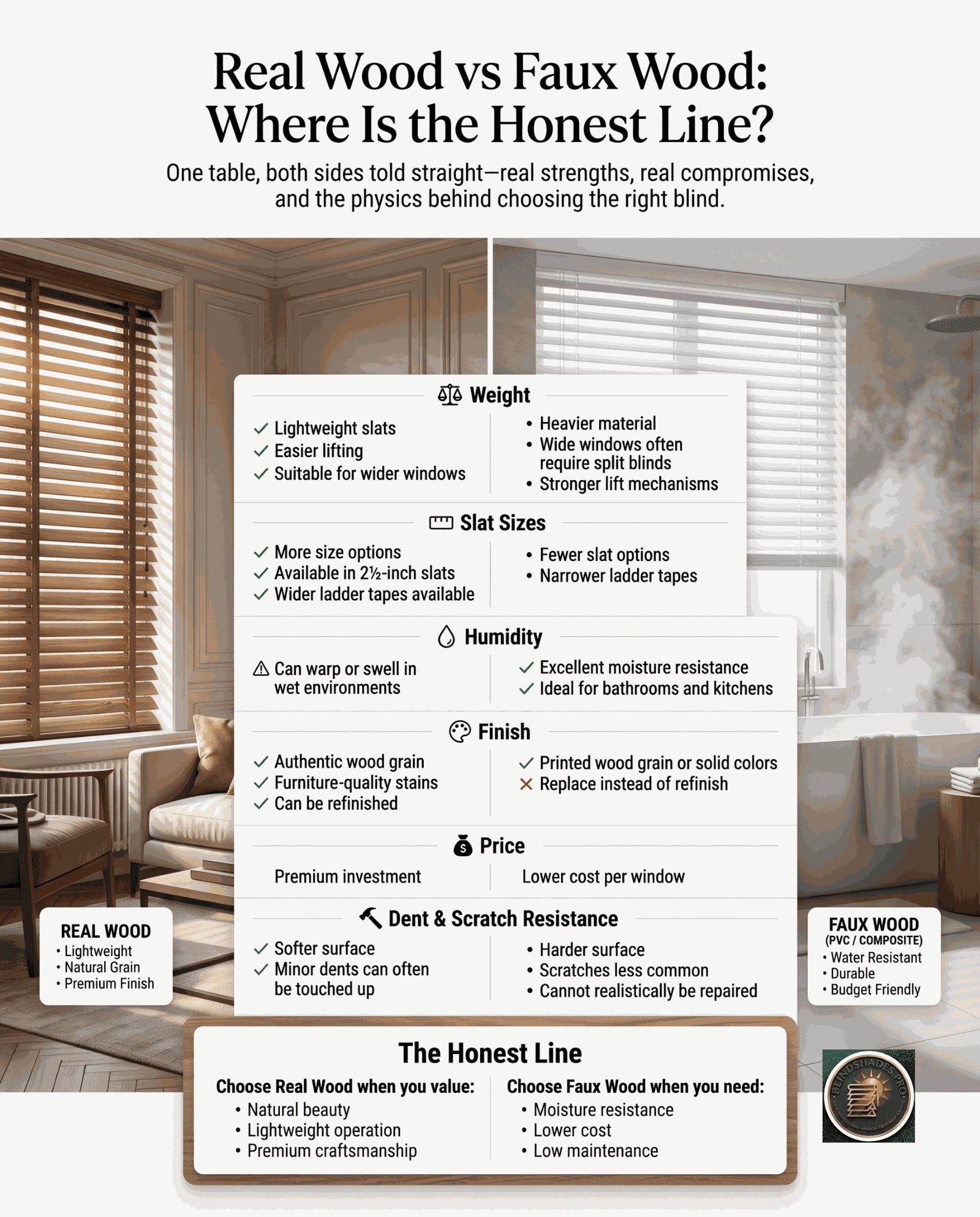
By Michael Turner, 30 years in the window treatment industry
Real wood blinds are the lightweight premium of the horizontal-blind family — genuine basswood and hardwood slats that weigh a fraction of PVC, span wide windows without sagging, take stain like furniture, and read as millwork rather than window covering. The market’s consensus names four brands — Hunter Douglas for craft, Bali and Levolor for value, Select Blinds for budget customs — and one hard rule: keep real wood out of humid rooms. This guide runs the full decision through three gates: Span (what the weight advantage actually buys you), Stain (species and finish, chosen like furniture), and Steam (the honest disqualifier that routes wet rooms to faux). Plus the section this category’s own searchers keep asking for and no ranked page provides: what real owners — not store rating widgets — actually report.
Key Takeaways
- Weight is the whole argument. Real wood is dramatically lighter than faux — which is why it spans wide windows without a mandatory center split, lifts easily by hand, and spares cordless spring mechanisms that PVC slats exhaust.
- Buy the species, then the brand. Basswood is the category’s quiet default — light, straight-grained, stain-hungry; North American hardwoods add density and depth; the slat you choose matters more than the logo on the headrail.
- Stain to the trim, not the floor. Real grain takes finish like furniture, and the room reads the blinds as part of the window casing — matching the trim is the designer default that never misses.
- Humidity is the honest disqualifier. Warping, delamination, and finish failure follow steam — bathrooms are a no, kitchens are a judgment call, and our faux wood guide owns the wet-room lane.
- Trust review volume, not store rankings. Two picks in this guide carry fifteen hundred reviews each; community threads endorse and indict the same retailers in the same breath — the Owner’s Verdict section below synthesizes what the rating widgets won’t.
⭐ Quick Answer — The Best Real Wood Blinds
The best real wood blinds are chosen at three gates — Span (light slats carry wide windows and easy lifts), Stain (basswood or hardwood, finished to the trim), and Steam (humidity disqualifies real wood):
- The weight advantage: real wood is dramatically lighter than faux — single blinds where PVC forces splits, and slat sizes up to two-and-a-half inch with wider ladders, per the buyers guide at Hunter Douglas.
- The volume picks: two-slat-size customs at Levolor and Blinds.com’s custom wood line lead the market at fifteen hundred reviews each — the full head-to-head against PVC is in wood vs faux wood blinds.
- The species truth: most “genuine hardwood” blinds are basswood — light, straight-grained, stain-hungry — and that is the correct engineering choice, not a shortcut; premium customer-ranked lines run two-sixty-one to four-seventy-seven at Blinds Chalet.
- The room rules: living spaces are home turf, bathrooms route to faux, and the kitchen call — ventilation, cooktop distance, grease — is decided in real wood blinds in the kitchen.
- The surprising yes: below-grade windows with condensation and radiator heat can still take real wood — the conditions are in real wood blinds in the basement.
Quick Specification Reference
| Specification | The Short Answer |
|---|---|
| Best overall | Levolor 2-inch Real Wood — around eighty-nine dollars at forty-five percent off, four point three across fifteen hundred reviews |
| Best value custom | Blinds.com Custom Wood — around seventy-six dollars, four point seven across fifteen hundred reviews |
| Best budget | SelectBlinds 2-inch Modern — around sixty-one dollars, four point six across one hundred eighty-seven |
| Best premium | Hunter Douglas Parkland — wide-slat genuine hardwood, custom-quoted |
| Typical cost range | Ninety-two to seven ninety-eight per American Blinds; premium band two-sixty-one to four-seventy-seven per Blinds Chalet |
| The species default | Basswood — light, straight-grained, takes stain evenly; hardwoods for density and deep finishes |
| Slat sizes | One, two, and two-and-a-half inch — bigger slats, bigger view-through, taller stack |
| The disqualifier | Humidity — bathrooms route to faux wood; kitchens are conditional |
Read the complete guide below for: the six Diamond picks with the community verdicts stated alongside the ratings, the Span-Stain-Steam Test, the real-versus-faux boundary in one honest table, the species and slat-size decisions nobody else explains, room-by-room suitability, lift and control options for wide spans, and the Owner’s Verdict — what fifteen hundred reviewers and three community threads actually say about where to buy.
What Are the Best Real Wood Blinds? Our Picks
Six picks, one per job — each verified against live market listings, with community verdicts stated next to the star ratings, because in this category they disagree.
The best real wood blinds for most rooms is a two-inch basswood blind from a high-volume custom shop — but the map has six territories.
Best Overall — Levolor 2-inch Real Wood Blinds. The volume king: around eighty-nine dollars at forty-five percent off via Blinds.com, four point three across fifteen hundred reviews, in two genuine hardwood slat sizes with a deep finish catalog — Levolor’s own page leads with exactly that customization case. The two-and-a-half-inch line (around one forty-six) is the buyable wide-slat route if Parkland pricing stings.
Best Value Custom — Blinds.com Custom Wood Blinds. Around seventy-six dollars, and the highest rating-at-volume on the entire market: four point seven across fifteen hundred reviews. The community record is honestly split — the top-voted answer in an r/homeowners thread reports using Blinds.com for ninety percent of a whole house, while another commenter in the same thread reports a payment-security dispute. Both are single anecdotes against a fifteen-hundred-review base; the Owner’s Verdict section below weighs them properly.
Best Budget — SelectBlinds 2-inch Modern Wood. Around sixty-one dollars at half off, four point six across one hundred eighty-seven — real wood at faux prices, and the entry point for whole-room renovations the market consensus credits Select for.
Best Dark Stain — Blindster 2-inch Black Walnut. Around ninety-one dollars, four point five across twelve hundred reviews, with the Performance line in Golden Oak (around one thirteen, four point four across one sixty-eight) covering the light end. Deep, even factory stains are where real grain separates hardest from printed PVC.
Best Premium / Wide Slat — Hunter Douglas Parkland. The craft benchmark: sustainably sourced genuine hardwoods, advanced tilt options, and the two-and-a-half-inch slat Hunter Douglas’s own buyers guide singles out — with the sharpest technical point on this market: real wood ships in more slat sizes with a wider ladder, the visible weave that carries the slats. Custom-quoted through dealers; treat it as the reference standard the mid-market imitates.
Best Cordless — Blindsgalore Cordless Hardwood. Around eighty-four dollars at half off, from the store whose Premium Wood line holds four point seven across one forty-nine — and cordless is where real wood’s light weight pays daily: springs sized for wood last; the same mechanisms hauling PVC don’t.
The Bali honesty line: Bali Wood Blinds sit mid-board at around one forty-four with four point four across nearly a thousand reviews — and a four-month-old community comment calls Bali “a cheap product that uses cheaper components.” A thousand-review base at four point four is not a cheap product; it is a value product with a vocal critic. Both facts belong in the open.
| Pick | Product | Approx. Price (as listed) | Rating / Reviews | Wins the gate for |
|---|---|---|---|---|
| Best Overall | Levolor 2-inch Real Wood | Around eighty-nine (45% off) | 4.3 / 1,500 | Volume-proven value, two slat sizes |
| Best Value Custom | Blinds.com Custom Wood | Around seventy-six | 4.7 / 1,500 | Highest rating-at-volume on the market |
| Best Budget | SelectBlinds 2-inch Modern | Around sixty-one | 4.6 / 187 | Real wood at faux prices |
| Best Dark Stain | Blindster Black Walnut 2-inch | Around ninety-one | 4.5 / 1,200 | Furniture-grade factory finishes |
| Best Premium | Hunter Douglas Parkland | Custom-quoted | Brand benchmark | Wide slats, craft, sustainable sourcing |
| Best Cordless | Blindsgalore Cordless Hardwood | Around eighty-four (half off) | Premium line 4.7 / 149 | Light slats that cordless springs survive |
How Do You Choose? The Span-Stain-Steam Test
Three gates, in order: what the weight buys you, how the wood will be finished, and whether the room’s air disqualifies the material entirely.
Gate 1 — Span. Real wood’s defining spec is what it weighs — or rather, what it doesn’t. The consequences are structural: wide windows carry without center supports, lifts stay one-handed, and hardware lives longer. The full physics is two sections down, because it deserves its own table.
Gate 2 — Stain. A faux blind is a color; a real wood blind is a finish. Grain direction, stain absorption, and species density decide how the blind reads from three feet away — which is why species selection comes before brand selection, covered below.
Gate 3 — Steam. Humidity is the category’s honest disqualifier. Moisture cycles swell and shrink wood fibers, warp slats, and lift finishes — the market consensus itself flags humid spaces as the exception to every real-wood recommendation. Bathrooms route to faux without debate; kitchens depend on ventilation and distance from the cooktop; and the counter-case — where real wood survives wet-adjacent rooms — is argued honestly in real wood blinds in the bathroom.
| Gate | The question | Pass looks like | Fail routes to |
|---|---|---|---|
| Span | How wide and tall is the window? | Wide/tall windows: real wood’s light slats carry the span | Small windows: weight matters less — decide on finish and price |
| Stain | Do you want furniture or color? | Visible grain, stained to the trim | Painted-white look: faux does it cheaper |
| Steam | Does the room make moisture? | Dry living spaces | Bathrooms → faux wood; kitchens → conditional |
Real Wood vs Faux Wood: Where Is the Honest Line?
One table, both sides told straight — and the full head-to-head lives in its own guide.
Our faux wood hub runs on the Three-W Test — Water, Weight, Width-of-slat — and argues faux’s case where water wins. This is the same physics told from the winning side of the other two Ws.
| Factor | Real wood | Faux wood (PVC/composite) |
|---|---|---|
| Weight | The category’s advantage — light slats, easy lifts, wide spans | Heavy; wide windows need 2-on-1 splits and stronger lift systems |
| Slat sizes | More options, including two-and-a-half inch, with wider ladders | Fewer sizes; ladders narrower |
| Humidity | Warps, swells, finish lifts — keep out of wet rooms | Shrugs off steam; owns bathrooms |
| Finish | Real grain, furniture-grade stains, can be refinished | Printed grain or solid color; replace, don’t refinish |
| Price | Premium — roughly ninety to eight hundred across the market | Consistently cheaper per window |
| Dent/scratch behavior | Softer — dents and dings show; touch-up pens work | Harder surface; scratches rare, repairs impossible |
The full comparison — including the composite middle ground and the room-by-room verdicts — is in wood vs faux wood blinds, and the faux side’s complete case is the best faux wood blinds guide.
Which Wood Species Should You Buy?
Basswood is the quiet default; hardwoods buy density and depth; the species matters more than the brand.
No ranked page on this market explains the single word doing the most work in this category: basswood. The overwhelming majority of “real wood” blinds — including most of the customs in the picks above — are basswood, and for good reasons: it is among the lightest commercial hardwoods, straight-grained and knot-free, dimensionally stable for its weight, and it drinks stain evenly, which is why factory finishes look furniture-grade. When a listing says “genuine hardwood” without naming a species, it usually means basswood — and that is not a downgrade; it is the correct engineering choice for a slat that must be light, straight, and stainable.
| Species class | What it is | Why choose it | Watch-out |
|---|---|---|---|
| Basswood | The category default — light, straight, even-staining | Best weight-to-stiffness for wide spans; flawless stain uptake | Soft — dents show; not a defect, a trade |
| North American hardwoods (oak, cherry, walnut classes) | Denser premium slats | Deeper grain figure, richer dark stains, harder surface | Heavier — partially spends the Span advantage |
| Exotic/ramin and mixed-source | Import-grade slats in budget lines | Price | Sourcing opacity; check certifications |
| Sustainably certified lines | Hunter Douglas Parkland class | Chain-of-custody sourcing on record | Premium pricing |
The finish rule that never misses: stain to the trim, not the floor. Blinds live inside the window casing, and matching the casing reads as architecture; matching the floor reads as furniture pushed against a window. White-painted real wood exists — but if the plan is paint, the faux wood guide does that look for less, and the grain you paid for disappears.
What Slat Size Should You Choose?
One, two, or two-and-a-half inches — the choice sets view-through, stack height, and how much wood the room sees.
| Slat size | View-through (tilted open) | Stack height (raised) | Best for |
|---|---|---|---|
| One inch | Narrow slices of view | Shortest stack | Small panes, cottage scale, shallow frames |
| Two inches | The balanced default | Moderate | Most rooms — the size every pick above leads with |
| Two-and-a-half inches | Widest view, most light per tilt | Tallest stack | Big windows, plantation-shutter looks, view-first rooms |
Two mechanical notes the stores skip. First, bigger slats mean fewer slats per drop — fewer ladder crossings, wider views, and a look that drifts toward plantation shutters; if that is the destination, compare honestly against the best plantation shutters, which JustBlinds’ own pitch prices real wood blinds against — the blinds are the cheaper route to the same architectural read. Second, Hunter Douglas’s buyers guide makes the point everyone else misses: real wood’s slat-size range comes with a wider ladder — the woven tapes carrying the slats — which spreads load across light slats and is part of why wide wood blinds hang flat where faux sags.
Why Does Weight Decide This Category? The Span Rule
Real wood’s lightness is not a comfort feature — it is structure. Here is what it buys, and what it costs.
Every source on this market repeats “lighter in weight” and moves on. Here is what the phrase actually purchases.
Wide windows without splits. A heavy faux blind past a certain width must become two blinds on one headrail — the 2-on-1 split the market consensus credits Bali’s heavy-duty headrails for managing. Real wood pushes that threshold far wider: a single blind, a single tilt, no center light gap, no twin bottom rails meeting unevenly. On a picture window, that is the visible difference between millwork and compromise.
Lifts that last. Cordless lift mechanisms are springs, and springs are rated for load. Light basswood slats are the load they were designed around; PVC at nearly twice the mass per slat is the load that exhausts them. If cordless or motorized operation matters — and on wide blinds it does — the material choice is quietly a mechanism-longevity choice. Wide-span control options, including 2-on-1 headrails and motorization, are covered with the venetian family’s mechanics in the complete venetian blinds guide.
Tall windows without fear. Drop height multiplies slat count, and slat count multiplies weight. A floor-to-ceiling faux blind is a two-person lift and a strained tilt rod; the same drop in basswood stays domestic.
| Lift / control option | How it behaves with real wood | Best for |
|---|---|---|
| Cordless lift | The natural pairing — springs rated for light slats last for years | Households with kids and pets; the market’s default recommendation |
| Corded lift (where offered) | Lower effort than the same cord on faux | Very tall drops on a budget |
| Motorized | Smaller motors suffice at wood weights; battery life stretches | Hard-to-reach and oversized windows |
| 2-on-1 headrail | The wide-window split — needed later on wood than on faux | Spans past your maker’s single-blind threshold |
| Tilt: wand vs advanced | Standard wands fine; premium tilt (Hunter Douglas class) adds precision | Two-and-a-half-inch slats where view control is the point |
The honest flip side. Light means soft. Basswood dents where PVC shrugs — a thrown toy, a ladder bump, a terrier with opinions. The trade is real: faux survives impacts and fails at spans; wood survives spans and records impacts. (Touch-up markers fix wood; nothing fixes cracked PVC.) And in one room the weight argument goes fully against the grain — below-grade windows with condensation and radiator heat, where the case for real wood anyway is argued in real wood blinds in the basement.
Which Rooms Suit Real Wood Blinds?
Living spaces are the home turf; kitchens are conditional; bathrooms are routed out by the Steam gate.
| Room | Verdict | The reasoning |
|---|---|---|
| Living / dining / family rooms | The home turf | The market’s own framing — wide windows, visible grain, furniture-grade read |
| Bedrooms | Yes | Pair with room-darkening routes; wood alone is not blackout |
| Home office | Yes | Two-and-a-half-inch slats manage screen glare by tilt |
| Kitchen | Conditional | Distance from cooktop and ventilation decide — the full call is in real wood blinds in the kitchen |
| Bathroom | No — routed to faux | Steam gate; the against-the-grain case is real wood blinds in the bathroom |
| Basement | Surprising yes, with conditions | Condensation and heat cycles managed — real wood blinds in the basement |
Two boundary notes. If the goal is warmth-of-material but the mechanism doesn’t matter, woven wood and bamboo shades deliver organic texture as a shade, not a blind — different guide, different physics. And if the debate is wood-look venetians generally, the value question — real wood against aluminum against faux across the whole venetian family — is argued in are wooden venetian blinds worth it and aluminum vs wood venetian blinds.
What Do Real Owners Actually Say? The Owner’s Verdict
The searches around this keyword — reddit, reviews, consumer reports — are a trust request. Here is the synthesis no store ranking will give you.
Buyers in this category visibly do not trust the rating widgets — the live searches attached to this keyword ask for reddit threads and consumer-reports verdicts, not more stars. Fair enough. Here is what the community record around this market actually contains, weighed honestly.
The endorsement. The top-voted answer in an r/homeowners where-to-buy thread (eleven months old): the poster used Blinds.com for ninety percent of their house — an owner-scale endorsement that matches the store’s four point seven across fifteen hundred reviews on its custom wood line.
The indictment. The same thread carries a payment-security complaint against the same retailer — a compromised card after an order. One incident, eight months old, unverifiable; it belongs in the record precisely because store pages will never show it to you.
The brand skeptic. “Bali is a cheap product that uses cheaper components” — four months old, two votes. Against it: nine hundred ninety-eight reviews at four point four. The honest read is that Bali is a value brand, engineered to a price, and both the fans and the critic are describing the same product from different expectations.
The discipline. Three rules turn this noise into signal. Weight review volume over review score — a four point nine across eight reviews is a rumor; a four point three across fifteen hundred is a census. Read the one-star page of the biggest listing — patterns (cracked slats in shipping, stain mismatch, cordless failures) matter; one-offs don’t. And treat “best-rated by our customers” store pages as what they are — a retailer ranking its own inventory; Blinds Chalet’s version is honest about its method and still only sees its own catalog.
| Retailer / Route | Listed range (as published) | Rating shown | The community verdict |
|---|---|---|---|
| Blinds.com (custom) | Seventy-six to one-fifteen customs | 4.7 / 1,500 · 4.3 / 1,500 (Levolor line) | The 90%-of-my-house endorsement AND one payment dispute — volume favors it |
| Blindsgalore (custom) | Sixty-five to one-thirty | Premium 4.7 / 149 | Quiet record; steep sales are the real price |
| Blindster (custom) | Ninety-one to one-thirteen | 4.5 / 1,200 · 4.4 / 168 | Large-base consistency across stain lines |
| SelectBlinds (custom) | Thirty-two to one-twenty-one | 4.6 / 187 | Budget line thin on reviews (4.6 / 5) — provisional |
| Bali (via Blinds.com and big-box) | Around one forty-four | 4.4 / 998 | The “cheaper components” critique vs a thousand-review base |
| Blinds Chalet (premium custom) | Two-sixty-one to four-seventy-seven | 4.7 store / 1,100 | Self-ranked “best-rated” list — honest method, own catalog |
| Hunter Douglas (dealer) | Custom-quoted | Brand benchmark | The reference standard; you pay for the dealer channel |
| JustBlinds | One-twenty-seven to one-eighty-two | 4.5 / 220 | The cheaper-than-shutters positioning is accurate |
How Do You Measure, Mount, and Maintain Real Wood Blinds?
Measure like any venetian, mount with the depth the headrail needs, and maintain like furniture — because that is what you bought.
Measurement follows the venetian family’s rules — inside-mount depth check, three-width measuring, smallest-number discipline — covered stepwise in how to measure for venetian blinds. Real-wood specifics worth stating: confirm headrail depth for inside mounts (wood headrails run deeper than mini-blind steel), respect the two-on-one threshold your maker quotes even though wood extends it, and on tall drops order the ladder-tape option — the wide woven ladders spread load and read as tailoring.
Maintenance is furniture care: dry dusting or a barely-damp cloth followed dry, never soaking; wood cleaners sparingly; touch-up markers for dents in stained slats. The one absolute: no steam, no soak — the Steam gate applies to cleaning as much as climate.
Related Buying Guides
- Best Faux Wood Blinds — the wet-room half of this decision, on the Three-W Test
- Best Venetian Blinds — the mechanism family and its controls
- Best Plantation Shutters — the architectural upgrade wood blinds are priced against
- Best Woven Wood & Bamboo Shades — organic texture as a shade, not a blind
Complete Real Wood Guide Library
- Wood vs Faux Wood Blinds — the full head-to-head
- Real Wood Blinds in the Kitchen — the conditional room, decided
- Real Wood Blinds in the Bathroom — the against-the-grain case
- Real Wood Blinds in the Basement — condensation, heat cycles, and the surprising yes
- Are Wooden Venetian Blinds Worth It? — the value question across the family
- Aluminum vs Wood Venetian Blinds — the metal alternative
Frequently Asked Questions
What are the best real wood blinds? The best real wood blinds for most rooms are two-inch basswood customs from high-volume shops — Levolor’s 2-inch line (four point three across fifteen hundred reviews) and Blinds.com’s custom wood (four point seven across fifteen hundred) lead the market — with Hunter Douglas Parkland as the premium wide-slat benchmark and SelectBlinds and Blindster covering budget and dark-stain lanes.
Are real wood blinds better than faux wood? In dry rooms, usually: dramatically lighter (wide spans, easy lifts, longer-lived cordless mechanisms), more slat sizes, and real grain that takes furniture-grade stain. Faux wins every humid room, survives impacts wood records, and costs less. The line is the Steam gate: bathrooms go faux, living spaces go real, kitchens get judged case by case.
What wood are wood blinds actually made of? Mostly basswood — light, straight-grained, knot-free, and even-staining, which is why unnamed “genuine hardwood” listings usually mean it. Premium lines add denser North American hardwoods for deeper grain and darker stains; budget imports use mixed-source species where certifications are worth checking.
Do real wood blinds insulate? Yes — wood is a natural insulator, and a closed two-inch wood blind adds meaningful resistance against a cold pane, which is part of the market’s consensus case for them. For serious thermal performance, though, cellular shades outperform any slatted blind; wood’s insulation is a bonus, not the buying reason.
What do real wood blinds cost? The live market runs roughly ninety-two to seven hundred ninety-eight dollars per American Blinds’ range, with the value core at sixty to one-fifteen (SelectBlinds, Blinds.com, Levolor at sale pricing), Blindster stains around ninety-one to one-thirteen, and the premium custom band at two-sixty-one to four-seventy-seven per Blinds Chalet — before dealer-channel lines like Hunter Douglas.
Can you use real wood blinds in a bathroom or kitchen? Bathrooms: no — steam cycles warp slats and lift finishes; faux wood owns that room. Kitchens: conditional — ventilation and distance from the cooktop decide, and grease is the real enemy above the stove. Both calls are argued in full in the room guides above.
