The Best Faux Wood Blinds: Water, Weight, and Width Before Brand

Authored By Michael Turner -30 Years Home Improvement Expertise | Updated 2026 | BlindShades.pro
Updated on July 19, 2026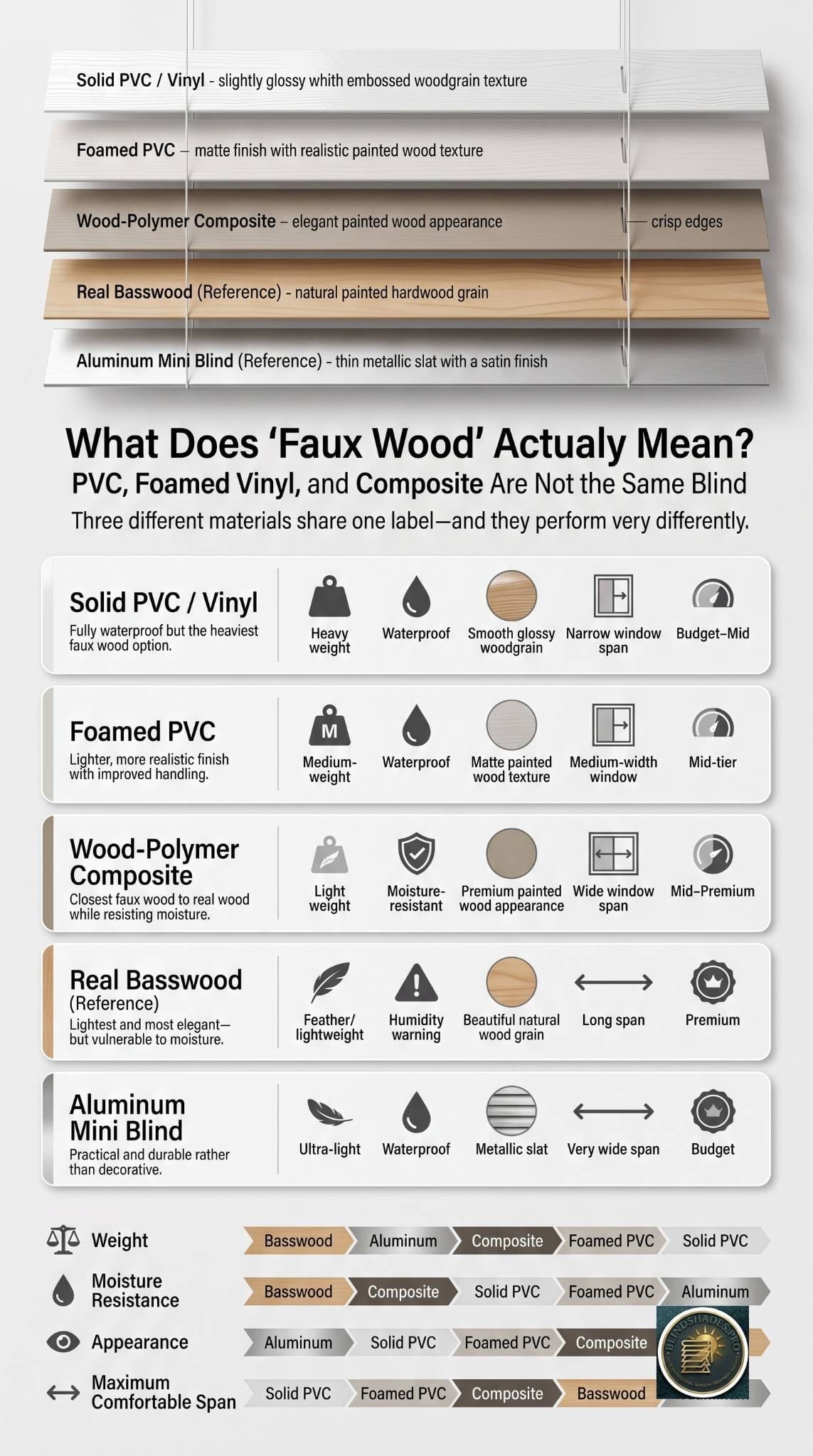
Authored by Michael Turner — 30 Years of Home Improvement Expertise | BlindShades.pro | Complete Buying Guide, Updated for 2026
The best faux wood blinds are chosen at three gates, and brand is the last stop, not the first. Gate one is Water: faux wood exists because real wood warps in humidity, so bathrooms, kitchens, and laundry rooms are the category’s home turf — the rooms where it isn’t a compromise but the correct answer. Gate two is Weight: PVC is far denser than basswood, and that single material fact explains every honest limitation faux wood has — width caps, heavy cordless lifts on wide windows, and sag on long spans. Gate three is Width of slat: two-inch versus two-and-a-half-inch, routed versus routeless, the decision that controls light leakage and privacy more than any brand badge. Answer the three gates and the shortlist writes itself: Norman’s Ultimate line at the premium end, SelectBlinds’ SelectWave and Blindster’s routeless designs in the custom-budget middle, and Bali’s off-the-shelf line where speed beats customization. This guide runs all three gates, then the verified picks, the honest physics, and the material taxonomy nobody else explains.
⭐ Quick Answer — The Best Faux Wood Blinds
The best faux wood blinds are chosen at three gates before any brand comparison — Water (is the room humid?), Weight (how wide is the window?), and Width of slat (2 in vs 2.5 in, routed vs routeless):
- Top picks by gate: Norman Ultimate for premium routeless SmartPrivacy engineering, SelectBlinds SelectWave Cordless for wet-room budget builds, Blindster’s no-holes cordless line for privacy value, Bali via Costco off the shelf, and the VENETA 2.5-inch Ultra Blackout at The Home Depot for wide windows.
- Wet rooms are home turf: moisture-proof PVC and composite slats shrug off bathroom steam and kitchen grease that warp real wood — the steam-room matchup is settled in faux wood vs aluminum blinds for bathrooms.
- Weight is the one law: PVC is roughly three times as dense as basswood, so wide spans need 2-on-1 headrail splits, composite slats, or the crossover argued in wood vs faux wood blinds.
- Routeless slats are the quiet upgrade: deleting the cord holes removes light pinpricks and sightlines — for true morning darkness, pair with the best blackout blinds & shades guide.
- Styling data point: white, natural wood, and gray are the three most-ordered faux wood finishes per Blindsgalore (May 2026).
Related guides: the other side of the Three-W Test — where light weight, wide spans and real grain win — is argued in the best real wood blinds guide.
Key Takeaways
- Faux wood owns the wet rooms. In bathrooms, kitchens, and laundry areas, moisture-resistant PVC and composite slats do what stained basswood cannot: shrug off steam, splashes, and daily humidity without warping, cracking, or peeling — which is exactly why every major maker leads with that claim.
- Weight is faux wood’s one physical law. Rigid PVC is roughly three times as dense as basswood by standard engineering materials data, so wide faux wood blinds get heavy fast — that is why manufacturers cap widths, why cordless lifts feel stiff on big windows, and why very wide spans belong to composite or real wood instead.
- The picks are stable across independent citations. Google’s own AI answer for this query crowns three: Norman’s Ultimate line for premium light-blocking with its patented SmartPrivacy routeless slats, SelectBlinds’ SelectWave cordless for custom budget builds starting around forty-eight dollars, and Blindster’s routeless cordless line in the fifty-three-to-sixty-five-dollar band for privacy value.
- Routeless slats are the quiet upgrade. Deleting the cord holes through each slat removes the pinpricks of light and the sightline gaps that make standard blinds leak — the single design change behind both Norman’s SmartPrivacy and Blindster’s no-holes designs, and the reason the wider two-and-a-half-inch routeless VENETA line at The Home Depot holds a 4.4-star rating on light blocking.
- Where you buy matters as much as what you buy. Custom online sellers win on exact-fit and options, big-box shelves win on speed and returns — Bali’s two-inch faux wood line through Costco carries a ninety-day return window — and the premium dealer tier (Norman, Hunter Douglas) wins on engineering. Match the channel to the job before comparing model names.
Quick Specification Reference
| Spec | The short answer |
|---|---|
| The three gates | Water (is the room humid?) → Weight (how wide is the window?) → Width of slat (2 in vs 2.5 in, routed vs routeless) |
| Material | Solid PVC/vinyl, foamed PVC, or wood-polymer composite — not the same blind (taxonomy below) |
| Moisture | The category’s reason to exist: bathroom, kitchen, and laundry safe |
| Weight & span | PVC is heavy; most makers cap single-headrail widths and offer 2-on-1 splits for wide openings |
| Slat sizes | 2 inch (standard) and 2.5 inch (more view-through, fewer slats, plantation look) |
| Routed vs routeless | Routeless (no cord holes) = less light leak, more privacy — the premium design cue |
| Lift options | Corded (still common in the category) or cordless; cordless is the child-safety standard |
| Best rooms | Bathrooms, kitchens, rentals, high-traffic family rooms |
| Price band | Off-the-shelf big-box sets at the low end through custom mid-range to dealer-grade premium — stated in words throughout, per our no-fabricated-prices rule |
| Cleaning | The category’s everyday win: damp-cloth washable, no refinishing, scratch-resistant |
Read the complete guide below for: the Three-W Test that replaces brand-first shopping; the five verified picks and the gate each one wins; the Weight Problem — the one physical law behind every faux wood limitation; the PVC-versus-foamed-versus-composite taxonomy every roundup blurs; the slat-size and routeless decision; the corded-versus-cordless call; the where-to-buy matrix; and room-by-room verdicts from bathroom steam to rental fleets.
What Are the Best Faux Wood Blinds? Our Picks
Five verified picks — the best faux wood blinds at each gate, not one “best at everything.”
| Pick | Product | Gate it wins | The attributed case |
|---|---|---|---|
| Best Premium | Norman Ultimate Faux Wood Blinds | Width of slat — routeless engineering | The premium pick in Google’s AI answer for this query: patented SmartPrivacy routeless slats and a pivoting bottom rail, regarded for superior light blocking and smooth heavy-duty operation per Norman USA’s product documentation |
| Best Custom Budget | SelectBlinds SelectWave Cordless | Water — wet-room value | Cited starting around forty-eight dollars with a moisture-resistant contoured design built for high-humidity bathrooms and kitchens without warping or cracking |
| Best Privacy Value | Blindster 2 Inch Super Value Cordless | Width of slat — routeless on a budget | The fifty-three-to-sixty-five-dollar band per the AI citation, with no-holes privacy slats and a redesigned valance per Blindster’s own listing |
| Best Off-the-Shelf | Bali 2 Inch Faux Wood (via Costco) | Where-to-buy — speed and returns | Costco’s Bali storefront calls the line moisture-proof, scratch-resistant, and easy to clean, with free delivery and a ninety-day return window — the DIY standard-size answer |
| Best Large-Window Blackout | VENETA Custom Designer 2.5 Inch Ultra Blackout (The Home Depot) | Weight — the wide-slat blackout build | A 4.4-star Home Depot listing pairing SmartPrivacy routeless slats with the wider two-and-a-half-inch format for bigger windows and unparalleled light blocking per the listing copy |
Read the table by your gates, not top to bottom: a steamy bathroom starts at SelectWave, a budget whole-house refresh starts at Blindster or the Bali shelf, a wide west-facing bedroom starts at the VENETA 2.5-inch build, and a premium living space starts at Norman. One honest tier note before the gates: Hunter Douglas remains the forum-legend answer — a sixteen-year-old Houzz thread still calls it the absolute best with a price, and the brand dominates the related-search box — but its dealer-quoted pricing model makes it a showroom conversation rather than a pick slot in a comparison table. If a dealer visit is on your calendar anyway, add it to the shortlist; if you are buying online this week, the five above are the buyable answers.
How Do You Choose Faux Wood Blinds? The Three-W Test
Water, Weight, and Width of slat — answer three questions and the brand shortlist picks itself.
| Gate | The question | What the answer decides |
|---|---|---|
| Water | Is the room humid — bathroom, kitchen, laundry, basement? | Yes → faux wood is the correct category, full stop; real wood is the wrong tool. No → faux wood competes on price, and real wood or composite enters the conversation for looks and weight |
| Weight | How wide is each window? | Narrow and standard windows → any faux line works. Wide spans → check the maker’s width cap, expect a 2-on-1 headrail split, spec a heavier-duty lift, or step up to composite or real wood |
| Width of slat | Do you want maximum privacy and light blocking, or maximum view-through? | Privacy/blackout leaning → routeless slats, consider 2.5 inch with a blackout build. View and airflow leaning → standard 2 inch routed keeps cost down |
The test exists because the category’s complaints all trace to a skipped gate. The stale forum threads that still rank for this query are full of wrong-gate purchases: real wood peeling in a bathroom (a Water miss), a seventy-inch faux wood blind whose cordless lift takes two hands (a Weight miss), and light stripes across a nursery at dawn (a Width-of-slat miss — routed holes where routeless belonged). Every one of those buyers would have been happy with the same budget pointed at the right spec. Run the gates in order — Water first because it eliminates whole categories, Weight second because it is non-negotiable physics, slat width last because it is taste plus light control — and the rest of this guide gives you the data for each.
Are Faux Wood Blinds Good Quality? The Weight Problem
Yes — inside their physics. Faux wood’s honest limits all come from one number: the density of PVC.
Here is the sentence no seller on page one will write: rigid PVC runs roughly three times the density of basswood — on the order of one-point-four grams per cubic centimeter against roughly zero-point-four for the basswood used in premium real-wood blinds, per standard engineering materials references such as the MatWeb materials database. Every honest limitation of faux wood is that one number expressing itself downstream. Heavier slats mean a heavier stack, which means more force to lift, which is why wide cordless faux wood blinds feel stiff, why manufacturers publish single-headrail width caps and push 2-on-1 splits on big openings, and why a long unsupported span can develop visible slat sag over years. None of this is a defect; it is the material doing what dense materials do.
| Window width band | What happens with faux wood | The honest mitigation |
|---|---|---|
| Under 36 inches | Nothing — faux wood’s sweet spot; every lift type works smoothly | Buy on the Water and slat gates alone |
| 36 to 48 inches | Lift effort rises; corded still easy, cordless noticeably firmer | Choose a quality cordless mechanism, or accept a cord with proper safety hardware in adult spaces |
| 48 to 72 inches | Real weight; center-support brackets become mandatory, cordless gets genuinely heavy | Spec a 2-on-1 headrail (two blinds, one rail), or step to lighter composite slats |
| Over 72 inches | Past most single-blind faux wood width caps | Split the opening, move to composite or real wood — or change category to a vertical or panel-track treatment |
Heat is the second expression of the same chemistry, and it deserves the same honesty: vinyl softens as temperatures climb, so a dark-colored solid-PVC blind pressed against hot south- or west-facing glass in a warm climate can bow or shimmer over time. The category answers are real, not marketing — lighter finish colors that absorb less heat (conveniently, Blindsgalore’s May 2026 order data shows white as the most-ordered faux wood finish anyway), foamed and composite slats engineered stiffer than solid vinyl, and simply choosing real wood for the one brutal west window while faux wood handles the rest of the house. For that crossover decision, the full head-to-head lives in wood vs faux wood blinds, and the case for spending up on timber is argued honestly in are wooden venetian blinds worth it.
So — are faux wood blinds good quality? Inside the gates, emphatically: moisture-proof where wood fails, scratch-resistant, damp-cloth washable, and cheaper than the timber they imitate. Outside the gates — very wide spans, blazing-hot glass, weight-sensitive cordless installs — the same material becomes the wrong answer, and a good guide says so.
What Does “Faux Wood” Actually Mean? PVC, Foamed Vinyl, and Composite Are Not the Same Blind
Three different materials share one label — and they behave differently at every gate.
Roundups treat “faux wood” as one product. It is three, and only the contract-market suppliers even gesture at the difference — SWFcontract’s specification pages, for instance, list faux wood and composite as distinct horizontal-blind materials with moisture-proof slats and woodgrain patterns as the shared selling points. The taxonomy:
| Material | Weight | Moisture | Look and feel | Span behavior | Tier |
|---|---|---|---|---|---|
| Solid PVC / vinyl | Heaviest | Fully waterproof | Smooth or embossed woodgrain; can look plasticky in glossy finishes | Shortest comfortable spans; strictest width caps | Budget to mid |
| Foamed PVC | Lighter than solid | Waterproof | Matte, more convincing woodgrain; slightly softer slat | Better than solid, still capped | Mid |
| Wood-polymer composite | Lighter and stiffer than both | Highly moisture-resistant | Closest to painted real wood | The widest faux spans; the step before real wood | Mid to premium |
| Real basswood (reference) | Lightest | Warps and peels in humidity | The benchmark | The longest spans at the least weight | Premium |
| Aluminum mini (reference) | Very light | Waterproof | Metallic, utilitarian | Long spans easily | Budget |
Two practical consequences fall out of the table. First, the budget-shelf blind and the premium faux line are usually different materials wearing the same label — which is why one “faux wood blind” feels like a toy and another feels like furniture, and why comparing them on price alone misleads. The broader material landscape across every blind type — including where basic vinyl sits below faux wood — is mapped in the made-to-measure blinds materials guide, and if the budget conversation drops below faux wood entirely, the honest bottom rung is covered in best plastic and vinyl window covers. Second, the aluminum row is not decoration: in genuinely punishing wet rooms, aluminum is faux wood’s real rival, and that specific matchup — steam, splash, and style — is settled in faux wood vs aluminum blinds for bathrooms.
A styling coda, since material and finish shop together: Blindsgalore’s design blog reported on May 1, 2026 that the three most-ordered faux wood finishes are white, natural wood, and gray — a tidy summary of the category’s job description. White for trim-matched kitchens and baths, natural woodgrain where the blind is impersonating timber, gray for the renovation-modern middle. Order finish samples regardless of channel; woodgrain embossing quality is the single most visible difference between the material tiers, and it photographs worse than it looks in person at the budget end.
Related guides: faux wood is PVC shaped as slats — the wider plastic family, from films to shutters, is mapped in our plastic and vinyl window covers guide.
Should You Choose 2-Inch or 2.5-Inch Slats — Routed or Routeless?
Slat width sets the view; route holes set the light leak. Together they are the whole privacy story.
| Choice | Light control | Privacy and view | Best for |
|---|---|---|---|
| 2 inch, routed | Standard; pinpoint leaks at cord holes | The default everywhere | Budget builds, small windows, rentals |
| 2 inch, routeless | Noticeably tighter closure | No cord-hole sightlines | Bedrooms and street-facing rooms on a budget — Blindster’s no-holes design lives here |
| 2.5 inch, routed | Fewer, wider slats; more view when open | Larger gaps when misaligned | Big windows wanting a plantation-shutter look |
| 2.5 inch, routeless | The category’s maximum light blocking | The premium combination | Wide bedroom and media-room windows — the VENETA Ultra Blackout build, rated 4.4 stars at The Home Depot |
Routeless deserves the plain-English explanation the listings skip. A standard blind threads its lift cords through holes punched in every slat; each hole is a pinprick of daylight and a needle-thin sightline at night. Routeless designs move the cord path to the slat edge and add a small notch or clip, deleting the holes — which is the entire engineering substance behind Norman’s patented SmartPrivacy branding and Blindster’s no-holes marketing. It is the rare premium feature that is visible from across the room at seven in the morning. If the destination is genuine morning darkness rather than merely dimness, slats alone have a ceiling — closed blinds still leak at the edges — and the full darkness stack (blind plus side-channel or layered treatment) is built out in the best blackout blinds and shades guide.
On slat width, one Weight-gate interaction worth naming: two-and-a-half-inch slats mean fewer slats per blind, which partially offsets the material’s density on wide windows — one reason the wide-slat format keeps showing up on large-window builds. The related-search data behind this page shows shoppers hunting both formats by name, so let the window decide: standard depth-of-frame windows take two-inch cleanly, while deep frames and wide glass flatter the wider slat.
Related guides: one-inch slats survive angled corners where two-inch slats collide — the full corner math by product is in the guide to the best bay window blinds.
Corded or Cordless Faux Wood Blinds?
Cordless is the safety standard; corded survives in this category for a weight reason worth understanding.
| Lift | The case for | The case against | The verdict |
|---|---|---|---|
| Cordless | The child-safety design answer under the ANSI/WCMA A100.1 standard — no accessible cords, cleaner look | On wide, heavy faux wood, the lift force is real; budget cordless mechanisms wear faster under PVC weight | Default for homes with children and pets, and for windows under roughly four feet |
| Corded | Mechanical advantage — the cord and tilt wand make heavy stacks easy; cheapest option | Accessible cords are the hazard the standard exists to eliminate; dated look | Defensible only in adult-only spaces on wide heavy blinds, with tension devices properly installed |
| Motorized | Solves the weight problem entirely — the motor does not care what slats weigh | Cost; power planning | The premium answer for wide faux wood spans; the full route/power/protocol decision lives in the best motorized and smart blinds guide |
The window-covering industry’s safety standard, ANSI/WCMA A100.1, is the reason stock blinds on American shelves went cordless: accessible operating cords are a documented strangulation hazard for young children, and cordless or inaccessible-cord designs are the engineering fix. For any room a child sleeps or plays in, that ends the debate. The nuance this category adds is the Weight gate talking again — faux wood is exactly the material where cordless lifts strain, which is why corded options persist on custom order forms and why the search data still shows demand for both formats by name. The honest playbook: cordless everywhere by default, upgraded lift mechanisms (or a 2-on-1 split) on wide windows, and motorization as the definitive answer where width, weight, and daily use all collide.
Where Is the Best Place to Buy Faux Wood Blinds?
Match the channel to the job: custom online for exact fit, big-box for speed, dealers for engineering.
The most-asked question around this search deserves a structural answer rather than a store name. The best faux wood blinds for your house depend on which channel matches your windows, timeline, and budget:
| Channel | Examples | Wins when | Watch for |
|---|---|---|---|
| Custom online | SelectBlinds, Blindster, Blinds Chalet, Blindsgalore, Levolor direct | Non-standard sizes, routeless upgrades, cordless specs, color matching — measured-to-the-eighth-inch fit | Measure twice; custom means no casual returns. Blinds Chalet holds a 4.7 store rating across roughly one thousand one hundred reviews — review depth is a real signal in this channel |
| Big-box off-the-shelf | The Home Depot, Lowe’s, Walmart (Better Homes and Gardens line), Costco (Bali) | Standard window sizes, this-weekend timelines, generous return policies — Costco’s Bali line ships free with ninety-day returns | Limited widths and colors; cut-down services trim width but not drop |
| Big-box custom programs | Home Depot’s VENETA custom line, Lowe’s custom Levolor | Custom specs with a storefront to stand in — the 4.4-star VENETA 2.5-inch Ultra Blackout runs through this channel | Lead times approach custom-online territory |
| Premium dealer | Norman, Hunter Douglas, local workrooms | Engineering-first buys, complex installs, warranty-backed service — the Houzz verdict tier | Quoted pricing; the visit is the price of admission |
| Contract / trade | SWFcontract and similar | Property managers and multi-unit fleets buying durability per dollar | Trade accounts; not a retail path |
Two honest notes on the channels. The budget forums have preached the big-box gospel for years — the ranking Reddit thread’s standing answer is Walmart’s Better Homes and Gardens two-inch faux line for bare-bones budgets — and for standard sizes in rentals that advice still holds. And for landlords specifically, faux wood is quietly the fleet material: waterproof, scratch-resistant, tenant-proof, and cheap enough to replace per unit without a meeting, which is why the contract channel stocks it in bulk. If your project is a whole property rather than a window, the durability-per-dollar logic scales — buy one custom sample first, then fleet-order the winner in standard sizes.
Related guides: the front-door threshold is faux wood’s proving ground — humidity swings, slammed frames, and the ten-inch slat rule are all mapped in our front door and sidelight blinds guide.
Which Rooms Do Faux Wood Blinds Win? Use-Case Verdicts
The best faux wood blinds for each room — and the windows where a different material honestly wins.
| Use case | Verdict | The build |
|---|---|---|
| Bathroom | The category’s strongest case | Solid PVC or composite, routeless for close-quarters privacy; the faux-versus-aluminum steam-room showdown is settled in faux wood vs aluminum blinds for bathrooms, and the room-wide plan in the bathroom blinds and shades guide |
| Kitchen | The second home game — grease wipes off PVC | White or gray two-inch, cordless over the sink; sink-window specifics in the best blinds for kitchen windows and the full room strategy in the kitchen window blinds and shades guide |
| Bedroom | Strong with the right spec | Routeless mandatory, 2.5-inch blackout build on big windows; pair with the darkness stack in the blackout blinds and shades guide |
| Rental / property fleet | The default fleet material | Standard-size big-box stock, corded only in adult-only units per the safety standard, white for universal trim match |
| Large and wide windows | Conditional — the Weight gate rules | 2-on-1 headrail splits, composite slats, or the crossover to real wood; motorize where daily use is heavy |
| Basement | Good, with a humidity footnote | Faux wood shrugs off basement damp that punishes timber — the same logic argued from the wood side in real wood blinds in basements |
| Formal living spaces | The honest crossover row | Where guests touch the blind and windows are dry and wide, painted basswood earns its premium — the venetian family’s full map, real and faux together, is the best venetian blinds guide |
The pattern across the table is the Three-W Test paying off room by room: faux wood wins every wet, messy, high-traffic, or budget-driven room in the house, concedes the very wide and the very formal, and turns the entire decision into spec-matching rather than brand worship. That is also the honest answer to which brand is best — the sixteen-year-old forum verdicts crowning a single brand predate routeless designs, composite slats, and the custom-online channel entirely; in 2026 the brand question dissolves into the gate questions, and any of the five picks above wins its own gate.
Related guides: torn between wipe-clean slats and natural texture? The other side of that debate is argued in our woven wood and bamboo shades guide.
Supporting Articles in This Cluster
- Wood vs Faux Wood Blinds
- Faux Wood vs Aluminum Blinds for Bathrooms
- Aluminum vs Wood Venetian Blinds
- Are Wooden Venetian Blinds Worth It
- Real Wood Blinds in Bathrooms
- Real Wood Blinds in Basements
- Best Blinds for Kitchen Windows
- Best Venetian Blinds for Bathrooms
- Made-to-Measure Blinds Materials Guide
Related Buying Guides
- The Best Venetian Blinds Buying Guide
- The Best Kitchen Window Blinds & Shades Buying Guide
- The Best Bathroom Window Blinds & Shades Buying Guide
- The Best Blackout Blinds & Shades Buying Guide
- The Best Real Wood Blinds Buying Guide
Frequently Asked Questions
Are faux wood blinds good quality?
Yes — inside their physics. Modern faux wood blinds are waterproof where real wood warps, scratch-resistant, damp-cloth washable, and markedly cheaper than timber, which makes them the correct engineering answer for bathrooms, kitchens, rentals, and family rooms. Their honest limits all trace to PVC’s density — roughly three times basswood’s per standard materials references — which caps widths, stiffens wide cordless lifts, and rules out the very largest spans. Quality also varies by material tier: solid vinyl, foamed PVC, and wood composite all sell under the same label, and the composite end genuinely rivals painted wood.
Which faux wood blind brand is best?
The brand question dissolves into three gates. Norman’s Ultimate line wins the premium routeless gate with its patented SmartPrivacy slats; SelectBlinds’ SelectWave wins the wet-room budget gate; Blindster wins routeless-on-a-budget; Bali via Costco wins off-the-shelf speed; and the VENETA 2.5-inch Ultra Blackout at The Home Depot wins the wide-window blackout build. Hunter Douglas remains the dealer-tier benchmark — a verdict forums have repeated since 2010 — but requires quoted showroom pricing. There is no single best brand, only a best brand per gate.
Where is the best place to buy faux wood blinds?
Match the channel to the job. Custom online sellers (SelectBlinds, Blindster, Blinds Chalet) win for exact-fit sizing, routeless upgrades, and color range. Big-box shelves (The Home Depot, Lowe’s, Walmart, Costco’s Bali line with its ninety-day returns) win for standard sizes on a weekend timeline. Premium dealers (Norman, Hunter Douglas) win for engineering-first purchases and complex installs. Landlords and property managers should look at the contract channel, where faux wood is the standard fleet material for durability per dollar.
Do faux wood blinds warp or melt in hot windows?
They do not warp from moisture — that is their whole advantage — but vinyl softens with heat, so a dark solid-PVC blind against blazing south- or west-facing glass in a hot climate can bow over time. The honest mitigations: choose lighter finishes (white is the category’s most-ordered color anyway, per Blindsgalore’s 2026 data), step up to stiffer foamed or composite slats, keep a small standoff from the glass, or give the single hottest window to real wood while faux handles the rest of the house.
Should I get 2-inch or 2.5-inch slats?
Two-inch is the safe default: it fits standard frame depths, costs less, and suits most windows. Two-and-a-half-inch earns its premium on larger windows — fewer slats, more view-through when open, a plantation-shutter presence, and slightly less weight per square foot of coverage. The bigger privacy lever is routeless versus routed: deleting the cord holes (Norman’s SmartPrivacy, Blindster’s no-holes design) removes the light pinpricks and sightlines that standard slats leak, whatever their width.
Are faux wood blinds better than real wood?
In wet and messy rooms, unambiguously yes — humidity destroys stained basswood and does nothing to PVC. In dry formal rooms with wide windows, real wood wins on weight, span, and the feel of the material. The full crossover argument, including cost over time and repaintability, is worked through in our wood-versus-faux comparison; the short version is that most houses are best served by both, assigned by room.
By Michael Turner | 30 Years Home Improvement Expertise | Updated 2026 | BlindShades.pro
