The Best Cordless Blinds & Shades Buying Guide

Authored By Michael Turner -30 Years Home Improvement Expertise | Updated 2026 | BlindShades.pro
Updated on July 16, 2026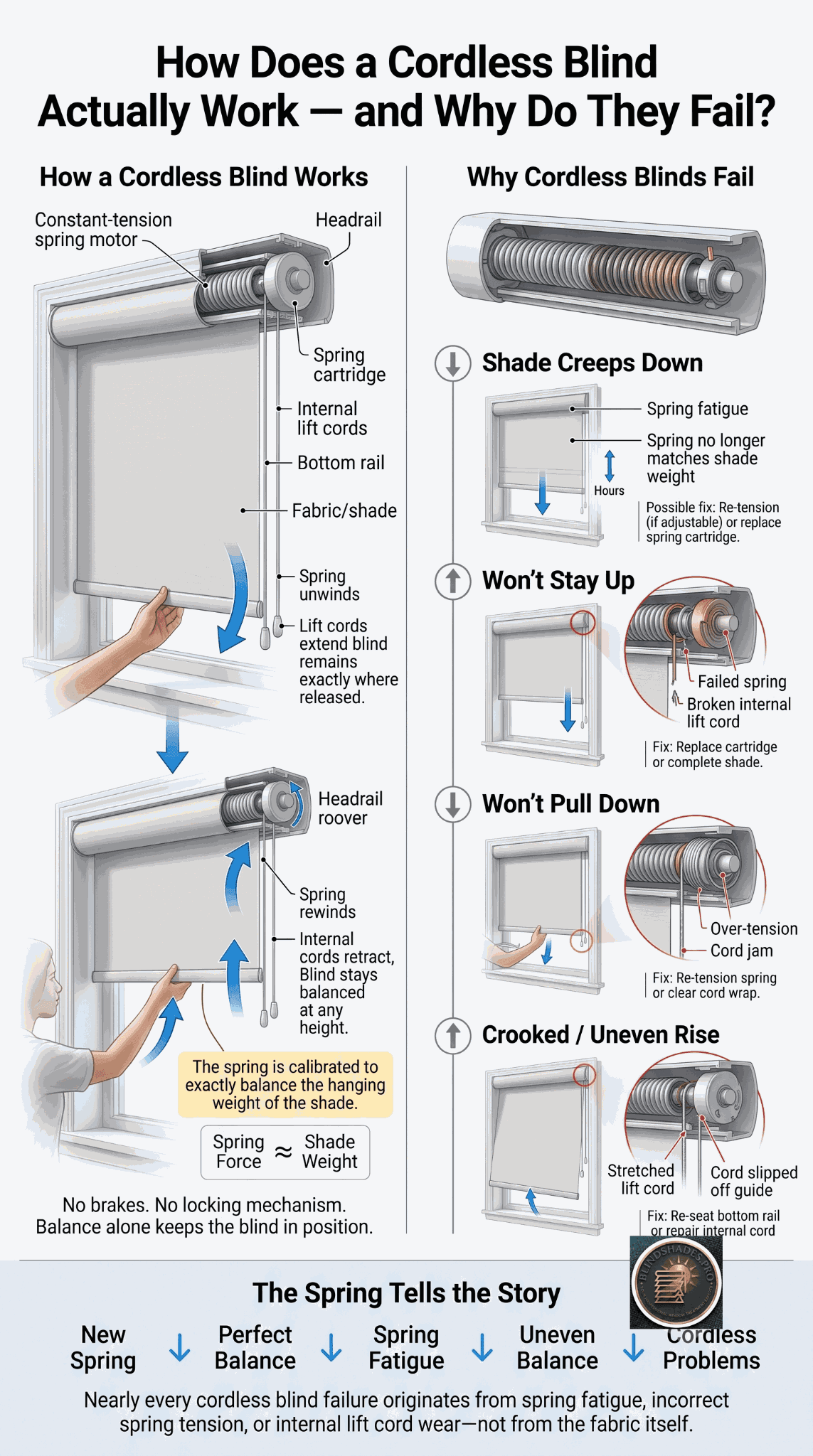
By Michael Turner, 30 years in the window treatment industry
A cordless blind is a spring motor wearing fabric. Understand that one sentence and this whole category makes sense: the constant-tension spring inside the headrail is balanced against the shade’s weight, which is why light cellular fabric made cordless famous, why heavy slats are the mechanism’s hardest job, and why the internet simultaneously swears by cordless and swears at it — both camps are right, about different products. The market’s tested verdicts agree on the podium: Select Blinds Classic Cordless (Wirecutter’s best-looking blackout), the ChrisDowa blackout roller (The Spruce’s overall pick), Windowsandgarden cordless honeycomb (Bob Vila’s top cellular), with Hunter Douglas Duette as the premier reference. This guide adds what none of them explain: how the spring works, when it fails, where cordless ends and motorized begins, and the safety case that made cord-free the modern default.
Key Takeaways
- The spring is the product. Cordless reliability is decided at purchase — fabric weight matched to spring rating — not in use; light cellular flatters the mechanism, heavy faux wood tests it.
- Safety made cordless the default. Free-hanging operating cords are the hazard the industry’s ANSI/WCMA A100.1 safety standard drove off stock products — cordless is the child-and-pet answer the entire market now leads with.
- The tested podium is consistent. Wirecutter (May 27, 2025), The Spruce (April 14, 2026), and Bob Vila (August 18, 2025) each ran hands-on tests and landed on cordless cellular and roller picks — attributed in full below.
- Reach is the honest limit. Cordless requires touching the bottom rail; tall windows, stairwells, and blocked glass fail that gate and climb the ladder to motorized — which is why motorized products rank inside cordless searches.
- Read the inversion before trusting a brand name. The consensus budget pick from a marquee brand rates three point six across five hundred fifty-seven reviews, while fifteen-dollar Blindster cordless shades hold four point seven across five thousand three hundred — volume beats logos in this category.
⭐ Quick Answer — The Best Cordless Blinds & Shades
The best cordless blinds are chosen at three gates — Spring (match fabric weight to the spring motor), Reach (the bottom rail must be touchable), and Room (nurseries make cord-free mandatory):
- The tested podium: Select Blinds’ cordless cellular took the best-looking-blackout verdict in the May 2025 hands-on test at Wirecutter, and Windowsandgarden’s cordless honeycomb leads the cellular test at Bob Vila.
- The mechanism truth: a cordless blind is a constant-tension spring balanced against fabric weight — light cellular flatters it, heavy slats fatigue it, and nearly every reliability complaint is a weight mismatch; the repair route is in the spring fix guide.
- The safety case: free-hanging cords are the hazard the industry standard removed from stock products — child-safe catalogs from twenty-six to one fifty-six dollars are on record at Blindsgalore, and the room where it is mandatory is covered in the best blinds for a nursery.
- The one-inch fork: whether cordless is decided here — which mini blind (vinyl or aluminum) is decided in the best cordless mini blinds.
- The honest limit: cordless ends where your reach does — tall, blocked and many-window homes climb the ladder to battery or wired motorization.
Quick Specification Reference
| Specification | The Short Answer |
|---|---|
| Best overall | Select Blinds cordless cellular — around forty-seven dollars at half off, four point eight across eighteen hundred reviews, plus Wirecutter’s best-looking-blackout verdict |
| Best budget | Blindster cordless TDBU cellular — around fifteen to eighteen dollars, four point seven across five thousand three hundred |
| Best blackout roller | ChrisDowa 100% blackout — The Spruce’s overall pick, April 2026 |
| Best insulation | Windowsandgarden cordless honeycomb — Bob Vila’s top pick; Hunter Douglas Duette as the premium reference |
| Typical cost range | Twenty-six to one fifty-six per Blindsgalore; seventy-five to two forty-five per Home Depot’s best-rated cordless shades |
| The mechanism | Constant-tension spring motor in the headrail, balanced to fabric weight |
| The safety context | Cord-free operation — the direction the ANSI/WCMA A100.1 standard moved the whole industry |
| The honest limit | Reach — bottom rail must be touchable; beyond that, motorize |
Read the complete guide below for: the six Diamond picks anchored to the biggest review bases in the category, the Spring-Reach-Room Test, how the spring mechanism actually works and why it fails, cordless behavior type by type, the safety comparison that explains the category’s existence, the cordless-to-motorized ladder with real prices, the cordless blackout playbook, and where to buy — with the brand-vs-volume inversion stated plainly.
What Are the Best Cordless Blinds & Shades? Our Picks
Six picks, one per job — anchored to this market’s three largest review bases and its three independent hands-on tests, all attributed.
The best cordless blinds for most windows is a cordless cellular shade — every independent test lands there — but the category has six real lanes.
Best Overall — Select Blinds Cordless Honeycomb Cellular. Around forty-seven dollars at half off, four point eight across eighteen hundred reviews — and the highest-authority endorsement in the category: Wirecutter’s May 2025 blackout testing called the Select Blinds Classic Cordless the best-looking of everything they tested and among the most effective at blocking light. The cordless blackout TDBU variant runs sixty-four to one twenty-nine (four point seven across six hundred eighty-four) with the brand’s ninety-nine-percent light-block claim on record.
Best Budget — Blindster Cordless Top-Down Bottom-Up Cellular. The value-volume king of this entire market: around fifteen to eighteen dollars at half off, four point seven across five thousand three hundred reviews on the light-filtering line and four point eight across two thousand one hundred on the no-tools TDBU. At these prices the spring mechanism is the same physics as the premium lines — light cellular fabric is simply the easiest job a spring will ever have.
Best Blackout Roller — ChrisDowa 100% Blackout Roller. The Spruce’s April 2026 overall blackout pick after years of testing, credited for easy installation and color range. Pair it with honest expectations: a roller blacks out the field, not the edges — the side-light truth is covered in the blackout section below.
Best Insulation — Windowsandgarden Cordless Honeycomb. Bob Vila’s August 2025 top pick among tested cellular shades, chosen for variety and performance — with Hunter Douglas Duette standing as the category’s premier reference for durability and cellular insulation, dealer-quoted.
Best Big-Box — Home Decorators Collection Cordless. Around twenty-five dollars at Home Depot, four point five across five thousand five hundred reviews — the walk-in-today option that outrates most of what ships in a week.
Best Cordless Faux Wood — the Home Depot cordless faux wood listing. Around forty-five dollars, four point six across twenty-one thousand reviews — the largest review base in this entire category, and the honest asterisk belongs in the same sentence: faux wood slats are the heaviest load a cordless spring is asked to lift, so keep widths moderate and expect firmer rail pressure. Blinds.com’s custom cordless faux wood (around twenty-nine, four point six across three thousand six hundred) is the made-to-measure route.
| Pick | Product | Approx. Price (as listed) | Rating / Reviews | Wins the gate for |
|---|---|---|---|---|
| Best Overall | Select Blinds cordless cellular | Around forty-seven (half off) | 4.8 / 1,800 + Wirecutter verdict | Looks, blackout, spring-friendly fabric |
| Best Budget | Blindster cordless TDBU | Fifteen to eighteen | 4.7 / 5,300 | Volume-proven value |
| Best Blackout Roller | ChrisDowa 100% blackout | Budget class | The Spruce’s overall pick | Easy install, color range |
| Best Insulation | Windowsandgarden honeycomb · Duette | Value · dealer-quoted | Bob Vila top pick · premier reference | Cellular insulation |
| Best Big-Box | Home Decorators cordless | Around twenty-five | 4.5 / 5,500 | Same-day availability |
| Best Faux Wood | Home Depot cordless faux wood | Around forty-five | 4.6 / 21,000 | The look, with the weight caveat stated |
How Do You Choose? The Spring-Reach-Room Test
Three gates, in order: whether the spring can carry the fabric, whether your hand can reach the rail, and whether the room makes cord-free mandatory.
Gate 1 — Spring. Every cordless blind lives or dies by the match between its spring motor and its fabric weight. Light materials — cellular, pleated, light rollers — are the spring’s natural partners; heavy materials — faux wood, wide real wood, layered Romans — are its stress test. The full mechanism, and the buying signals that predict reliability, get their own section next.
Gate 2 — Reach. Cordless operation means lifting and lowering by the bottom rail — with your hand. Windows above sofas, over kitchen sinks, in stairwells, or anywhere past comfortable reach fail this gate daily, and a Houzz thread on exactly this problem lands where physics does: top-down/bottom-up helps, and motorization solves. The escalation ladder is mapped below.
Gate 3 — Room. In a nursery or a child’s bedroom, cord-free is not a preference — it is the standard of care the whole industry moved toward, and the reason every retailer on this market leads with child-and-pet safety. The room-level playbook, crib placement included, is in the best blinds for a nursery.
| Gate | The question | Pass looks like | Fail routes to |
|---|---|---|---|
| Spring | Is the fabric light enough to live with the spring? | Cellular, pleated, light rollers | Heavy slats: moderate widths, or wand-tilt/motorized |
| Reach | Can you touch the bottom rail at every height you’ll use? | Standard windows, reachable rails | Motorized — see the ladder below |
| Room | Do children or pets use this room? | Cordless or motorized only | Corded products don’t belong here |
How Does a Cordless Blind Actually Work — and Why Do They Fail?
Inside the headrail is a constant-tension spring motor. Nearly every cordless complaint on the internet is that spring, mismatched or exhausted.
Here is the answer to the question this category’s own searchers ask — are cordless blinds reliable? — and to the forum thread titled “Can’t deal with cordless window blinds.”
A cordless mechanism is a spring (or several) wound inside the headrail, connected to the lift cords internally, calibrated so its tension exactly balances the shade’s hanging weight at any height. Push the rail down, the spring pays out and holds; lift it, the spring gathers the slack and holds again. No brakes, no locks in most designs — just equilibrium. That elegance is also the failure map:
| Symptom | What the spring is telling you | Fix or replace? |
|---|---|---|
| Shade creeps down over hours | Spring tension no longer matches fabric weight — fatigue or overload | Some headrails allow re-tensioning; otherwise replace the cartridge or shade |
| Won’t stay up at all | Same disease, further along — or a failed internal cord | Cartridge replacement if the maker sells one; the repair walkthrough is in our spring-fix guide |
| Won’t pull down / fights you | Over-tensioned spring or jammed internal cord | Re-tension if adjustable; check for cord wrap |
| Rises unevenly / crooked | One internal lift cord stretched or slipped | Re-seat the rail level; persistent tilt means a cord issue |
The two community verdicts now make sense together. The Reddit homeowner who lifts blinds daily and says cordless cellular is the way to go is describing the spring’s easiest job: featherweight honeycomb fabric, modest window, tension match that lasts years. The Bogleheads poster who “can’t deal” with cordless — and lands on battery-powered motorized as the “simple and elegant solution” — was almost certainly living with a heavy or oversized shade whose spring lost the argument with gravity. Same mechanism, opposite loads, opposite verdicts.
Four buy-time signals that predict reliability: fabric weight first (cellular and pleated flatter springs; the twenty-one-thousand-review faux wood pick above is beloved and the mechanism’s hardest test — both true); review volume on the mechanism (search the reviews for “stay up” before buying); warranty length on the lift system specifically; and whether the maker sells replacement cartridges — the difference between a ten-dollar fix and a landfill shade.
How Does Cordless Behave Across Each Blind and Shade Type?
Same spring, different loads — the type you choose decides the mechanism’s working life.
| Type | Spring’s job | Verdict | Deep dive |
|---|---|---|---|
| Cellular / honeycomb | Easiest — featherweight fabric, compresses small | The category’s natural home; every tested list agrees | Cellular & honeycomb guide |
| TDBU cellular | Easy, with two rails to balance | The privacy-plus-light upgrade — light from the top, privacy below | Top-down bottom-up guide |
| Roller shades | Easy to moderate — the spring lives in the tube | Strong for blackout; check side-light expectations below | Do blackout rollers block all light? |
| Pleated | Easy — cellular’s single-layer cousin | Budget-friendly spring pairing | Pleated blinds guide |
| Mini blinds (vinyl/aluminum) | Moderate — slat stacks add up | Fine at standard sizes; the material fork is its own decision | Best cordless mini blinds |
| Faux wood | Hardest — the heaviest slats in the category | Beloved (4.6 across twenty-one thousand) and the spring’s stress test; keep widths moderate | Faux wood guide |
| Roman shades | Moderate to heavy — layered fabric | Works; motorized often serves better on large Romans | Cordless vs motorized Roman shades |
One boundary stated plainly: this guide covers the cordless mechanism across every family. For the mini-blind material decision — vinyl versus aluminum, the one-inch world’s own fork — the dedicated guide is the best cordless mini blinds; this page decides whether cordless, that page decides which mini.
Why Did Cordless Become the Safety Default?
Free-hanging cords were the hazard; the industry standard moved; cordless is what compliance looks like in a home with children.
The modern market did not go cordless for looks. Accessible operating cords are a documented strangulation hazard for young children, and the industry’s ANSI/WCMA A100.1 safety standard drove free-hanging cords off stock products — which is why every retailer on this market leads with child-safe positioning, from Blindsgalore’s child-safe catalog framing to American Blinds’ children-and-pets language. Cordless and motorized are the two compliant answers; everything else is legacy.
| Operation | Cord hazard | Reach requirement | Best for |
|---|---|---|---|
| Corded (legacy/custom) | The hazard the standard addressed | None — cords reach down | Nowhere children or pets live; being phased out of stock retail |
| Cordless (spring) | None — no accessible cords | Bottom rail must be touchable | The modern default for reachable windows |
| Wand tilt + cordless lift | None | Rail for lift; wand for tilt | Slatted blinds in kid spaces |
| Motorized | None — and no touching at all | None | Tall, blocked, and many-window homes |
Room-level guidance — crib clearances, which fabrics, blackout for naps — lives in the best blinds for a nursery, and the bedroom system it grows into is the complete bedroom blinds guide.
When Should You Skip Cordless and Motorize? The Ladder
Cordless is a rung, not a destination — which is exactly why motorized products keep ranking inside cordless searches.
Look at this market’s own shelf: a wired smart shade at four point three across one hundred ninety-four, a motorized roller at five point zero across one hundred one, smart cellular at four point six, a motorized blackout cellular from a big-box aisle — five motorized crossovers ranking for a cordless query. That is not algorithm noise; it is buyers discovering mid-search that their window fails the Reach gate. The honest escalation:
| Rung | What it solves | Listed entry pricing (as published) | When to stop here |
|---|---|---|---|
| Cordless | No cords, clean look | Fifteen to fifty typical (Blindster to Select class) | Reachable windows, daily use |
| Cordless TDBU | Adds privacy-with-light | Around eighteen budget; sixty-four-plus custom | Street-facing rooms, bathrooms |
| Wand systems | Tilt without reach-lifting | Bundled with slatted blinds | Slat blinds at moderate heights |
| Motorized (battery) | Removes the Reach gate entirely | Around one sixteen (Kincmo class, 5.0/101) to one seventy (Graywind smart) | Tall, blocked, or many windows |
| Motorized (wired/smart-home) | Permanent power, automation scenes | Around one fifty (RYSE class, 4.3/194; Soma at one fifty-nine) | New builds, whole-home systems |
The Bogleheads defector quoted above reached this ladder’s top rung and reported back: battery-powered, “simple and elegant,” no cords. Correct conclusion for that window. The full protocol-and-power decision — the one that outlasts the fabric — is the complete motorized and smart blinds guide, with the Roman-specific fork in cordless vs motorized Roman shades.
Can Cordless Shades Actually Black Out a Bedroom?
The fabric can; the edges are the fight — and the searches around this keyword are overwhelmingly blackout searches.
Six of the eight live searches adjacent to this keyword are blackout searches — side tracks, bedroom blackout, blackout cellular, blackout TDBU. So here is the straight answer. Cordless blackout fabric performs: Select Blinds’ cordless blackout cellulars carry a ninety-nine-percent light-block claim across six hundred eighty-four reviews, and budget rollers advertise roughly ninety percent. The remaining light is not through the fabric — it is around it. Inside-mounted shades leak at both side gaps; the perimeter glow at sunrise is geometry, not defect.
| Blackout goal | Cordless answer | The honest limit |
|---|---|---|
| Darker room, better sleep | Cordless blackout cellular or roller | Side gaps glow — mount outside with overlap |
| Near-total darkness | Blackout fabric + side tracks or channels | Tracked systems seal edges; see the blackout guide |
| Shift-worker / nursery-nap dark | Layered: shade plus curtain | The two-layer system in the bedroom guide |
| “Does 100% blackout exist?” | Fabric yes, window no — without edge control | The full physics: do blackout roller shades block all light? |
The side-leak diagnosis and fixes — including the tracked and magnetic options those live searches are asking about — are in why light comes through the sides of blackout blinds, with the whole-home strategy in the complete blackout blinds and shades guide.
Where Should You Buy Cordless Blinds — and Why Does the Big Brand Lose?
Buy volume-proven mechanisms, not logos — this category’s ratings prove the point.
| Retailer / Route | Listed range (as published) | Rating shown | Watch-out |
|---|---|---|---|
| Blindsgalore (custom, 120+ cordless) | Twenty-six to one fifty-six | 4.7 store / 4,600 | Child-safe positioning is real; half-off is the real price |
| SelectBlinds (custom) | Forty-seven to one twenty-nine | 4.8 / 1,800 product; 4.7 / 684 TDBU | The Wirecutter pick lives here |
| Blindster (custom) | Thirteen to eighteen budget lines | 4.7 / 5,300 · 4.8 / 2,100 | The volume-value king |
| Blinds.com (custom) | Twenty-nine to one-oh-eight | 4.7 store / 2,600 · faux 4.6 / 3,600 | Cellular range forty-three to one seventy-three |
| Home Depot (big-box) | Seventy-five to two forty-five best-rated shades | 4.6 store / 3,900 | Same-day pickup; listings fragment — sort by review count |
| American Blinds (custom) | Twenty-five to one fifty-two | 4.8 store / 680 | Safety-first framing |
| The inversion | Levolor cordless roller, around fifteen to thirty-three | 3.6 / 557 | The marquee name underperforming fifteen-dollar Blindster at 4.7 / 5,300 |
The inversion deserves its sentence: the consensus budget pick from the category’s most famous brand carries the worst large-base rating on this market — three point six across five hundred fifty-seven — while a fifteen-dollar shade from a direct shop holds four point seven across ten times the base Levolor’s premium lines see. In cordless, the mechanism is the product, and volume-tested mechanisms beat brand equity. Sort by review count, read the “won’t stay up” complaints, then decide.
Best Sources for Going Deeper
- Wirecutter / The New York Times — “The 4 Best Blackout Shades of 2026” (May 27, 2025) — the highest-authority hands-on test in this category; the Select Blinds Classic Cordless verdict.
- The Spruce — “After Years of Testing Blackout Shades, These 8 Are the Best” (April 14, 2026) — the freshest tested list; the ChrisDowa overall pick.
- Bob Vila — “The Best Cellular Shades — Tested” (August 18, 2025) — the cellular-specific test; Windowsandgarden on top.
- Blindsgalore — Cordless category (4.7 across 4,600) — the honeycomb-spring mechanism sentence and the 120-product child-safe catalog.
- The Bogleheads thread — “Can’t deal with cordless window blinds” (August 25, 2025) — the reliability objection in the wild, and its motorized resolution.
Related Buying Guides
- Best Cellular & Honeycomb Shades — the spring’s favorite fabric, in full
- Best Top-Down Bottom-Up Blinds & Shades — the privacy-plus-light upgrade
- Best Motorized & Smart Blinds — the top of the ladder
- Best Blackout Blinds & Shades — where the blackout searches lead
- Best Mini Blinds — the one-inch family
Complete Cordless Guide Library
- Best Cordless Mini Blinds — vinyl vs aluminum, the one-inch fork
- Best Top-Down Bottom-Up Blinds & Shades — two rails, one spring family
- Best Blinds for a Nursery — the room where cord-free is mandatory
- Cordless vs Motorized Roman Shades — the heavy-fabric fork
- Do Blackout Roller Shades Block All Light? — the honest percentage
- Roller Blind Won’t Stay Up: The Spring Fix — the repair walkthrough
- Why Light Comes Through the Sides of Blackout Blinds — edge geometry and fixes
- Best Cellular & Honeycomb Shades — the category’s home fabric
Frequently Asked Questions
What are the best cordless blinds? The best cordless blinds by tested consensus are cordless cellular shades — Select Blinds’ cordless honeycomb (four point eight across eighteen hundred, plus Wirecutter’s best-looking-blackout verdict) leads, with Blindster’s fifteen-dollar TDBU cellulars (four point seven across five thousand three hundred) as the volume-proven budget pick, ChrisDowa’s blackout roller as The Spruce’s overall choice, and Hunter Douglas Duette as the premium reference.
Are cordless blinds reliable? Yes — when the spring matches the fabric. A cordless blind is a constant-tension spring balanced against the shade’s weight; light cellular and pleated fabrics keep that balance for years, while heavy faux wood and oversized shades fatigue springs into the classic creeping-down failure. Buy light fabrics where possible, check reviews for “stays up,” prefer makers that sell replacement cartridges, and motorize past the point where weight or reach strains the design.
How do cordless blinds work without a cord? A spring motor inside the headrail is calibrated so its tension equals the shade’s hanging weight at any height — push the bottom rail down and the spring pays out and holds; lift it and the spring gathers slack and holds. There is no lock in most designs, just equilibrium, which is why weight matching decides everything about the mechanism’s working life.
Are cordless blinds safe for kids and pets? They are the standard of care. Free-hanging operating cords are the documented hazard the industry’s ANSI/WCMA A100.1 safety standard drove off stock products, and cordless and motorized are the two compliant answers. For nurseries, pair cordless or motorized operation with the room-level rules — crib away from the window, no accessible inner cords — covered in our nursery guide.
Can cordless shades be blackout? Yes — cordless blackout cellulars and rollers are the category’s strongest sellers, with claims from roughly ninety percent light-block on budget rollers to ninety-nine percent on premium cellulars. The honest limit is the edges: inside mounts glow at the side gaps regardless of fabric, so mount outside with overlap, add side tracks for near-total darkness, or layer a curtain for shift-worker dark.
What do cordless blinds cost? The live market runs twenty-six to one hundred fifty-six dollars at Blindsgalore and seventy-five to two forty-five across Home Depot’s best-rated cordless shades, with the budget floor at thirteen to eighteen dollars (Blindster class), big-box staples around twenty-five, custom cellulars around forty-seven to one thirty, and the motorized rungs starting near one hundred sixteen.
