What Pleat Size Should I Choose for My Windows — The Complete Size Guide

Authored By Michael Turner -30 Years Home Improvement Expertise | Updated 2026 | BlindShades.pro
Updated on May 10, 2026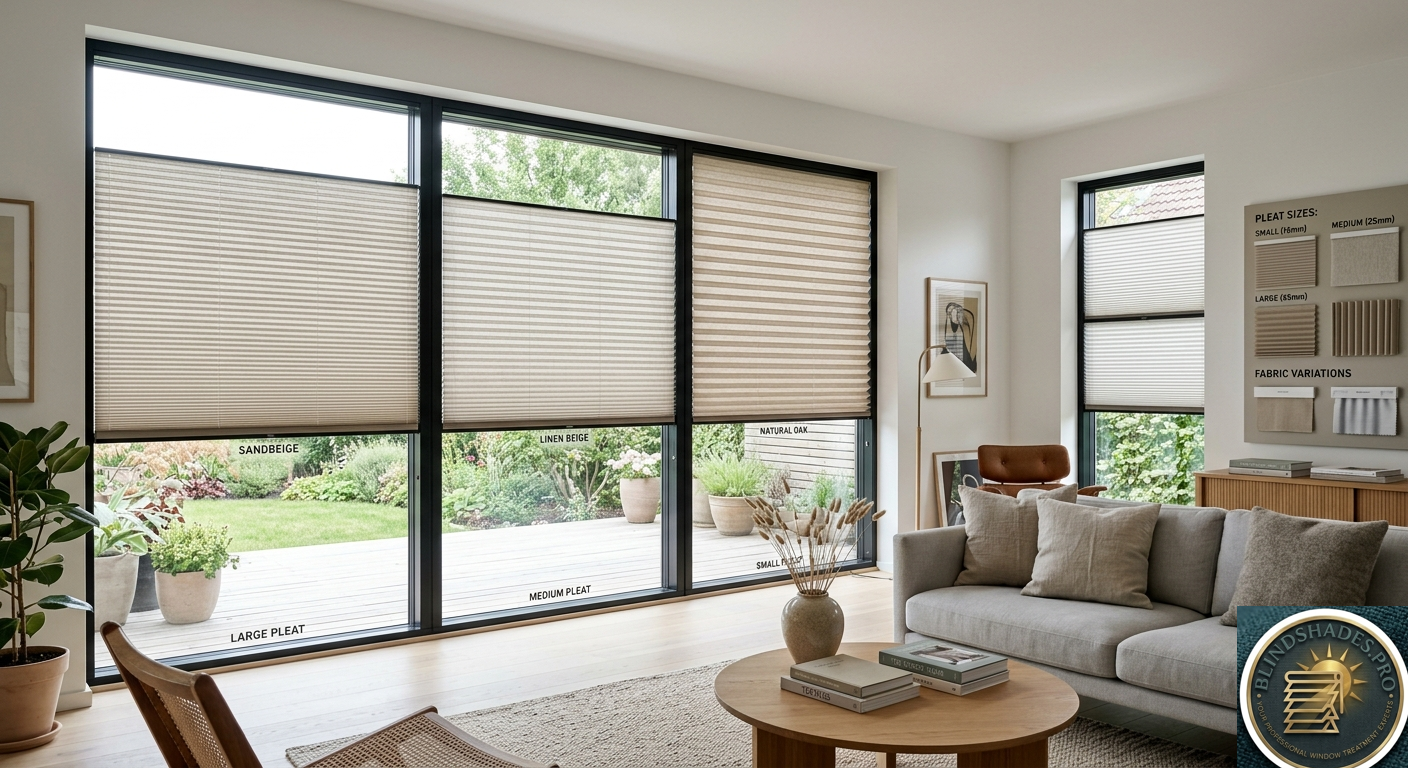
⭐ Quick Answer — What Pleat Size Should I Choose?
- Under 24 inches wide: 3/8-inch pleats — fine delicate texture, smallest stack when raised (~1.0–1.5 inches), correct for bathroom windows, sidelight panels, and small accent windows
- 24–48 inches wide: 9/16-inch pleats — the most popular residential size, balanced appearance for most rooms and design styles (~$30–$50 mid-range per window via SelectBlinds or Blindsgalore)
- 48–72 inches wide: 3/4-inch pleats — bolder architectural line proportionally correct for wider glass; contemporary and transitional rooms
- Over 72 inches wide: 1-inch to 1¼-inch pleats — bold, confident scale for feature windows and sliding doors; specify a 2-on-1 headrail for panels over 72 inches wide (available at Blindsgalore and American Blinds)
- Ceiling 9 ft or above: Move up one pleat size from what window width alone suggests — a 40-inch window in a 9-foot room needs 3/4-inch, not 9/16-inch
- Stack heights: 3/8-inch = 1.0–1.5 inches · 9/16-inch = 1.5–2.5 inches · 3/4-inch = 2.0–3.5 inches · 1¼-inch = 3.0–4.5 inches
⚠️ Most Pleat Size Guides Are Actually About Cellular Shades — Not Standard Pleated Shades: When you search “what pleat size should I choose,” most Page 1 results are guides for cellular (honeycomb) shade cell sizes — 3/8″, 9/16″, and 3/4″ only. Standard pleated shades have a wider pleat range (up to 2 inches) and different proportion rules. According to SelectBlinds, the most popular cellular cell size is 3/4-inch — but for standard pleated shades the most popular pleat size is 9/16-inch. Confirm which product you are ordering before applying any pleat size guide. And for panels wider than 60 inches — always specify hidden back-ladder (NeatPleat) construction to prevent pleat sagging. See the full explanation below.
💡 The Wrong Pleat Size Has a Real Visual Consequence — and Price Difference Is Negligible: Too-small pleats on a large window — approximately 96 pleat lines across a 60-inch window with 3/8-inch pleats — looks cluttered and busy from across the room. Too-large pleats on a small window — 10 pleat lines across a 20-inch window with 1-inch pleats — looks over-scaled and disproportionate. The good news: pleat size itself does NOT significantly change the cost. The price difference between 9/16-inch and 3/4-inch pleats on the same window is typically under $5. Choose the size for correct proportion — not to save money. See what the wrong size actually looks like below.
📖 Read the complete guide below for: the full pleat size chart matched to window width, room-by-room specification table (10 rooms), ceiling height rule, what the wrong pleat size looks like (with specific examples), the 2-on-1 headrail solution for windows over 72 inches, NeatPleat hidden back-ladder for panels over 60 inches, whether pleat size affects price, and the step-by-step ordering checklist.
Important First — Standard Pleated Shades vs Cellular Shades
Most guides on this topic confuse the two products. When you search “what pleat size should I choose,” most Page 1 results are actually about cellular shade cell sizes — not standard pleated shade pleat sizes. They are different products with different pleat size ranges.
Standard pleated shades: Single-layer fabric folded into an accordion pattern. Pleat sizes range from 3/8-inch through 2-inch. Wider selection of sizes.
Cellular shades (honeycomb shades): Two bonded fabric layers forming closed air-trapping cells. Cell sizes typically 3/8-inch, 9/16-inch, or 3/4-inch only. Limited by the manufacturing bonding process.
According to SelectBlinds, the most popular cellular shade cell size is 3/4-inch. For standard pleated shades — the most popular size is 9/16-inch. Different products, different answers.
This guide covers standard pleated shade pleat sizes only. If you are shopping for cellular shades — the cell size guide is different and the performance implications change significantly.
The Pleat Size Guide — Matched to Window Width
3/8-Inch Pleats — Small and Accent Windows
Best for: Windows under 24 inches wide — bathroom hopper windows, sidelight panels beside a front door, small accent windows beside a fireplace.
Why this size works: The 3/8-inch pleat creates a fine, delicate texture — many small pleats across the surface. At a narrow window width this fine texture is proportionally correct. The small number of pleats across a 14–20 inch sidelight or bathroom window reads as elegant and clean.
What happens with 3/8-inch on a large window: According to Blinds.com, “too many rows of small cells can look busy in a large picture window.” The same principle applies directly to pleated shades — approximately 96 individual pleat lines across a 60-inch window creates a visual that reads as cluttered from across the room. Never use 3/8-inch pleats on windows wider than 30 inches.
Stack height when raised: Approximately 1.0–1.5 inches for a standard 36-inch tall window. The smallest stack of any pleat size — maximum unobstructed glass when raised.
Affiliate recommendation: SelectBlinds and Bali (Home Depot) both offer 3/8-inch pleated shades in custom widths starting from 9 inches — ideal for sidelights, bathroom windows, and narrow accent windows.
9/16-Inch Pleats — The Standard Residential Size
Best for: Standard residential windows 24–48 inches wide — living rooms, bedrooms, home offices, dining rooms, kitchens. The universal correct specification for most homes in most rooms.
Why this size works: The 9/16-inch pleat is the most common residential pleated shade size for a proven reason — it is visually balanced at the widths that cover the majority of USA residential windows. It reads as neither too fine nor too bold. It creates a clean elegant accordion line without appearing delicate or over-patterned. Graber Blinds, SelectBlinds, and Blindsgalore all list 9/16-inch as their standard residential default.
Stack height when raised: Approximately 1.5–2.5 inches for a standard 36–48 inch tall window.
Room suitability:
| Room | Correct? | Notes |
|---|---|---|
| Bedroom (standard) | ✅ | Clean, quiet line — restful aesthetic |
| Living room (standard) | ✅ | Balanced for most design styles |
| Home office | ✅ | Professional, undistracting |
| Dining room | ✅ | Works with most dining aesthetics |
| Kitchen (over sink) | ✅ | Standard proportion — use moisture-resistant fabric |
| Bathroom | ⚠️ | Only if window is 24–30 inches wide — use 3/8-inch for narrower |
Affiliate recommendation: Graber, SelectBlinds, and Blindsgalore all offer the widest fabric variety in 9/16-inch construction — the most pattern, colour, and texture options at this size.
3/4-Inch Pleats — Medium to Large Windows
Best for: Windows 48–72 inches wide — living rooms with oversized windows, master bedrooms with wider glass, any room with a contemporary or transitional design aesthetic where a bolder pleat line is an intentional design choice.
Why this size works: At widths over 48 inches the 9/16-inch pleat begins to look slightly fine — too many pleats for the window’s scale. The 3/4-inch pleat increases the distance between fold lines, creating a more spacious, architectural appearance that is proportionally correct for larger glass areas.
The contemporary design case: In modern and transitional interiors where clean lines and bold texture are intentional — 3/4-inch pleats read as a design decision rather than a utilitarian default. They create presence without overwhelming the room.
Stack height when raised: Approximately 2.0–3.5 inches for a 48–60 inch tall window.
Affiliate recommendation: Blindsgalore’s cordless pleated shade program offers 3/4-inch pleats in a full range of light-filtering and blackout fabrics — the correct mid-to-large window specification at mid-market pricing.
1-Inch to 1¼-Inch Pleats — Large and Feature Windows
Best for: Windows over 72 inches wide — sliding glass doors, floor-to-ceiling feature windows, high-ceiling rooms (9 feet and above) where standard pleat sizes read as visually undersized relative to the room volume.
Why this size works: Very wide windows and tall rooms require a pleat that commands visual weight proportional to the glass area. A 3/4-inch pleat on a 96-inch wide floor-to-ceiling window reads as tentative — too many small pleats across a large expanse. A 1-inch or 1¼-inch pleat creates a bold architectural line that reads as intentional and confident from across the room.
Cleaning advantage: Fewer individual pleats per square foot means faster, easier dusting and vacuuming. For large windows where cleaning is already more time-consuming — the larger pleat size reduces maintenance effort per clean.
Stack height when raised: Approximately 3.0–4.5 inches for a 60–80 inch tall window. The largest stack of any pleat size — confirm this is acceptable for the specific window application before ordering.
The NeatPleat / hidden back-ladder specification: Standard pleated shades at large widths use a back-ladder cord system visible from behind the shade. On very large widths — this ladder can cause the pleats to sag or bow between support points over time. Specify NeatPleat (American Blinds), hidden back-ladder, or single-needle construction from the supplier for any pleated shade wider than 60 inches. This eliminates the visible back cord and prevents pleat sagging on wider applications.
Affiliate recommendation: Hunter Douglas Applause and Graber pleated shades offer 1-inch and 1¼-inch pleat sizes with hidden back-ladder construction — the correct premium specification for large feature windows.
Does Ceiling Height Affect Pleat Size Choice?
Yes — and this is the factor every competitor guide misses entirely. Window width alone does not determine the correct pleat size. The relationship between the window and the room’s overall scale matters equally.
The proportion rule: The pleat size should feel proportional to the room’s total scale — not just the window width. A 40-inch wide window in a 10-foot ceiling room reads differently than a 40-inch wide window in an 8-foot ceiling room.
The high-ceiling rule: If your ceiling is 9 feet or above — move up one pleat size from what window width alone suggests.
The complete room-based specification table:
| Room | Ceiling Height | Window Width | Correct Pleat Size |
|---|---|---|---|
| Small bathroom | 8 ft | 12–18 inches | 3/8-inch |
| Standard bedroom | 8 ft | 30–42 inches | 9/16-inch |
| Standard living room | 8 ft | 36–48 inches | 9/16-inch |
| Master bedroom | 8 ft | 48–60 inches | 3/4-inch |
| Open-plan living | 9 ft | 48–60 inches | 3/4-inch |
| High-ceiling living | 9 ft | 60–72 inches | 1-inch |
| Feature room / loft | 10–12 ft | 72–96+ inches | 1¼-inch + 2-on-1 headrail |
| Home office | 8–9 ft | 30–48 inches | 9/16-inch |
| Sliding glass door | Any | 72–96 inches | 1-inch + 2-on-1 headrail |
| Sidelight panel | Any | 8–14 inches | 3/8-inch (or frosted film) |
What Happens When You Choose the Wrong Pleat Size?
This is the question no competitor answers — and the most useful decision-making information a buyer can have.
Too-Small Pleats on a Large Window
Visual effect: The shade looks busy, delicate, and undersized for the glass area. The many fine pleats create a texture that reads as wallpaper rather than a window treatment. From a normal seating distance of 10–12 feet — the shade appears cluttered and over-detailed.
Specific example: A 60-inch wide living room window with 3/8-inch pleats has approximately 96 individual pleat lines across the width. From across the room this creates a visual texture that reads as overwhelming rather than elegant.
Is there a functional problem? No — the shade operates correctly. The consequence is purely aesthetic. But in a primary room like a living room or master bedroom — aesthetic mismatch is a meaningful outcome for a product you will look at every day.
Too-Large Pleats on a Small Window
Visual effect: The shade looks bold, heavy, and over-scaled. A small number of large pleats on a narrow window reads as a mismatch — like an oversized cushion on a small chair.
Specific example: A 20-inch bathroom window with 1-inch pleats has approximately 10 pleat lines across the width. The boldness of each individual fold looks visually disproportionate to the small glass area.
Functional effect: Slightly higher stack when raised — which may obstruct more light at the top of a small window than the room requires.
The 2-on-1 Headrail — The Solution for Very Wide Windows
For windows over 72–84 inches wide, a single pleated shade panel can be difficult to operate and may sag across the width over time. The 2-on-1 headrail is the correct engineering solution — and it is mentioned briefly in one competitor guide but never properly explained.
What a 2-on-1 headrail does: A single headrail unit contains two separate pleated shade panels side by side — each covering half the total window width. Both panels are on the same headrail so they look like one continuous shade from the front. Each panel operates independently, allowing fine adjustment of each half.
The structural benefit: Two narrower panels are significantly easier to raise and lower than one panel spanning the full width. They are also less prone to fabric sagging across the mid-span of a very wide window.
When to specify: Any pleated shade application where a single panel would exceed 72 inches in width. For sliding glass doors typically 72–96 inches wide — the 2-on-1 headrail is the standard professional specification.
Availability: American Blinds, SelectBlinds, and Blindsgalore all offer 2-on-1 headrail pleated shades. Confirm availability at your specific total window width before ordering.
Does Pleat Size Affect the Price?
No competitor guide addresses this — yet it is a common buyer question. Here is the honest answer.
Pleat size itself does not significantly change the fabric cost. The same quantity of fabric is used regardless of pleat size at the same window dimensions. The cost difference between a 9/16-inch and a 3/4-inch pleated shade of the same fabric at the same dimensions is minimal — typically under $5 per window at mid-range pricing.
What does add cost:
- Hidden back-ladder / NeatPleat construction — typically $10–$25 per shade for widths over 60 inches
- 2-on-1 headrail — typically $15–$30 additional for the dual mechanism
- Premium fabric — larger pleat sizes are sometimes only available in premium fabric ranges
The practical implication: Choose pleat size based on proportion and aesthetics — not on cost. The price difference between sizes is negligible. The visual difference is significant and permanent.
How to Order — Step-by-Step Checklist
✅ Step 1 — Confirm you are ordering standard pleated shades (not cellular)
If the product description mentions “honeycomb cells” or “air pockets” — it is cellular, not pleated. Pleat size guidance differs between the two products.
✅ Step 2 — Measure the window width at three points
Measure at the top, middle, and bottom of the window frame. Use the narrowest measurement for inside mount specifications.
✅ Step 3 — Note the ceiling height
If 9 feet or above — move up one pleat size from what the window width alone suggests.
✅ Step 4 — Match pleat size to the width + ceiling guide above
Under 24″ → 3/8-inch
24–48″ →9/16-inch
48–72″ → 3/4-inch
Over 72″ → 1-inch + consider 2-on-1 headrail
Request NeatPleat or hidden back-ladder construction from the supplier for any single-panel pleated shade over 60 inches wide.
✅ Step 6 — Order a free sample before committing
SelectBlinds and Blindsgalore both offer free fabric samples. For large windows where the investment is significant — confirm the pleat size and fabric together in hand before placing the full order. The pleat size will be visible in the sample.
Frequently Asked Questions
What is the most popular pleated shade pleat size? For standard residential windows — 9/16-inch is the most popular pleated shade pleat size. It provides a balanced, elegant accordion line that works proportionally for the 30–48 inch window widths most common in USA homes. Note that 3/4-inch is cited by SelectBlinds as the most popular cellular shade cell size — but cellular and standard pleated shades are different products with different correct answers.
What happens if I choose the wrong pleat size? Too-small pleats on a large window looks busy and cluttered from across the room — approximately 96 pleat lines across a 60-inch window creates a visual texture that reads as overwhelming. Too-large pleats on a small window looks bold and disproportionate — 10 pleat lines across a 20-inch window reads as over-scaled. The mistake is aesthetic, not functional — but since you will look at the shade every day, proportion matters significantly.
Do larger pleats insulate better than smaller pleats? No — pleat size has no effect on thermal insulation. Insulation in a pleated shade comes from the fabric weight and any liner added. For meaningful insulation — specify a blackout liner (improves R-value from R-2.20 to R-2.60–R-3.00) or upgrade to cellular shades (R-3.50–R-4.80).
Can I use different pleat sizes on different windows in the same room? No — always match pleat sizes across all windows in the same room. Mismatched pleat sizes in the same room create a visually uncoordinated appearance that is immediately noticeable. If windows in the same room are different widths — choose the pleat size appropriate for the largest window and use that size throughout the room.
What is a NeatPleat or hidden back-ladder on a pleated shade? Standard pleated shades have a back-ladder cord running vertically behind the pleat folds to support the shade structure. On wide shades this cord can become faintly visible from certain angles and can cause pleat sagging over time as the fabric spans wider distances. NeatPleat (American Blinds) or hidden back-ladder construction eliminates this cord using an alternative pleat support system. It is the correct specification for any pleated shade panel wider than 60 inches.
What is a 2-on-1 headrail and when do I need it? A 2-on-1 headrail contains two separate pleated shade panels side by side on one headrail — each covering half the total window width. The result looks like one continuous shade from the front but each half operates independently. Specify this for any window wider than 72 inches — particularly sliding glass doors at 72–96 inches. It is easier to operate and prevents mid-span fabric sagging on very wide single panels. Available from American Blinds, SelectBlinds, and Blindsgalore.
Related Guides on BlindShades.pro
- The Best Pleated Shades Buying Guide — full specification including liner options, brands and pricing
- Pleated Shades vs Cellular Shades — The Honest R-Value and Price Comparison — which product is right for your window
- Can Pleated Shades Be Blackout — The Liner Upgrade Guide — liner specs for every pleat size
- Why Are Pleated Shades Cheaper Than Cellular — the construction cost difference explained
- The Best Sidelights and Front Door Blinds Buying Guide — 3/8-inch pleat narrow window specification
By Michael Turner | 30 Years Home Improvement Expertise | Updated 2026 | BlindShades.pro
