Are Blackout Blinds Worth It for Better Sleep — The Science and the Specification

Authored By Michael Turner -30 Years Home Improvement Expertise | Updated 2026 | BlindShades.pro
Updated on July 10, 2026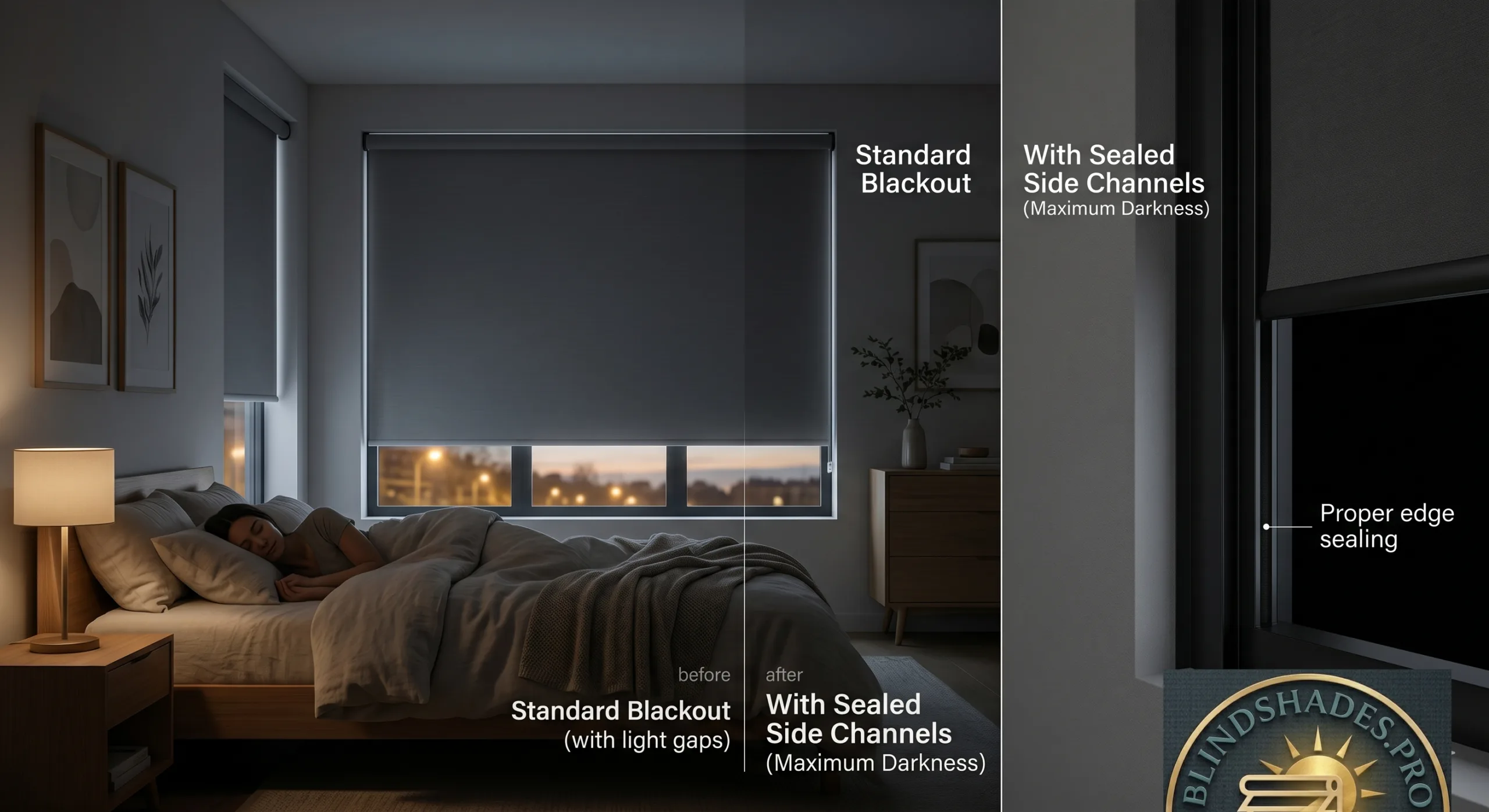
⭐ Quick Answer — Are Blackout Blinds Worth It for Better Sleep?
- The Verdict: Yes — for light-sensitive sleepers, east-facing bedrooms with dawn light, urban rooms with street lighting, and shift workers. No — if your insomnia is caused by anxiety, pain, or sleep apnoea. And marginal benefit if your bedroom is already below 10 lux. Blackout shades address only light — they do not fix non-light causes of poor sleep
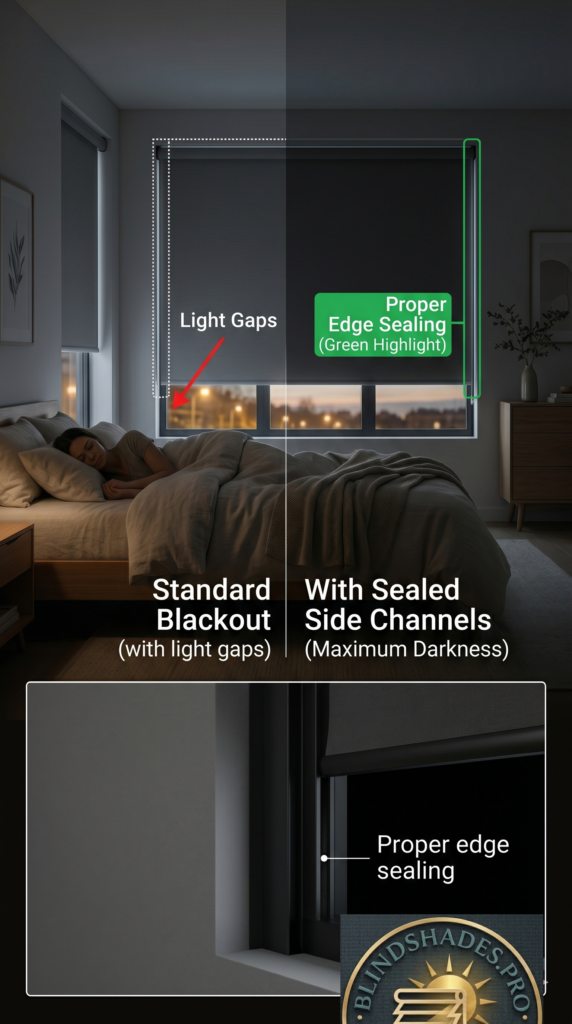
- The Lux Science — Edge Gaps Matter as Much as Fabric: Zeitzer et al. (2000, Sleep) identified the melatonin suppression curve: 3 lux = 50% suppression; 10 lux = 50–80%. A typical blackout shade with inside-mount edge gaps admits 10–15 lux — still suppressing 50–80% of melatonin. Full edge gap elimination (cassette + side channels, or outside wall-surface mount) is required to reach the 0–5 lux range where research benefits are strongest
- The SWS Sleep Architecture Benefit: Research in Sleep (Cho et al.) shows ambient light specifically reduces slow-wave sleep (Stage 3 NREM) — the deepest, most restorative stage where memory consolidation and growth hormone secretion occur. Blackout shades improve sleep quality not just by helping you fall asleep, but by increasing the proportion of deep SWS sleep you achieve
- The Cardiovascular Case: Windred et al. (2024, PNAS) tracked 89,000 UK Biobank participants using 13 million hours of wrist light sensor data — brighter nighttime environments predicted higher cardiometabolic mortality. The mechanism: suppressed melatonin → elevated cortisol → sustained sympathetic nervous system activation → elevated blood pressure during sleep
- The Alarm Grogginess Risk: A perfectly dark bedroom removes the morning light that naturally moves you to lighter sleep before your alarm. If the alarm fires during deep SWS — sleep inertia lasts 30–60 minutes. Fix: motorized blackout shade with sunrise schedule rising 30–60 minutes before wake time (Hunter Douglas PowerView, Lutron Serena)
- Best Sources: Complete darkness (cassette + channels) → Hunter Douglas Duette LightLock + PowerView · Mid-range → Blindsgalore Blackout Roller outside mount · Budget → SelectBlinds Blackout Roller with light blockers
⚠️ When a $30 Sleep Mask Beats a $150 Blackout Shade — and the Chronotype Factor: If the only issue is darkness during sleep — a sleep mask achieves equivalent melatonin production biology for $25–$40. Blackout shades are worth more than a mask when: (1) pre-sleep light environment matters (melatonin production begins 1–2 hours before sleep onset — a mask worn only during sleep misses this), (2) a partner doesn’t want to wear a mask, or (3) motorized sunrise simulation is desired. And chronotype matters: Morning types (larks) benefit most from blocking dawn light (east-facing windows); evening types (owls) benefit most from reducing evening light exposure — blackout shades help less with the latter (indoor lights are still on). For owls — dim indoor lighting in the 2 hours before bed matters more than the blackout shade specification. See the full chronotype guide below.
💡 The Research-Grade Darkness Specification — 0–5 Lux Requires Both Fabric AND Edge Gap Elimination: The research threshold is 3 lux or below for 50% melatonin suppression at peak sensitivity (Zeitzer 2000). A standard inside-mounted blackout shade admits 10–15 lux from edge gaps — still suppressing 50–80% of melatonin. To reach 0–5 lux: (1) True blackout fabric (≤0.1% transmittance) AND (2) edge gap elimination — cassette headrail with integrated side channels (Hunter Douglas LightLock, Blindsgalore side channel option) or outside-mount on wall surface extending 3–4 inches beyond casing. Without edge gap elimination, even the best blackout fabric is insufficient to reach the research optimal threshold. See the full specification guide below.
📖 Read the complete guide below for: the full Zeitzer 2000 lux-melatonin suppression curve, Gooley 2011 and Northwestern 2022 study data explained, slow-wave sleep architecture benefit, cardiovascular mechanism chain, sleep mask vs blackout shade comparison, chronotype-dependent benefit analysis, the “is it worth it” verdict table by scenario, alarm grogginess risk and motorized sunrise solution, and the research-grade 0–5 lux specification.
The Sleep Science — What the Research Actually Shows
Most blackout shade guides cite the same two or three studies, often without explaining what they actually measured. Here is the complete picture.
The Melatonin Suppression Research
Gooley et al. (2011), Journal of Clinical Endocrinology and Metabolism: 116 participants were exposed to room light (mean 200 lux) or dim light (mean 3 lux) in the 8 hours before sleep onset and during sleep. Room light before bedtime suppressed melatonin by more than 50% and shortened melatonin production duration by approximately 90 minutes.
What this actually means for bedroom darkness: This study compared a normally lit room (200 lux) to near-darkness (3 lux). A quality blackout shade with edge gaps typically admits 10–15 lux into the bedroom — significantly darker than a normally lit room but not the same as the 3 lux “dim light” comparison condition.
The Zeitzer et al. (2000, Sleep) threshold data: Research by Zeitzer and colleagues provides the most granular lux-response curve for melatonin suppression:
- 0.5 lux: approximately 10% melatonin suppression
- 3 lux: approximately 50% suppression at maximum sensitivity
- 10 lux: approximately 50–80% suppression
- 100 lux: approximately 85% suppression
- 200 lux: approximately 90%+ suppression
The practical implication: A bedroom that receives 10–15 lux from edge gap light around a blackout shade still suppresses approximately 50–80% of melatonin — meaningfully better than a lit room but not the complete-darkness ideal. Complete edge gap elimination (cassette headrail + side channels, or outside mount with wall overlap) is required to reach the 3 lux or below level where melatonin suppression falls to 50% or less.
The Cardiovascular Research — The Strongest Case for Blackout Shades
The most compelling recent evidence for bedroom darkness is not directly about sleep quality — it is about long-term cardiovascular health.
Windred et al. (2024, Proceedings of the National Academy of Sciences): This analysis of 89,000 UK Biobank participants using 13 million hours of wrist-worn light sensor data found that brighter nighttime light environments independently predicted higher all-cause premature mortality, with the strongest associations for cardiometabolic causes (heart failure, type 2 diabetes).
Northwestern University / Zee et al. (2022, PNAS): Participants sleeping in moderate room light (100 lux) versus near-darkness (less than 3 lux) for just one night showed increased heart rate, decreased heart rate variability, and increased insulin resistance the following morning.
The mechanistic chain no competitor guide explains:
- Ambient light at night suppresses melatonin production
- Melatonin suppression elevates cortisol (the primary stress hormone)
- Elevated cortisol maintains sympathetic nervous system activation (fight-or-flight state)
- Sustained sympathetic activation elevates blood pressure and heart rate during sleep
- Chronic repetition of this pattern contributes to hypertension, insulin resistance, and cardiac risk
The cardiovascular case for bedroom darkness is substantially stronger than the “better sleep” case alone. For anyone with cardiovascular risk factors — hypertension, diabetes, family history of heart disease — sleeping in as dark a room as achievable is supported by the research regardless of subjective sleep quality improvement.
The Slow-Wave Sleep Connection — The Overlooked Benefit
All guides focus on melatonin. The more specific sleep architecture benefit of bedroom darkness is its effect on slow-wave sleep.
Slow-wave sleep (SWS), also called Stage 3 NREM or deep sleep: SWS is the sleep stage in which the brain performs memory consolidation, cellular repair, growth hormone secretion, and immune system restoration. It is the most restorative sleep stage and the one most commonly disrupted by poor sleep environments.
How light specifically affects SWS: Research published in the journal Sleep by Cho et al. demonstrates that ambient light exposure during sleep specifically reduces the proportion of time spent in SWS — more than it reduces REM or other sleep stages. Light keeps the brain in lighter sleep stages (Stage 1 and 2 NREM) at the expense of the deepest restorative stage.
The practical implication: If you wake feeling unrefreshed despite sleeping 7–8 hours — reduced SWS is a possible cause. A bedroom that admits ambient light (from street lighting, electronic standby lights, or dawn light through imperfect blackout shades) may be reducing the proportion of deep SWS sleep you achieve. Blackout shades improve sleep quality not just by helping you fall asleep but by improving the depth and restorability of the sleep you get.
Blackout Shades vs Sleep Masks — The Honest Comparison
This is the question no competitor guide addresses in a “is it worth it” context.
If the biological goal is melatonin production in complete darkness — a sleep mask worn during sleep achieves this for approximately $25–$40. A quality blackout shade costs $60–$200. Why choose the shade?
The specific advantages of blackout shades over sleep masks:
1. Pre-sleep visual environment: Melatonin production begins in the 1–2 hours before sleep onset, not just during sleep. The Gooley 2011 study found room light during the pre-sleep period was equally important to light during sleep itself. A sleep mask worn only during sleep misses this pre-sleep melatonin building phase. Darkening the bedroom with a blackout shade before bedtime addresses the full pre-sleep light environment.
2. Natural morning light management: With a sleep mask, you control when it comes off — either by alarm or by waking. With blackout shades and a motorized sunrise schedule, the shade can rise gradually at your desired wake time, simulating natural dawn light to trigger the cortisol awakening response for easier waking without sleep inertia.
3. Partner compatibility: A sleep mask is a personal device. If one partner needs complete darkness and the other does not want to wear a mask — blackout shades are the shared-room solution.
4. No physical contact: Sleep masks can cause pressure around the eye area, disrupt breathing, and may cause discomfort for side sleepers. Blackout shades require no physical contact with the sleeper.
When a sleep mask is sufficient: For a single person who sleeps alone, has no partner, doesn’t mind the physical contact, and whose bedroom environment is dark except for a specific light source that a mask blocks — a sleep mask provides equivalent biological benefit at a fraction of the cost. Blackout shades are worth the additional investment primarily for the pre-sleep light environment and for households where shared-room management matters.
The Chronotype Factor — Why Benefit Depends on Your Sleep Type
This is a nuance absent from every competitor guide.
Chronotypes and light sensitivity: The science of chronobiology identifies two primary chronotypes:
- Morning types (larks): Natural early risers who are most sensitive to morning light (which advances their already-early sleep timing further) and less sensitive to evening light
- Evening types (owls): Natural late sleepers who are most sensitive to evening light (which delays their already-late sleep timing further) and less sensitive to morning light
The blackout shade benefit by chronotype:
For morning types (larks): The highest-value specification is a blackout shade that prevents morning light from entering the bedroom at dawn. For a lark sleeping in an east-facing bedroom, dawn light at 5am — well before desired wake time — advances the circadian clock further and shortens sleep. A blackout shade preventing this dawn light is high-value for larks.
For evening types (owls): Owls struggle with early wake times and late-onset sleep. Their highest-value specification is light management in the evening before sleep — reducing exposure to bright indoor light in the hours before bed. The blackout shade helps less with this (you still have indoor lights on in the evening). For owls — the combination of dimming indoor lights in the evening AND a blackout shade for morning dark is most beneficial.
For both: Street lighting at night (from lamp posts, car headlights, illuminated signs) affects all chronotypes. For any bedroom with significant nighttime street light — blackout shades provide universal benefit regardless of chronotype.
The “Is It Worth It” Verdict — By Scenario
| Scenario | Worth It? | Reason |
|---|---|---|
| East-facing bedroom with dawn sunrise (early morning wake-up problem) | ✅ Definitively yes | Dawn light advance circadian clock; blackout prevents this |
| Street-lit urban bedroom (orange sodium or LED street lighting) | ✅ Definitively yes | Nighttime light suppresses melatonin throughout sleep |
| Shift worker sleeping during daylight hours | ✅ Highest value of any scenario | Full daylight = 10,000–100,000 lux vs near-darkness = 0–15 lux |
| Light-sensitive sleeper who wakes from any ambient light | ✅ Yes | Specific subjective sleep quality improvement documented |
| Person with cardiovascular risk factors | ✅ Yes | Windred 2024 PNAS supports minimising nighttime light exposure |
| Average sleeper in a moderately dark bedroom | ⚠️ Marginal benefit | If room is already below 10 lux, additional darkness provides limited improvement |
| Person whose insomnia is anxiety, pain, or sleep apnoea driven | ❌ No | Blackout shades address only light; do not help with anxiety, pain, or airway obstruction |
| Natural sunrise-waker who uses dawn light as an alarm substitute | ⚠️ Caution | Blackout removes the morning light cue; replace with motorized sunrise simulation |
| Person in internal bedroom with no windows | ❌ Unnecessary | No external light to block |
The Alarm Dependency and Sleep Inertia Problem
This is a practical consequence of blackout shades that no competitor guide addresses.
Sleep inertia: When an alarm wakes you from deep slow-wave sleep (Stage 3 NREM), you experience sleep inertia — a period of severe grogginess, impaired reaction time, and cognitive difficulty that can last 30–60 minutes. This is the “I cannot think or function when my alarm goes off” experience.
How blackout shades affect this: A bedroom without blackout shades allows morning light to gradually brighten, which naturally moves the sleeper toward lighter sleep stages (Stage 1 and 2 NREM) in the 30–60 minutes before the desired wake time. This “dawn simulation” effect means the alarm is more likely to catch you in light sleep rather than deep SWS.
A perfectly dark bedroom with blackout shades maintains deep sleep conditions until the alarm abruptly fires. This can increase the probability of alarm-induced sleep inertia — particularly pronounced if you are sleeping more hours than usual or the alarm goes off at an earlier time than normal.
The solution — motorized sunrise simulation: A motorized blackout shade programmed to rise gradually 30–60 minutes before the desired wake time provides natural light exposure that moves the sleeper toward lighter sleep stages before waking. Hunter Douglas PowerView and Lutron Serena both support sunrise scheduling. This specification captures all the melatonin benefits of complete darkness during sleep while eliminating the sleep inertia risk of an abrupt dark-room alarm wake.
The Minimum Effective Specification for Sleep Benefits
Based on the research, here is the specification that achieves the documented sleep benefits:
For melatonin production: Target room darkness below 3 lux (the dim light comparison condition used in research). This requires:
- True blackout fabric (light transmittance ≤ 0.1%)
- Edge gap elimination — cassette headrail with side channels, or outside mount with wall overlap
- Bottom sill coverage — outside mount extending 2–3 inches below sill
For cardiovascular benefit (based on Windred 2024): Minimise nighttime light exposure below measurable levels. As above — true blackout fabric plus edge gap elimination.
For SWS architecture improvement: Same specification — the degree of darkness affects SWS proportion proportionally to the degree of nighttime light reduction.
The honest minimum: A blackout shade with a good outside mount and no dedicated side channels typically achieves 5–20 lux — meaningful improvement over 50–200 lux in an urban bedroom, but not reaching the 3 lux research threshold. Full blackout specification (cassette + channels or outside mount wall surface) achieves 0–5 lux. The research benefit is strongest at the 0–5 lux range.
Where to Order — The Right Specification for Sleep
For complete darkness including edge gap elimination (maximum sleep benefit): Hunter Douglas Duette LightLock — factory-integrated U-shaped side channels, cellular blackout construction, PowerView motorization with sunrise scheduling. The specification that achieves research-grade bedroom darkness with dawn simulation wake.
For quality blackout with outside mount (mid-range complete solution): Blindsgalore Blackout Roller Shade — cordless or motorized, specify outside mount with wall overlap for edge gap elimination. Pair with a motorized upgrade for sunrise simulation.
For budget blackout with maximum value: SelectBlinds Blackout Roller Shade — specify outside mount, add light blocking strips for side gap reduction. This achieves 10–20 lux — meaningful improvement for most sleepers at lower cost than cassette systems.
Related guides: For complete buying advice, see our blackout blinds and shades buying guide.
Frequently Asked Questions
Are blackout blinds worth it for better sleep? For most people with light-sensitive sleep, an urban bedroom with street lighting, or an east-facing bedroom that brightens at dawn — yes. Research by Gooley et al. (2011) in the Journal of Clinical Endocrinology and Metabolism found that room light before and during sleep suppressed melatonin by more than 50%. Research by Windred et al. (2024) in PNAS found that brighter nighttime light environments predicted higher cardiometabolic mortality in 89,000 participants. However, if your sleep problem is anxiety, pain, or sleep apnoea — blackout shades will not help, because the problem is not light. And if your bedroom is already below 10 lux — additional blackout shades provide marginal additional benefit.
How much darkness do you need for better sleep? Research by Zeitzer et al. published in Sleep identifies 3 lux or below as the threshold where melatonin suppression drops to 50 percent or less at peak sensitivity. Room conditions above 10 lux suppress approximately 50 to 80 percent of melatonin even at non-peak periods. A quality blackout shade with edge gaps typically admits 10 to 15 lux — meaningfully better than a lit room but not reaching the optimal 3 lux threshold. Full edge gap elimination through cassette headrail with side channels or outside wall-surface mount is required to reach 0 to 5 lux.
Do blackout blinds actually improve sleep quality or just help you fall asleep? Both — but the sleep architecture improvement is the less commonly known benefit. Research published in Sleep by Cho and colleagues demonstrated that ambient light during sleep specifically reduces the proportion of time spent in slow-wave sleep (Stage 3 NREM deep sleep) — the most restorative sleep stage where memory consolidation, growth hormone secretion, and immune restoration occur. Blackout shades improve sleep quality not just by helping you fall asleep but by improving the depth of sleep achieved, which affects morning cognitive function, mood, and physical recovery.
Should I get a sleep mask instead of blackout blinds? A sleep mask achieves equivalent melatonin production during sleep for approximately $25 to $40 versus $60 to $200 for blackout shades. The advantages of shades over masks are: they darken the pre-sleep environment (melatonin production begins 1 to 2 hours before sleep onset, not just during sleep), they enable motorized sunrise simulation for alarm-free natural waking, and they don’t require physical contact with the eyes. For a single person who doesn’t mind wearing a mask and whose only concern is darkness during sleep — a sleep mask provides equivalent biological benefit at lower cost. Blackout shades are the better investment when pre-sleep environment, partner accommodation, and morning light management matter.
Do blackout blinds cause grogginess by removing morning light? Yes, potentially — if used with a standard alarm clock. Without morning light, the brain maintains deeper sleep conditions until the alarm abruptly fires, which can increase sleep inertia grogginess lasting 30 to 60 minutes if the alarm catches you in slow-wave sleep. The solution is a motorized blackout shade with a sunrise schedule — programmed to rise gradually 30 to 60 minutes before the desired wake time, providing natural light exposure that moves the sleeper toward lighter sleep stages before waking. Hunter Douglas PowerView and Lutron Serena both support sunrise scheduling for this purpose.
Related Guides on BlindShades.pro
- The Best Bedroom Blinds & Shades Buying Guide — the complete bedroom specification guide
- What Is the Difference Between Blackout Shades and Room-Darkening Shades — the full blackout vs room-darkening specification guide including lux calculations
- Why Is Light Coming Through the Sides of My Blackout Blinds — How to Fix Light Gaps — edge gap elimination for achieving research-grade bedroom darkness
- Blackout Roller Shades vs Blackout Cellular Shades — Which Is Better for a Bedroom — the product comparison including SWS acoustic benefit
- Are Motorized Blackout Blinds Worth It for a Bedroom — Cost, Convenience and Sleep Guide — the motorized sunrise specification and sleep inertia prevention guide
By Michael Turner | 30 Years Home Improvement Expertise | Updated 2026 | BlindShades.pro
