How Do I Get Privacy in a Bathroom Without Losing Natural Light

Authored By Michael Turner -30 Years Home Improvement Expertise | Updated 2026 | BlindShades.pro
Updated on July 16, 2026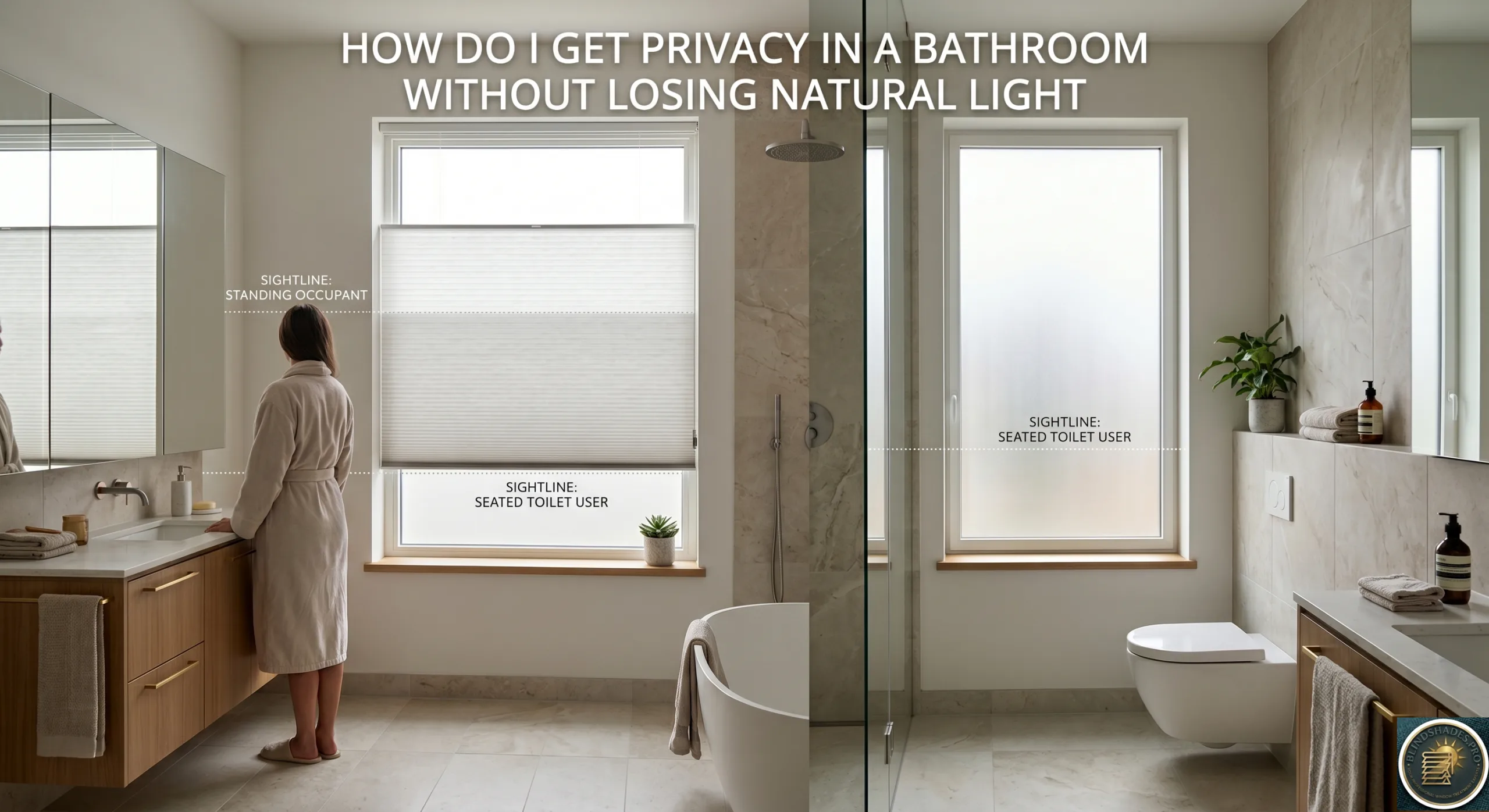
⭐ Quick Answer — How Do I Get Privacy in a Bathroom Without Losing Natural Light?
- Check Your Sill Height First — You May Need Nothing: Achieving bathroom privacy without losing light starts with measuring the window sill from the floor. Sill above 64–66 inches = standing occupant not visible from street level — no treatment needed for standing privacy. Sill below 48 inches = seated toilet user visible to any passer-by at street level within 30–40 feet. Identify the risk before spending anything
- Best Day + Night Solution — Frosted Window Film: Frosted film transmits 80–90% of natural light vs clear glass, provides permanent day AND night privacy ($25–$80 DIY). Unlike solar shades and mirror films which fail when interior light exceeds exterior at night, frosted film scatters light in both directions — no luminance reversal. A south-facing bathroom loses negligible light; a north-facing bathroom should specify high-transmittance 80–90% frosted film only
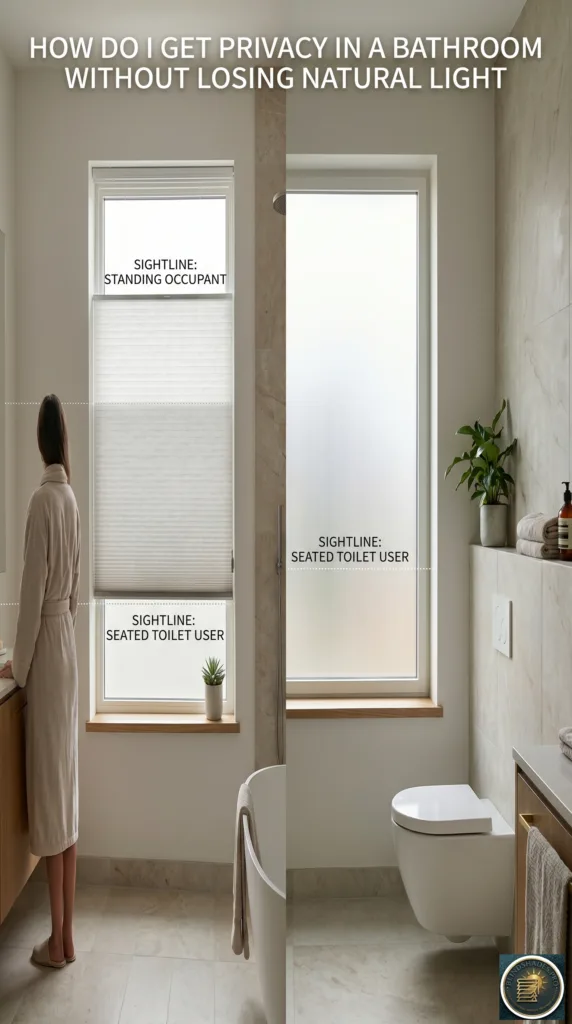
- TDBU Shade — Raise the Bottom, Not the Top: All guides say “lower the TDBU top for sky view.” In a bathroom, the correct operation is the opposite — raise the bottom to block the low-angle sightline to a seated toilet user (entering through the lower window), while leaving the upper window open for natural light. The living room TDBU configuration exposes toilet users in a bathroom
- Café Curtain — Height Calibration by Activity: Cover bottom 40–50% for seated toilet user · bottom 50–60% for bath privacy · insufficient for standing shower (full height needed). Café curtains provide zero nighttime privacy when bathroom lights are on — always layer with an opaque blind for nighttime use
- 7-Solution Cost-Performance Ranking: Frosted film $25–$80 (80–90% light, day+night) · Café curtain $20–$60 (daytime lower zone only) · TDBU cellular $80–$180 (adjustable, full control) · Frosted film + roller $80–$200 (permanent base + opaque on demand) · Obscure glass replacement $150–$400 (permanent, level 2–3 recommended) · Smart glass $1,200–$4,500 (switchable, premium)
- Best Sources: Frosted film → 3M Fasara (humidity-rated, professional grade) · TDBU cellular → SelectBlinds moisture-treated TDBU · Faux wood Venetian → Blindsgalore Faux Wood range
⚠️ The Four Mistakes That Cost People Natural Light and Privacy: (1) Installing full opaque coverage on a high window (sill above 66 inches) — you lose all light solving a privacy problem that doesn’t exist. (2) Installing a solar shade or mirror film for bathroom privacy without losing light — both fail completely at night when interior lighting (600–1,000 lux) exceeds street lighting (5–20 lux); see Can Solar Shades Be Used in a Bathroom for the full physics. (3) Using TDBU in the living-room configuration (lower top for sky view) in a bathroom — this leaves the lower window open, exposing a seated toilet user to direct sightline. (4) Hanging a café curtain at mid-window height without calculating whether that height actually blocks the sightline to the activity being protected — a mid-window café curtain covering 50% of the window height may still leave a toilet user fully visible if the window sill is low. See the full sightline height table below.
💡 Frosted Film Light Quality Bonus — and the Obscure Glass Opacity Level Guide: Frosted film doesn’t just maintain bathroom privacy without losing light — it improves bathroom light quality for specific activities. Frosted film converts harsh directional sunlight into diffuse light: better for makeup vanity (eliminates face shadows), glare-free for bath relaxation, and spa-like ambiance for morning showers. If permanent glass replacement is preferred over film, obscure glass comes in opacity levels 1 (slight rain pattern, shapes visible, 95%+ light) through 5 (deep reeded, fully private, 50–65% light). For most bathrooms: level 2–3 provides adequate privacy at 75–90% light transmission. For a ground-floor bathroom on a busy street — level 4 (stippolyte, 65–75% light) is appropriate. Film is removable and costs $25–$80; glass replacement is permanent and costs $150–$400 installed. For the full TDBU shade bathroom configuration guide, see the dedicated article. See the full 7-solution cost table below.
📖 Read the complete guide below for: the sightline height table (sill height vs seated toilet vs standing occupant risk), the frosted film light transmission data by type (80–90% vs 60–75%), why frosted film works at night when solar shades fail, the bathroom-specific TDBU configuration for toilet vs shower vs vanity activities, the café curtain height calibration formula, the obscure glass opacity levels 1–5, the 7-solution cost-performance comparison table, and the four common mistakes that cost natural light unnecessarily.
Step Zero — Measure Your Window Before Buying Anything
The sill height determines the risk level. This is the calculation no competitor guide makes, and it is the most important factor in the entire bathroom privacy decision.
Window sill height and privacy risk:
| Sill Height From Floor | Standing Occupant | Seated Toilet User | Risk Level |
|---|---|---|---|
| Above 64–66 inches | ✅ Not visible at all | ✅ Not visible | Inherent privacy — no treatment needed |
| 48–64 inches | Partially visible at distance | ✅ Not visible | Low risk — light treatment adequate |
| 36–48 inches | Visible at close range | ⚠️ Visible at street level | Moderate risk — TDBU or film required |
| Below 36 inches | Fully visible from street | ❌ Fully exposed | High risk — full coverage required |
The geometry: A standing observer at street level has eye height of approximately 60–66 inches. For the observer to see into a bathroom through a window with a sill above 65 inches, they would need to be standing on an elevated surface or looking downward from above — which is rarely the case from a public pavement. For windows above 65 inches sill height — natural privacy exists regardless of treatment, and any solution you install is for aesthetic comfort rather than functional privacy.
The seated toilet user specific risk: A person seated on a standard toilet is at approximately 35–40 inches height. A window with a 48-inch sill exposes someone at this height to any observer at street level from up to 30–40 feet away. This is the most common overlooked bathroom privacy risk — the window that appears high enough for standing privacy is low enough to expose a seated occupant.
How to Get Bathroom Privacy Without Losing Light — The Complete Solution Guide
Once the sightline risk is quantified, select the solution tier that matches the risk level.
Solution Tier 1 — Frosted Window Film (Best for Day and Night Privacy Without Any Light Loss)
Definition: Frosted window film is a self-adhesive polyester film applied to the interior glass surface that scatters transmitted light, creating a translucent surface through which shapes and colours are diffused but individuals cannot be identified.
Light transmission data:
- Clear glass: 100% light transmission (reference)
- Standard frosted film: 80–90% light transmission
- Patterned or decorative privacy film: 70–85% light transmission
- Heavy frosted film: 60–75% light transmission
For a north-facing bathroom window: A north-facing window receives only diffuse skylight — every lumen is valuable. A standard frosted film at 80–90% transmission loses 10–20% of already-limited light. In a windowless-feeling north bathroom, this matters. Specify the highest-transmission frosted film available (80–90%), not heavy-density frosted.
For a south-facing bathroom window: A south-facing window receives abundant direct sun — often too much. At 80% transmission, frosted film still delivers more usable light than the bathroom needs. The light loss is negligible.
The night privacy advantage over blinds: Frosted film provides privacy at night without requiring the occupant to remember to lower a blind before switching on the bathroom light. Solar shades, mirror films, and sheer curtains all fail at night when interior light exceeds exterior light. Frosted film works at night because it diffuses light in both directions — an observer outside cannot resolve a clear image through frosted film regardless of which side is brighter. See Can Solar Shades Be Used in a Bathroom — The Night Privacy Problem for the complete explanation of why night luminance reversal disqualifies most “privacy” films.
The frosted film light quality improvement: Frosted film converts harsh directional sunlight into diffuse light — a genuine quality improvement for several bathroom activities:
- Makeup vanity application: diffuse light eliminates face shadows that direct sun creates, making colour accuracy better
- Relaxing in the bath: diffuse spa-like glow vs harsh glare patches from direct sun
- Morning shower: pleasant diffuse light vs blinding sunrise beam through clear glass
Where to order: Self-adhesive frosted window films are available from 3M (Fasara glass film — professional grade), Purlfrost (see the Purlfrost bathroom privacy guide for their range), and from most home improvement retailers. For a bathroom, specify a film rated for high-humidity environments — standard office films degrade in sustained moisture.
Solution Tier 2 — TDBU Cellular Shade (Best Adjustable Privacy + Light Control)
Definition: A TDBU (top-down bottom-up) cellular shade is a honeycomb fabric shade that can be operated from both the top and the bottom simultaneously, allowing the occupant to open the upper portion for light while keeping the lower portion closed, or vice versa.
The bathroom-specific configuration guide (which no competitor explains):
All guides say “TDBU allows you to lower the top for sky view while keeping the bottom closed for sightline privacy.” This is the correct configuration for a living room where the sightline to a seated sofa user enters through the lower portion of the window.
In a bathroom, the correct configuration depends on the activity:
For toilet privacy: The sightline to a person seated on a standard toilet (35–40 inch occupant height) enters through the lower portion of the window — especially for windows with a sill at 36–48 inches. The correct TDBU configuration is to raise the bottom portion of the shade to cover the lower window, blocking this low-angle sightline, while leaving the upper portion of the window open for natural light entry from above.
For shower privacy: The sightline to a standing shower occupant (60–66 inch height, shower typically set back 3–6 feet from window) enters the window at a nearly horizontal angle through the middle portion. The correct TDBU configuration for shower privacy is to keep the middle portion of the window covered — using both the upper and lower operation to leave only the very top open for light.
For vanity mirror privacy: A person standing at a vanity is at approximately 60–66 inches — visible through the upper to middle portion of the window. For ground-floor vanity windows, close the upper portion while leaving the lower portion open, providing light from below-eye-level while blocking the upper sightline zone.
This is the most important TDBU operational insight for bathroom use — and it is completely absent from every competitor guide.
For a full explanation of TDBU mechanics, see What Are Top-Down Bottom-Up Shades — Are They Good for a Bathroom.
Solution Tier 3 — Café Curtains at Calibrated Height (Budget Privacy for Daytime Use)
Definition: A café curtain is a curtain panel covering only the lower portion of a window, typically mounted on a tension rod at mid-window height.
The height calibration guide: Café curtains are effective only when mounted at the correct height to block the specific sightline they are protecting. Most guides show café curtains at approximately mid-window without explaining why that height matters.
The correct café curtain mounting height by bathroom activity:
| Activity Being Protected | Sightline Height | Café Curtain Should Cover | Mount Rod Position |
|---|---|---|---|
| Seated toilet user (35–40 inch height) | Lower window | Bottom 40–50% of window | Top of lower 40–50% of window height |
| Person in bath (20–30 inch height) | Lower window | Bottom 50–60% of window | Top of lower 50–60% of window height |
| Standing shower occupant (60–66 inch height) | Full window | Insufficient — full coverage needed | N/A — use roller or TDBU shade instead |
| Standing at vanity (60–66 inch height) | Upper window | Upper coverage — inverted curtain position | N/A — use blind with adjustable slats |
The key limitation: Café curtains provide no nighttime privacy when bathroom lights are on — the thin fabric allows interior light to silhouette the occupant against the lit background. For nighttime privacy, layer an opaque blind above or behind the café curtain.
Solution Tier 4 — Obscure Glass Replacement (Permanent Solution for New Builds and Renovations)
Definition: Obscure glass is glass that has been modified during manufacturing — by acid etching, sandblasting, or surface texturing — to diffuse transmitted light and prevent clear sightlines through the glass.
Obscure glass opacity levels: Obscure glass is manufactured in opacity levels from 1 to 5 (or equivalent grading systems depending on manufacturer):
| Level | Description | Privacy | Light Transmission |
|---|---|---|---|
| Level 1 | Slight texture (rain pattern) | Shapes and outlines visible | 95%+ |
| Level 2 | Moderate texture (satin, granite) | Blurred figures visible | 85–90% |
| Level 3 | Heavy texture (bark, flemish) | Shapes barely discernible | 75–85% |
| Level 4 | Very heavy texture (stippolyte) | No individual visible | 65–75% |
| Level 5 | Opaque (cast glass, deep reeded) | Fully private, directional light only | 50–65% |
For most bathrooms: Level 2–3 provides adequate privacy with good light transmission. Level 4 is appropriate for ground-floor windows at high pedestrian-traffic locations.
Permanent vs removable comparison:
| Solution | Cost | Permanence | Privacy (Day) | Privacy (Night) | Light |
|---|---|---|---|---|---|
| Frosted window film | $25–$80 DIY | Removable | ✅ Excellent | ✅ Excellent | 80–90% |
| Obscure glass Level 2–3 | $150–$400 installed | Permanent | ✅ Excellent | ✅ Excellent | 75–90% |
| Smart / switchable glass | $200–$500/sq ft | Permanent | ✅ Excellent | ✅ Excellent | 90% clear |
For homeowners who plan to stay in the property long-term — obscure glass replacement is the highest-quality permanent solution. For renters or those wanting flexibility — frosted film is functionally equivalent at a fraction of the cost.
Solution Tier 5 — Smart Glass / Switchable Glass (Premium Control)
Definition: Smart glass (also called switchable glass or PDLC glass) is a glass unit containing a liquid crystal layer that transitions from opaque to clear when an electrical charge is applied.
Smart glass provides full control: clear when privacy is not needed (maximising natural light entry), opaque on demand. Unlike frosted film, smart glass does not reduce light transmission in its clear state. Unlike blinds, it requires no physical operation and leaves no gap for light entry at edges.
Cost reality: $200–$500 per square foot installed (a standard 24×36 inch bathroom window = approximately $1,200–$4,500). Smart glass is a renovation-budget item, not a blind replacement. For the full comparison of smart film options for bathroom glass partitions, see Can Solar Shades Be Used in a Bathroom — The Night Privacy Problem which covers the PDLC film alternative at lower cost.
The Cost-Performance Comparison — What Nobody Gives You
| Solution | Cost Range | Day Privacy | Night Privacy | Light % | Adjustable |
|---|---|---|---|---|---|
| Frosted film DIY | $25–$80 | ✅ Excellent | ✅ Excellent | 80–90% | ❌ Permanent |
| Café curtain (bottom 50%) | $20–$60 | ✅ Lower zone only | ❌ None | 70%+ | ✅ Limited |
| TDBU cellular shade | $80–$180 | ✅ Excellent | ✅ Good | Variable | ✅ Full |
| Faux wood Venetian | $50–$120 | ✅ When closed | ✅ When closed | Variable | ✅ Full |
| Frosted film + roller shade | $80–$200 | ✅ Excellent | ✅ Excellent | 80–90% when open | ✅ Shade only |
| Obscure glass replacement | $150–$400 | ✅ Excellent | ✅ Excellent | 75–90% | ❌ Permanent |
| Smart glass | $1,200–$4,500 | ✅ Excellent | ✅ Excellent | 90% clear | ✅ Full |
The highest value specification for most bathrooms: Frosted window film ($25–$80) provides day and night privacy, 80–90% light transmission, and no nighttime blind-lowering requirement — at a fraction of the cost of any adjustable window treatment. If adjustability is also needed (for full blackout on demand), layer a PVC vinyl roller shade above the frosted film. This combination provides permanent baseline privacy plus on-demand full coverage.
Related guides: diffused light with daytime privacy is exactly what vane shades were built for — see the sheer shades guide.
The Four Common Mistakes — How People Lose Light Unnecessarily
Mistake 1 — Specifying full coverage for a high window: Installing a full opaque roller shade on a window with a sill above 64 inches provides no meaningful privacy benefit (the standing occupant is not visible anyway) while blocking all natural light when the shade is lowered. A TDBU shade or frosted film provides equivalent functional privacy with significantly better light management.
Mistake 2 — Installing a solar shade and discovering the night problem: Solar shades appear to solve the bathroom privacy and light problem — until 9pm with lights on. The luminance reversal (interior brighter than exterior) makes the occupant completely visible from outside. See Can Solar Shades Be Used in a Bathroom for the physics and the layered solutions that address this.
Mistake 3 — Using mirror film (one-way vision film) as a standalone solution: Mirror film has the same night failure as solar shades — the reflective effect reverses at night when interior light exceeds exterior. Multiple Purlfrost forum users report silhouettes visible through mirror film at night. For a bathroom — mirror film requires a secondary night privacy layer to be effective.
Mistake 4 — Not calibrating the TDBU shade position for the specific sightline: Installing a TDBU shade and leaving the bottom open “for light” while lowering the top “for sky view” — the living room configuration — can expose a seated toilet user to direct sightline through the lower window. In a bathroom, the correct TDBU configuration is the reverse of living room guidance: raise the bottom to block the sightline from below, leave the top open for light.
Related guides: privacy is one of three gates — our bathroom buying guide adds the steam-zone map and the mounting playbook.
Where to Order — By Solution Type
For frosted window film: 3M Fasara glass film — 3m.com/window-film-us — professional grade, high humidity rating. Purlfrost self-adhesive frosted film — full range of opacity levels. Home Depot or Lowe’s frosted contact paper for budget applications.
For TDBU cellular shade: SelectBlinds TDBU Cellular Shade — selectblinds.com — moisture-treated polyester, multiple cell options. Blindsgalore TDBU Cordless Cellular Shade — good mid-range option with Zone 3 moisture resistance.
For faux wood adjustable Venetian: Blindsgalore Faux Wood Venetian Blind — slat angle control for sightline management. SelectBlinds Premium Faux Wood — routeless option for full privacy when closed.
Frequently Asked Questions
How do I get privacy in a bathroom without losing natural light? The most effective approach for bathroom privacy without losing light is frosted window film: it transmits 80 to 90 percent of natural light while permanently eliminating clear sightlines from both daytime and nighttime observers without requiring the occupant to operate any covering. For adjustable control, a TDBU cellular shade allows opening the upper window for sky light while keeping the lower portion closed to block sightlines. The correct TDBU bathroom configuration is raising the bottom portion (not lowering the top) to block the low-angle sightline to a seated toilet user, while leaving the upper window open for natural light entry from above.
What is the best bathroom window treatment for both daytime and nighttime privacy? Frosted window film provides the most reliable combined daytime and nighttime bathroom privacy without losing natural light. Unlike solar shades, mirror films, and sheer curtains, frosted film scatters light in both directions regardless of which side is brighter — it does not fail at night when bathroom interior lighting exceeds exterior street lighting. A TDBU opaque cellular shade also provides day and night privacy when correctly configured, but requires the occupant to lower the shade before switching on the bathroom light.
What is the cheapest way to get bathroom privacy without losing light? Self-adhesive frosted window film at $25 to $80 for a standard bathroom window is the most cost-effective bathroom privacy solution that does not reduce natural light. It is a DIY application taking approximately 20 to 30 minutes per window, provides both daytime and nighttime privacy (unlike solar shades that fail at night), and transmits 80 to 90 percent of natural light. For comparison, a TDBU cellular shade costs $80 to $180 and a smart glass replacement costs $1,200 to $4,500 for a standard bathroom window.
How high should a café curtain be hung in a bathroom? A café curtain should be mounted at the height that blocks the specific sightline being protected. For toilet privacy (occupant at 35 to 40 inch seated height) — hang the café curtain rod at a height that covers the bottom 40 to 50 percent of the window. For bath privacy (occupant at 20 to 30 inch reclining height) — cover the bottom 50 to 60 percent. Café curtains provide no nighttime privacy when bathroom lights are on and are insufficient for standing shower occupant privacy.
Does frosted window film reduce the natural light in a bathroom? Standard frosted window film transmits approximately 80 to 90 percent of the natural light that passes through clear glass — a reduction of only 10 to 20 percent. For a south-facing bathroom window with abundant light, this reduction is negligible. For a north-facing bathroom window where every lumen matters, specify the highest-transmission frosted film available (80 to 90 percent transmittance rating) rather than heavy-density frosted options at 60 to 75 percent transmittance.
Contextual Internal Links — Used in Article Body
| Anchor Text | Links To | Location in Article |
|---|---|---|
| Can Solar Shades Be Used in a Bathroom — The Night Privacy Problem | /guide/solar-shades-bathroom-privacy/ | Frosted film section + Mistake #2 |
| What Are Top-Down Bottom-Up Shades — Are They Good for a Bathroom | /guide/top-down-bottom-up-shades-bathroom/ | TDBU section |
| Can Solar Shades Be Used in a Bathroom (PDLC comparison) | /guide/solar-shades-bathroom-privacy/ | Smart glass section |
Related Guides on BlindShades.pro
- The Best Bathroom Window Blinds & Shades Buying Guide
- What Are the Best Blinds for a Bathroom Window — Privacy and Moisture Guide
- Can Solar Shades Be Used in a Bathroom — The Night Privacy Problem
- What Are Top-Down Bottom-Up Shades — Are They Good for a Bathroom
- What Are the Best Blinds for a Window Inside a Shower
By Michael Turner | 30 Years Home Improvement Expertise | Updated 2026 | BlindShades.pro
