Solar Shades for Bathroom Privacy: What Works in Wet Rooms

Authored By Michael Turner -30 Years Home Improvement Expertise | Updated 2026 | BlindShades.pro
Updated on July 23, 2026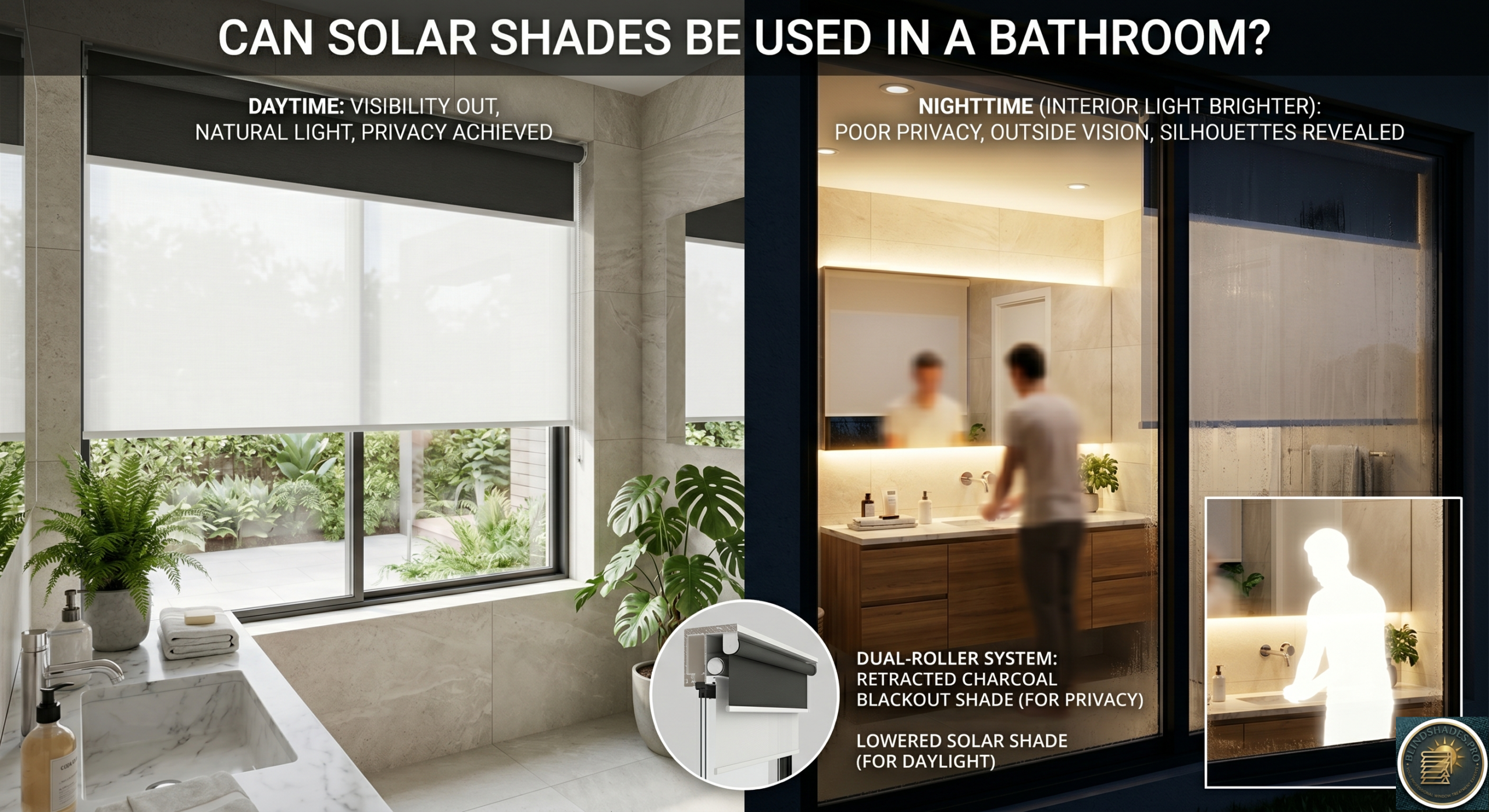
By Michael Turner — 30 years in window treatments
Solar shades for bathroom privacy work in exactly three situations — and fail in every other one. That conditional is the answer the field refuses to give: half the industry says “never” (right about night, silent about the exceptions), and the other half sells “1–3% for the most privacy” without mentioning that a lit bathroom broadcasts silhouettes through every weave made. Both halves miss the two facts that decide a wet room: no mesh survives the sightline test alone after dark — and no fabric in the category survives steam better. This guide gives the two-test rule, the three exceptions, the paired recipes the community already proved, and the verdict matrix for every bathroom type.
Key Takeaways
- The night verdict is unanimous among honest sources. Hunter Douglas’s own record concedes the privacy is daytime-only, and even dense 1% and 3% fabrics fail to obscure shapes under artificial lighting; Elevated Views (July 22, 2025) states it flat — they do not recommend installing solar shades in your bathroom.
- The community’s warning is a year old and still circulating. The 190-plus-comment record that begins “solar shades NEVER offer privacy” exists because buyers were sold the daytime effect without the night reversal — the expectations failure our disadvantages research names the category’s top callback.
- But “never” overshoots. Three bathroom situations pass the sightline test with solar alone — obscured glass already in the frame, upper-floor windows without sightlines, and daytime-only powder rooms — and the field’s binary answers serve none of them.
- The pro-solar bathroom argument nobody makes: steam. PVC-coated polyester and fiberglass mesh shrug at humidity that warps wood and corrodes cheap hardware — solar fabric is among the most bathroom-proof materials in the category; it is the privacy, not the moisture, that needs a partner.
- The community already wrote the pairings. A 26-vote answer says bottom-up coverage; a 24-vote answer says frosted film that lets you see out; the dual-shade fix appears in the same threads — this page compiles all three into complete recipes.
⭐ Quick Answer — Solar Shades for Bathroom Privacy
Solar shades for bathroom privacy pass in exactly three situations — and need a partner everywhere else. The two-test rule decides it: sightline and steam.
- The sightline verdict is on the record: even dense 1–3% weaves fail to obscure shapes under artificial light — Hunter Douglas concedes the privacy is daytime-only, and Elevated Views flatly advises against solo mesh in bathrooms.
- The three exceptions where solar alone works: frosted or obscured glass already in the frame, upper-floor windows with no sightlines, and daytime-only powder rooms.
- Everywhere else, run a recipe: frosted film under the mesh (see out by day, private always), bottom-up coverage per the community’s top-voted fix, or a dual shade with a waterproof blackout layer — the blackout guide ranks that partner.
- The argument nobody makes: PVC-coated mesh is the most steam-proof fabric in the category — it fails the privacy test and wins the humidity test, which is why every recipe keeps it; Blindsgalore’s entire bathroom collection is built on that moisture logic.
- The night physics in full: our privacy guide covers the reversal and the dusk window — and the verified mesh picks live in the complete solar shades guide.
Do Solar Shades Work for Bathroom Privacy?
The Two-Test Rule (Sightline · Steam): a bathroom treatment must pass two tests — what outsiders can see after dark, and what daily humidity does to the material. Solar mesh aces the steam test and fails the sightline test alone. That split verdict is the whole subject.
| The test | How solar mesh scores | The record |
|---|---|---|
| Sightline — daytime | Passes: brightness outside makes the mesh read opaque from the street | Hunter Douglas’s day-privacy description — see out, others cannot see in |
| Sightline — night, lights on | Fails at every openness — silhouettes and figures visible through 1% and 3% alike | The shapes-under-artificial-lighting concession + the 190-comment “NEVER” record |
| Sightline — side gaps | Inside mounts leak at the edges | Bringnox (July 19, 2026) flags the narrow-side-gap problem on inside-mounted rollers |
| Steam & humidity | Passes better than anything — engineered PVC-coated polyester and fiberglass resist moisture that warps wood and rusts cheap mechanisms | The materials case detailed below |
| UV, glare, daylight | Passes — the mesh’s ordinary talents work identically over a tub | The category’s standing record |
Read the ledger and the field’s contradiction resolves: the “never” camp — Elevated Views’ flat non-recommendation, the community record — is right about the night rows and silent about the rest, while sellers still promising that a tighter weave “offers the most privacy” are describing the daytime row and letting buyers assume it survives sunset; the fuller claims in circulation deserve the scrutiny they get in the openness FAQ below. Neither camp answers the real question a bathroom owner is asking — is my bathroom one of the exceptions? Three are.
When Do Solar Shades Alone Work in a Bathroom?
| The exception | Why solar alone passes | The disqualifier |
|---|---|---|
| Obscured or frosted glass already in the frame | The glass carries the privacy at all hours; the mesh adds glare, UV, and daylight control on top | Clear glass anywhere in the window voids it |
| Upper-floor bath with no sightlines | No vantage point exists — a second-story window facing open sky or a blank wall has nothing to fail against | A neighboring second story, a hill, a street with any angle in |
| Daytime-only powder room | Half-baths used with daylight ride the mesh’s strongest hours; lamps-on moments are brief and low-stakes | Any room where showering or dressing happens after dark |
Honest scoring: those three cover a minority of bathrooms — the street-facing full bath that sent 190 commenters to the forums fails on sight. If your room fails all three rows, solar shades for bathroom privacy are the wrong solo answer at any openness — the 1% hope is adjudicated in our night privacy guide, and the verdict is obscurity, not privacy. But failing the solo test does not evict the mesh; it assigns it a partner.
What Should You Pair With Solar Shades in a Wet Room?
The community’s scattered fixes, compiled into three complete recipes:
| Recipe | The parts | Privacy result | Daylight kept |
|---|---|---|---|
| Solar over frosted film (the 24-vote fix, formalized) | Adhesive frosted or one-way film on the lower glass + solar mesh on the frame | Around-the-clock — film scatters inbound sightlines day and night | Excellent — film passes light; mesh manages glare above it |
| Bottom-up coverage (the 26-vote fix) | Top-down/bottom-up cellular — moisture-rated, cordless — or a TDBU-configured shade; glass covered where bodies are, open above | Strong at all hours on the covered zone | Excellent — the top stays open; the cellular guide has moisture-rated picks |
| Dual shade: solar + waterproof blackout (the dual-systems fix from the 190-comment record) | One headrail or two brackets: mesh for the day shift, a wipe-clean blackout layer for lights-on hours — the blackout guide ranks the roller half | Total when the second layer drops | Full by day, zero when sealed |
Renters get a fourth path: no-drill waterproof cellular units exist as a product class, and the no-damage routes — tension mounts, adhesive film that peels clean — are covered in the temporary blinds guide. Whichever recipe fits, note what every one of them keeps: the solar layer. That is not sentiment — it is materials.
Which Materials Survive Bathroom Humidity?
This is the pro-solar bathroom argument nobody in the field makes: the mesh that fails the privacy test is simultaneously the most steam-proof fabric in the category. Solar shades are woven from PVC-coated polyester or fiberglass — vinyl-family engineering built for years of direct sun, which shrugs at shower humidity, wipes clean, and neither warps, swells, nor mildews. The contrast cases are the bathroom’s usual casualties: real wood warps and clouds, fabric romans hold moisture and grow musty, cheap mechanisms corrode over the tub. The industry’s own merchandising agrees — an entire bathroom-treatments category exists around handling humidity and steam, anchored by vinyl-family products. So when a “vinyl solar shade” listing appears, read it correctly: PVC-coated mesh is the vinyl family’s weave, and its wet-room durability is genuine. The honest bathroom ranking: solar mesh and vinyl-family products for moisture, faux-wood for the louvered look, moisture-rated cellular for the TDBU recipe — with privacy decided separately by the two-test rule, never by the fabric. Which is exactly how the community reasons when you read their votes in order.
What Does the Community Actually Recommend?
The vote ladder is the field’s best document. In a 90-plus-comment thread on preserving bathroom light and view, the top answer at 26 votes is a bottom-up blind — coverage where it counts, daylight above; second at 24 votes is window film that lets you see out while outsiders cannot see in; third at 22 votes is the pragmatist’s shrug — dress in the adjoining room. A 560-plus-comment thread runs the same conversation at scale, and a five-year-old thread asking whether 1% openness gives privacy fields the same answer our research reached: after dark, no. And the 190-plus-comment record — the one that begins “solar shades NEVER offer privacy” — reads, a year on, less like a product review than a complaint about selling: people love that they can see out during the day, the thread notes, but they are never told the reverse is true at night. Every recipe above is that thread’s advice formalized: the dual systems its commenters suggested, the frosted film its veterans recommended, the honest caveat its buyers never got. The community did not conclude “no shades in bathrooms” — it concluded no unpartnered mesh in lit bathrooms, which is precisely the two-test verdict. One variant question remains before the matrix.
Indoor or Outdoor Solar Shades for a Bathroom?
Indoor — the outdoor variants belong to a different job. Exterior solar screens intercept heat before the glass and serve patios and hot walls; they mount outside, weather with the seasons, and do nothing for a bathroom’s actual problems — interior sightlines and interior steam. A bathroom’s mesh hangs inside, with the privacy carried by the recipe, not the mounting side. The interior-versus-exterior family split is its own subject with its own math, covered where it belongs rather than compressed here. For the wet room the answer is one word, and the matrix finishes the job:
| Your bathroom | The verdict | The spec |
|---|---|---|
| Street-facing full bath | Recipe 1 or 3 — never solo mesh | Frosted film + 3–5% mesh, or dual solar/waterproof blackout |
| Upper-floor bath, no sightlines | Solar alone passes | 5% for daylight; dark fabric if glare bites |
| Powder room, daytime use | Solar alone passes | 5% light fabric — brightness is the brief |
| Family bath, evening showers | Recipe 2 or 3 | TDBU moisture-rated cellular, or the dual shade |
| Kids’ bath | Recipe 2, cordless mandatory | Cordless TDBU — safety and privacy in one spec |
| Rental | Recipe 1 or 4, no drilling | Peel-clean film + tension-mounted mesh, or no-drill waterproof cellular |
Who Should Buy Solar Shades for a Bathroom?
✔ Buy solar for the bathroom if: your window passes an exception row (obscured glass, no sightlines, daytime-only use), or you are building one of the recipes and want the most steam-proof day layer money buys — glare control, UV protection, and daylight over the tub with fabric that outlasts every natural material in the room. ✖ Do not buy solar alone if: the room is lit after dark with any outside vantage — no openness percentage changes the verdict, and a seller promising otherwise is selling the daytime effect; the full limits ledger, bathroom row included, is in the disadvantages guide. Undecided on the whole-house plan? The percentage logic for every other room runs through the living-room verdict and the openness ladder.
Avoid These Mistakes
- Buying “1% for bathroom privacy.” The tightest weave still silhouettes a lit room — the five-year forum record and the industry’s own concessions agree; 1% buys dimness, not decency.
- Trusting a “provides privacy” product line without the night caveat. Ask the seller one question — what happens at lights-on? — and watch the claim narrow to daytime.
- Inside-mounting for looks in a privacy-critical bath. The side-gap leak is on the record; outside-mount generously or let the film carry the edges.
- Solving moisture and privacy with one cheap product. Wood warps, fabric mildews, and bargain mechanisms corrode — the wet room punishes single-purchase thinking; run the two tests separately.
- Skipping cordless in a kids’ bath. The TDBU recipe exists in cordless, moisture-rated form — there is no reason to hang a cord over a bathtub.
- Removing the mesh because it failed the privacy test. It never failed the steam test — demote it to day shift, add the partner, and keep the most durable layer in the room.
The Bottom Line
Solar shades for bathroom privacy: alone, only in the three exceptions — obscured glass, sightline-free floors, daytime powder rooms. Everywhere else, run a recipe: frosted film under mesh for see-out-by-day and privacy always, bottom-up coverage for daylight over modesty, or the dual shade for total control — and in every version, the mesh stays, because nothing else in the category shrugs at steam the way PVC-coated fabric does. The privacy is conditional; the durability is not. The night physics lives in our privacy guide, the partner layers in the blackout guide, and the verified mesh picks across every openness in the complete solar shades guide.
FAQ
Can people see into a bathroom through solar shades at night? Yes — at every openness, a lit bathroom shows silhouettes and movement to anyone outside, because the daytime privacy effect is a brightness trick that reverses at lamps-on. Tighter weaves blur detail; none restore decency. The full physics, the dusk crossover, and the fixes live in our night privacy guide.
Is 1% openness enough for bathroom privacy? No — even the densest 1% and 3% fabrics fail to obscure shapes under artificial lighting, on the industry’s own record, and the community reached the same verdict years ago. Claims that a tighter weave “offers the most privacy” describe the daytime effect only; after dark, privacy comes from the recipes, not the percentage.
Are vinyl solar shades better for bathrooms? They are the same family — solar mesh is PVC-coated polyester or fiberglass, which is exactly the vinyl-class engineering a wet room wants: steam-proof, wipe-clean, warp-free. The moisture verdict is genuinely excellent; the privacy verdict is unchanged. Buy the fabric for the steam test and solve sightlines with a pairing.
What is the best window treatment for bathroom privacy overall? Frosted glass or film, by the community’s own votes — it blocks sightlines day and night while passing light — with top-down/bottom-up moisture-rated cellular close behind for coverage-plus-daylight. Solar mesh joins either as the day layer for glare, UV, and durability; alone, it wins only the exception bathrooms.
Do solar shades get damaged by shower steam? No — this is the mesh’s quiet bathroom superpower. Engineered PVC-coated polyester and fiberglass resist humidity that warps real wood, mildews fabric shades, and corrodes cheap mechanisms; splashes wipe clean. Choose a quality lift mechanism and the fabric will outlast every natural material hanging in the room.
Should bathroom solar shades be indoor or outdoor? Indoor — exterior solar screens are a different product family built to intercept heat before the glass on patios and hot walls, and they do nothing for a bathroom’s interior sightlines or steam. Hang interior mesh, mounted generously, and let the pairing recipe carry the privacy at night.
Related Guides
- Best Solar Shades — the complete guide
- Can You See Through Solar Shades at Night?
- What Are the Disadvantages of Solar Shades?
- Best Blackout Blinds & Shades
- Best Cellular & Honeycomb Shades
- What Percentage Solar Shade for a Living Room?
