How Do You Clean Greasy Kitchen Blinds?

Authored By Michael Turner -30 Years Home Improvement Expertise | Updated 2026 | BlindShades.pro
Updated on May 25, 2026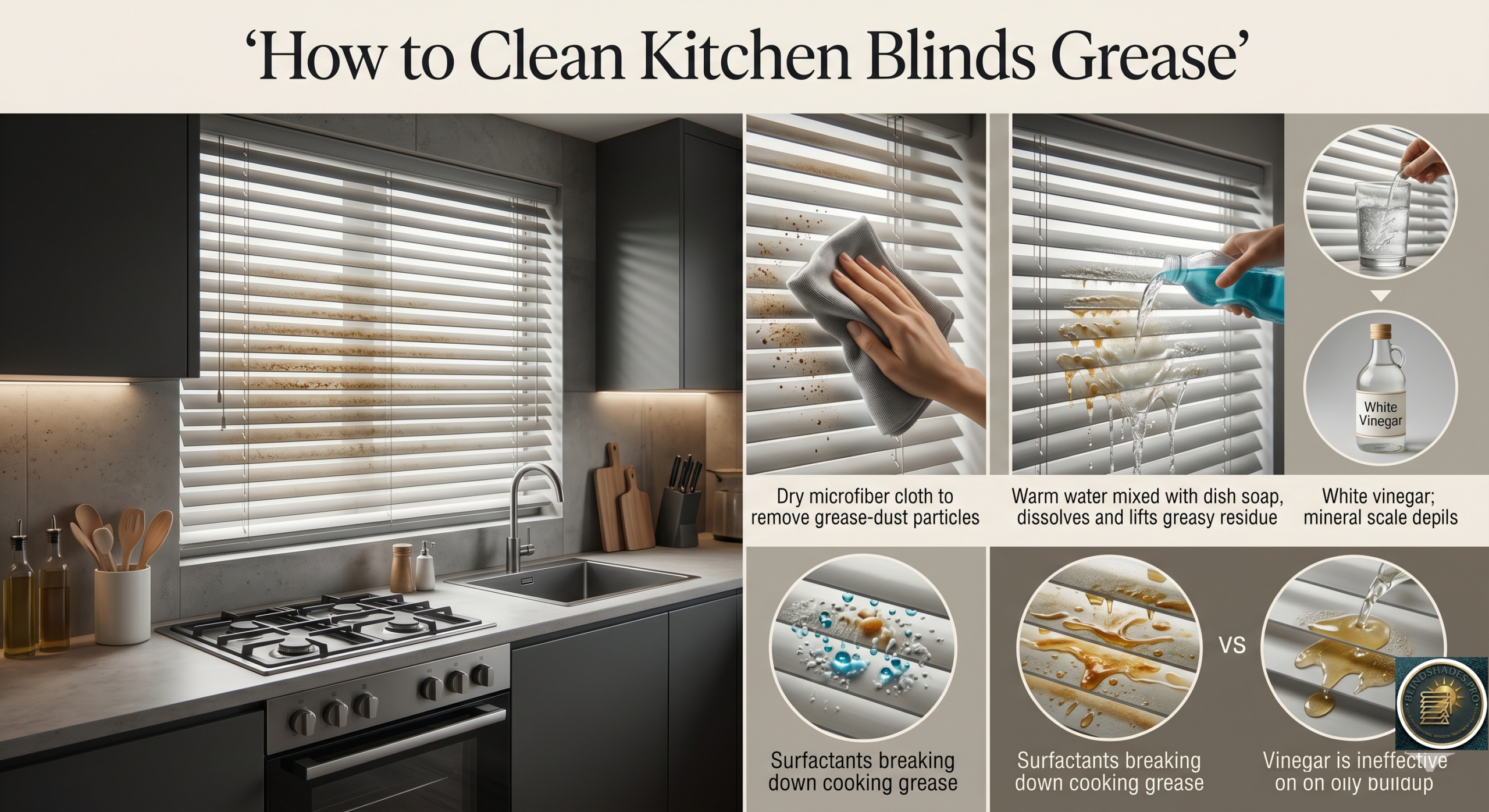
⭐ Quick Answer — How Do You Clean Greasy Kitchen Blinds?
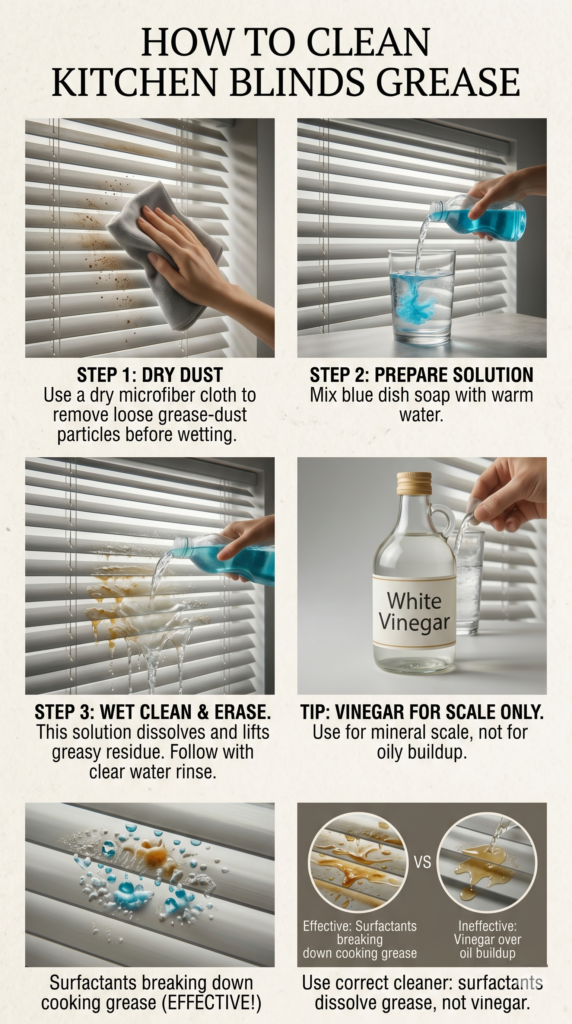
- The Two-Stage Protocol Every Guide Misses: The correct way to clean kitchen blinds grease is in two stages. Stage 1 — dry-remove first: wipe each slat with a clean dry microfibre cloth before applying any wet cleaner. Applying wet solution directly to an accumulated grease-dust matrix pushes the loose surface layer into slat micro-pores, creating a smeared residue worse than the original deposit. Stage 2 — wet clean: dish soap with warm water at 40–50°C, damp cloth (not wet), wipe each slat, follow with clean damp cloth, dry immediately
- Dish Soap — Not Vinegar: All 10 competitor guides recommend white vinegar as the primary degreaser for kitchen blinds grease. This is wrong. Vinegar (acetic acid, pH 2.5) dissolves calcium mineral deposits — it is NOT a degreaser and cannot emulsify non-polar cooking lipids. Dish soap contains surfactant molecules that surround and lift cooking grease off the slat surface. Vinegar is appropriate only as a secondary agent if mineral scale deposits are also present. Use dish soap as the primary agent
- Why 40–50°C Water Works Better: Cooking grease is semi-viscous at room temperature — dish soap surfactant struggles to penetrate the thick grease film. At 40–50°C (hot shower temperature), cooking grease becomes less viscous and the surfactant penetrates and emulsifies the grease significantly faster. Do not use water above 60°C for PVC faux wood — PVC composite begins softening at 60–70°C with sustained heat exposure
- The Pivot Cord Pinch-and-Slide Method: The ladder cord accumulates more grease than the slat faces because the braided texture absorbs cooking fat. Standard slat-wiping misses the cord entirely. Apply dish soap to a microfibre cloth, pinch the cord from both sides, and slide down the full length in one continuous pass. Do not wipe side-to-side — this contacts only one side of the braided cord. Repeat until the cloth no longer shows grease. Follow with a damp cloth pass, then dry
- Zone-Specific Cleaning Frequency: Zone K1 (sink window): wipe weekly + deep clean monthly. Zone K2 (stove-adjacent): wipe weekly + deep clean every 6–8 weeks. Zone K3 (nook/dining, 1.5m+ from cooking): wipe every 2–3 weeks + deep clean quarterly. Halve the frequency for light cooking households; double it for heavy daily cooking with frequent frying
- Best Sources: Step-by-step blind cleaning → COIT blind cleaning guide · Wood blind cleaning → Blindsgalore wood blind guide · Aluminium Venetian kitchen grease → Impress Blinds kitchen grease guide
⚠️ The Headrail Cleaning Nobody Does — and the pH Restriction for Aluminium Degreasers: The most neglected part of how to clean kitchen blinds grease is the headrail mechanism. In an active cooking kitchen, the tilt mechanism inside the headrail housing collects cooking grease internally, causing the tilt rod to stiffen and eventually seize within 2–3 years without maintenance. Fix: hold a compressed air can at the open ends of the headrail and blow out loose grease-dust accumulation (do this over a sink). Use cotton buds with dish soap on the accessible interior surfaces and tilt rod channel. For a stiff mechanism: apply a single drop of light machine oil (sewing machine oil or 3-in-1) to the tilt drum and cycle repeatedly. And the pH warning for aluminium slat blinds: highly alkaline degreasers (pH 10–12) gradually dissolve the anodised aluminium oxide layer. For aluminium kitchen blinds: dish soap (pH 7–8) or diluted Simple Green (pH 9–10 maximum). Never use oven cleaner or caustic-based products. For the full by-material cleaning protocol, see What Are the Best Blinds for Kitchen Windows. See the full headrail guide below.
💡 The Bathtub Soak — Kitchen-Specific Protocol for Aluminium and Faux Wood: For heavily greased aluminium or faux wood kitchen blinds, the bathtub soak is the most effective deep clean — but the standard guide protocol is wrong. Correct kitchen-specific protocol for how to clean kitchen blinds grease by soaking: (1) dry-wipe all slats first (Stage 1 — removes loose grease-dust so it does not contaminate the soak water immediately); (2) fill the bath with 40–50°C water and generous dish soap (not vinegar as primary); (3) lay the blind loosely flat — do not stack slats tightly (solution needs to circulate around each slat face); (4) soak 30–60 minutes (not 1–2 hours — extended soaking affects headrail components if not removed); (5) wipe each slat gently with a soft sponge while still in the water; (6) rinse thoroughly, lay on towels, wipe each slat dry before rehanging. For real wood blinds: never soak — use the nearly-dry microfibre protocol described in Can You Use Real Wood Blinds in a Kitchen. See the full bathtub soak protocol below.
📖 Read the complete guide below for: the two-stage dry-then-wet protocol with the grease-dust matrix mechanism explained, why vinegar cannot emulsify non-polar cooking lipids (dish soap is correct), why 40–50°C water improves surfactant penetration, the by-material protocols (PVC vinyl roller, baked enamel aluminium, faux wood, real wood), the pivot cord pinch-and-slide cleaning method, the headrail mechanism cleaning sequence (compressed air, cotton bud, machine oil), the zone-specific and activity-level cleaning frequency guide, and the pH restriction for commercial degreasers on aluminium blinds.
How to Clean Kitchen Blinds Grease – The Two-Stage Protocol
Definition: Kitchen blind grease is a combination of polymerised cooking lipids (fats and oils that have undergone partial polymerisation from heat exposure) and household dust, forming a sticky grease-dust matrix on blind surfaces that is harder to clean than either component alone.
The two-stage protocol addresses the grease-dust matrix structure:
Stage 1 – Dry removal of the loose surface layer: Before applying any wet cleaning solution, wipe the slat surface with a dry microfibre cloth to remove the loose top layer of the grease-dust matrix. This step is absent from all competitor cleaning guides but makes a significant difference. When wet cleaning solution is applied directly to a grease-dust matrix without this prior dry removal:
- The wet solution partially dissolves the grease component
- The released dust becomes suspended in the wet solution and is redeposited in the slat surface micro-pores
- The result is a smeared residue that can look worse than the original deposit
After dry-wiping, the remaining deposit is the base grease film directly on the slat surface – this is now cleanable with wet dish soap solution without the redeposition problem.
Stage 2 – Wet cleaning with dish soap (not vinegar) as primary agent: Apply warm water (40-50 degrees Celsius) with several drops of dish soap to a microfibre cloth. Wring the cloth until it is damp but not dripping. Wipe each slat in one direction from one end to the other. Follow with a clean damp cloth (plain warm water) to remove soap residue. Dry immediately with a dry cloth.
Why Dish Soap Is Correct and Vinegar Is Not – The Chemistry
This is the most important and most commonly misunderstood aspect of cleaning kitchen blind grease.
What vinegar actually does: White vinegar (acetic acid, approximately pH 2.5) is effective at:
- Dissolving calcium carbonate deposits from hard water (limescale)
- Killing bacteria and mold spores
- Removing alkaline mineral deposits
What vinegar cannot do: dissolve or emulsify cooking grease. Cooking grease is composed of non-polar polymerised lipid molecules. Acetic acid is a polar molecule. The fundamental chemistry principle “like dissolves like” means that a polar solvent (vinegar) cannot dissolve a non-polar substance (cooking grease). Applying vinegar to a greasy kitchen blind slat removes any mineral deposits on top of the grease layer and leaves the grease film completely intact.
What dish soap actually does: Dish soap contains surfactant molecules (detergent) that have two distinct functional ends: a hydrophilic (water-loving) head and a hydrophobic (water-fearing, oil-loving) tail. When dish soap contacts a greasy surface, the hydrophobic tails insert into the grease film and surround the grease molecules. The hydrophilic heads face outward toward the water. The surfactant molecules lift the grease off the surface and suspend it in the rinse water as an emulsion. This emulsification is the only mechanism that effectively removes kitchen cooking grease from blind slats.
The correct combined protocol for maximum effectiveness:
- Dish soap with warm water – primary agent for cooking grease removal
- White vinegar solution – secondary agent if mineral scale deposits are also present
- Never use vinegar alone as the primary kitchen blind cleaning agent
This contradicts the standard advice given in every competitor kitchen blind cleaning guide.
The Water Temperature Factor
All cleaning guides say “use warm water.” None explain why the temperature matters.
Cooking grease viscosity and temperature: Cooking grease is not a uniform substance – it is a mixture of saturated and unsaturated fatty acids that exist in a semi-solid to liquid state depending on temperature. At room temperature (20-22 degrees Celsius), kitchen blind grease deposits are in a semi-viscous state – the grease is thick and resistant to penetration by surfactant molecules.
At 40-50 degrees Celsius:
- The grease deposits become less viscous and more fluid
- The dish soap surfactant molecules penetrate the grease film more readily
- The emulsification process is significantly faster and more complete
- The warm water helps the surfactant rinse away the emulsified grease
The upper temperature limit: Water above 60 degrees Celsius is not appropriate for PVC faux wood or aluminium blinds for different reasons. PVC composite faux wood begins to soften at 60-70 degrees – cleaning with very hot water repeatedly can gradually affect the dimensional stability of the slat. Aluminium slats are unaffected by high temperature but very hot water increases the risk of burns to the operator.
Optimal cleaning water temperature: 40-50 degrees Celsius (hot to the hand but not uncomfortable – approximately the temperature of a hot shower).
The By-Material Cleaning Protocol
PVC Vinyl Roller Shades (Zone K1 and K2)
PVC vinyl has a single flat non-porous surface. Cooking grease deposits on the surface only and cannot penetrate the material. This is the easiest kitchen blind material to clean.
Routine weekly clean (2-5 minutes):
- Wipe with dry microfibre cloth (Stage 1 – remove loose surface layer)
- Apply dish soap solution (40-50 degrees Celsius water, several drops dish soap) to a damp microfibre cloth
- Wipe the full roller panel from top to bottom in one pass
- Follow with a clean damp cloth, then dry
Heavy accumulation clean (monthly): Remove the roller shade from its brackets. Lay flat on a clean surface or hang over a shower rail. Apply dish soap solution liberally with a sponge, working the sponge across the fabric surface. Rinse with a clean damp cloth (multiple passes). Allow to air dry completely before rehanging. Do not re-roll the shade until completely dry – moisture trapped inside the rolled shade promotes mould at the headrail.
Baked Enamel Aluminium Venetian Blinds (Zone K2)
Aluminium slats have a smooth metal surface with baked enamel coating. The grease deposits on the enamel surface and in the gap between slats. The ladder cord is the most heavily greased component.
Routine weekly clean:
- Close slats fully (flat position). Dry-wipe Stage 1 with a clean dry cloth
- Apply dish soap solution (pH 7-9 cleaners only – avoid highly alkaline degreasers that degrade the anodised surface)
- Wipe each slat individually, supporting it with the other hand to prevent bending
- Clean the ladder cord using the pinch-and-slide method (described below)
- Flip slats to reverse angle and repeat on back face
- Follow with clean damp cloth and dry
The pH restriction for aluminium: Highly alkaline commercial degreasers (pH 10-12) gradually dissolve the anodised aluminium oxide layer that protects the metal from corrosion. For aluminium kitchen blinds: dish soap (pH approximately 7-8) is safe. Diluted Simple Green (pH 9-10 when diluted) is acceptable for occasional heavy cleaning. Oven cleaner, caustic soda, and heavy-duty alkaline degreasers are not appropriate.
The bathtub soak for heavily greased aluminium blinds:
- Dry-wipe all slats (Stage 1)
- Remove from headrail brackets
- Fill bathtub with 40-50 degree water and generous dish soap (not vinegar primary)
- Lay the blind flat or lean it loosely – do not coil tightly (allows solution to reach all slat surfaces)
- Soak for 30-60 minutes (not 1-2 hours as some guides suggest – extended soaking can affect the headrail components if not removed)
- Gently wipe each slat with a soft sponge while still in the water
- Rinse thoroughly, lay on clean towels to dry, wipe each slat with a dry cloth
- Ensure completely dry before rehanging
Faux Wood PVC Composite Venetian Blinds (Zone K2 and K3)
Faux wood is PVC composite – moisture-resistant and safe for dish soap cleaning without the temperature restrictions of real wood. Cleaning approach is similar to aluminium but with no pH restriction concern (PVC is chemically resistant to most household cleaning agents).
The bathtub soak is the most efficient deep clean for heavily greased faux wood: Same protocol as aluminium above. No pH restriction – diluted commercial degreasers are safe. The routeless (cordless holes) faux wood specification eliminates the pivot hole accumulation problem.
For the full material comparison for kitchen blind selection, see What Are the Best Blinds for Kitchen Windows.
Real Wood Venetian Blinds (Zone K3 only)
As covered in Can You Use Real Wood Blinds in a Kitchen, real wood requires the nearly-dry protocol to avoid moisture swelling. Grease cleaning on real wood is the most challenging of all kitchen blind materials.
Real wood grease cleaning protocol:
- Dry-dust Stage 1 with a barely-damp microfibre cloth (dry, not wet – just to remove loose dust without any grease solvent)
- Apply 2-3 drops dish soap to a new clean microfibre cloth, dampen with warm water, wring completely until barely damp
- Wipe each slat immediately dry with a completely dry cloth
- Never allow any residual moisture to remain on the slat surface
- Never use vinegar on real wood (degrades lacquer over time)
- Never use commercial degreasers or solvents (strip lacquer)
The Pivot Cord Cleaning Method – The Most Neglected Step
The ladder cord that passes through each slat pivot hole accumulates more cooking grease than the slat faces because it is a porous braided material (unlike the smooth slat surfaces that shed grease more readily).
Why the standard slat-wiping approach misses the cords: Standard blind cleaning focuses on wiping the visible slat face. The ladder cord runs vertically along the back of the blind, hanging between each slat. Most homeowners clean the slat faces without ever addressing the cord – which becomes progressively stickier and darker with grease until the tilt mechanism becomes difficult to operate.
The pinch-and-slide cord cleaning method:
- Apply dish soap solution to a microfibre cloth or fold of paper towel
- Pinch the ladder cord between the wet cloth from both sides
- Slide the cloth down the length of the cord from top to bottom in one continuous motion
- Repeat until the cloth no longer picks up visible grease
- Follow with a clean damp cloth pinch-and-slide, then a dry cloth
This pinch-and-slide method cleans the full circumference of the braided cord in one pass. Wiping the cord side-to-side (left to right) is ineffective because it only contacts one side of the cord.
The Headrail – The Mechanism Failure You Can Prevent
Every kitchen blind cleaning guide focuses entirely on slat surfaces. The headrail housing is not mentioned. Yet in an active cooking kitchen, the headrail tilt mechanism collects cooking grease that causes the tilt rod to stiffen and eventually seize within 2-3 years of neglected maintenance.
Headrail cleaning protocol:
Step 1 – Compressed air blow-out: Hold a can of compressed air (keyboard cleaner) at the open ends of the headrail. Brief bursts of compressed air dislodge loose grease-dust accumulation from inside the mechanism housing. Do this over a sink or outside – the expelled particles are visibly greasy.
Step 2 – Cotton bud cleaning: Use cotton buds dampened with dish soap solution to clean the accessible interior surfaces of the headrail – the tilt rod channel, the end caps, and the tilt wand socket.
Step 3 – Mechanism restoration (if stiff): For a headrail tilt mechanism that has become stiff from grease accumulation: apply a single small drop of light machine oil (sewing machine oil or 3-in-1 oil) to the tilt rod and tilt drum. Cycle the tilt mechanism repeatedly to distribute the oil. This restores smooth operation and buys additional service life before full mechanism replacement is needed.
Zone-Specific and Activity-Level Cleaning Frequency Guide
No competitor guide gives cleaning frequency by kitchen zone or household cooking activity. This is the practical guide that makes the difference between maintenance and crisis cleaning.
By zone:
| Kitchen Zone | Wipe-down | Deep Clean |
|---|---|---|
| Zone K1 (sink window) | Weekly minimum | Monthly |
| Zone K2 (stove-adjacent) | Weekly | Every 6-8 weeks |
| Zone K3 (nook/dining, 1.5m+ from cooking) | Every 2-3 weeks | Quarterly |
By cooking activity level:
| Household | Cooking Frequency | Multiply frequency by |
|---|---|---|
| Light cooking (2-3 meals/week, minimal frying) | Low grease deposition | 0.5x (halve the above) |
| Average cooking (daily meals, moderate frying) | Moderate deposition | 1x (use above as stated) |
| Heavy cooking (daily multiple meals, frequent frying/roasting) | High deposition | 2x (double the above) |
Where to Order – Tools for Kitchen Blind Cleaning
The correct cleaning tools are as important as the cleaning protocol:
Essential tools:
- E-cloth or microfibre cloth: removes 99% of bacteria with water alone for routine dry-wiping (Stage 1)
- Compressed air can: for headrail mechanism cleaning
- Soft-bristle brush: for ladder cord pivot holes and slat edge accumulation
- Cotton buds: for headrail interior and mechanism channel cleaning
Cleaning agent: Dish soap (any standard washing-up liquid) is sufficient for regular cleaning. For heavy accumulation, diluted Simple Green at 1:10 with water is effective for faux wood and aluminium. See the COIT blind cleaning step-by-step guide and Blindsgalore wood blind cleaning guide for additional material-specific protocol references. For the metal Venetian blind specific deep clean, see Impress Blinds kitchen grease removal guide for the full step-by-step slat support technique.
Frequently Asked Questions
How do you clean greasy kitchen blinds? Clean greasy kitchen blinds with a two-stage protocol. First, dry-wipe each slat with a clean dry microfibre cloth to remove the loose grease-dust surface layer without spreading it into slat micro-pores. Second, wipe with a damp microfibre cloth containing warm water at 40 to 50 degrees Celsius and several drops of dish soap – the correct degreasing agent for cooking lipids. Follow with a clean damp cloth and dry immediately. Clean Zone K1 sink windows weekly, Zone K2 stove-adjacent windows weekly, and Zone K3 eating area windows every 2 to 3 weeks. The interval should be halved for light cooking households and doubled for heavy daily cooking households.
Is white vinegar good for cleaning greasy kitchen blinds? White vinegar is not effective as a primary degreaser for kitchen blinds. Vinegar is acetic acid, which dissolves calcium carbonate mineral deposits from hard water and kills bacteria, but it cannot emulsify or remove polymerised cooking grease because grease is a non-polar substance and acetic acid is a polar solvent. Dish soap is the correct primary cleaning agent for kitchen grease because it contains surfactant molecules that surround and lift non-polar grease from the slat surface. Use dish soap as the primary agent and apply vinegar only as a secondary agent if mineral scale deposits are also present in addition to grease.
How do you clean the ladder cord on greasy kitchen blinds? Clean the ladder cord using the pinch-and-slide method. Apply dish soap solution to a microfibre cloth or folded paper towel. Pinch the cord between the wet cloth from both sides and slide down the full length of the cord in one continuous motion from top to bottom. Repeat until the cloth no longer picks up visible grease and follow with a clean damp cloth and dry cloth. Do not wipe the cord side to side – this contacts only one side of the braided cord and misses the back half of the accumulated grease. The ladder cord accumulates more grease than the smooth slat faces because the braided texture has more surface area and absorbs cooking grease into the braid.
What temperature water should you use to clean kitchen blinds? Use water at 40 to 50 degrees Celsius when cleaning greasy kitchen blinds. This temperature reduces the viscosity of cooking grease deposits, making them less resistant to penetration by dish soap surfactant molecules, and significantly improving the speed and completeness of grease removal compared to room-temperature water. Do not use water above 60 degrees Celsius for PVC faux wood blinds because PVC composite begins to soften at 60 to 70 degrees with sustained heat exposure.
Can you use commercial degreasers on kitchen blinds? Commercial degreasers can be used on PVC vinyl and PVC faux wood kitchen blinds but require careful selection for aluminium blinds. Highly alkaline commercial degreasers at pH 10 to 12 or higher gradually degrade the anodised aluminium oxide layer that protects the metal from corrosion. For aluminium kitchen blinds, use dish soap at approximately pH 7 to 8, or diluted Simple Green at pH 9 to 10 maximum. Avoid oven cleaner, caustic soda, and concentrated alkaline degreasers on aluminium. For real wood kitchen blinds, no commercial degreaser should be used – only the nearly-dry microfibre dish soap protocol described in the real wood section.
Related Guides on BlindShades.pro
- The Best Kitchen Window Blinds and Shades Buying Guide
- What Are the Best Blinds for Kitchen Windows
- Can You Use Real Wood Blinds in a Kitchen
- Can You Use Roman Shades in a Kitchen
- What Are the Best Window Treatments for a Kitchen Near a Stove
By Michael Turner | 30 Years Home Improvement Expertise | Updated 2026 | BlindShades.pro
