What Are the Best Window Treatments for Narrow Sidelights?

Authored By Michael Turner -30 Years Home Improvement Expertise | Updated 2026 | BlindShades.pro
Updated on May 28, 2026
Key Takeaways:
- Faux wood and aluminium Venetian blinds ordered at under 12 inches width are tilt-only – the headrail is too narrow to accommodate both a tilt rod and a lift cord mechanism simultaneously; the blind cannot be raised; buyers who expect a blind that raises and lowers are frequently surprised at delivery
- Specify 9/16-inch pleat cellular shades for sidelights 8 to 14 inches wide – standard 3/4-inch pleat shades have a raised stack of 6 to 8 inches on a 72-inch sidelight; 9/16-inch pleat shades have a raised stack of only 3 to 4 inches, preserving significantly more open glass area when raised
- A 72 to 80 inch sidelight puts the bottom rail at near-floor level; lifting an 8 to 10 inch cordless bottom rail from near the floor while bending is an accessibility concern for elderly occupants; motorized operation or the TDBU hold-down configuration (bottom permanently clipped) eliminates this reach problem
- 2-inch faux wood slats are proportionally too wide for sidelights under 10 inches – the individual slats represent 20 percent of the total window width and the blind looks chunky; specify 1-inch mini blind or 9/16-inch cellular for sidelights below 10 inches wide
- A sidelight in the door frame air infiltration zone loses heat disproportionately to its area; a cellular shade adding R-3 to R-4 to a single-pane sidelight at R-0.9 triples the window’s thermal resistance – a higher-value upgrade than the same shade on a standard interior window
⭐ Quick Answer — What Are the Best Window Treatments for Narrow Sidelights?
- The Four Width Categories — What Treatment Works at Each: The best window treatment for narrow sidelights depends entirely on the width. 6–8 inches (very narrow): 1-inch aluminium mini blind or window film only — cellular shades cannot be manufactured at 6 inches minimum. 8–10 inches (narrow): 1-inch mini blind or 9/16-inch pleat cellular; NOT 2-inch faux wood Venetian (wrong proportion AND tilt-only below 12 inches). 10–14 inches (moderately narrow, most common): full range — cellular, roller shade, mini blind, and 2-inch faux wood Venetian at 12 inches and above. 14–16 inches (wide narrow): all treatments including plantation shutters — full menu available
- The Tilt-Only Warning — Faux Wood Venetian Under 12 Inches Cannot Be Raised: The critical fact for narrow sidelight buyers: faux wood and aluminium Venetian blinds ordered at under 12 inches are manufactured with tilt-only operation. The headrail is too narrow to accommodate both the tilt rod and the lift cord mechanism simultaneously. The lift cord is omitted. The blind can be tilted open, angled, or closed — but cannot be raised to the headrail. Buyers who expect a blind that raises and lowers are frequently surprised at delivery. For a sidelight blind that both tilts AND raises at narrow widths: specify 1-inch aluminium mini blind (both functions available at 6-inch minimum) or a 9/16-inch cellular shade
- The 9/16-inch Pleat Cellular Shade — The Sidelight-Specific Product: For narrow sidelights 8–14 inches wide, specify a 9/16-inch pleat (ultra-slim honeycomb) cellular shade rather than a standard 3/4-inch pleat. A standard 3/4-inch pleat cellular shade on a 72-inch sidelight has a raised stack of approximately 6–8 inches covering the top of the window even when “fully raised.” A 9/16-inch pleat shade on the same window has a raised stack of approximately 3–4 inches — preserving significantly more open glass. Hunter Douglas Duette 9/16-inch, Premier 9/16-inch, and Bali 9/16-inch are the primary options. Confirm availability at your sidelight width before ordering
- Slat Proportion and the Sag Problem: For window treatments on narrow sidelights below 10 inches: avoid 2-inch faux wood slats — at 8 inches wide, 4 slats across the window looks chunky and coarse; specify 1-inch mini blind (8 slats across) or 9/16-inch cellular (14 cells across) for correct visual proportion. And the sag problem: a sidelight at 8 inches wide by 72 inches tall has a 1:9 aspect ratio — flat-panel roller shades can bow outward at the midpoint, creating a light gap at eye level. Fixes: cassette roller shade with weighted bottom rail; 9/16-inch cellular (pleated structure resists bowing); 1-inch aluminium mini blind (rigid slats prevent sag entirely)
- Operating Reach and the Thermal Argument: A 72–80-inch narrow sidelight puts the bottom rail at near-floor level — lifting a cordless 8–10-inch bottom rail from near the floor is an accessibility concern for elderly occupants. The fix: motorized operation (no reach required) or TDBU with hold-down brackets (bottom permanently clipped; only the top panel operates from standing height). And the thermal case: sidelights sit in the door frame air infiltration zone — the highest heat-loss area in any exterior wall. Adding a single-cell cellular shade to a single-pane sidelight at R-0.9 brings the total to R-3.9 to R-4.9 — a 4x improvement in thermal resistance at the most infiltration-prone point in the wall
- Best Sources: Custom narrow sidelight treatments → Blindsgalore sidelights guide · Narrow sidelight shades 8-inch minimum → Factory Direct Blinds sidelight range · 9/16-inch cellular sidelight spec → SelectBlinds cellular range
⚠️ The Headrail Limitation in Detail and the TDBU Minimum Width: The headrail width limitation for narrow sidelight window treatments is a manufacturing constraint, not a product defect. A standard Venetian blind headrail needs approximately 1/2 to 3/4 inch per mechanism — tilt rod AND lift cord together require more width than the headrail of a 10-inch blind can provide. Manufacturers omit the lift cord rather than make the headrail protrude beyond the slat width. The result: the blind is tilt-only. This applies to all Venetian blind types under 12 inches — faux wood, real wood, and 2-inch aluminium. The 1-inch aluminium mini blind is the exception because the 1-inch slat width corresponds to a narrower headrail profile that can accommodate both mechanisms at widths as narrow as 6 to 8 inches. For TDBU operation specifically: Hunter Douglas Duette 9/16-inch honeycomb operates as a cordless TDBU from a minimum of 6 inches wide; standard cellular shades with TDBU hardware are typically viable from 9 to 10 inches. Below 6 inches, TDBU mechanisms cannot function — tilt-only mini blind or film is the only option. For the full frame depth, mount type, hold-down, and approach-angle privacy specification for all sidelight types, see What Are the Best Blinds for Sidelights. See the full four width category guide below.
💡 The Panel Curtain Alternative and the Sill-Height Hemming Rule: For narrow sidelights 14–16 inches wide in craftsman, farmhouse, or traditional homes where a softer fabric appearance is preferred over a hard blind, a single panel curtain on a tension rod is worth considering. A tension rod requires only 1 to 2 inches of frame depth (no drilling); the panel provides soft filtered light and a warmer aesthetic than a cellular shade. The critical operational rule for panel curtains on sidelights: hem the panel to exactly sill height or 1/2 inch above — a panel that puddles at or below the threshold will be snagged and torn when the door opens or when occupants pass through. The privacy limitation: a panel pushed to one side for see-out cannot provide reliable consistent privacy — it depends on the occupant remembering to push it back after viewing. For front door sidelights where consistent privacy is the primary requirement, a blind or shade with a held position is more reliable than a panel that must be manually repositioned. For wider-than-16-inch sidelights in traditional homes, see the plantation shutter specification in Can You Put Plantation Shutters on Sidelights. See the full slat and pleat proportioning guide below.
📖 Read the complete guide below for: the four width categories (6–8″ mini blind/film only; 8–10″ 9/16″ cellular or 1″ mini blind; 10–14″ full range; 14–16″ plantation shutters viable), the headrail width limitation for faux wood Venetian under 12 inches (tilt-only: no lift cord), the 9/16-inch pleat cellular shade specification (3–4 inch raised stack vs 6–8 inch standard; Hunter Douglas Duette / Premier / Bali), the sag mechanism for 1:9 aspect ratio sidelights (bowing at eye level) and the three fixes (cassette roller / cellular / mini blind), the slat and pleat proportioning table (2-inch at 8-inch window = 4 slats = chunky), the operating reach accessibility problem for 72–80-inch sidelights, the thermal infiltration value at door frame zone (R-0.9 single-pane → R-3.9 to R-4.9 with cellular), and the panel curtain alternative with sill-height hemming requirement.
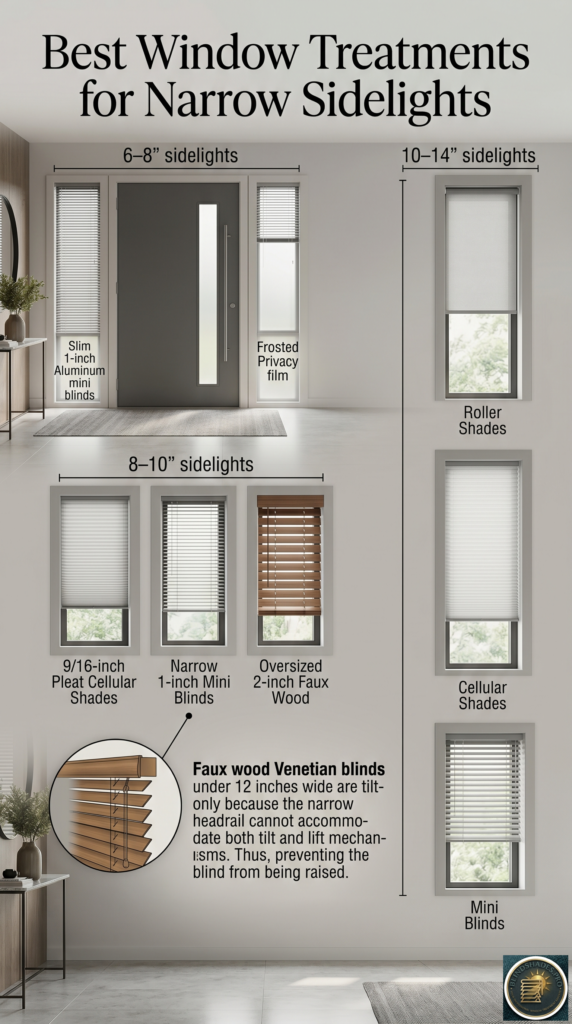
Window Treatments for Narrow Sidelights – The Four Width Categories
Definition: A narrow sidelight is any sidelight window measuring less than 14 inches in clear width. The narrower the sidelight, the more constrained the available treatment options due to minimum manufacturing widths and mechanical limitations of blind hardware at narrow headrail widths.
The four-category width breakdown:
Category 1 – Very Narrow Sidelights (6-8 inches)
Available treatments:
- 1-inch aluminium mini blind (minimum 6-8 inches depending on manufacturer) – can be raised and lowered; tilt rod controls slat angle
- Window film (frosted/privacy) — no minimum width; applied directly to glass
- Custom panel curtain on tension rod (for 14-16 inch sidelights in this category)
Not available:
- Cellular shades (minimum 9-10 inches)
- Roller shades (minimum 10-12 inches standard systems)
- Faux wood Venetian blinds (minimum 10 inches; tilt-only at this width)
- Plantation shutters (minimum panel 8-10 inches; functional louvers require width)
The key operational note: For very narrow sidelights, the 1-inch aluminium mini blind is the only adjustable treatment available. It provides both tilt (slat angle) and lift (raise/lower) at widths as narrow as 6 inches. All other adjustable treatment types cannot be manufactured at this width.
Category 2 – Narrow Sidelights (8-10 inches)
Available treatments:
- 1-inch aluminium mini blind — full tilt and lift operation
- 9/16-inch pleat cellular shade (specified below in the product section) — minimal raised stack
- Standard cellular shade from some specialist sidelight manufacturers — confirm minimum width with supplier
- Roller shade from specialist sidelight systems — some manufacturers reach 8-inch minimum
Not available (at 8-10 inches):
- 2-inch faux wood Venetian blind — proportionally wrong for widths below 10 inches AND tilt-only at under 12 inches
- Standard roller shade (10-12 inch minimum at most manufacturers)
- Plantation shutters (minimum 8-10 inches per panel; functional at 10 inches minimum)
- Woven wood shade (minimum width typically 10-12 inches)
The tilt-only warning: Any Venetian blind (faux wood, real wood, or aluminium in 2-inch slat) ordered at under 12 inches is typically tilt-only due to headrail width limitations. See the full explanation in the Headrail Width Limitation section below.
Category 3 – Moderately Narrow Sidelights (10-14 inches) — Most Common
Available treatments:
- Cellular shade in any pleat depth — TDBU functional
- Roller shade — full range of fabrics (room-darkening, blackout, solar)
- 1-inch aluminium mini blind — full tilt and lift
- 2-inch faux wood Venetian — tilt-only below 12 inches; full tilt AND lift at 12 inches and above
- Plantation shutters (minimum panel 8-10 inches)
This is the most common sidelight width range and the sweet spot where the widest range of treatment types becomes viable.
Category 4 – Wide Narrow Sidelights (14-16 inches)
Available treatments: Full range — same as a standard small window. All cellular, roller, faux wood Venetian, plantation shutter, and panel curtain options are available and mechanically functional.
At 14-16 inches, the full treatment menu opens. Plantation shutters — the premium sidelight treatment — become fully functional at panel widths above 14 inches. TDBU cellular shades with standard hardware operate smoothly. The headrail width limitation does not apply above 12-14 inches.
The Headrail Width Limitation — Why Narrow Faux Wood Blinds Cannot Be Raised
This is the most commercially important fact for narrow sidelight buyers and is absent from all competitor guides except a single Blinds Chalet FAQ.
The mechanism: A Venetian blind headrail contains two mechanical systems:
- The tilt rod mechanism — controls the angle of the slats (open/closed/angled)
- The lift cord mechanism — raises and lowers the blind
Both mechanisms require physical space within the headrail housing — typically 1/2 inch to 3/4 inch per mechanism. A standard headrail at 14 inches or wider has adequate space for both. A narrow headrail at under 12 inches typically does not.
The consequence: Faux wood Venetian blinds and aluminium Venetian blinds in 2-inch slat width ordered at under 12 inches width are manufactured with tilt-only operation. The lift cord mechanism is omitted from the headrail.
What this means for the buyer:
- The blind can be installed on the sidelight
- The slats can be tilted open (fully open), angled (partial light), or closed (privacy)
- The blind CANNOT be raised to the headrail position
- The blind is permanently at its installed drop length
Why this matters specifically for sidelights:
- Daytime light maximisation: many homeowners want to fully raise the sidelight blind during daylight hours for maximum light — this is not possible with a tilt-only Venetian blind
- Privacy management: the TDBU strategy (raise the bottom section to let in lower light while the upper section remains for privacy) is not possible with a tilt-only blind
- Egress: if the sidelight is an egress point (unusual but possible in some configurations), a non-raisable blind impedes emergency exit
The correct specification for narrow sidelights requiring a raise-and-tilt blind:
- 1-inch aluminium mini blind (available at 6-8 inches minimum; both tilt and lift at all widths)
- 9/16-inch or 3/8-inch pleat cellular shade
- Cordless roller shade
The 9/16-inch Pleat Cellular Shade — The Sidelight-Specific Product
This sidelight-specific product specification is absent from all competitor guides.
What it is: A 9/16-inch pleat (sometimes marketed as “Duette-style” or “ultra-slim honeycomb”) cellular shade has pleats that are 9/16 of an inch deep — approximately half the depth of a standard 3/4-inch honeycomb pleat.
Why it matters for narrow sidelights:
When a cellular shade is raised to the headrail position, the folded cells stack at the top of the window. The stack height is directly proportional to the number of cells and the pleat depth.
For a 72-inch sidelight:
- Standard 3/4-inch pleat cellular: raised stack = approximately 6-8 inches
- 9/16-inch pleat cellular: raised stack = approximately 3-4 inches
The practical difference: A standard 3/4-inch pleat cellular shade on a 72-inch sidelight leaves 6-8 inches of covered glass at the top even when “fully raised.” On an 8-inch wide sidelight where every square inch matters for light, this 8-inch covered zone at the top is a significant light loss.
A 9/16-inch pleat shade on the same sidelight leaves only 3-4 inches covered — allowing approximately 65-68 inches of clear glass when raised versus 64-66 inches for the standard shade.
For sidelights 8-14 inches wide: specify 9/16-inch pleat (or 3/8-inch if available) cellular shade to maximise the open glass area when raised.
Product examples (confirm current availability):
- Hunter Douglas Duette 9/16-inch — the original sidelight-specific honeycomb shade; TDBU available from 6-inch minimum width when in non-operable static specification; operable TDBU from 6 inches minimum with standard cordless
- Premier 9/16-inch Blackout Single Cell (Blinds Chalet)
- Bali and SelectBlinds offer 9/16-inch single-cell in selected fabric ranges
The Sag Problem for Tall Narrow Sidelights
The 1:9 aspect ratio physics challenge — absent from all competitor guides.
A typical sidelight at 8 inches wide and 72 inches tall has a width-to-height aspect ratio of 1:9. A standard roller shade or cellular shade at this ratio is:
- 8 inches wide
- 72 inches tall
- Supported only at the top (headrail) and weighted at the bottom (bottom rail)
- With no lateral support across the 72-inch span
At this extreme aspect ratio, a fabric roller shade will bow outward at the midpoint due to:
- The weight of the fabric pulling down from the headrail
- Any slight tension differential side-to-side
- Air movement from the door opening
This bowing creates a gap between the shade fabric and the window frame, allowing light infiltration and reducing privacy exactly at the most critical zone — the eye-level portion of the sidelight.
The solutions for sag prevention:
Cassette roller shade system: A cassette-style roller shade has a rigid bottom rail that is heavier and stiffer than a standard bottom rail. The weight keeps the fabric taut and prevents bowing. The cassette headrail also ensures the fabric rolls evenly, reducing the differential tension that causes sag.
9/16-inch cellular shade: The pleated structure of a cellular shade provides inherent rigidity in the vertical dimension. The pleat folds create a self-supporting accordion structure that resists the lateral bowing that affects flat-panel roller shades.
1-inch aluminium mini blind: The rigid aluminium slats provide structural support across the window width at each slat level. The interconnected ladder tape holds each slat in alignment. Mini blinds at narrow widths have the least sag risk of any treatment type because the rigid slat structure eliminates the fabric-bowing mechanism entirely.
Avoid for tall narrow sidelights: standard flat-panel roller shades with lightweight bottom rails; fabric panel curtains (severe sagging on long narrow panels without support).
Slat and Pleat Proportioning for Narrow Sidelights
The aesthetic specification guide absent from all competitor articles.
The visual proportion of a window treatment is determined by the relationship between the individual slat/pleat width and the total window width. A well-proportioned treatment looks balanced; a poorly proportioned treatment looks chunky or coarse.
The proportioning guide:
| Sidelight Width | Slat/Pleat Size | Number Across Window | Visual Result |
|---|---|---|---|
| 8 inches | 2-inch faux wood slat | 4 slats | Coarse/chunky — avoid |
| 8 inches | 1-inch mini blind slat | 8 slats | Acceptable proportion |
| 8 inches | 9/16-inch cellular pleat | 14 cells | Well proportioned / tailored |
| 10 inches | 2-inch faux wood slat | 5 slats | Borderline — acceptable |
| 10 inches | 1-inch mini blind slat | 10 slats | Good proportion |
| 10 inches | 9/16-inch cellular pleat | 17 cells | Well proportioned |
| 12 inches | 2-inch faux wood slat | 6 slats | Acceptable |
| 14 inches | 2-inch faux wood slat | 7 slats | Standard — fully appropriate |
The practical guidance: For sidelights under 10 inches wide: specify 1-inch mini blind or 9/16-inch cellular shade — NOT 2-inch faux wood. The 2-inch slat at 4-5 slats across the window width creates a coarse, blocky appearance that looks incorrect at narrow widths.
For sidelights 12 inches and above: 2-inch faux wood becomes visually acceptable and is the correct proportional specification for traditional, craftsman, and colonial door styles.
The Operating Reach Problem
The accessibility consideration absent from all competitor guides.
A sidelight at 72-80 inches tall positions the bottom rail at approximately floor level (for inside-mount) or 6-12 inches above floor level (for outside-mount positioned at the sill).
The reach challenge: Lowering a 72-inch cordless cellular shade places the bottom rail near the floor. Raising it requires bending to near-floor level and gripping an 8-10 inch wide bottom rail. For most adults this is simply inconvenient. For elderly occupants, those with limited mobility, or those with back conditions, this daily bending operation is a genuine accessibility barrier.
The TDBU hold-down solution for narrow sidelights: Following the baseline established in What Are the Best Blinds for Sidelights, a TDBU cellular shade with hold-down brackets permanently clips the bottom section to the sill. The bottom section never needs to be raised — it stays permanently clipped at the appropriate privacy level. The only operating element is the top panel, operated from the headrail at a comfortable standing height.
The motorization solution: A motorized blind operates without any manual reach to the bottom rail. The 72-inch sidelight bottom rail stays at floor level without requiring any interaction. Voice commands or scheduled automation operate the blind. For elderly occupants or accessibility-priority specifications: motorized sidelight treatment eliminates the reach problem entirely.
The Thermal Value Argument for Cellular Treatment on Narrow Sidelights
Why a small sidelight deserves a quality insulating treatment — absent from all guides.
A typical narrow sidelight is positioned in the door frame zone — the area immediately surrounding the front door. This zone is the primary air infiltration point in any exterior wall because:
- The door frame has multiple joints, weatherstripping interfaces, and threshold gaps
- Cold air entering around the door perimeter concentrates adjacent to the sidelight glass
A sidelight in this high-infiltration zone loses more heat per square inch than an equivalent-sized window in the centre of an exterior wall.
The cellular shade thermal upgrade:
| Sidelight Specification | R-value | Total Window R-value |
|---|---|---|
| Single-pane glass only | Inherent R-0.9 | R-0.9 |
| Single-pane + single-cell cellular | R-3 to R-4 added | R-3.9 to R-4.9 |
| Double-pane glass only | Inherent R-2 to R-3 | R-2 to R-3 |
| Double-pane + single-cell cellular | R-3 to R-4 added | R-5 to R-7 |
| Double-pane + double-cell cellular | R-4.5 to R-6 added | R-6.5 to R-9 |
The proportional argument: Adding a cellular shade to an 8-inch wide sidelight with a single-pane glass upgrades the window from R-0.9 to approximately R-4 — a 4x improvement in thermal resistance. The same upgrade on a double-pane window provides a 2-3x improvement.
At the door frame infiltration zone, this thermal improvement reduces the cold draft from the door area more effectively than an equivalent cellular shade on a standard interior window position.
The Panel Curtain Alternative for Wider Narrow Sidelights
For sidelights in the 14-16 inch width range in traditional, craftsman, or farmhouse-style homes where a soft fabric treatment is more appropriate than a hard blind, a panel curtain on a tension rod or sash rod is an alternative worth considering.
The practical specification:
- Tension rod positioned inside the sidelight frame (minimum 1-2 inch frame depth required)
- Single panel of sheer, voile, or lightweight fabric — hemmed to precisely the window height
- Panel hangs straight without a tie-back for maximum privacy coverage
The limitations for privacy: A panel curtain that must be pushed to one side for see-out does not provide reliable privacy when the homeowner is inside — the panel can be pushed aside during entry and may remain partially open. For front door sidelights where consistent privacy is the priority, a blind or shade is more reliable than a panel.
The sill height hemming requirement: As established in Knight’s Carpets sidelight guide research: a panel that puddles at or below the threshold will be snagged and damaged when the door opens or when people enter. Hem any panel curtain to exactly sill height or 1/2 inch above to prevent door snagging.
Where to Order
For 9/16-inch pleat cellular sidelight shades (primary specification for 8-14 inch sidelights): SelectBlinds cellular range at selectblinds.com/cellular-shades — confirm 9/16-inch pleat availability for the sidelight width being ordered; specify cordless TDBU, room-darkening or blackout fabric.
For the complete narrow sidelight treatment range: Blindsgalore sidelights at blindsgalore.com/sidelights — 100% custom-built to exact sidelight measurements; covers all widths from approximately 9 inches upward; TDBU, roller, and cellular all available. Factory Direct Blinds sidelight shades at factorydirectblinds.com — good selection for 8-12 inch width category with cellular and roller shade options.
Frequently Asked Questions
What are the best window treatments for narrow sidelights? The best window treatments for narrow sidelights depend on the width. For sidelights 6 to 8 inches wide, only 1-inch aluminium mini blinds or window film are reliably available as cellular and roller shades have minimum widths above 9 to 10 inches. For 8 to 10 inch sidelights, specify 9/16-inch pleat cellular shade or 1-inch mini blind – not 2-inch faux wood Venetian which is tilt-only at under 12 inches and proportionally too coarse at narrow widths. For 10 to 14 inch sidelights, the full range of cellular, roller shade, and mini blind is available with TDBU functional at these widths.
Why can’t I raise my narrow faux wood sidelight blind? Faux wood Venetian blinds ordered at under 12 inches wide are typically manufactured with tilt-only operation because the headrail is too narrow to accommodate both the tilt rod and the lift cord mechanism simultaneously. The lift cord is omitted from the narrow headrail, leaving only the tilt function. The blind can be tilted open, angled, or closed for light and privacy control but cannot be raised to the headrail. For a sidelight blind that can both tilt and raise at narrow widths, specify a 1-inch aluminium mini blind which retains both functions at widths as narrow as 6 to 8 inches, or a cellular shade or roller shade.
What is a 9/16-inch pleat cellular shade and why is it better for narrow sidelights? A 9/16-inch pleat cellular shade has pleats that are 9/16 of an inch deep, approximately half the depth of a standard 3/4-inch honeycomb pleat. When the shade is raised, the folded cells stack at the headrail. A standard 3/4-inch pleat shade on a 72-inch sidelight has a raised stack of approximately 6 to 8 inches, covering that portion of the glass even when fully raised. A 9/16-inch pleat shade on the same sidelight has a raised stack of approximately 3 to 4 inches, preserving significantly more open glass area for daylight when the shade is raised.
Do narrow sidelights sag or bow in the middle? Yes – narrow sidelights with aspect ratios of 1:9 (for example 8 inches wide by 72 inches tall) can cause flat-panel roller shades to bow outward at the midpoint, creating a gap between the shade and the frame that allows light infiltration. The solutions are cassette roller shade systems with a weighted rigid bottom rail, 9/16-inch cellular shades whose pleated structure provides inherent rigidity, or 1-inch aluminium mini blinds where the rigid slats prevent fabric bowing entirely. Avoid lightweight flat-panel roller shades without cassette systems on sidelights taller than 48 inches.
Are cellular shades worth the cost for a small narrow sidelight? Yes – cellular shades are particularly worth the cost on narrow sidelights in the door frame zone because the sidelight is positioned in the primary air infiltration area around the door frame. A single-cell cellular shade adds R-3 to R-4 to a single-pane sidelight at R-0.9, tripling the window’s thermal resistance. This thermal improvement is proportionally more valuable at the infiltration-prone door perimeter than the same upgrade on a standard interior wall window.
Related Guides on BlindShades.pro
- The Best Sidelights and Front Door Blinds Buying Guide
- What Are the Best Blinds for Sidelights
- How Do You Measure Sidelights for Blinds
- Can You Put Plantation Shutters on Sidelights
- Is Frosted Film Better Than Blinds for Sidelights
By Michael Turner | 30 Years Home Improvement Expertise | Updated 2026 | BlindShades.pro
