Is Frosted Film Better Than Blinds for Sidelights?

Authored By Michael Turner -30 Years Home Improvement Expertise | Updated 2026 | BlindShades.pro
Updated on May 30, 2026
Key Takeaways:
- Frosted film wins for sidelights specifically because of the approach-angle problem: solar shades and semi-transparent blinds fail when a visitor approaches the door at 30 to 60 degrees (the weave opens up and interior is visible) but frosted film provides consistent privacy at all viewing angles including oblique approach
- For paired sidelights (one each side of the door), the film vs blind choice must be the same on both sides – one sidelight with frosted film and one with a blind creates an asymmetric appearance visible to every visitor from the street
- The “frosted mini blinds” film (Solyx SX-3006) provides the visual appearance of mini blind slats as a permanent film – the crossover product for homeowners who want the aesthetics of blinds with the simplicity and durability of film
- Front door sidelights sustain more mechanical blind damage than any other window in the home – children and pets congregate at the front door, the glass extends to near floor level, and excited dogs jumping at the door will strike and damage the blind’s bottom rail and slats repeatedly
- The combination strategy: frosted film on the lower two-thirds of the sidelight (covering the child and pet height zone and the primary inward sightline zone) with a roller shade on the upper third – provides permanent low-maintenance privacy on the most-trafficked portion with adjustable coverage above
⭐ Quick Answer — Is Frosted Film Better Than Blinds for Sidelights?
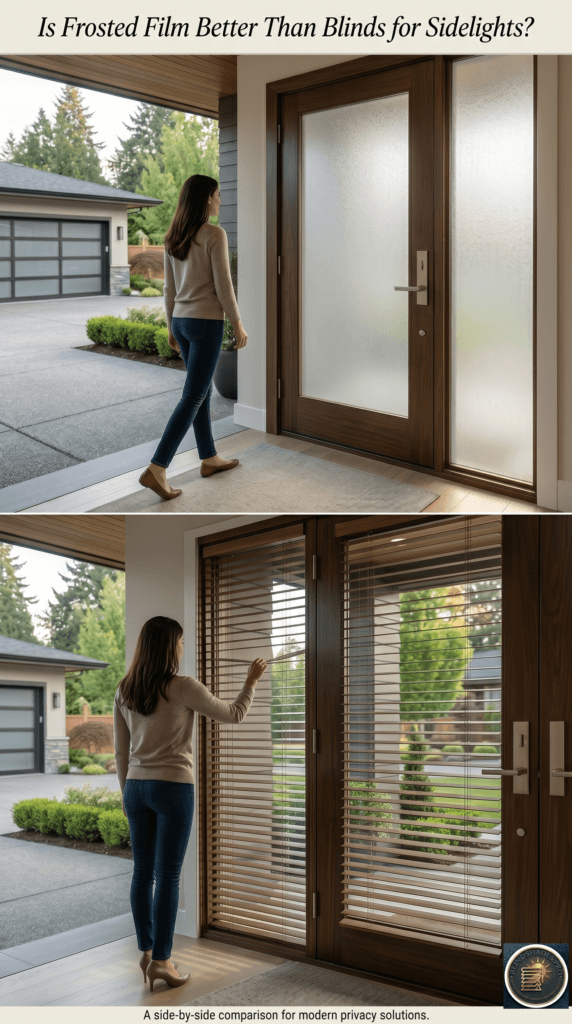
- Film Wins the Approach-Angle Test That Blinds Fail: For most situations, frosted film beats blinds on sidelights because of the approach-angle problem. A visitor walking toward the front door approaches at 30 to 60 degrees from the sidelight glass — not perpendicular. Semi-transparent blinds and solar shades that appear private from directly in front allow clear interior visibility from this oblique approach angle because the weave opens up at an angle. Frosted film’s obscuring effect is based on the glass surface itself — it provides consistent privacy at all viewing angles including the approach angle. This is the most important privacy comparison point specifically for sidelights: film wins an angle test that no blind can match
- Film Costs $2–8 Per Year vs Cellular $15–57 Per Year: When comparing frosted film vs blinds for sidelights on cost: adhesive-backed frosted film at $25–$80 per sidelight over a 10–15 year lifespan = approximately $2–8 per year. A cellular shade at $150–$400 per sidelight over a 7–10 year replacement cycle = approximately $15–57 per year. Front door sidelights also sustain above-average blind damage from children and excited dogs — pets jumping at the door repeatedly strike the blind’s bottom rail and slats, which are at floor level. Each replacement cycle adds $150–$400. Frosted film has no moving parts and sustains no damage from normal door activity. For rental properties: film installed once serves 3–5 tenancies vs a blind replaced every 2–3 years
- The Frosted Mini Blinds Film — The Crossover Product: For homeowners who prefer the visual appearance of blinds but want the simplicity of film: Solyx SX-3006 “Frosted Mini Blinds” film by Decorative Films prints the appearance of mini blind slats as an adhesive privacy film on the sidelight glass. You get the permanent privacy, zero maintenance, and approach-angle protection of frosted film with the aesthetic look of venetian blind slats from both inside and outside. This product is designed specifically for sidelights and front door glass — it directly bridges the film vs blind aesthetic divide. Available from Decorative Films; also look for similar “blind pattern film” products at approximately $25–$60 per sidelight
- When Blinds Win — The See-Out Requirement: Frosted film beats blinds on sidelights in most scenarios but blinds win one: when the homeowner needs to see who is approaching through the sidelight glass without opening the door. Frosted film eliminates see-out completely (both directions are obscured). A TDBU cellular shade with the top panel LOWERED from the headrail (covering the upper 50–60% where the inward sightline enters) while the lower portion remains clear preserves a limited see-out angle at lower heights. Plantation shutters with partially angled louvers also preserve see-out. If a video doorbell or traditional peephole is installed: frosted film’s see-out limitation is a non-issue and film wins the comparison decisively
- The Combination Strategy and the Paired Sidelight Rule: For sidelights where some see-out matters AND low maintenance is a priority: apply frosted film to the lower two-thirds (approximately 48 inches of a 72-inch sidelight) and add a small roller shade covering only the upper third. The lower zone film covers the primary inward sightline zone permanently and eliminates the child/pet damage risk; the roller shade provides adjustable coverage above for night privacy or full-coverage when needed. And the paired sidelight rule: if the home has two sidelights, the film vs blind choice must be the SAME on both sides — frosted film on one and a blind on the other creates a visible asymmetry from the street that no visitor will miss
- Best Sources: Sidelight film options including frosted mini blinds film → Decorative Films sidelight guide · Day-and-night frosted film vs mirror film vs blinds → Window Film Phoenix frosted guide · Adjustable TDBU sidelight blinds → Blindsgalore sidelights
⚠️ The Night Privacy and Maintenance Comparison Specific to Front Door Sidelights: Two dimensions where frosted film conclusively beats blinds on sidelights. Night privacy: frosted film works at night because its obscuring effect is based on the glass surface, not a luminance differential. One-way mirror film fails at night when the entryway chandelier creates 100 to 500 lux interior against near-zero exterior — the one-way effect reverses and the glass becomes transparent from outside. The same night reversal failure affects solar shades and any semi-transparent blind in the partially open position. Frosted film is immune to this. Maintenance: a front door sidelight is the most-trafficked glass in any home — fingerprints from visitors, pet nose prints from dogs, rain splash from the doorstep, dusty air movement from door openings. Frosted film: wipe the entire sidelight surface in one pass in under 30 seconds. Mini blind on the same sidelight: approximately 72 slats, each requiring individual wiping on both surfaces — 5 to 15 minutes per cleaning, often skipped, creating visible dust accumulation on the most visible glass in the home. And the resale value signal: a decorative etched-pattern frosted film on a sidelight presents as premium etched glass from the street, adding perceived entry quality that a blind cannot replicate. For the full five-level privacy scale and TDBU top-down configuration for sidelights, see What Is the Best Privacy Treatment for Front Door Sidelights. See the full eight-dimension comparison below.
💡 The Decision Framework — When Each Option Wins: The frosted film vs blinds sidelight decision depends on one primary question: do you need to see who is at the door through the sidelight? No (video doorbell or peephole installed): frosted film wins on all dimensions — approach-angle privacy, day-and-night coverage, zero maintenance, no damage risk, lower per-year cost, better resale signal. Yes (need see-out through the glass): TDBU cellular shade (top panel down) or plantation shutters with angled louvers. Children or pets active at the front door: frosted film mandatory — floor-level blind components sustain repeated damage; film has none. Rental property: frosted film as a landlord improvement — one installation, 10 to 15 years, not damageable by tenants. Short-term homeowner (moving in 3 years): static cling frosted film ($15 to $40 per sidelight) — removable and takes the investment with you. Want the visual look of blinds: Solyx SX-3006 Frosted Mini Blinds film — slat appearance with film simplicity. Two sidelights: whatever you choose, the same treatment on both sides — asymmetric appearance is visible to every visitor. For the full treatment comparison by sidelight width, depth, and mount type, see What Are the Best Blinds for Sidelights. See the full decision framework table below.
📖 Read the complete guide below for: the eight comparison dimensions (privacy day and night / natural light / adjustability and see-out / maintenance in the high-traffic entry context / damage resistance at the front door / rental property and long-term cost / aesthetics and resale value / combination strategy), the approach-angle privacy test (30 to 60 degrees visitor approach; film angle-independent vs blind weave opening), the frosted mini blinds film crossover product (Solyx SX-3006), the children and pets damage factor at floor-level sidelights, the $2 to $8 per year film vs $15 to $57 per year blind cost-per-year calculation, the rental landlord replacement cost ($50 to $200 per year in blind replacements across tenancies), the decorative etched film resale value signal, the combination strategy (film on lower two-thirds plus roller shade on upper third), and the decision framework table.
Frosted Film vs Blinds for Sidelights – The Head-to-Head Comparison
The eight comparison dimensions that determine which is better for your specific sidelight:
Dimension 1 – Privacy Effectiveness (Day and Night)
Frosted film: Works at all times and at all viewing angles. The obscuring effect is produced by the glass surface itself — not by a luminance differential. Frosted film provides consistent privacy when the exterior is brighter (day), when the interior is brighter (night with entry chandelier on), and when both are equal (overcast day). No adjustment required. No night reversal failure.
Blinds: Adjustable — privacy depends on the operating position. Room-darkening or blackout fabric at full closure provides better-than-frosted-film privacy (complete blockage). Semi-transparent or solar shades in the open position provide privacy only when the exterior is brighter than the interior — failing at night when the entry chandelier reverses the luminance differential (Article 45-2, Article 45-5).
Sidelight-specific factor: The approach-angle problem (Article 45-1) makes frosted film the clear winner for sidelights over all semi-transparent blind options. A visitor approaching the front door at 30 to 60 degrees from the sidelight can see through any semi-transparent blind’s weave from that oblique angle even if the blind appears private from directly in front. Frosted film’s obscuring effect is based on the glass surface — it provides consistent privacy at all approach angles. This is the most important privacy comparison point for sidelights specifically.
Winner: Frosted film (privacy at all angles, all times, no operation needed)
Dimension 2 – Natural Light Transmission
Frosted film: Transmits 70-90% of natural light depending on the density specification. The light enters as diffused, soft illumination rather than direct shafts — the frosted surface scatters the incoming light. The foyer receives ambient natural light without direct sunlight beams. For dark entryways where natural light is the primary reason for having sidelights: frosted film preserves substantially more natural light than any blind in the privacy position.
Blinds: Light transmission depends on the operating position. When fully raised: 100% of available light (same as no treatment). When in the privacy position (top panel down for sidelights, following Article 45-5): approximately 40-80% of the uncovered lower zone transmits. When fully lowered in blackout: 0-1%.
Winner: Frosted film for consistent daytime light; Blinds for maximum light when fully raised or for blackout capability
Dimension 3 – Adjustability and See-Out Capability
Frosted film: Not adjustable. Once installed, the privacy level is fixed. See-out is eliminated — the homeowner cannot see who is at the door through frosted glass. The door viewer/peephole or video doorbell becomes the identification tool.
Blinds: Fully adjustable. The TDBU cellular shade with the top panel down provides privacy while the uncovered lower zone preserves a limited see-out angle. Plantation shutters with angled louvers preserve see-out while obscuring interior detail. A fully closed blind eliminates see-out entirely.
Winner: Blinds for homeowners who want to see who is approaching without opening the door; Frosted film for homeowners with a video doorbell or peephole who prioritise set-and-forget simplicity
Dimension 4 – Maintenance in the High-Traffic Entry Context
The sidelight-specific maintenance factor no comparison guide addresses.
A front door sidelight is the most-trafficked glass surface in any home. Adjacent to the most-used door, at child and pet height, subject to fingerprints from visitors reaching toward the doorbell, pet nose prints from dogs watching outside, and rain splash from the entry step — the sidelight accumulates surface contamination faster than any interior window.
Frosted film maintenance: Wipe the entire sidelight surface with a damp cloth — the frosted film cleans in a single pass in under 30 seconds. Fingerprints, nose prints, and rain splash all clean with a single wipe.
Blind maintenance: Wipe each individual slat or fabric surface on both the room-facing and glass-facing sides. A 72-inch sidelight mini blind has approximately 72 slats — each must be wiped individually on both surfaces. Time per cleaning: 5-15 minutes. Frequency at the front door position: more often than any interior window due to the high-contact environment.
Winner: Frosted film — particularly decisive at the front door sidelight position
Dimension 5 – Damage Resistance at the Front Door
The sidelight-specific damage factor absent from all competitor guides.
Front door sidelights are uniquely exposed to mechanical damage because:
- Children congregate at the front door when visitors arrive — curious hands reach for the blind slats
- Pets at the front door — excited dogs jumping and scratching can strike the blind’s bottom rail and slats repeatedly
- A 72-inch sidelight with an inside-mount blind has its bottom rail at or near the floor — within reach of children and most dog breeds
- Each door opening creates air movement that causes any loose blind to swing, repeatedly striking the frame if hold-down brackets are loose or worn
Frosted film: No moving parts, no bottom rail, no slats to bend or break, no fabric to tear. The only damage risk is scratching from sharp objects against the film surface. A well-installed adhesive film is not damaged by normal door-entry activity.
Blind damage scenarios:
- Bent aluminium mini blind slats from pet contact: the slat cannot be straightened to the original profile; the blind must be replaced
- Torn cellular shade fabric: cannot be repaired; replaced at full cost
- Broken hold-down clips: the blind swings freely until replaced
- Lost bottom rail weight bar: the blind sags asymmetrically
Winner: Frosted film — decisive at the front door where pets and children are most active
Dimension 6 – Rental Property and Long-Term Cost
The landlord perspective absent from all comparison guides.
Owner-occupier (long-term): Adhesive-backed frosted film: $25-80 per sidelight; installed once; 10-15 year lifespan. Per-year cost: approximately $2-8. Cellular shade: $150-400 per sidelight; 7-10 year lifespan. Per-year cost: approximately $15-57. Frosted film is less expensive per year for a long-term owner-occupier.
Rental property (landlord perspective): A blind installed in a front door sidelight will sustain damage from tenant pets and children at above-average rates due to the position. A landlord who replaces a sidelight blind after each tenancy (average 2-3 year tenure) may spend $150-400 every 2-3 years — $50-200 per year in replacement costs.
Frosted film installed by a landlord: one installation ($25-80) lasting 10-15 years across multiple tenancies — approximately $2-8 per year regardless of tenant turnover. The film also cannot be damaged by normal tenant activity.
Winner: Frosted film on a cost-per-year basis for both long-term owners and rental properties; Blinds for short-term owners who may prefer the flexibility to change the treatment when they leave
Dimension 7 – Aesthetics and Resale Value Signal
The comparison dimension most guides address superficially — the sidelight-specific resale angle is absent.
Frosted film (plain): Clean, minimal appearance. No hardware visible. From outside the home: the sidelight glass has a uniform frosted appearance. In lower quality, it reads as frosted film. In higher quality with etched patterns: it reads as premium etched or sandblasted glass.
Frosted film (decorative/etched pattern): A medium-density etched glass pattern film presents as architectural etched glass from the street — adding perceived value to the entry. Estate agents consistently report that etched or decorative glass sidelights are a positive feature in front door presentations.
Blinds: A mini blind or roller shade visible through a front door sidelight reads as a standard window treatment. It provides privacy but adds no architectural character to the entry facade.
The crossover product — Frosted Mini Blinds Film (Solyx SX-3006): This specific product mimics the appearance of mini blind slats as a printed adhesive film. It provides the permanent privacy of frosted film with the visual aesthetic of venetian blinds — a direct answer for homeowners who prefer the blind look but want the simplicity and durability of film. Mentioned only by Decorative Films and never analysed in any comparison guide.
Winner: Frosted film — particularly decorative etched pattern film — for resale value and architectural character; Frosted mini blinds film for homeowners who prefer the blind slat aesthetic
Dimension 8 – The Combination Strategy for Sidelights
The specific sidelight solution absent from all comparison guides.
For sidelights where some see-out capability is important AND low maintenance is a priority, the combination strategy provides the best of both:
The zone approach:
- Apply frosted film to the LOWER 2/3 of the sidelight (approximately 48 inches of a 72-inch sidelight)
- The lower zone is the primary privacy zone — it covers the primary inward sightline from a standing observer at 20-30 degrees downward toward the sidelight (Article 45-5 TDBU correction)
- The lower zone is also the zone most exposed to child and pet activity — film in this zone eliminates the damage risk
- Leave the upper 1/3 (approximately 24 inches) clear for light entry and limited see-out capability at high angles
Adding a roller shade for the upper zone: A small roller shade mounted at the top of the frame covering only the upper 24 inches provides additional coverage at night or when full privacy is needed. When raised: the upper zone is clear; the frosted lower zone provides primary privacy. When lowered: full sidelight coverage.
This combination eliminates the main weaknesses of both film alone (no see-out) and blinds alone (full-surface maintenance and damage risk).
The Decision Framework
| Situation | Better Choice | Reason |
|---|---|---|
| You have a video doorbell or peephole | Frosted film | See-out not needed; film’s 24-hour privacy, approach-angle protection, and zero maintenance win |
| You need to see who is at the door through the sidelight | Blinds (TDBU cellular, top panel down) | Only treatment that provides privacy AND see-out simultaneously |
| You have children or pets active at the front door | Frosted film | No bottom rail, no slats, no moving parts to damage |
| Rental property / multiple tenancies | Frosted film | One installation; 10-15 year lifespan; not damageable by tenants |
| You want maximum adjustability | Blinds | Fully adjustable from open to blackout |
| You want to enhance entry aesthetics | Decorative etched film | Presents as premium etched glass from street |
| Paired sidelights must match | Whichever you choose | The SAME treatment must be on both sidelights |
| Short-term homeowner (moving within 3 years) | Static cling film or blinds | Film investment not fully realised in short term; static cling is reversible |
Where to Order
For sidelight-specific frosted film products: Decorative Films sidelight inspiration at decorativefilm.com — the most comprehensive source for sidelight-specific film options including the Solyx SX-3006 Frosted Mini Blinds film and the Crystal Lattice etched pattern film.
For the frosted film vs blinds privacy analysis including day/night performance: Window Film Phoenix frosted film guide at windowfilmphoenix.com specifically addresses the day-and-night privacy advantage of frosted film vs one-way mirror film vs blinds.
For the adjustable blind specification if see-out is required: Blindsgalore sidelight range at blindsgalore.com/sidelights — TDBU cellular shades and roller shades for sidelights where adjustable privacy with some see-out capability is the priority.
Frequently Asked Questions
Is frosted film better than blinds for sidelights? For most sidelight situations, frosted film is better than blinds because it solves the approach-angle problem that defeats semi-transparent blinds at front door sidelights. A visitor walking toward the door at 30 to 60 degrees can see through the weave of solar shades and semi-transparent blinds even though they appear private from directly in front. Frosted film’s obscuring effect is based on the glass surface and provides consistent privacy at all approach angles. Blinds are better when the homeowner needs to see who is approaching through the sidelight without opening the door – frosted film eliminates this see-out capability.
What is the frosted mini blinds film for sidelights? Frosted mini blinds film, such as Solyx SX-3006 from Decorative Films, is an adhesive privacy film that prints the visual pattern of mini blind slats onto frosted glass film. It provides the permanent privacy and low-maintenance properties of frosted film while presenting the aesthetic appearance of venetian blind slats from both inside and outside the home. This crossover product is designed specifically for sidelights and front door glass where some homeowners prefer the visual appearance of blinds but want the durability and simplicity of film rather than the mechanical components of an actual blind.
Why are sidelight blinds damaged faster than blinds in other windows? Sidelight blinds sustain faster mechanical damage than any other window position because front door sidelights are at floor level and adjacent to the most-trafficked zone in the home. Children curious about visitors and dogs excited by arrivals regularly contact the sidelight glass and any blind installed there. A 72-inch sidelight blind has its bottom rail at or near the floor, within reach of children and most dog breeds. Repeated contact from excited pets can bend aluminium slats, tear cellular fabric, and damage hold-down clips within months. Frosted film has no moving parts or components within reach and sustains no damage from normal front door activity.
Can frosted film and a blind be used together on sidelights? Yes – the combination strategy uses frosted film on the lower two-thirds of the sidelight, which covers the primary inward sightline zone and the child and pet contact height, while leaving the upper third clear. A small roller shade covering only the upper third can be added for night privacy or full coverage when needed. When the shade is raised, the frosted lower zone provides permanent privacy with the upper portion clear for light and limited see-out. This combination provides the low-maintenance durability of film in the most-trafficked zone with the adjustability of a shade in the upper zone.
Does frosted film work for night privacy on sidelights? Yes – frosted film provides consistent privacy at night, unlike one-way mirror film and solar shades which fail when interior lighting creates higher luminance inside than outside. The entryway chandelier creates 100 to 500 lux of interior luminance against near-zero exterior luminance at night, reversing the one-way effect of mirror film and making it transparent from outside. Frosted film’s obscuring effect is based on the glass surface rather than on a luminance differential, so it works regardless of which side is brighter. This night privacy reliability is a key advantage over solar shades and one-way mirror films at front door sidelight positions.
Related Guides on BlindShades.pro
- The Best Sidelights and Front Door Blinds Buying Guide
- What Are the Best Blinds for Sidelights
- What Is the Best Privacy Treatment for Front Door Sidelights
- How Do You Cover a Front Door Window for Privacy
- How Do You Add Privacy to Sidelights Without Blocking Light
By Michael Turner | 30 Years Home Improvement Expertise | Updated 2026 | BlindShades.pro
