How Do You Add Privacy to Sidelights Without Blocking Light?

Authored By Michael Turner -30 Years Home Improvement Expertise | Updated 2026 | BlindShades.pro
Updated on July 16, 2026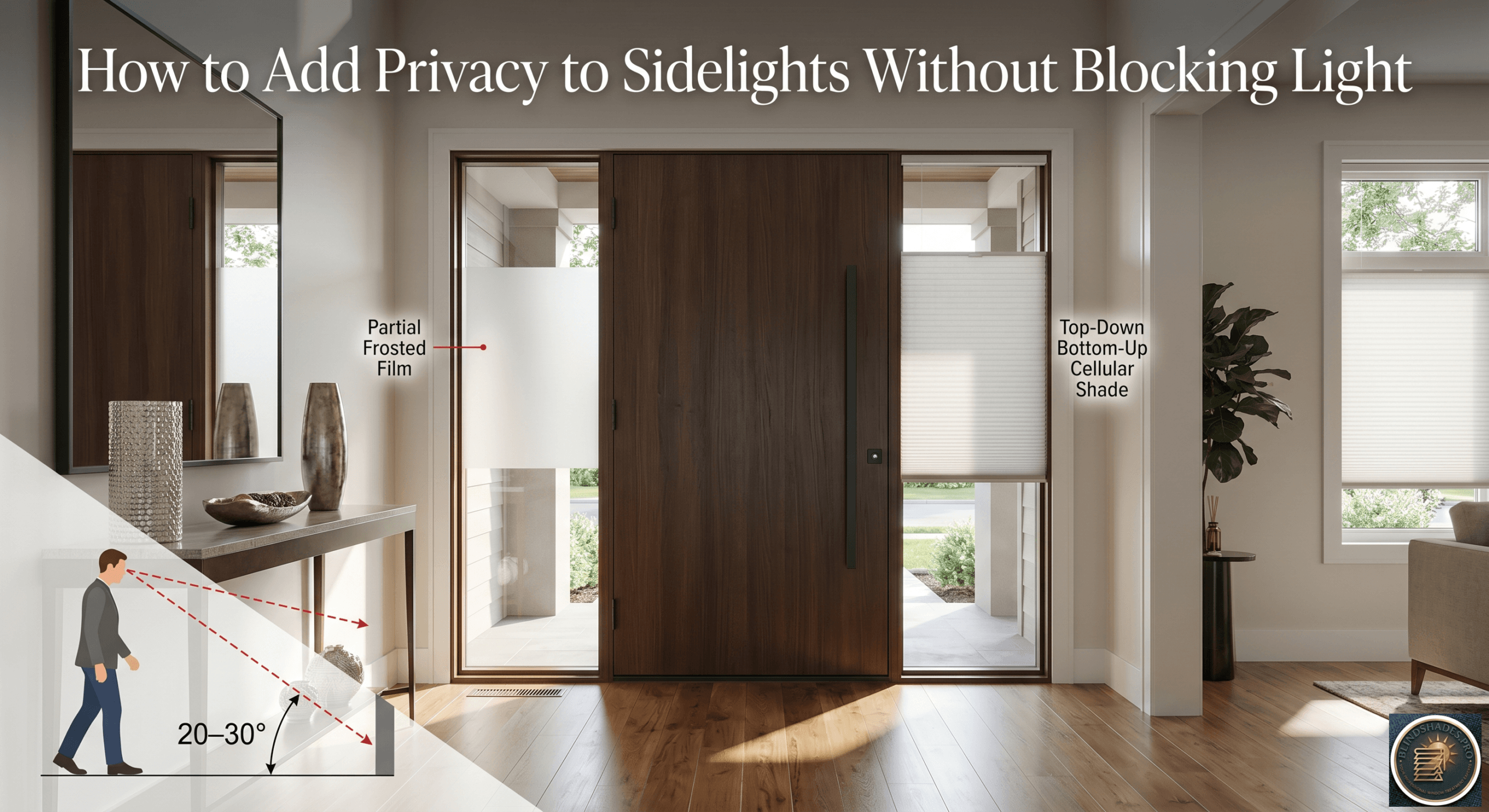
Key Takeaways:
- A 12 by 72 inch sidelight provides approximately 300 to 600 lux of natural light – often the only daylight source in a closed foyer; frosted film preserves approximately 200 to 420 lux (70 to 85 percent of that output) while blocking all interior visibility; room-darkening cellular fully lowered drops the foyer to 10 to 30 lux, requiring artificial lighting all day
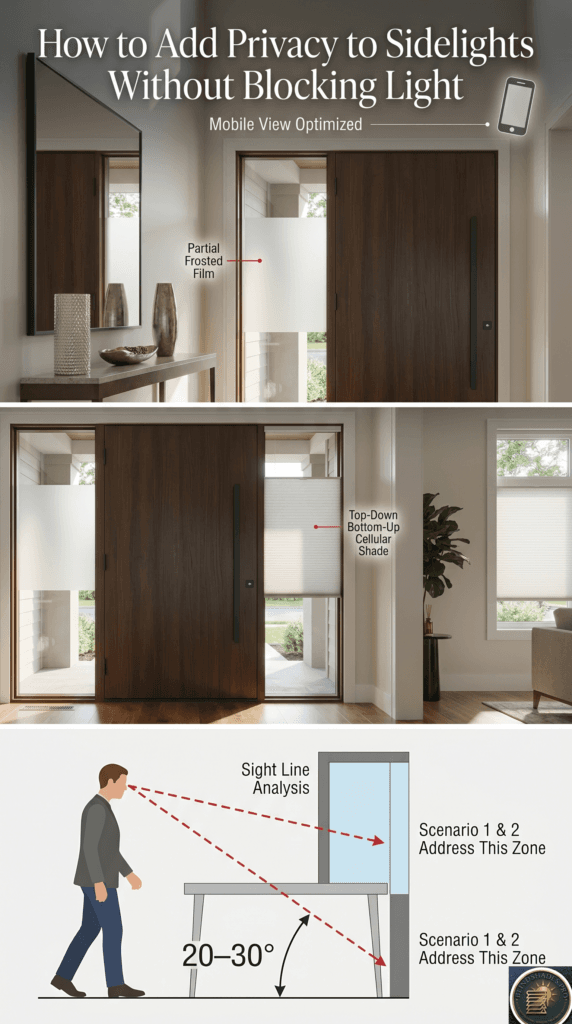
- Only the upper 30 to 40 percent of a sidelight requires privacy coverage – a visitor approaching the front door looks downward at 20 to 30 degrees, and the primary inward sightline enters through the upper window zone; frosted film applied only to the top 24 to 29 inches of a 72-inch sidelight blocks the sightline while leaving the lower 43 to 48 inches as clear glass for maximum light
- Semi-privacy striped film with alternating frosted and clear stripes transmits 85 to 90 percent of natural light – significantly more than uniform frosted film at 70 to 80 percent – because the clear stripes transmit full-intensity direct light while the frosted stripes prevent any single clear line of sight through the glass
- Multiple competitor guides incorrectly show TDBU shades with the bottom panel raised for “light from below” on sidelights; the correct configuration is to lower the TOP panel to cover the upper sightline zone and leave the BOTTOM section open – the uncovered bottom glass transmits substantially more light than light-filtering fabric in the closed position
- Homeowners in northern climates should prefer adjustable or removable treatments over permanent full-coverage frosted film – winter daylight hours are limited and every lux matters; static cling frosted film can be removed in winter to maximise precious daylight and reapplied in summer when privacy-plus-light balance is the priority
⭐ Quick Answer — How Do You Add Privacy to Sidelights Without Blocking Light?
- The 5 Options Ranked by Lux Preserved — From Most Light to Least: Adding sidelight privacy without blocking light means choosing a treatment that preserves lux while obscuring interior visibility. A 12 by 72 inch sidelight provides approximately 300–600 lux — often the only daylight in a closed foyer. Ranked by light preserved: Semi-privacy striped film: 255–540 lux (85–90%) — alternating frosted and clear stripes; clear stripes transmit direct light, frosted stripes block sightlines. Frosted film (standard): 210–480 lux (70–80%) — uniform diffusion; day-and-night privacy. TDBU top panel down (50% covered): 150–300 lux — uncovered lower glass transmits full-intensity light. Light-filtering cellular fully lowered: 80–150 lux (25–35%). Room-darkening cellular: 10–30 lux — artificial lighting required all day
- Cover Only the Upper 30–40% — Not the Full Sidelight: The most overlooked insight for sidelight privacy without blocking light: only the upper 30 to 40 percent of the sidelight needs coverage. A visitor approaching the front door looks downward at approximately 20–30 degrees — the primary inward sightline enters through the upper window zone. The lower 60–70% of the sidelight is below the approach sightline of a standing visitor. For a 72-inch sidelight: frosted film applied to only the top 28–34 inches blocks all approach-angle visibility while leaving the lower 38–44 inches as clear glass — preserving approximately 50–60% of the full sidelight daylight output as direct light rather than diffused. This partial-coverage approach out-preserves full-coverage frosted film by a significant margin
- The TDBU Direction Error — Most Guides Show This Wrong: Competitor guides describe TDBU cellular shades for sidelights without blocking light as “lower the top for light” — this is the incorrect configuration. For sidelights, lower the TOP panel to COVER the upper sightline zone and leave the BOTTOM section OPEN. The uncovered bottom glass transmits full-intensity natural light — substantially more than light-filtering fabric in the closed position. Light-filtering cellular fully lowered: 80–150 lux. The same shade with the top panel down 50% and the lower glass open: approximately 150–300 lux from the clear lower zone. The clear glass half transmits roughly twice the lux of the fabric half. Always lower the top panel, not raise the bottom, for sidelight privacy with maximum light
- Semi-Privacy Striped Film — The Highest Light Transmission Option: For maximum sidelight light preservation with privacy: semi-privacy striped film (such as Window Film World’s Ritz Semi-Privacy) uses alternating frosted and clear stripes across the film surface. The clear stripes transmit full-intensity direct light — boosting total lux above uniform frosted film. The frosted stripes prevent any single clear line of sight through the full glass width. Net result: 85–90% light transmission vs 70–80% for standard uniform frost, while maintaining privacy at all approach angles. The clear stripes also preserve limited outward see-out capability for the homeowner. Available in standard sidelight sizes (7.75″×78″ and 11.75″×78″) as static cling from Window Film World — removable and repositionable without residue
- Stained Glass Film and the Seasonal Adjustment Strategy: For craftsman, Victorian, and arts and crafts homes: stained glass film provides sidelight privacy without blocking light while creating jewel-toned ambient illumination in the foyer — warm ambers, golds, and blues from the colored translucent film. Transmits 70–80% of light as colored diffused glow; architecturally appropriate where standard frosted film reads as too clinical. And the northern climate seasonal strategy: homeowners in Minnesota, Michigan, New England, and the Pacific Northwest should use removable static cling frosted film — apply in summer (April–September) when daylight is abundant; remove in winter (October–March) when daylight hours are only 7–9 per day and every lux matters. Standard adhesive film year-round can drop an already-dim January foyer below comfortable illumination in northern climates
- Best Sources: Pre-sized sidelight frosted and semi-privacy film → Window Film World sidelight film · Solyx SX-5960 White Mist and Crystal Lattice → Decorative Films sidelight guide · TDBU light-filtering cellular sidelight shades → Factory Direct Blinds sidelight range
⚠️ The Light Quality Argument and the Partial Height Calculation: Adding privacy to sidelights without blocking light is not only about preserving lux quantity — it is also about the quality of light entering the foyer. Clear glass transmits direct daylight with sharp shadows and high contrast. Frosted film converts the same daylight to soft, even diffused ambient illumination — a distinctly different and often preferred quality for foyer ambience. For homes with marble, polished tile, or glossy hardwood entry floors: frosted film eliminates direct sun glare that bounces off reflective surfaces, improving visual comfort even at slightly lower total lux. Partial height calculation for a 72-inch sidelight: stand outside at 4 to 5 feet from the glass; your sightline at 25 degrees downward crosses the glass at approximately the midpoint height (36 inches from the top). To block this sightline: apply frosted film from the top down to 34–36 inches from the top. The lower 36–38 inches remains clear glass — contributing approximately 160–320 lux of direct light while the frosted upper zone contributes 75–150 lux of diffused light. Total: approximately 235–470 lux from a partially treated 72-inch sidelight — comparable to the fully clear window. For the full TDBU sightline correction and the five-level privacy scale covering all treatment types and day-and-night performance, see What Is the Best Privacy Treatment for Front Door Sidelights. See the full lux preservation table below.
💡 The Frosted Film Product Comparison and the Solar Shade Limitation: Key frosted film products for sidelight privacy without blocking light: 3M Fasara Dusted Crystal (SH2DCST): soft uniform frost; fully obscures all silhouettes; described by 3M as ideal for sidelights; high-quality optical adhesive; repositionable during install. Solyx SX-5960 White Mist: light airy frost; approximately 60% VLT; popular for sidelights and casual living areas. Window Film World Ritz Semi-Privacy: alternating frosted and clear stripes; static cling; available pre-cut to 7.75″×78″ and 11.75″×78″ sidelight dimensions. Solar shades note: despite their excellent light transmission (60–80%), solar shades are NOT appropriate as the primary sidelight privacy solution on front door sidelights. As established in earlier articles, the approach-angle problem — visitor at 30 to 60 degrees sees through the weave — means solar shades fail the front door sidelight privacy test even at high-privacy (1% openness) specification. Solar shades are appropriate for sidelights where the approach is perpendicular only, or for rear and side entries with no oblique approach path. For the full frosted film vs adjustable blinds comparison including approach-angle analysis, maintenance, cost-per-year, and the frosted mini blinds film crossover product, see Is Frosted Film Better Than Blinds for Sidelights. See the partial height application protocol below.
📖 Read the complete guide below for: the five treatments ranked by lux preserved (semi-privacy striped film 85–90% / frosted film 70–80% / TDBU clear lower zone 50–65% / light-filtering cellular 25–35% / room-darkening cellular 3–7%), why only the upper 30–40% of the sidelight needs coverage (approach-angle sightline geometry), the partial height calculation for a 72-inch sidelight (apply film from top to 28–34 inches; lower 38–44 inches stays clear), the TDBU direction correction (lower the top panel not raise the bottom; clear glass transmits more lux than closed fabric), the semi-privacy striped film mechanism (clear stripes direct light plus frosted stripes block sightlines = 85–90%), the light quality transformation from sharp to diffused (glare elimination on reflective entry floors), the stained glass film option for heritage homes, and the seasonal static cling removal strategy for northern climates.
Sidelight Privacy Without Blocking Light – The Lux Preservation Guide
Why this matters specifically for sidelights:
A standard 12-inch wide by 72-inch tall front door sidelight provides approximately 300-600 lux of natural light to the foyer on a clear day – equivalent to the illumination of a comfortable office. In many homes, the sidelights are the only source of daylight in the entry hall. A front door without sidelights produces a dark foyer that requires artificial lighting throughout the day.
Any treatment that significantly reduces this natural light turns the foyer from a welcoming daylit entry to a dimly-lit vestibule.
The lux output by treatment type:
| Treatment | Foyer Lux (from 12×72″ sidelight) | % of Daylight Preserved | Privacy Level |
|---|---|---|---|
| No treatment (clear glass) | 300-600 lux | 100% | None |
| Solar shade (3% openness) | 180-360 lux | 60-80% | Daytime only |
| Semi-privacy striped film | 255-540 lux | 85-90% | Day and night |
| Frosted film (standard density) | 210-480 lux | 70-80% | Day and night |
| TDBU top panel down (50% covered) | 150-300 lux | 50-65% (from lower clear glass) | Day and night (covered zone) |
| Light-filtering cellular fully lowered | 80-150 lux | 25-35% | Day and night |
| Room-darkening cellular fully lowered | 10-30 lux | 3-7% | Full day and night |
| Blackout cellular fully lowered | 0-5 lux | 0-1% | Maximum |
The design principle: For sidelights where preserving natural light is a priority alongside privacy, aim for treatments that land in the 200-500 lux range — enough light for a welcoming foyer without requiring artificial lighting during the day.
The Sightline Zone Analysis — Only Cover What You Need to Cover
The single most important concept for sidelight privacy without blocking light — absent from all competitor guides.
Most homeowners apply privacy treatments to the full height of the sidelight because “privacy” implies full coverage. This is unnecessary — and causes more light loss than the actual privacy requirement demands.
The sightline geometry:
A standing adult visitor at your front door is approximately 5-6 feet tall. Standing 3-5 feet from the sidelight glass (standard approach distance before ringing the bell), they look down toward the sidelight at approximately 20-30 degrees from horizontal.
For a 72-inch sidelight with the top at door height and the bottom at the floor:
- The visitor’s primary sightline crosses the glass at approximately the upper third to midpoint of the window
- The lower 40-50% of the sidelight is below the direct sightline of a standing visitor at approach distance
- A child or shorter observer’s sightline enters slightly lower; a taller adult’s slightly higher
The partial coverage implication:
If the primary inward sightline enters through the upper 35-40% of the sidelight, applying frosted film to only that zone provides effective privacy from the approach angle while the lower glass remains clear.
For a 72-inch sidelight:
- Film from the top down to 28 inches from the top (covering approximately 39% of the window): blocks the primary standing visitor sightline
- Clear glass from 28 inches to the floor (approximately 44 inches): transmits full-intensity unobstructed daylight
- The lower clear zone contributes approximately 60% of the full sidelight’s daylight output
The result: Partial upper-zone frosted film application provides approach-angle privacy while preserving substantially more natural light than full-height coverage.
The Treatments — Ranked by Light Preservation
Option 1 — Semi-Privacy Striped Film (Highest Light Transmission)
What it is: Semi-privacy films (such as Window Film World’s “Ritz Semi-Privacy” and similar products) feature alternating frosted stripes and clear stripes across the film surface. The frosted stripes obscure visibility; the clear stripes transmit full-intensity direct light.
Why it transmits more light than uniform frost: Standard frosted film converts all incoming light to diffused ambient illumination — the scattering process reduces the effective lux somewhat. Semi-privacy striped film’s clear stripes transmit full-intensity direct light without scattering, boosting total lux output above uniform frost.
The privacy mechanism: From outside the glass, the alternating stripes prevent any single clear sightline through the full width of the glass. A viewer at any approach angle sees frosted stripes interrupting the clear areas — interior detail is obscured. From inside: the clear stripes provide limited outward visibility, which may be desirable for the homeowner’s see-out capability.
Light transmission: 85-90% Privacy level: Good at all angles, all times Best for: Maximum foyer daylight with full-day privacy; homeowners who want some limited see-out through the clear stripes
Option 2 — Frosted Film (Standard Density)
What it is: Uniform frosted film converts all incoming light to soft, diffused ambient illumination. The most versatile and most popular solution for sidelight privacy without blocking light.
Key products for sidelights:
- 3M Fasara Dusted Crystal (SH2DCST): soft uniform frost; fully obscures silhouettes; described by 3M as “ideal for sidelights”
- SX-5960 White Mist (Solyx): transmits approximately 60% of visible light; popular for kitchens and casual living areas
- Window Film World standard sidelight film: available in exact sidelight dimensions (7.75″×78″ and 11.75″×78″) — sized specifically for standard sidelight widths
The light quality advantage: Frosted film does not just transmit light — it transforms it. Direct daylight from clear glass creates sharp shadows and high-contrast illumination in the foyer. Frosted film converts the same daylight to soft, even ambient illumination — the foyer glows with natural light rather than receiving a direct beam.
For homes with marble, tile, or polished hardwood entry floors: frosted film eliminates direct sun glare on the reflective floor surface, which improves perceived comfort even though the total lux is slightly lower.
Light transmission: 70-80% Privacy level: Full at all angles, all times Best for: Permanent privacy + light solution; homes with reflective entry floors; low-maintenance priority
Option 3 — TDBU Light-Filtering Cellular Shade (Correct Configuration)
Multiple competitor guides get this wrong. Correcting it here.
Factory Direct Blinds states: “Top-down/bottom-up configurations let you lower from the top for light while maintaining coverage at eye level.” This is the standard above-grade window TDBU advice — and it is the incorrect configuration for sidelights.
The correct sidelight TDBU configuration:
As established in What Is the Best Privacy Treatment for Front Door Sidelights, the visitor’s downward sightline enters through the UPPER portion of the sidelight. The correct configuration is:
- Lower the TOP panel from the headrail to cover the upper 40-50% of the sidelight
- Leave the BOTTOM section open (or permanently clipped with hold-down brackets)
- The uncovered lower glass transmits FULL-INTENSITY natural light — significantly more than light-filtering fabric in the closed position
The light comparison:
- Light-filtering cellular fabric: transmits 25-35% of incoming light as filtered illumination
- Open glass (uncovered lower zone): transmits 100% of incoming light as direct daylight
A TDBU shade with the top panel covering 50% of the sidelight and the bottom half open provides approximately 150-300 lux from the clear lower zone — substantially more than a fully lowered light-filtering cellular shade at 80-150 lux.
Light transmission: 50-65% (from clear lower zone) Privacy level: Full in covered upper zone; none in uncovered lower zone Best for: Adjustable privacy; see-out capability through uncovered lower zone; daily operation preferred; adjustable seasonal light control
Option 4 — Stained Glass Film (Heritage Homes)
The light-preserving privacy solution for craftsman, Victorian, and traditional homes — absent from all comparison guides.
Stained glass film is colored translucent film that mimics actual leaded stained glass panels. It provides privacy by obscuring interior visibility while transmitting 70-80% of natural light as colored ambient illumination.
The unique interior light effect: Unlike frosted film (which transmits neutral white diffused light), stained glass film creates jewel-toned ambient light in the foyer — warm ambers, golds, rich blues, and greens — depending on the pattern selected.
For homes where the foyer already has decorative elements (heritage tile floors, natural wood trim, period hardware), this colored ambient light from the sidelight creates an architectural lighting effect that no blind or standard frosted film replicates.
Architectural appropriateness:
- Craftsman and arts and crafts homes: amber and green geometric patterns complement the natural palette
- Victorian and traditional homes: jewel-toned stained glass patterns match the decorative character of the period
- Modern or contemporary homes: standard frosted or semi-privacy film is more appropriate
Light transmission: 70-80% (as colored diffused light) Privacy level: Full at all angles, all times Best for: Heritage home styles where stained glass is architecturally appropriate; interior light ambience as a design feature
Option 5 — Solar Shade (Daytime-Only Application)
Solar shades with 3% openness transmit 60-80% of natural light during the day — preserving significant foyer illumination while providing privacy from perpendicular viewing.
The sidelight limitation: As established in Article 45-1, solar shades fail the approach-angle privacy test at sidelights. At 30-60 degree approach angle, the weave opens and interior visibility is available. Solar shades are appropriate only for sidelights where:
- No visitors approach the door at an angle (side sidelights, rear entries)
- Interior lighting will not be on when the sidelight is accessible from outside (daytime-only occupancy)
For standard front door sidelights visible to approaching visitors: solar shades are not recommended for privacy purposes despite their excellent light transmission.
Light transmission: 60-80% Privacy level: Daytime only from perpendicular view; inadequate for front door approach angle Best for: Light control and UV protection only on non-front-door positions; not recommended as primary privacy solution for front door sidelights
The Partial Height Application Protocol
The specific calculation for applying frosted film to only the sightline zone — absent from all guides.
Step 1 — Determine the primary sightline height:
Stand outside the front door at normal approach distance (3-5 feet from the sidelight). Note the height at which your eye level intersects the sidelight glass. For most adults (5.5-6.5 feet tall), the direct line of sight toward the sidelight at a 25-degree downward angle crosses the glass at approximately:
- 3-foot approach distance: approximately 65-70% from the bottom (top one-third)
- 5-foot approach distance: approximately 50-60% from the bottom (upper half)
- 10-foot approach distance: approximately 60-70% from the bottom (upper third)
Step 2 — Calculate the coverage height:
For a 72-inch sidelight and a typical approach at 4-5 feet:
- Cover the upper 30-36 inches from the top (42-50% of the total height)
- Leave the lower 36-42 inches clear glass
This configuration blocks the primary sightline while leaving the lower half or more as clear glass.
Step 3 — Apply film or specify TDBU:
For film application: cut or order frosted film to the width of the sidelight and the calculated coverage height. Apply to the upper zone from the top down.
For TDBU specification: order the shade at full sidelight height; the top panel is lowered to the calculated coverage height; the bottom section remains open (or hold-down clips keep it permanently at floor level).
The light result: A 72-inch sidelight with frosted film on the upper 34 inches and clear glass below:
- Frosted zone (34 inches, 47% of window): approximately 150-250 lux of diffused light
- Clear zone (38 inches, 53% of window): approximately 160-320 lux of direct light
- Total: approximately 310-570 lux — similar to the fully clear sidelight
The Seasonal Adjustment Strategy for Northern Climates
The light-preservation strategy for homeowners in winter-dark climates — absent from all guides.
Northern US states (Minnesota, Wisconsin, Michigan, New England, Pacific Northwest) have winter days of only 7-9 daylight hours with a low sun angle that delivers reduced lux even through clear glass. In January in Minneapolis, a south-facing sidelight may provide only 100-200 lux even without treatment — well below the comfortable foyer illumination level.
The seasonal implication: A permanent frosted film applied year-round reduces that already-limited 100-200 lux to 70-160 lux — potentially requiring artificial lighting even in a window-lit foyer during winter.
The seasonal adjustment solutions:
Static cling removable frosted film: Apply in summer (April-September) when daylight is abundant. Remove in winter (October-March) to maximise precious winter daylight. Static cling film (such as Window Film World’s sidelight-specific static cling products) applies with water, removes without residue, and can be reapplied each spring. This is the optimal solution for northern homeowners who want privacy + light in summer without sacrificing winter daylight.
TDBU adjustable shade: Raise the top panel fully in winter to expose the entire glass for maximum daylight; lower the top panel partially in spring-summer for privacy with light. The adjustable TDBU allows seasonal optimisation without any film application or removal.
For southern climates (Florida, Gulf Coast, Southwest) where summer sun is intense and winter daylight is adequate: permanent frosted film is the optimal solution — year-round privacy without seasonal light loss.
Related guides: for privacy that keeps the light on entry glass, the tilting-vane option is explained in the complete guide to sheer shades.
Where to Order
For sidelight-specific film (including semi-privacy and stained glass options): Window Film World sidelight film at windowfilmworld.com/collections/sidelight-window-film — films pre-sized to standard sidelight dimensions (7.75″×78″ and 11.75″×78″); frosted, semi-privacy, etched, and stained glass options; static cling application. Decorative Films sidelight inspiration at decorativefilm.com — Solyx range including SX-5960 White Mist and Crystal Lattice geometric pattern.
For TDBU light-filtering cellular sidelight shades: Factory Direct Blinds sidelight shades at factorydirectblinds.com/collections/sidelight-window-shades — light-filtering TDBU cellular available from 8-inch minimum width; specify cordless TDBU, light-filtering fabric (not room-darkening), and hold-down brackets.
Frequently Asked Questions
How do you add privacy to sidelights without blocking light? The most effective ways to add privacy to sidelights without blocking light are frosted privacy film, which transmits 70 to 80 percent of natural light as diffused ambient illumination while blocking interior visibility at all angles and all times, and TDBU light-filtering cellular shades with the top panel lowered to cover the upper sightline zone while the uncovered lower glass transmits full-intensity natural light. For maximum light preservation, semi-privacy striped film with alternating frosted and clear stripes transmits 85 to 90 percent of natural light. For partial coverage that preserves the most light, applying frosted film to only the upper 30 to 40 percent of the sidelight blocks the primary approach-angle sightline while leaving most of the glass clear.
How much natural light does frosted film block on sidelights? Standard density frosted film transmits 70 to 80 percent of natural light as soft diffused illumination. A 12 by 72 inch sidelight that provides 300 to 600 lux of natural light through clear glass will provide approximately 210 to 480 lux through a standard frosted film – sufficient for a well-lit foyer without artificial lighting. Semi-privacy striped film transmits 85 to 90 percent. Room-darkening cellular shades fully lowered reduce sidelight output to 10 to 30 lux. Blackout cellular reduces output to near zero. For homeowners whose sidelights are the primary daylight source in the foyer, frosted film or semi-privacy film preserve comfortable foyer illumination while providing full-time privacy.
Does frosted film on sidelights work at night? Yes – frosted film provides consistent sidelight privacy at night because its obscuring effect is based on the glass surface rather than a luminance differential. One-way mirror films and solar shades fail at night when interior entry lighting creates higher interior than exterior luminance, reversing the one-way effect. Frosted film scatters light in all directions regardless of which side is brighter, providing the same obscuring effect at night as during the day. For sidelights adjacent to an illuminated entry hall or foyer, frosted film is the only light-transmitting privacy treatment that works reliably at all hours.
How do you apply frosted film to only part of a sidelight? To apply frosted film to only the upper sightline zone of a sidelight, determine the approximate height where the primary visitor sightline enters the glass. From a normal approach distance of 3 to 5 feet, a standing adult’s sightline at 20 to 30 degrees downward enters the glass at approximately the upper 30 to 40 percent of the window height. For a 72-inch sidelight, this is approximately the top 22 to 29 inches. Measure down from the top of the glass, mark this height, and cut the frosted film to the sidelight width by this coverage height. Apply from the top down. The film below the mark is omitted, leaving the lower glass clear for maximum light entry.
Is frosted film or a light-filtering cellular shade better for sidelight privacy without blocking light? Frosted film preserves more natural light with less daily effort – approximately 70 to 80 percent light transmission, zero maintenance, and consistent day-and-night privacy without daily operation. A light-filtering cellular TDBU shade provides adjustable privacy and more flexibility – the top panel can be raised to expose the full glass for maximum light in winter or when additional daylight is needed, and lowered to the appropriate coverage height when privacy is required. For homeowners in northern climates where winter daylight is limited and adjustable coverage is important, a TDBU shade is preferable. For homeowners seeking a zero-maintenance permanent solution, frosted film is the better choice.
Related Guides on BlindShades.pro
- The Best Sidelights and Front Door Blinds Buying Guide
- What Are the Best Blinds for Sidelights
- What Is the Best Privacy Treatment for Front Door Sidelights
- Is Frosted Film Better Than Blinds for Sidelights
- Are Cellular Shades Good for Sidelights
By Michael Turner | 30 Years Home Improvement Expertise | Updated 2026 | BlindShades.pro
