Can You Put One Blind Across a Bay Window?

Authored By Michael Turner -30 Years Home Improvement Expertise | Updated 2026 | BlindShades.pro
Updated on June 3, 2026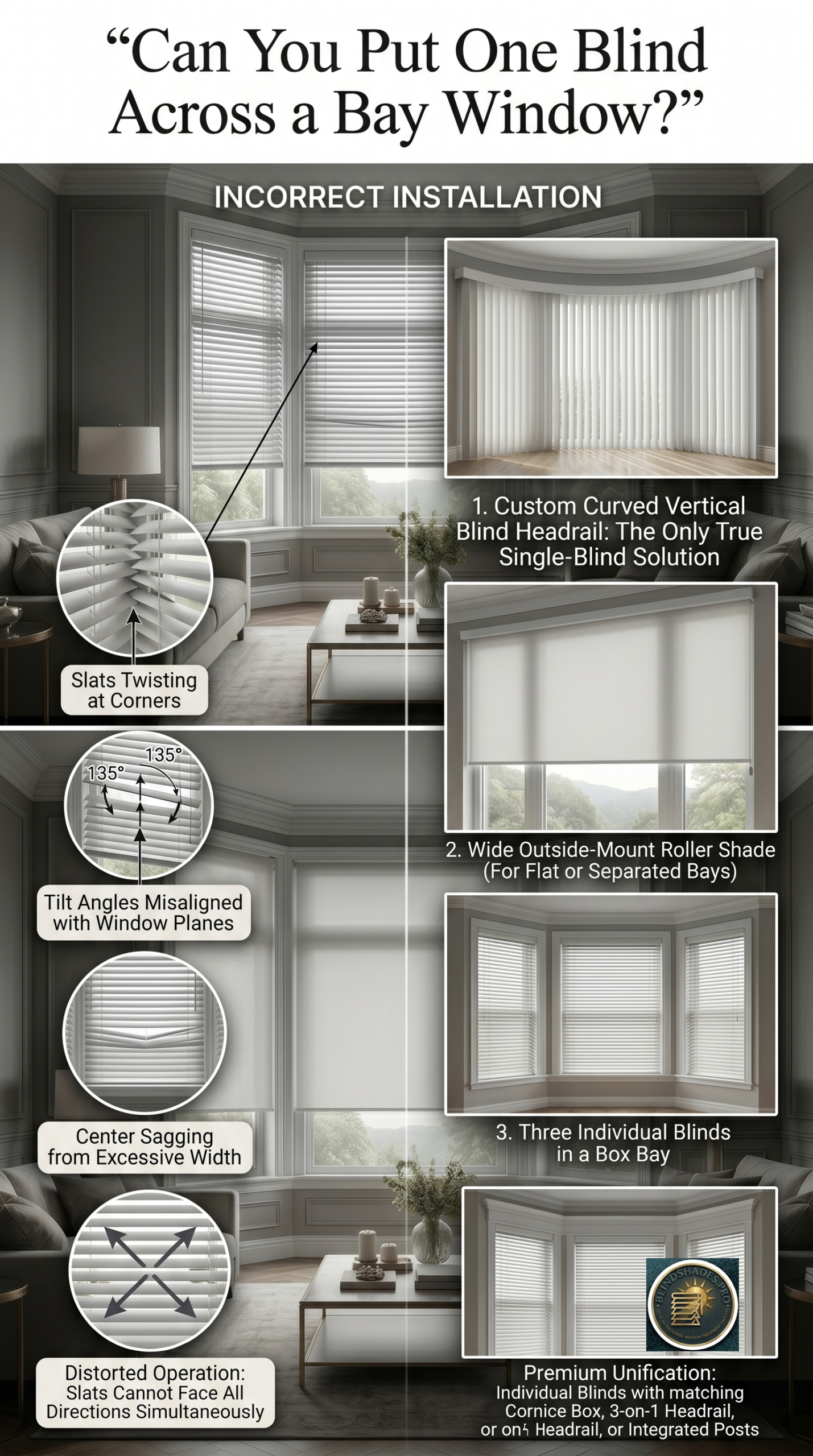
Key Takeaways:
- You cannot put one standard horizontal blind across an angled bay window because the slats must tilt at the same angle simultaneously, but the three panels of a bay window face different directions; a single wide horizontal blind spanning a 30 or 45-degree bay would have its slats twisted and misaligned at the corner transitions and would bow downward at the center from its own weight above approximately 72 inches in width
- A custom curved vertical blind headrail — manufactured to follow the exact 30 or 45-degree bay window profile — is the only product that genuinely creates a single blind across an angled bay window; the vertical louvers traverse continuously across all three sections as one action; Factory Direct Blinds confirms custom curved headrails can follow any bay window profile
- Three methods create the APPEARANCE of one blind across a bay window while keeping individual panel operation: a 3-on-1 headrail (three blind panels sharing one continuous headrail and valance); Norman-style bay posts (structural posts at the angled corners making individual shutters appear unified); and a continuous valance or cornice box spanning the full bay width
- The 3-on-1 headrail works correctly for separated bay windows where panels sit on a flat wall; for angled touching bay panels, the continuous headrail must specifically accommodate angle changes — most standard 3-on-1 headrail products are designed for flat windows and will not follow bay angles
- A single outside-mount shade spanning the full bay width is operationally viable only up to approximately 72 to 84 inches of width with manual cordless or corded operation; above this width motorization is essentially mandatory; a single shade across a 120-inch bay weighs approximately 8 to 12 lbs for a cellular shade and exceeds the lift force capacity of standard cord hardware
⭐ Quick Answer — Can You Put One Blind Across a Bay Window?
- Why a Standard Horizontal Blind Fails Across an Angled Bay — The Technical Reason: You cannot put one blind across a standard angled bay window using a horizontal venetian or faux wood blind. Two specific failures occur. (1) The slat angle problem: a horizontal blind tilts all slats simultaneously to the same angle via a single tilt rod; but the three panels of a bay window face different directions (center faces forward; side panels face 30 or 45 degrees); a single wide blind cannot tilt its slats to the correct orientation relative to all three window planes at once — the slats at the corner transitions would be twisted and misaligned. (2) The center sag problem: a horizontal blind spanning more than approximately 72 inches bows downward at the center from its own weight; Bartlett Blinds confirms faux wood horizontal blinds are “prone to bowing in the middle” at wide widths; a 120-inch bay blind at 2-inch faux wood creates approximately 15 to 20 lbs of suspended weight, far beyond standard cord hardware capacity
- The Width Threshold — When a Single Blind Is and Is Not Viable: For one blind across a bay window: under 60 inches on a flat separated panel configuration — viable; single blind on a flat surface handles this width with standard hardware. 60 to 72 inches flat bay — marginal; cordless preferred; center sag detectable. 72 to 96 inches flat bay — not recommended; center sag visible; cord hardware under strain. Over 96 inches — not viable for any bay configuration; 15 to 20 lbs for faux wood; standard cord mechanisms fail. For angled bays with 30 or 45-degree panels: no width is viable for a standard horizontal blind regardless of weight. The angle failure occurs at any width; even a narrow angled bay with three sections at different orientations cannot be covered by a single flat horizontal blind
- The Only True Single-Blind Solution and the Three-Level Unity Framework: A custom curved vertical blind headrail is the only product that genuinely puts a single continuous blind across an angled bay window. The headrail is manufactured to follow the exact 30 or 45-degree bay profile; the vertical louvers traverse continuously across all three sections as one unified action. Factory Direct Blinds confirms “curved windows typically use flexible headrails that follow the curve in a single continuous track.” The limitation: vertical louvers provide glare control but not full blackout. The three-level unity framework for one blind across a bay window: Level 1 — visual unity (three separate blinds that LOOK like one; achievable for any bay); Level 2 — operational unity (three blinds that move together via motorized synchronized control; $450–$1,200 for three panels); Level 3 — true single unit (one blind, one headrail, one control; achievable only with curved vertical blind headrail on angled bay, or single shade on flat separated bay)
- The 3-on-1 Headrail — Achieves Visual Unity but Has a Critical Bay Angle Limitation: The 3-on-1 headrail (Blinds Chalet) is a single continuous headrail carrying three blind panels with a shared valance; each panel operates independently while the top line appears unified. It achieves Level 1 visual unity effectively. The critical limitation for bay windows: the 3-on-1 headrail is a straight horizontal bar designed for flat window configurations. For separated bay windows where all three panels sit on the same flat wall with wall material between them: the 3-on-1 headrail works correctly. For angled touching bay panels at 30 or 45 degrees: a straight headrail cannot follow the bay angles. Mounting three individual headrails at the correct angles and adding a continuous valance or cornice box above them achieves the same visual result without requiring a single headrail to follow bay angles. Norman USA also confirms “bay posts specially designed for bay windows” make individual shutters appear as a single unified unit
- Panel Track, Weight Threshold, and the Three Visual Unity Methods Ranked: Panel track is suitable for one blind across a bay window only in specific configurations: 90-degree box bay (standard corner track brackets accommodate the right angle); separated flat bay (panel track runs continuously above all three panels on the flat wall). Panel track is NOT suitable for 30 or 45-degree angled touching bay panels. For single outside-mount shades: manually operable to approximately 72 to 84 inches; above this motorization is essentially mandatory (a single cellular shade across a 120-inch bay weighs approximately 8 to 12 lbs). The three visual unity methods ranked by cost: (1) Continuous fabric valance above three separate headrails: $50–$150; (2) 3-on-1 headrail with shared valance (flat/separated panels only): included in blind cost; (3) Three-sided cornice box spanning full bay alcove width: $150–$400 but provides the most complete visual unification by hiding all individual headrails entirely
- Best Sources: Custom curved vertical blind headrails for angled bay windows → Factory Direct Blinds bay window vertical blinds · 3-on-1 headrail systems for flat/separated bay panels → Blinds Chalet multiple blinds on one headrail · Three-on-one arrangements with cellular, woven wood, and Roman shades → Blindsgalore bay window treatment guide
⚠️ The Worth-It Decision Matrix for One Blind Across a Bay Window: The right approach depends on the bay type and the level of unity needed. True single unit across any angled bay: custom curved vertical blind headrail (only option; vertical louvers; no blackout). Visual unity without single-unit coverage (any angled bay): cornice box plus individual panels ($150–$400 cornice) or continuous valance plus individual panels ($50–$150 valance). Three blinds that move simultaneously: motorized with synchronized group control ($450–$1,200 add for three panels). Single shade across flat or separated bay under 72 inches: single outside-mount shade manual cordless. Single shade across flat or separated bay 72 inches and over: single outside-mount motorized shade. 90-degree box bay single treatment: panel track or single wide outside-mount shade. What does NOT achieve one blind across an angled bay: standard horizontal blind (slat angle failure); 3-on-1 headrail on angled panels (straight headrail cannot follow 30 or 45-degree angles); any single shade wider than 72 inches operated manually (weight exceeds cord capacity). For the full bay window treatment selection guide by angle configuration, headrail depth chart, and the cardboard interference test, see What Are the Best Blinds for Bay Windows. See the full technical failure analysis below.
💡 Continuous Treatments by Bay Type and the Separated Bay Exception: 3 Day Blinds states continuous treatments are “not suitable for sharply angled bays.” This rule applies specifically to 30-degree and 45-degree angled bay windows with touching panels. Two bay configurations ARE suitable for continuous single treatments. 90-degree box bay: the side panels are perpendicular to the center; ceiling-mounted panel track can turn 90-degree corners with standard corner brackets; a panel track spans all three sections including the side panels and operates as one continuous system. Separated bay window: panels are on a flat wall with visible wall material or trim (2 or more inches) between them; the 3-on-1 headrail works correctly because the headrail sits on a flat mounting surface and does not need to follow bay angles; a panel track above a separated bay also runs on a flat ceiling track above all three panels without needing angle accommodations. The separated bay exception is important: many homeowners with separated bay windows apply the “individual panels only” rule unnecessarily because they read advice meant for angled touching panels. For a separated bay, a 3-on-1 headrail with cellular, Roman, or woven wood shades is entirely appropriate and creates a genuinely unified appearance with independent panel operation. For the curtain rod and continuous drapery approach including curved rods with elbows at the angles and stack-back calculation for bay windows, see How Do You Hang Curtains on a Bay Window. See the full worth-it assessment table below.
📖 Read the complete guide below for: the technical failure analysis of horizontal blinds across angled bays (slat angle problem; center sag above 72 inches; 15 to 20 lbs at 120-inch span), the width threshold table (under 60 inches viable flat only; 60-72 marginal; 72-96 not recommended; over 96 not viable any bay), the custom curved vertical blind headrail as the only true single-blind solution (Factory Direct Blinds; continuous traverse; limitation = glare control not blackout), the three-level unity framework (Level 1 visual unity $50-$400; Level 2 operational unity $450-$1,200; Level 3 true single-unit; specific products for each level), the 3-on-1 headrail limitation at angled bays (straight headrail cannot follow 30/45-degree angles; works for flat separated panels only), the panel track conditional suitability (90-degree box bay = yes; 30/45-degree angled touching = no; separated flat bay = yes), the weight threshold for single wide outside-mount shades (manual to 72-84 inches; motorized required above; 8-12 lbs for cellular at 120-inch span), and the complete worth-it decision matrix by bay type and unity level required.
One Blind Across a Bay Window — Why Standard Horizontal Blinds Fail
The technical explanation absent from all competitor guides.
Every guide for bay windows says “individual panels are the correct approach.” None explain the specific physics of why a single horizontal blind fails on an angled bay.
The Slat Angle Problem
A horizontal venetian blind works by rotating all slats simultaneously to the same tilt angle via a single tilt rod. When the slats are tilted closed, they all rotate to the same orientation — typically lying flat at approximately 0 degrees or pitched at approximately 90 degrees depending on position.
In a bay window with angled side panels (30 or 45 degrees), the three sections face three different directions:
- The center panel faces directly outward
- The two side panels face outward at 30 or 45 degrees to the left and right
The failure: If a single wide horizontal blind were stretched across all three sections of an angled bay:
- The tilt rod would tilt all slats to the same angle
- The slats at the center would be correctly oriented relative to the center panel’s glass
- The slats at the side transitions would be misaligned — tilting toward a direction irrelevant to the angled side panel’s glass
- At the angled corner transition: the slats would be physically twisted where the blind changes direction, creating a visually conspicuous crumple zone
The center sag: Separately from the angle problem, a horizontal blind spanning more than approximately 72 inches will bow downward at the center from its own weight. Bartlett Blinds and Shutters confirms: “horizontal aluminum or faux-wood blinds can become extremely heavy at wide widths, making them difficult to lift and prone to bowing in the middle.”
A 120-inch wide bay window opening covered by a single faux wood 2-inch blind would create approximately 15 to 20 lbs of suspended weight on a single set of cord hardware — far beyond the operational design load of standard blind hardware.
The Width Threshold for Single Horizontal Blinds
The specific numbers absent from all guides.
| Bay Width | Single Horizontal Blind Viability | Notes |
|---|---|---|
| Under 60 inches | Viable (flat/separated bay only) | No angle problem for flat panels; standard cord hardware handles the weight |
| 60 to 72 inches | Marginal (flat bay only; begin to feel heavy) | Cordless preferred at this width; center sag becomes detectable |
| 72 to 96 inches | Not recommended even for flat bays | Center sag visible; cord hardware under strain; operate with difficulty |
| Over 96 inches | Not viable for any bay | 15–20+ lbs for faux wood; center sag severe; standard cord mechanisms fail |
The conclusion: Even for flat/separated bay windows with no angle problem, a single horizontal blind wider than approximately 72 inches has operational difficulties. For angled bays (the majority of residential bay windows), no horizontal blind of any width works across all three panels.
The One True “Single Blind Across Bay Window” Solution
The only product that genuinely creates one blind across an angled bay — absent from all competitor buying guides.
A custom curved vertical blind headrail is the only product that legitimately puts a single continuous blind across an angled bay window.
How it works: Factory Direct Blinds confirms: “curved windows typically use flexible headrails that follow the curve in a single continuous track.” A custom curved vertical blind headrail is manufactured to follow the exact profile of the bay window — the track bends at the corner angles (30 or 45 degrees) to match the bay. The vertical louvers (vanes) hang from carrier clips attached to this curved track and traverse continuously across all three sections.
The operation: One pull of the traverse cord opens or closes ALL vanes across the full bay — center panel and both side panels simultaneously. It operates as a single unified blind.
The limitations:
- Vertical louvers provide glare control and moderate privacy but not the same full blackout performance as closed horizontal slats
- The fabric vanes on curved headrails cannot be tilted the same way as vanes on a standard straight headrail (the curve changes the tilt geometry)
- Custom manufacturing is required for each bay window’s specific corner angles and dimensions
- Cost is higher than standard vertical blind headrails due to the custom curve fabrication
Best for: Homeowners who genuinely want one unified operating blind across an angled bay and are willing to accept vertical louvers as the treatment type. Particularly appropriate for large living room bays where a bold unified window treatment is the design intent.
The Three-Level Unity Framework
The distinction absent from all competitor guides — not all “unified” bay window treatments are the same.
Understanding which level of unity is needed prevents over-engineering the solution:
Level 1 — Visual Unity (Three Separate Blinds That LOOK Like One)
Three individual blinds operate independently but appear visually cohesive from inside the room. This is achievable for any bay window at any angle.
Methods:
- Continuous valance running horizontally across all three panel tops
- Three-sided cornice box spanning the full bay alcove width, hiding individual headrails
- 3-on-1 headrail (see below): continuous headrail with shared valance
- Norman bay posts: structural posts at the angled corners designed to make shutters appear unified
Cost: Visual unity elements add $150–$400 for a cornice box; $50–$150 for a fabric valance; included in the Norman shutter system.
Level 2 — Operational Unity (Three Blinds That MOVE Together as One)
Three individual blinds operate simultaneously from a single control. Each blind is still a separate physical unit.
Methods:
- Motorized blinds with synchronized control: all three panels programmed to operate from one button, app, or voice command; most smart home motorized blind systems (Lutron Serena, Somfy, Hunter Douglas PowerView) allow group control
- Hard-wired electric motorization: all three panels wired to a single wall switch
Cost: Motorized bay window blinds add approximately $150–$400 per panel for the motor; total for a three-panel bay: $450–$1,200 above material cost.
Level 3 — True Single-Unit Coverage (One Blind, One Headrail, One Control)
One physical treatment spans all three sections.
What achieves it:
- Custom curved vertical blind headrail (any angled bay)
- Single shade outside-mount on a flat/separated bay
- Single wide curtain across the entire bay opening (no coverage of glass; decorative framing only)
What does NOT achieve it:
- Standard horizontal blinds on any angled bay (slat angle failure + center sag)
- 3-on-1 headrail on an angled bay (three headrails, not one)
The 3-on-1 Headrail — What It Does and Its Bay Window Limitation
The specific limitation absent from all guides.
Blinds Chalet confirms: “a 3-on-1 headrail is a single, continuous headrail that carries two or more individual blind panels. You get a unified top line and shared valance/cassette, while each panel operates on its own.”
What the 3-on-1 headrail achieves:
- A single continuous headrail line across all three panels — the top of the treatment looks like one piece
- A single shared valance hiding individual operational mechanisms
- Each panel operates independently while appearing unified
The bay window limitation: The 3-on-1 headrail is designed and built for flat window configurations — the headrail is a straight horizontal bar. For separated bay windows where all three panels sit on the same flat wall with wall material between them: the 3-on-1 headrail works correctly.
For angled touching bay windows with panels at 30 or 45 degrees: a straight continuous headrail cannot follow the bay angles. The headrail would have to change direction at the corners — which is not how a standard 3-on-1 product is manufactured.
The workaround for angled bays: Mount each of the three blinds on its own individual headrail at the correct angle, then add a continuous valance or cornice box ABOVE all three headrails. The valance achieves the visual unity that a 3-on-1 headrail provides, without requiring a single headrail to follow bay angles.
The Panel Track — When It Works for Bay Windows
The conditional analysis absent from all guides.
3 Day Blinds states: continuous treatments are “not suitable for sharply angled bays.” No guide explains WHEN panel track IS appropriate for bay windows.
Panel track works for bay windows when:
- 90-degree box bay: the side panels are perpendicular to the center; the ceiling-mounted track can turn 90-degree corners with standard corner track brackets; panel track can cover all three sections including side panels
- Separated bay window: the panels are on a flat wall with visible wall material between them; the panel track runs continuously across the full width above all three panels as if they were windows on a flat wall; no angled corner track is needed
Panel track does NOT work for:
- 30-degree or 45-degree angled touching bay panels: the angled corner between adjacent panels requires the ceiling track to bend at the same angles, which standard panel track corner brackets cannot accommodate
The Worth-It Assessment — What to Specify
The decision framework:
| Goal | Best Solution |
|---|---|
| True single blind across ANY angled bay | Custom curved vertical blind headrail |
| Visual unity without true single-unit coverage | Cornice box + individual panels |
| Three blinds that move simultaneously | Motorized with group control ($450–$1,200 add) |
| Budget visual unity | Continuous fabric valance above three separate headrails |
| Single shade across FLAT/SEPARATED bay (under 72″ wide) | Single outside-mount shade (manual) |
| Single shade across flat/separated bay (72″+ wide) | Single outside-mount motorized shade |
| 90-degree box bay single treatment | Panel track or single wide outside-mount shade |
Where to Order
For custom curved vertical blind headrails for angled bay windows: Factory Direct Blinds at factorydirectblinds.com/collections/vertical-blinds-on-bay-windows — custom headrails that follow curved and angled bay window profiles; the only commercially available product that achieves a genuine single blind across an angled bay.
For 3-on-1 headrail systems for flat/separated bay windows: Blinds Chalet at blindschalet.com/upgrade-1-multipleheadrails.html — 2-on-1 and 3-on-1 headrail configurations for cellular, faux wood, and Roman shade panels; each section operates independently; unified top line and shared valance; best for flat/separated bay panels.
For three-on-one arrangements with cellular, woven wood, or Roman shade panels: Blindsgalore at blindsgalore.com — cellular, woven wood, and Roman shade panels in three-on-one arrangement sharing one headrail and valance; “CELLULAR BLINDS, or WOVEN WOOD SHADES or ROMAN SHADES would work well for this three on one arrangement.”
Frequently Asked Questions
Can you put one blind across a bay window? You cannot put one standard horizontal blind across an angled bay window. The slats of a horizontal blind must all tilt to the same angle simultaneously, but the three panels of an angled bay face different directions, so the slats cannot be correctly oriented relative to all three window planes at once. Above approximately 72 inches in width, a single horizontal blind also sags at the center from its own weight. The exception is a custom curved vertical blind headrail that follows the bay window profile, which is the only product that genuinely puts a single continuous blind across an angled bay.
What is the only true single-blind solution for an angled bay window? A custom curved vertical blind headrail is the only product that creates a genuine single blind across an angled bay window. The headrail is manufactured to follow the exact 30-degree or 45-degree bay window profile, bending at the corner angles, and the vertical louvers traverse continuously across all three sections as one unified action. Factory Direct Blinds confirms that custom headrails can follow curved and angled bay window profiles. The limitation is that vertical louvers provide glare control rather than the full blackout performance of closed horizontal slats.
What is the 3-on-1 headrail and does it work for bay windows? A 3-on-1 headrail carries three individual blind panels on one continuous headrail with a shared valance, giving the appearance of a single unified treatment while allowing each panel to operate independently. It works correctly for separated bay windows where all three panels sit on the same flat wall with wall material between them. For angled touching bay panels at 30 or 45 degrees, a standard 3-on-1 headrail does not work because the straight headrail cannot follow the bay angles. For angled bays, three separate individual headrails with a continuous valance or cornice box above them achieves the same visual result.
How do you make bay window blinds look like one unified treatment? Three methods make bay window blinds look like one unified treatment without requiring a single headrail. A 3-on-1 headrail creates a continuous top line and shared valance for flat separated bay panels. Norman-style bay posts at the angled corners make individual plantation shutters appear as a single unit. A continuous valance or three-sided cornice box spanning the full bay alcove width hides the individual headrails from the room side while each blind operates independently behind it. For blinds that also MOVE together as one unit, motorized blinds with synchronized group control operate all three panels simultaneously from a single control.
At what width does a single bay window blind become impractical? A single horizontal blind becomes impractical above approximately 72 inches in width due to center sag from its own weight and the strain on standard cord hardware. Faux wood blinds at 2-inch slats spanning 120 inches create approximately 15 to 20 lbs of suspended weight, far exceeding the operational design load of standard cord mechanisms. For single outside-mount shades spanning a flat or separated bay window under 72 inches: manual cordless operation is practical. Above 72 to 84 inches: motorized operation is effectively required for comfortable single-panel bay window shade operation.
Related Guides on BlindShades.pro
- The Best Bay Window Blinds & Shades Buying Guide
- What Are the Best Blinds for Bay Windows
- How Do You Hang Curtains on a Bay Window
- Can You Put Plantation Shutters in a Bay Window
- Are Cellular Shades Good for Bay Windows
By Michael Turner | 30 Years Home Improvement Expertise | Updated 2026 | BlindShades.pro
