What Are the Best Blinds for French Doors?

Authored By Michael Turner -30 Years Home Improvement Expertise | Updated 2026 | BlindShades.pro
Updated on July 15, 2026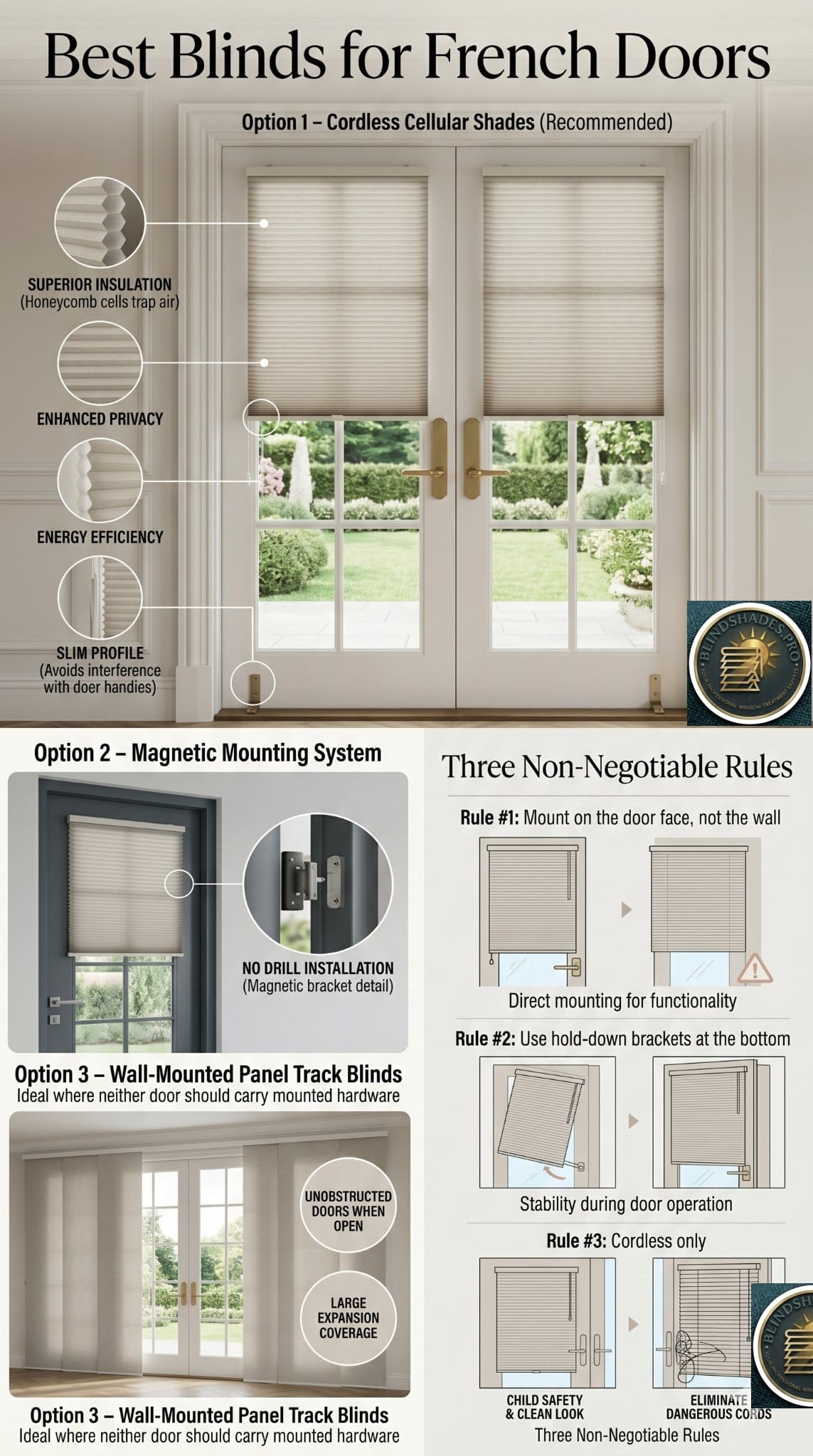
Key Takeaways:
- The four critical differences between French door blinds and standard window blinds: (1) the blind mounts ON the door face, not the wall or ceiling; (2) hold-down brackets at the bottom are not optional — without them the blind swings, rattles, and knocks against the glass every time the door opens; (3) cordless operation is required — corded blinds entangle with door hardware; (4) handle projection must be measured before ordering — if the headrail is deeper than the handle’s clearance zone, the blind will crease and the motorized version will stall
- Door material determines which mounting method is possible before any blind type is selected: wood French doors allow standard drill installation; fiberglass and composite doors allow drilling but require pre-drilling and warranty checks; steel French doors cannot be drilled without voiding the manufacturer’s warranty and creating rust entry points — magnetic mounting systems are the correct solution; uPVC and vinyl-framed doors have hollow sections that provide no screw grip — no-drill systems are required
- For inswing French doors (doors that swing into the room): specify lightweight treatments only — roller shades or 1-inch aluminum cellular shades; heavy blinds create a pendulum effect when the door swings that can pull the treatment off the hold-down brackets; the jolt force when a French door slams is approximately 2 to 3 times the blind’s static weight
- For double French doors: the two most practical approaches are (a) two matching door-mounted blinds, one per door panel with independent hold-downs, or (b) a single wall or ceiling-mounted panel track blind covering the entire opening from above — in this case neither door carries any hardware and both doors swing freely; the panel track is stationary but provides privacy only when both doors are closed
- Always measure each door glass panel independently, even on a matching pair; French doors are installed by hand on-site and slight variations of 0.25 inches or more between the left and right panel are common; an order based on one measurement applied to both panels will result in one blind that fits and one that is marginally too wide or too narrow
Related guides: for the full decision — mounting mechanics, the handle measurement, and hung vs tracked vs enclosed — see the complete French door blinds & shades guide.
⭐ Quick Answer — What Are the Best Blinds for French Doors?
- The Four Non-Negotiable Rules for Any French Door Blind: The best blinds for French doors differ from standard window blinds in four fundamental ways. (1) Mount ON the door face, not the wall or ceiling: BuyHomeBlinds (January 2026) confirms: “for nearly all French door uses, the standard is an outside mount with the headrail bracket attached to the surface of the door over the glass — treatment follows the door at all times.” (2) Hold-down brackets at the bottom are essential: BuyHomeBlinds confirms: “any treatment installed without hold down will swing, rattle and knock against the glass with every swing of the French door.” Hold-down brackets are small clips at the bottom corners of the glass panel; the bottom rail clips into them to keep the blind flat against the door. (3) Cordless operation is required: corded blinds “swing out when the door opens and can become entangled with the hardware” (BuyHomeBlinds). (4) Measure handle projection first: Weffort (March 2025) confirms handle clearance is the most common mistake — “if your shade rolls down and hits the handle, the smart motor will sense the resistance and stop, or worse, the fabric will bunch up and crease”
- The Door Material Drilling Matrix — Check Before Selecting Any Blind Type: The correct mounting method for French door blinds is determined by door material before any blind type is chosen. Wood French doors: standard drill installation; #8 wood screws; straightforward. Fiberglass/composite: can drill but pre-drill carefully to avoid delaminating; check door manufacturer warranty before drilling. Steel/metal French doors: cannot drill — drilling voids the manufacturer warranty and creates rust entry points; HomeToSight (1 month ago) confirms the REGAL estate MagMount magnetic system “solves the fundamental problem of mounting blinds on metal French doors: you cannot drill into a steel door frame without voiding warranties or creating rust points; its magnetic top rail latches onto the door surface in seconds.” uPVC/vinyl-framed French doors: the hollow sections of uPVC framing provide no screw grip — adhesive or magnetic mounting only. For steel and uPVC doors: specify a magnetic mounting system before selecting any blind type — a cellular shade with a standard screw-mount headrail is the wrong product regardless of how well it fits the glass
- Inswing vs Outswing — Why Lightweight Is Essential for Inswing French Doors: Selecting the best blind for a French door requires knowing the swing direction. Inswing French doors (open INTO the room): when opened, the door and blind sweep the room interior; the blind experiences a pendulum effect with the blind’s weight acting as a counterweight swinging away from the door face; a door slam creates a jolt force of approximately 2 to 3 times the blind’s static weight on the mounting hardware. For a full-glass French door (36″ × 72″): roller shade weighs approximately 1 to 2 lbs (2 to 6 lbs under slam); 2-inch faux wood blind weighs approximately 4 to 8 lbs (8 to 24 lbs under slam). Weffort confirms roller shades are preferred because they “weigh significantly less, which puts less strain on the mounting screws.” The specification rule for inswing doors: roller shades or 1-inch aluminum cellular shades only; 2-inch faux wood blinds are not recommended for any French door. Outswing French doors (open outward): blind stays indoors on opening; magnetic hold-downs more critical because the door swings away from the building
- Double French Door Strategy and the “Measure Each Door Separately” Rule: For double French door blinds, two approaches are practical. (1) Two door-mounted blinds: one blind per door panel, each with its own hold-down brackets, ordered as separate custom units; both blinds must be independently released before each door can open. (2) Single wall or ceiling-mounted panel track blind covering the entire opening from above: neither door carries any hardware; both doors swing freely; HotianWindows (December 2025) confirms this option — “stays stationary when door opens; door passes behind the treatment.” Limitation: provides privacy only when both doors are closed. The separate measurement rule: HotianWindows explicitly confirms: “Measure Each Door’s Glass SEPARATELY — even if they look identical, slight variations exist.” French doors are fitted on-site and the left and right glass panels commonly vary by 0.25 inches or more. Always measure each door glass independently at three points and order each blind as a separate custom unit with its own specific dimensions
- The 1-Inch Slat Standard and the Best Blind Types Ranked: For the best blinds for French doors by treatment type: Cordless cellular shade (single cell): top recommendation — slim profile; insulation; lightweight (1 to 2 lbs); Wayfair confirms 1.5-inch sidelight cellular shade minimum 1.75-inch inside frame depth. Roller shade: best for motorized; tightest stack at top (glass fully clear when open); very lightweight; Weffort recommends over faux wood for motorized. 1-inch aluminum mini-blind: correct venetian specification for French doors; projects only 0.75 inches from door surface when tilted (vs 2-inch slat at 1.5 inches); Blinds Chalet confirms 1-inch slat as most common for French doors. Double-cell cellular shade: best insulation; slightly heavier than single cell; better for low-traffic doors or outswing. Roman shade: decorative; suitable for lower-traffic interior French doors. 2-inch faux wood blind: not recommended — heavy (4 to 8 lbs); high pendulum force; projects 1.5 inches from door surface; repeated door slam load degrades mounting screw grip
- Best Sources: Outside mount standard, hold-down brackets free on all French door orders, cordless specification → BuyHomeBlinds French door guide · Handle projection measurement, slim cassette selection, magnetic hold-down for motorized → Weffort smart retrofit guide · Magnetic mounting for steel/metal doors, REGAL MagMount, RPET impact-resistant slats → HomeToSight French door blinds
⚠️ The Complete French Door Blind Selection Table and Handle Projection Calculation: French door blind selection by priority: Privacy + insulation first = double-cell cordless cellular shade (outside mount on door; hold-down brackets; 1.5-inch headrail or slimmer). Motorized + minimalist = roller shade with slim cassette (tightest stack; lightest weight; magnetic hold-down brackets auto-release when motor raises blind). Venetian blinds = 1-inch aluminum only (projects 0.75 inches; lighter than 2-inch faux wood). No-drill steel door = REGAL MagMount magnetic system (top rail + dual magnetic hold-downs; no warranty voiding; no rust). uPVC door = adhesive mounting or magnetic system only. Double French doors = two matching door-mounted cellular shades OR single wall-mounted panel track (doors swing free; privacy when closed only). Handle projection calculation: (1) Measure handle projection from door surface (typically 1.5 to 3 inches for lever handles; 1 to 2 inches for round knobs). (2) Compare to selected headrail depth (typically 1.5 to 3 inches for standard; 1 to 1.5 inches for slim-profile). (3) If headrail depth is equal to or less than handle projection: no spacer blocks needed. (4) If headrail depth exceeds handle projection: add spacer blocks equal to the depth difference to push headrail away from door surface. (5) Alternative: order blind to cover glass above the handle only and add a second shorter blind below the handle. Lever handles require clearance for the full lever arm arc — not just the static projection distance. For between-glass French door blind options including factory-integrated and Pella Slimshade systems, see Can You Put Blinds Between French Door Glass. See the full four-difference guide below.
💡 The Inswing vs Outswing Decision Framework and Spacer Block Protocol: Choosing the best blinds for French doors by swing direction: Inswing (opens into room): specify roller shade or single-cell cellular shade (1 to 2 lbs); avoid 2-inch faux wood (4 to 8 lbs; door slam = 8 to 24 lbs jolt on mounting screws); use standard hold-down brackets; lightweight reduces pendulum force on mounting screws and hold-down clips. Outswing (opens toward exterior): door swings away from building; blind stays indoors; magnetic hold-down brackets particularly important (door swings away from wall stop that would otherwise limit swing force); any lightweight treatment acceptable. Spacer block installation protocol when headrail is deeper than handle projection: (1) Install spacer blocks on the headrail mounting brackets before attaching to door. (2) Spacer blocks push headrail further from door surface so headrail and handle are at the same depth. (3) Use two spacer blocks of equal thickness — one per bracket — to maintain headrail level. (4) Confirm spacer blocks are flush against door surface and bracket is flush against spacer block before fastening final screws. HotianWindows confirms: “Spacer Blocks / Extension Brackets: used behind the headrail brackets; these small blocks push the headrail further away from the door surface, creating extra clearance for bulky handles — essential if your chosen blind headrail is deeper than the space available above the handle.” Multiple small panes (grids or lites): HotianWindows confirms: “Multiple small panes = usually best to treat the whole glass area as one with a single blind per door.” Measure the total glass area (top to bottom of all panes; left to right of all panes) and order one blind per door panel covering the full glass area. For the complete installation protocol including hold-down bracket installation, the 30-degree side channel technique, and the motorized remote pairing sequence, see How Do You Install Blinds on French Doors. See the full door material drilling matrix below.
📖 Read the complete guide below for: the four critical French door blind rules (mount on door; hold-down brackets essential; cordless required; measure handle projection first), the door material drilling matrix (wood standard drill; fiberglass pre-drill and warranty check; steel = magnetic mounting only — drilling voids warranty and creates rust; uPVC = no-drill), the handle projection vs headrail depth calculation with spacer block protocol, the inswing vs outswing distinction (inswing = lightweight only; door slam = 2 to 3 times static weight jolt), the door-mounted vs wall-mounted strategy for double French doors (panel track stationary; both doors swing free), the 1-inch slat standard for venetian blinds on French doors (0.75-inch projection vs 2-inch at 1.5 inches), the measure-each-door-separately rule (0.25-inch typical variation on matching pairs), and the complete treatment type comparison ranked by weight, projection, and suitability.
Best Blinds for French Doors — The Four Critical Differences from Standard Windows
Why French door blind selection is fundamentally different from standard window blind selection.
VelaBlinds (September 2025) states: “The best blinds for French doors are low-profile styles that mount directly onto the door. Finding blinds that fit properly without obstructing handles can be a major challenge for any project.”
The four critical differences:
1 — The blind mounts on the door face, not the wall
BuyHomeBlinds (January 2026) confirms: “For nearly all French door uses, the standard is an outside mount with a headrail bracket attached to the surface of the door over the glass. Treatment is applied on the entire glass surface and follows the door at all times.”
For a standard window: the blind mounts on the wall or window frame — a stationary surface. For a French door: the blind mounts on the door panel — a surface that moves multiple times per day. This single difference drives every other French door blind requirement.
2 — Hold-down brackets at the bottom are essential
BuyHomeBlinds confirms: “Any treatment installed without hold down will swing, rattle and knock against the glass with every swing of the French door.”
Hold-down brackets are small clips installed at the bottom corners of the glass panel. The bottom rail of the blind clips into them, keeping the treatment flat against the door surface at all times.
3 — Cordless operation is required
BuyHomeBlinds confirms: “All French door applications are strongly recommended to be cordless blinds and shades. Cords that are on corded treatments swing out when the door opens and can become entangled with the hardware.”
Cords on a door-mounted blind present two problems: tangling with door hardware during opening, and safety risk near children or pets.
4 — Handle projection must be measured first
Weffort (March 2025) confirms: “The biggest mistake people make is ignoring the door hardware. If your shade rolls down and hits the handle, the smart motor will sense the resistance and stop, or worse, the fabric will bunch up and crease. To fix this, you must measure the depth of your door handle.”
The Door Material Drilling Matrix
The mounting method is determined by door material before any blind type is chosen — absent from all competitor guides.
| Door Material | Can Drill? | Correct Mounting Method |
|---|---|---|
| Solid wood | YES | Standard bracket screws; #8 wood screws; 1.5–2″ bite |
| Hollow-core wood | YES (with care) | Pre-drill; use hollow-door anchors for light treatments |
| Fiberglass/composite | YES (with caution) | Pre-drill carefully; check door manufacturer warranty |
| Steel/metal | NO | Magnetic mounting systems only; drilling voids warranty and creates rust entry points |
| uPVC/vinyl-framed | NO | Hollow sections provide no screw grip; adhesive or magnetic mounting only |
| Aluminium-framed | Depends | Check frame section; some aluminium framing allows drilling; verify |
HomeToSight (published 1 month ago) confirms: “The REGAL estate MagMount solves the fundamental problem of mounting blinds on metal French doors: you cannot drill into a steel door frame without voiding warranties or creating rust points. Its magnetic top rail latches onto the door surface in seconds, and the dual magnetic hold-down brackets anchor the bottom rail.”
For steel and uPVC French doors: specify a magnetic or adhesive mounting system before selecting any blind type. A cellular shade with a standard screw-mount headrail is the wrong product regardless of how well it fits the glass.
The Handle Projection Measurement and Headrail Depth Calculation
The specific calculation absent from all competitor guides.
Every French door has a door handle (lever, knob, or pull). This handle projects from the door surface at a specific depth. The blind’s headrail also has a specific depth. These two measurements must be reconciled before ordering.
The measurement:
- Measure the handle projection: the distance from the door surface to the furthest point of the handle (typically 1.5–3 inches for lever handles; 1–2 inches for round knobs)
- Measure — or confirm from the product spec — the headrail depth of the proposed blind
The calculation:
- If headrail depth ≤ handle projection: the blind can be mounted above the handle with the headrail sitting flush at the same depth as the handle; no spacer blocks required
- If headrail depth > handle projection: the headrail will project beyond the handle; specify spacer blocks to push the headrail further from the door surface equal to the depth difference
- Alternative: order the blind to cover only the glass ABOVE the handle; add a second shorter blind below the handle
Handle style matters: HotianWindows (December 2025) confirms: “Lever handles often need more clearance than round knobs.” A lever handle with an arc motion requires clearance for the full lever arm stroke — not just the static projection.
BuyHomeBlinds confirms: “Handle projection is a measurement made by our specialists at each French door prior to the product specification.”
The Inswing vs Outswing Distinction
The operational difference absent from all competitor guides.
Inswing French doors (doors that open INTO the room): When opened, the door (and the blind mounted on it) swings into the room. The blind effectively sweeps the room interior. Heavy blinds on inswing doors create a significant pendulum effect — the blind’s weight acts as a counterweight swinging away from the door face, which can pull the blind off the hold-down brackets.
The recommendation for inswing doors: lightweight treatments only — roller shades or 1-inch aluminum cellular shades. Weffort confirms: “roller shades weigh significantly less, which puts less strain on the mounting screws.”
Outswing French doors (doors that open OUTWARD from the room): When opened, the door swings toward the exterior. The blind (on the interior door face) stays in the interior and does not sweep the room. The hold-down brackets are more critical for outswing because the door acceleration as it opens pushes the blind forward off the hold-down clip.
The pendulum force calculation: A door slam creates a jolt force of approximately 2 to 3 times the blind’s static weight on the mounting hardware. Weffort confirms lightweight roller shades are preferred specifically because they “put less strain on the mounting screws.” For a full-glass French door (36 inches × 72 inches):
- Roller shade: approximately 1–2 lbs static; 2–6 lbs under slam
- 1-inch aluminum mini-blind: approximately 1.5–2.5 lbs static; 3–7.5 lbs under slam
- 2-inch faux wood blind: approximately 4–8 lbs static; 8–24 lbs under slam
The recommendation: lightweight roller shades or 1-inch aluminum cellular shades for any inswing French door. 2-inch faux wood blinds are not recommended for French doors.
The 1-Inch Slat Standard for French Door Venetian Blinds
The slat width specification absent from all buying guides.
If a venetian blind (horizontal slat blind) is the chosen treatment for a French door, the slat width must be 1 inch — not the standard residential 2-inch or 2.5-inch slat.
Blinds Chalet confirms: “1-inch slat blinds [are] the most common for French doors… narrower slats extend less off the door.”
Why 1-inch slat is correct:
- A 2-inch slat when tilted open projects approximately 1.5 inches from the door surface
- A 1-inch slat when tilted projects approximately 0.75 inches from the door surface
- On a door that swings, every inch of projection from the door face increases the pendulum moment (rotational force) when the door moves
- The 1-inch slat’s lower projection reduces the risk of the blind swinging off hold-down brackets
- 1-inch slats also have lower weight than 2-inch faux wood, reducing the mounting screw load
Slat materials for French door venetian blinds:
- 1-inch aluminum: lightest option; excellent for French doors; Blinds Chalet lists aluminum mini-blinds as the top French door venetian
- 1-inch PVC: slightly heavier than aluminum; HomeToSight confirms RPET slats are “2.5x more impact-resistant than standard PVC” and are a premium alternative
- 1-inch real wood: not recommended for French doors (heavy; vulnerable to humidity changes from door movement + air gap)
The “Measure Each Door Separately” Rule
The ordering protocol absent from all guides.
HotianWindows (December 2025) explicitly states: “Measure Each Door’s Glass SEPARATELY! Even if they look identical, slight variations exist. Use a metal tape measure for accuracy. Measure width at top, middle, bottom. Measure height at left, middle, right.”
Why this matters practically: French doors are installed by hand on-site by a carpenter. Even doors purchased as a matching pair from the same manufacturer may have glass panels that differ by 0.25 inches or more once installed in their frames. Site framing irregularities mean the left door opening and the right door opening may not be identical.
The ordering rule:
- Measure the left door glass independently: width at 3 points; height at 3 points; use the smallest width for inside mount
- Measure the right door glass independently: same protocol
- Order left door blind and right door blind as two separate custom orders with their own specific dimensions
- Do NOT order two identical blinds based on a single panel measurement
For matching appearance: specify the same fabric, color, and mechanism for both orders so the installed pair looks coordinated even though the dimensions differ slightly.
Door-Mounted vs Wall or Ceiling-Mounted Strategy
The strategic mounting choice absent from all guides.
For French doors, there are two valid approaches:
Approach 1 — Door-Mounted Blinds (Standard)
Each blind mounts directly on the door face; travels with the door; provides privacy regardless of door position.
Best for:
- Single French doors
- Double French doors where independent door operation is required
- Situations where privacy when the door is open matters
Requirements:
- Hold-down brackets (essential)
- Cordless mechanism
- Lightweight treatment
- Each door measured separately
Approach 2 — Wall or Ceiling-Mounted Treatment (Panel Track or Wide Roller)
A single panel track blind or wide roller shade mounts above the entire doorway on the wall or ceiling. The treatment stays stationary when the doors open. Both doors swing freely without carrying any hardware.
HotianWindows (December 2025) confirms: “Wall/ceiling mounted: Stays stationary when door opens. Door passes behind or through the treatment.”
Best for:
- Double French doors where a single continuous treatment is preferred
- Situations where door-handle clearance is an obstacle
- Patio-style French doors where the full opening is used frequently
The limitation: Wall or ceiling-mounted treatments provide no privacy when the doors are open (the glass is fully exposed). For patio-facing double French doors used frequently in full-open position, a wall-mounted panel track is a better daily-use solution than two door-mounted blinds that must be unclipped and re-clipped at every opening.
The Best Blind Types for French Doors — Comparison
| Treatment | Slim Profile | Hold-Down | Cordless | Weight | Best For |
|---|---|---|---|---|---|
| Cellular shade (1-cell) | YES | Standard | YES | Light | Inswing; insulation priority |
| Roller shade | YES | Standard | YES | Very light | Motorized; minimalist |
| 1″ aluminum mini-blind | YES | Standard | YES | Light | Budget; adjustable light |
| Cellular shade (double-cell) | YES | Standard | YES | Moderate | Insulation + privacy priority |
| Roman shade | Moderate | Standard | YES | Moderate | Decorative; lower traffic doors |
| 2″ faux wood blind | NO | Standard | YES | Heavy | NOT recommended for French doors |
| Plantation shutter | Mounted to door frame | N/A | N/A | Heavy | Permanent; high-end finish |
Where to Order
For the definitive French door blind guide including handle projection and hold-down bracket standard: BuyHomeBlinds at buyhomeblinds.com/french-door-blinds-and-shades — outside mount standard confirmed; hold-down brackets included free of charge; cordless specification for all French door orders; handle projection pre-measurement by specialists.
For motorized French door blind installation including handle clearance and slim cassette selection: Weffort at weffortshades.com/blogs/daily-news/adding-blinds-to-french-doors-my-smart-retrofit-guide — handle projection measurement process; roller shade recommendation over faux wood; magnetic hold-down brackets for motorized; slim cassette specification.
For magnetic mounting systems for steel and metal French doors: HomeToSight at hometosight.com/best-blinds-for-french-doors — REGAL estate MagMount system; magnetic top rail and dual hold-downs; RPET 2.5x impact-resistant slats; free-stop spring mechanism; no-drill solution for metal doors.
Frequently Asked Questions
What are the best blinds for French doors? The best blinds for French doors are cordless cellular shades mounted on the door face with hold-down brackets at the bottom corners. Cellular shades provide the optimal combination of a slim profile that clears door handles, air-trapping insulation at the door surface, privacy and light control, and lightweight construction that reduces pendulum force when the door swings. For steel or metal French doors where drilling is not possible, magnetic mounting systems are the correct specification. For double French doors, wall-mounted panel track blinds covering the full opening allow both doors to swing freely without carrying hardware.
Do French door blinds go on the door or the wall? French door blinds mount on the door face, not the wall or ceiling, for nearly all single-door applications. BuyHomeBlinds confirms the standard is an outside mount with the headrail bracket attached to the surface of the door over the glass, so the treatment travels with the door at all times. The exception is double French doors where a wall or ceiling-mounted panel track blind covers the entire opening from above, allowing both doors to swing freely while the treatment remains stationary.
Why are hold-down brackets essential for French door blinds? Hold-down brackets prevent the blind from swinging, rattling, and knocking against the glass every time the door opens. BuyHomeBlinds confirms that any treatment installed without hold-down brackets will swing against the glass with every door swing. Hold-down brackets are small clips installed at the bottom corners of the glass panel on the door face; the bottom rail of the blind clips into them to keep the treatment flat against the door at all times.
Can I use 2-inch faux wood blinds on French doors? 2-inch faux wood blinds are not recommended for French doors for two reasons. First, the 2-inch slat projects approximately 1.5 inches from the door surface when tilted, significantly increasing the pendulum force when the door swings and the risk of the blind pulling off the hold-down brackets. Second, 2-inch faux wood blinds are significantly heavier than 1-inch aluminum or cellular shades; a door slam creates a jolt force of approximately 2 to 3 times the blind’s static weight, which places excessive repeated load on the mounting screws. 1-inch aluminum or 1-inch PVC slats are the correct venetian blind specification for French doors.
Should I measure both French doors separately even if they look the same? Yes. HotianWindows confirms that even matching pairs of French doors have slight variations in their glass panel dimensions once installed. French doors are fitted on-site by hand, and framing irregularities can result in the left and right door glass panels differing by 0.25 inches or more. Always measure each door glass panel independently at three points across the width and three points down the height, and order each door’s blind as a separate custom unit with its own specific dimensions.
Related Guides on BlindShades.pro
- The Best French Door Blinds & Shades Buying Guide
- How Do You Measure French Doors for Blinds
- Can You Put Blinds Between French Door Glass
- Are Magnetic Blinds Good for French Doors
- How Do You Stop French Door Blinds From Swinging
By Michael Turner | 30 Years Home Improvement Expertise | Updated 2026 | BlindShades.pro
