How Do You Measure French Doors for Blinds?

Authored By Michael Turner -30 Years Home Improvement Expertise | Updated 2026 | BlindShades.pro
Updated on June 11, 2026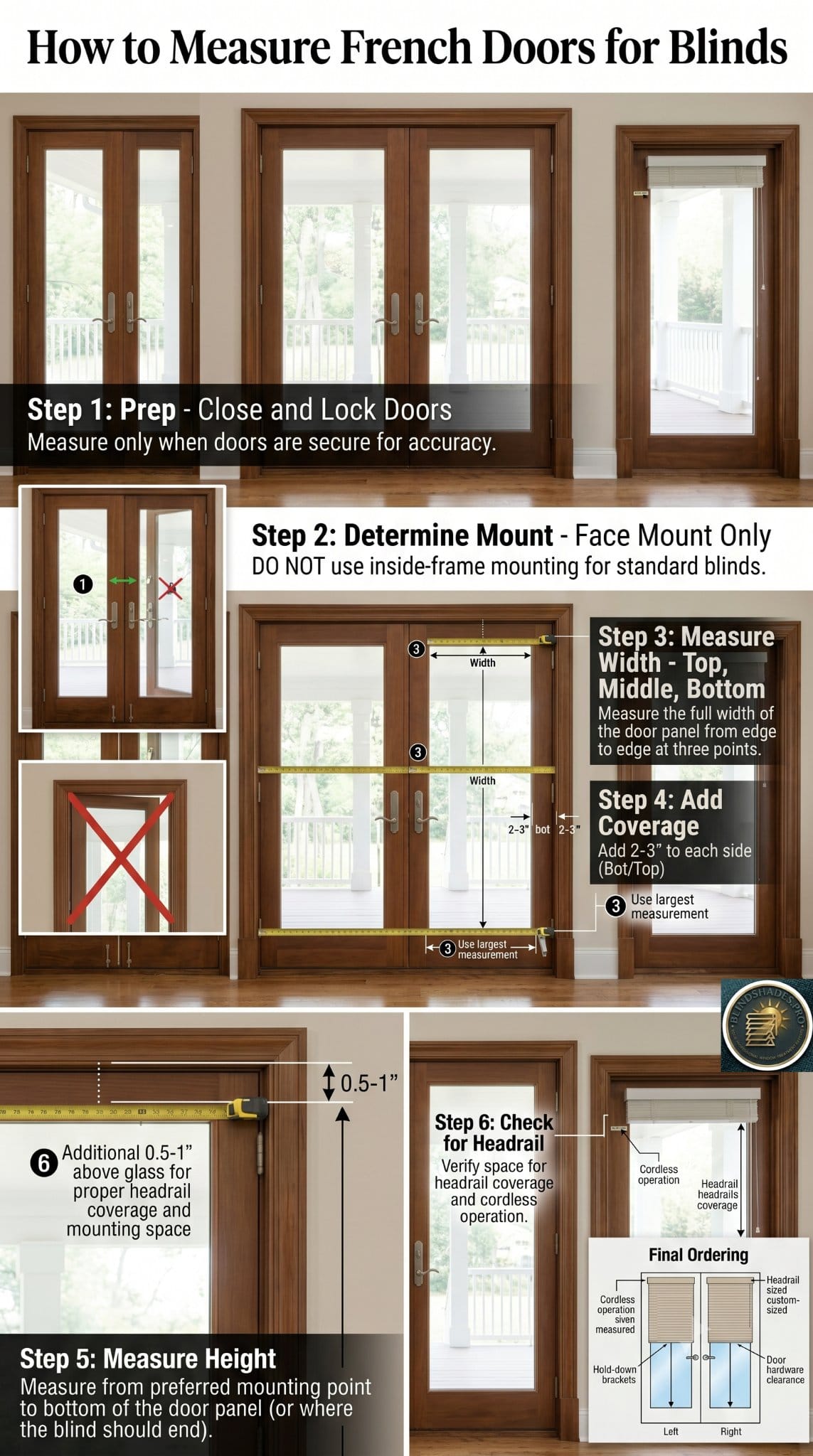
Key Takeaways:
- French door blind measurement uses the LARGEST of three glass width measurements — the opposite rule from standard inside-mount window blinds (which use the smallest); this is because French door blinds are always outside mount: they are mounted on the door face and sized to COVER the glass, not fit inside a frame opening; SelectBlinds and SmartWings both confirm use the largest width measurement
- There are two completely different height measurements on a French door: (1) the door height (top of door to floor) and (2) the glass panel height (top of glass to bottom of glass); you need the glass panel height plus your headrail mounting extension — NOT the door height; French doors have a lower wood rail below the glass and an upper rail above the glass; if you order to the door height, the blind will be too long to clip into the hold-down brackets at the glass bottom edge
- The hold-down brackets must be positioned at the BOTTOM EDGE OF THE GLASS PANEL — not at the door bottom, not at the floor; place the bracket on the lower wood rail of the door with the clip at the glass bottom edge; your blind height order = distance from your headrail screw position down to the bracket clip position
- For raised panel molding: the spacer block must exactly match the molding projection height; measure molding projection by holding a flat ruler across the flat door surface and measuring the gap between the ruler and the molding face (typically 0.25 to 0.75 inches); order spacer blocks at the nearest matching size; if your molding projection doesn’t match a standard size, order the next size up and use thin shims to level; an incorrectly sized spacer causes the headrail to tilt, making the blind hang crooked
- When measuring a matching pair of French doors, measure each door’s glass panel independently and order two separate blinds at each panel’s own dimensions; matching pairs installed on-site commonly vary by 0.25 inches or more; specify the same fabric and mechanism for both orders so they look visually matched; the 0.25-inch difference is imperceptible when both blinds are lowered
⭐ Quick Answer — How Do You Measure French Doors for Blinds?
- The 6-Step Protocol — and Why French Door Measurement Is the Opposite of Standard Windows: To measure French door blinds: (1) Close and lock the door before taking any measurement — an unlatched door can shift up to 0.25 inches from its locked position. (2) Confirm outside mount on the door face (not inside a frame recess — French door blinds have no inside mount option). (3) Measure glass width at top, middle, and bottom; use the LARGEST of the three measurements. This is the opposite of standard inside-mount window measuring (which uses the smallest) — SelectBlinds and SmartWings both confirm: for French door outside-mount blinds, use the largest width. (4) Add 2 to 3 inches to the largest glass width for coverage and mounting clearance. (5) Measure height from headrail mounting position to hold-down bracket position at the glass bottom edge (see Height section below). (6) Confirm cord controls on the hinge side, not the handle side. Order each door panel as a separate custom unit at its own specific dimensions. SelectBlinds confirms: for outside mount, the manufacturer makes no deductions — the blind is made to your exact stated dimensions, plus or minus one-eighth of an inch
- The Height Measurement — Why Glass Panel Height and Door Height Are Not the Same: The single most common French door blind measurement error: ordering to the door height instead of the glass panel height. French doors have a horizontal lower wood rail below the glass panel (the wood member between the glass bottom and the door bottom). If you measure to the door bottom or the floor, the blind will be ordered longer than the glass panel — the fabric extends onto the lower wood rail rather than covering glass, and the blind buckles or fails to clip properly into the hold-down brackets. The correct height measurement: (a) Mark your headrail mounting position on the door face (typically 0 to 0.5 inches above the glass top edge) — this is Point A. (b) Position the hold-down bracket at the bottom edge of the glass panel (not the door bottom) — this is Point B. (c) Measure from Point A to Point B. This distance is the blind height to order. SmartWings confirms: add 4 to 6 inches to the glass panel height if measuring glass top to glass bottom (the addition accounts for headrail hardware above and hold-down hardware below — not needed if measuring from actual headrail position to actual bracket position)
- The Molding Decision — Flush vs Raised and the Spacer Block Sizing Calculation: Before measuring French door blinds, confirm whether the trim around the glass panel is flush or raised. Flush molding sits at the same level as the door face — measure the glass opening. Raised panel molding projects above the flat door face and creates a decision: (1) Sit the blind INSIDE the molding frame (measure the glass opening; the molding becomes a decorative border around the blind; no spacer blocks needed). (2) Cover the molding (measure from outside molding edge to outside molding edge; spacer blocks REQUIRED equal in thickness to the molding projection). The spacer block sizing calculation: hold a flat metal ruler flush across the flat door surface, bridging the raised molding; the gap between the ruler and the door face where the molding protrudes = the molding projection height (typically 0.25 to 0.75 inches). Order spacer blocks at the nearest matching standard size: 3/8 inch, 1/2 inch, 3/4 inch, or 1 inch. Undersized spacer = headrail tilts (one edge on molding, other on flat surface) = blind hangs crooked. Oversized spacer = visible gap between headrail bottom and molding top. Blinds Chalet includes spacer brackets with all French door blind orders
- The Cord Side Rule — Why Hinge Side Is Correct for Both Inswing and Outswing Doors: Blinds Chalet confirms: “recommend having the tilt and lift controls on the side next to the door hinges, away from the handle.” The reason — absent from all competitor guides — depends on swing direction. Inswing French door (opens into room): when the door swings open, the handle side sweeps through the room interior; cords on the handle side arc through the room, catching on furniture, clothing, or people passing through the doorway. Outswing French door (opens away from room): when the door swings outward, the handle side moves toward the exterior; cords on the handle side catch on exterior weather stripping, the door stop, or exterior hardware during opening. The hinge side is the correct cord position for both directions: the hinge is the pivot axis around which the door rotates; cords on the hinge side stay compressed against the hinge edge with minimal outward movement regardless of swing direction. For motorized blinds, no cord placement consideration applies — either side is acceptable for the motor and battery pack
- Measuring Mismatched Pairs and the Divided Lights Rule: Two additional French door blind measurement rules absent from most guides. (1) Matching pair measurement: even French doors purchased as a matched pair from the same manufacturer commonly vary by 0.25 inches or more once installed on site — carpentry tolerances mean each door’s glass panel is shimmed and fitted by hand. HotianWindows (December 2025) confirms: “measure each door’s glass separately; even if they look identical, slight variations exist.” Measure the left door and right door glass panels independently; order two separate blinds at each panel’s own dimensions; specify identical fabric color, mechanism type, lift style, and cord side for both orders. A 0.25-inch width difference is visually imperceptible when both blinds are in the lowered position. (2) Divided lights: French doors with grilles or muntins dividing the glass into smaller panes should be measured as one continuous glass area per door — not per individual pane. Factory Direct Blinds (May 2026) confirms French doors are “measured per panel including mullions.” Individual divided pane widths (typically 5 to 10 inches) are too narrow for standard hold-down brackets; one blind per door covering the full glass area is the correct specification
- Best Sources: LARGEST width rule confirmed + exact outside-mount dimensions + no deductions → SelectBlinds French door measuring guide · Add 2-3 inches width and 4-6 inches height confirmed + 3-point largest width protocol → SmartWings doors measuring guide · Per-panel-including-mullions confirmed + 4-inch outside mount allowances → Factory Direct Blinds sliding and French door guide
⚠️ The Complete Width and Height Reference Table for French Door Blind Measurement: French door blind measurement allowances by construction type: (1) Cellular shades (door-mounted, 1-cell or 2-cell): add 1 to 1.5 inches per side to glass width (2 to 3 inches total); height = glass panel height from headrail to hold-down bracket at glass bottom edge. (2) Roller shades (door-mounted, cassette): add 1 to 1.5 inches per side; same height rule; confirm cassette headrail depth does not exceed available flat door surface above molding. (3) 1-inch mini-blinds or aluminum blinds (door-mounted): add 0.5 to 1 inch per side only — wider additions cause interference with stile hardware on narrow French door panels; height = glass panel height as above. (4) Cordless vs corded: no difference in measurement protocol; cord side placement (hinge side) applies to corded only — motorized and cordless require no cord-side specification. (5) Double French door (matching pair): measure each door independently as above; order as two separate products; specify matching fabric and mechanism; visual match achieved when both lowered. (6) Lever handle clearance check: after calculating final width, confirm the blind’s fabric edge on the handle side is at minimum 0.5 inches away from the lever body; for lever handles on doors with narrow stiles, consider whether the 1-inch per-side addition clears the handle — Blinds Chalet confirms lever handle interference occurs with 2-inch and 2.5-inch slat blinds when tilting (slats in front of lever must be manually moved); 1-inch cellular or roller shades avoid this issue. For the installation sequence after measuring, see How Do You Install Blinds on French Doors. See the full 6-step protocol below.
💡 Between-Glass vs Retrofit and the Pre-Measurement Checklist: Before measuring French door blinds, confirm whether you need a factory between-glass blind or a retrofit door-face blind — the measurement rules are completely different. Factory between-glass blinds (Pella SlimShade, Andersen, Marvin): the blind is sealed inside the insulating glass unit during manufacturing; you cannot order a custom-sized blind; measure the full glass unit width and height including the glass unit frame on all sides (not the visible glass opening); match these to the manufacturer’s fixed available sizes. Retrofit door-face blinds: all six steps above apply. For the complete between-glass guide, see Can You Put Blinds Between French Door Glass. Pre-measurement checklist before measuring any French door: (1) Confirm door material: wood = standard drill; steel/metal = cannot drill, confirm magnetic mounting system headrail width before measuring; uPVC = no-drill system, confirm headrail width. (2) Confirm molding type: flush = measure glass opening; raised = decide to cover or sit inside, then measure accordingly and calculate spacer block thickness. (3) Confirm swing direction: inswing or outswing — determines cord side note on order. (4) Confirm between-glass or retrofit — determines entire measurement approach. (5) Confirm matching pair or single door — matching pairs require two independent measurement sets. For the full door material and mounting system guide, see What Are the Best Blinds for French Doors. See the full molding measurement guide below.
📖 Read the complete guide below for: the 6-step measuring protocol (close and lock door; confirm outside mount; LARGEST of 3 widths; add 2-3 inches; glass panel height not door height; hinge-side cord), why French door measuring uses the largest width measurement (opposite of standard inside-mount windows), the glass vs molding decision (flush = glass opening; raised = cover or sit inside; covering requires spacer blocks equal to molding projection height measured with flat ruler), the hold-down bracket placement at the glass bottom edge (not door bottom — lower wood rail below glass makes blind too long), the hinge-side cord rule for both inswing and outswing doors, the independent measurement protocol for matching pairs (0.25-inch variation normal; order separately; same spec for visual match), factory between-glass vs retrofit measurement distinction (between-glass = full glass unit dimensions; retrofit = glass opening), and the divided lights single-panel rule (one blind per door covering all panes).
Why French Door Blind Measurement Is Different from Standard Windows
Three fundamental differences that make French door measurement its own category.
Measuring how to measure French door blinds is fundamentally different from measuring a standard window blind in three ways that affect every step of the process.
Difference 1 — Outside mount is always the starting point.
Covering Windows confirms: “Window treatments for French doors are typically mounted directly on the door.” There is no inside mount option on a French door. The blind mounts on the flat face of the door over the glass panel — an outside mount by definition. This changes the measurement rules: SelectBlinds confirms that for outside mount, “no adjustments are made by the factory — the blind is sized to your exact measurements, plus or minus one-eighth of an inch.” You are ordering to your exact stated dimensions.
Difference 2 — Use the LARGEST, not the smallest, of the three width measurements.
For a standard inside-mount window blind, you measure the opening at three horizontal points and use the SMALLEST measurement so the blind fits inside the frame. For a French door outside-mount blind, SelectBlinds confirms: take the largest width measurement. The largest width ensures the blind covers the glass fully at the widest point. A smaller measurement would leave the glass partially uncovered at the widest point.
Difference 3 — The height is the glass panel height, not the door height.
A French door has multiple horizontal wood members: the top rail (above the glass), the bottom rail (below the glass), and potentially a middle rail if there are multiple glass panels stacked vertically. The blind covers the glass panel only — not the full door height. Ordering to the door height produces a blind that is too long to clip into hold-down brackets at the glass bottom edge.
The Pre-Measurement Checklist — 5 Confirmations Before Measuring
Five questions to answer before touching the tape measure.
1 — Is the door wood, steel, or uPVC?
Door material determines the mounting system before any measurement matters:
- Wood: standard drill and screw mounting; standard measurement protocol applies
- Steel/metal: cannot drill without voiding warranty and creating rust; magnetic mounting system required; confirm the magnetic system’s headrail width before measuring (see Are Magnetic Blinds Good for French Doors)
- uPVC/vinyl: hollow sections with no screw grip; no-drill system required; confirm headrail compatibility before measuring
2 — Is the molding flush or raised?
Stand facing the door. Look at the trim around the glass panel. Does the molding project from the flat door face or sit flush?
- Flush molding: measure the glass opening — the blind sits against the flat door surface
- Raised molding: decide whether you want the blind to sit INSIDE the molding frame (measure the glass opening; molding frames the blind visually) or COVER the molding (measure from outside molding edge to outside molding edge; requires spacer blocks equal to the molding projection height)
3 — Does the door have a lever or knob handle?
Lever handles project further from the door face than round knobs. Blinds Chalet confirms: for lever handles, 2-inch and 2.5-inch slat blinds still fit but the slats in front of the lever must be manually moved for tilting operation. Confirm that your chosen blind’s headrail depth does not exceed the lever handle projection height.
4 — Is the door inswing or outswing?
You will need this to determine cord side placement in Step 6.
- Inswing: door opens into the room
- Outswing: door opens away from the room
5 — Is this a factory between-glass blind or a retrofit door-face blind?
This determines the entire measurement approach:
- Factory between-glass (Pella, Andersen, Marvin SlimShade): measure the full glass unit width and height including the glass frame — NOT the glass opening. Between-glass systems are matched to the glass unit dimensions from the factory. See Can You Put Blinds Between French Door Glass for the full between-glass guide.
- Retrofit door-face blind: continue with the steps below.
How Do You Measure French Doors for Blinds — The 6-Step Protocol
The complete measurement sequence for a door-face retrofit blind.
Step 1 — Close and Lock the Door
Measure with the door in its installed, closed, and locked position. An unlatched door can shift slightly from the locked position, affecting measurements by up to 0.25 inches. Factory Direct Blinds (May 2026) confirms: “Closed, locked doors without obstacles prevent gaps that skew measurements.”
Do not measure a door that is propped open. Do not measure from the inside of the house with the door open against the wall — the door must be in its normal closed operating position.
Step 2 — Measure Glass Width at Three Points
Using a metal tape measure (cloth or plastic measuring tapes stretch and produce inaccurate readings), measure the width of the glass panel at three horizontal points:
- At the very top edge of the glass
- At the exact middle of the glass
- At the very bottom edge of the glass
Record all three measurements. Use the LARGEST of the three measurements as your glass width baseline. This is the opposite of inside-mount window measuring (which uses the smallest).
SmartWings confirms this protocol: “Measure the width of the glass inside each door across the top, middle and bottom. Take the largest width.”
Step 3 — Add Width Allowance for Coverage and Mounting
To the largest glass width, add your width coverage allowance:
| Blind Type | Add to Each Side | Total Width Addition |
|---|---|---|
| Minimum coverage (no molding) | 0.5–1 inch per side | 1–2 inches total |
| Standard coverage (Blinds Chalet) | 1 inch per side minimum | 2 inches total |
| SmartWings recommendation | 1–1.5 inches per side | 2–3 inches total |
| If covering raised molding | Molding width each side + 0.5 inch | Varies |
Important width limit: Do not extend the blind width so far that it reaches the door handle or hinge hardware. Confirm the blind’s maximum width stays clear of both the handle projection and the hinge hardware on the opposite side.
Lever handle check: Measure the distance from the glass edge to the lever handle body on the handle side. Your width addition on the handle side must leave at least 0.5 inches of clearance between the blind edge and the lever body.
Step 4 — Determine the Headrail Mounting Position
Where will the top bracket of the blind be mounted? There are two options:
Option A — Mount just above the glass top edge: Place the headrail bracket 0 to 0.5 inches above the top edge of the glass. The blind fabric starts just above the glass — minimal headrail coverage, slight gap between headrail and glass top possible.
Option B — Mount above the raised molding (if applicable): If the door has raised panel molding above the glass, the headrail mounts on the flat door face above the molding line. Measure from the flat door surface above the molding to the top of the molding — add this distance to the blind height to ensure the fabric covers the molding.
Mark your headrail mounting position with a pencil mark on the door face. This mark is your height reference point A — the top of your height measurement.
Step 5 — Determine the Hold-Down Bracket Position and Measure Height
Hold-down brackets must be positioned at the bottom edge of the glass panel — not at the door bottom and not at the floor.
Why the glass bottom, not the door bottom: French doors have a lower horizontal rail (a wood member) below the glass panel. If the hold-down bracket is positioned at the door bottom, the blind must be ordered longer than the glass panel height — the blind fabric extends onto the lower wood rail, which is not glass. The blind fabric hangs against wood, not glass, at the bottom. More critically: if the blind is too long, it buckles when clipped into hold-downs at a point shorter than the fabric length.
How to position the bracket: Place the hold-down bracket on the lower wood rail with the bracket’s receiving clip located exactly at the bottom edge of the glass panel. The blind’s bottom rail should rest at the glass bottom edge when clipped in — covering the glass fully down to its bottom edge without extending below it.
Mark this bracket position on the door face. This mark is your height reference point B — the bottom of your height measurement.
Measure height: Using the metal tape measure, measure from Point A (headrail mounting position) down to Point B (hold-down bracket clip position). This is your blind height to order.
SmartWings confirms the height approach: “Measure top to bottom on the left, middle and right. Take the largest height and add 4–6 inches to it.” The 4–6 inch addition accounts for headrail hardware above the glass and hold-down hardware below it — but only if measuring from glass top to glass bottom. If measuring from headrail position to bracket position (as described above), no addition is needed — those measurements already account for the hardware.
Step 6 — Determine Cord Side Placement
Blinds Chalet confirms: “We recommend having the tilt and lift controls on the blinds to be on the side next to the door hinges, away from the handle.”
Why hinge side — the inswing vs outswing explanation absent from all guides:
- Inswing French door: When the door opens into the room, the handle side swings through the room interior. Cords on the handle side arc through the room as the door opens, catching on furniture, clothing, or people passing through the doorway. Cords on the hinge side stay compressed against the hinge edge as the door rotates — minimal outward movement.
- Outswing French door: When the door opens away from the room, the handle side sweeps toward the exterior. Cords on the handle side can catch on exterior weather stripping, the door stop, or exterior hardware during opening. Cords on the hinge side again stay on the pivot axis — minimal movement.
The hinge side is the correct cord placement for both inswing and outswing French doors. For motorized blinds, no cord concern exists and either side is acceptable.
The Glass vs Molding Measurement Decision
The most common measurement mistake on French doors with raised panel molding.
Many French doors have raised panel molding around the glass — the trim that frames the glass panel is elevated above the flat door face. This creates a measurement decision that no standard guide addresses clearly.
Step 1: Identify the molding type
- Flush applied molding: the molding sits at the same level as the door face; no projection; measure the glass opening
- Raised panel molding: the molding projects above the flat door face; typically 0.25 to 0.75 inches in projection height
Step 2: Decide whether to cover the molding or sit inside it
| Decision | What to Measure | Requires Spacer Blocks? | Visual Result |
|---|---|---|---|
| Sit inside molding | Glass opening width and height | NO | Molding frames the blind visually |
| Cover the molding | Outer molding edge to outer molding edge | YES | Blind fully covers glass and molding |
Step 3: If covering the molding — measure the molding projection for spacer sizing
The spacer block thickness must exactly equal the molding projection height. An incorrectly sized spacer causes the headrail to tilt: one edge sits on the raised molding surface while the other rests on the flat door face — the blind hangs at an angle.
How to measure molding projection: Hold a flat metal ruler flush across the flat door face surface, bridging the raised molding. The gap between the ruler’s bottom edge and the flat door face where the molding projects = the molding projection height. Standard molding projection sizes: 0.25 inch, 0.375 inch (3/8″), 0.5 inch, 0.75 inch.
Standard spacer block sizes available: 3/8 inch, 1/2 inch, 3/4 inch, 1 inch. If the molding projection falls between standard sizes, order the next size up and use adhesive-backed shim tape behind the bracket to level the headrail precisely.
Measuring a Matching Pair — The Independent Measurement Rule
Why identical-looking French doors require separate measurements and separate orders.
French doors are installed by carpenters on-site. Even doors purchased as a matching pair from the same manufacturer can have glass panel dimensions that vary by 0.25 inches or more after installation, because:
- The rough opening in the wall framing is cut by hand and is rarely perfectly square
- The door frame is shimmed level and plumb by hand, creating slight variations in the glass panel dimensions from door to door
- The glass itself is glazed into the door frame during manufacture and may vary slightly between panels
The correct ordering protocol:
- Measure the left door glass panel (3-point width, height from A to B)
- Measure the right door glass panel independently (3-point width, height from A to B)
- Record each set of measurements separately
- Order the left door blind at the left panel’s specific dimensions
- Order the right door blind at the right panel’s specific dimensions
- Specify IDENTICAL fabric color, mechanism type, lift style, and cord side for both orders
The visual match when installed: A 0.25-inch difference in blind width between the left and right doors is visually imperceptible when both blinds are in the lowered position. The fabric panels appear identically sized to any viewer in the room. The distinction only becomes visible if both headrails are compared side-by-side when raised — and even then, the difference is subtle.
If the measurement variation is greater than 0.5 inches: Inspect the door installation. A 0.5-inch+ variation between matching panels suggests the doors may not be installed squarely, which can affect blind operation and hold-down bracket alignment. Consult a door installer before ordering blinds.
Between-Glass French Door Blinds — Different Measurement Rules
Factory between-glass blinds require a completely different measurement approach.
Factory-integrated blinds from Pella (SlimShade), Andersen, and Marvin are sealed inside the insulating glass unit during manufacturing. These are not retrofit products — you cannot order a custom-sized blind and install it between the glass panels of an existing door.
For between-glass blind replacement or new door ordering:
- Measure the full glass unit width and height — including the glass unit frame on all sides
- This is NOT the visible glass opening (the light transmission area); it is the entire glass assembly from frame edge to frame edge
- Match these dimensions to the manufacturer’s available glass unit sizes (between-glass blinds are produced in fixed sizes corresponding to standard glass unit dimensions, not custom-sized)
For retrofit door-face blinds: Use the 6-step protocol above. If you have an existing factory between-glass blind that has failed and want to replace it with a retrofit door-face blind instead, the article above applies — measure the glass opening (not the full glass unit) and proceed normally.
See our full guide: Can You Put Blinds Between French Door Glass.
Divided Lights and Grilles — Measuring When the Glass Has Panes
The “treat as one panel” rule for French doors with divided lights.
Many French doors have divided lights (also called grilles or muntins) — horizontal and vertical bars that divide the glass panel into a grid of smaller panes. These are either true divided lights (individual glass panes separated by actual wood or vinyl bars) or simulated divided lights (one large glass pane with decorative grilles applied to the front surface).
The measurement rule for both types:
Factory Direct Blinds (May 2026) confirms: “French doors measured per panel including mullions.” Measure the full glass panel from the outermost edge of the frame on one side to the outermost edge on the other — treat the entire glass area as one continuous panel regardless of how many small panes or grilles divide it.
Why not measure each individual pane separately: Individual divided panes on a residential French door are typically 5 to 10 inches wide — below the minimum width for standard blind products and well below the minimum width for reliable hold-down bracket function (approximately 12 inches). A blind ordered at 6 inches wide cannot be held stable by standard hold-down brackets. The blind for a French door with divided lights must cover the entire glass area as one continuous panel per door.
Frequently Asked Questions
How do you measure French doors for blinds? Measure the width of the glass panel at three horizontal points (top, middle, bottom) and use the LARGEST measurement. Add 2 to 3 inches to the total width for coverage and mounting clearance. For height, measure from the planned headrail mounting position down to the hold-down bracket position at the glass bottom edge — not to the door bottom. Order each door panel as a separate blind with its own specific measurements, even on a matching pair. All French door blinds are outside mount, so the manufacturer will not make deductions from your stated dimensions.
Should I use the largest or smallest measurement when measuring French doors? The largest of your three width measurements. French door blinds are outside mount — they cover the glass rather than fitting inside a frame opening. The largest measurement ensures the blind covers the glass fully at its widest point. This is the opposite of inside-mount window measuring, which uses the smallest of three measurements to ensure the blind fits within the frame.
Do I measure the glass or the molding when measuring French door blinds? It depends on whether you want the blind to sit inside the raised molding (measure the glass opening) or cover the molding (measure from outside molding edge to outside molding edge). If covering raised molding, you must also use spacer blocks equal in thickness to the molding projection height so the headrail sits level. For flush molding, measure the glass opening — the distinction does not apply.
Why do hold-down brackets go at the glass bottom edge, not the door bottom? French doors have a horizontal wood rail below the glass panel. If hold-down brackets are placed at the door bottom, the blind must be ordered longer than the glass panel — the fabric covers the lower wood rail rather than ending at the glass. The blind also becomes too long to clip correctly into brackets at the glass bottom edge. Always place hold-down brackets at the glass bottom edge and measure blind height from the headrail mounting position to the bracket clip position.
Which side should the cord or lift control be on? The hinge side — away from the door handle. Cords on the handle side sweep through the room interior when an inswing door opens, catching on furniture or people. On an outswing door, cords on the handle side can catch on exterior hardware or weather stripping during opening. The hinge side is the correct cord placement for both inswing and outswing French doors. For motorized blinds, no cord consideration applies.
What if my matching pair of French doors have different measurements? This is normal. French doors are fitted on-site and matching pairs commonly vary by 0.25 inches or more. Measure each door panel independently and order two separate custom blinds — one at each panel’s own dimensions. Specify identical fabric, mechanism, and lift style for both orders. A 0.25-inch width difference is visually imperceptible when both blinds are lowered.
Related Guides on BlindShades.pro
- The Best French Door Blinds & Shades Buying Guide
- What Are the Best Blinds for French Doors
- How Do You Install Blinds on French Doors
- Can You Put Blinds Between French Door Glass
- Are Magnetic Blinds Good for French Doors
- How Do You Stop French Door Blinds From Swinging
By Michael Turner | 30 Years Home Improvement Expertise | Updated 2026 | BlindShades.pro
