Can You Put Blinds Between French Door Glass?

Authored By Michael Turner -30 Years Home Improvement Expertise | Updated 2026 | BlindShades.pro
Updated on June 11, 2026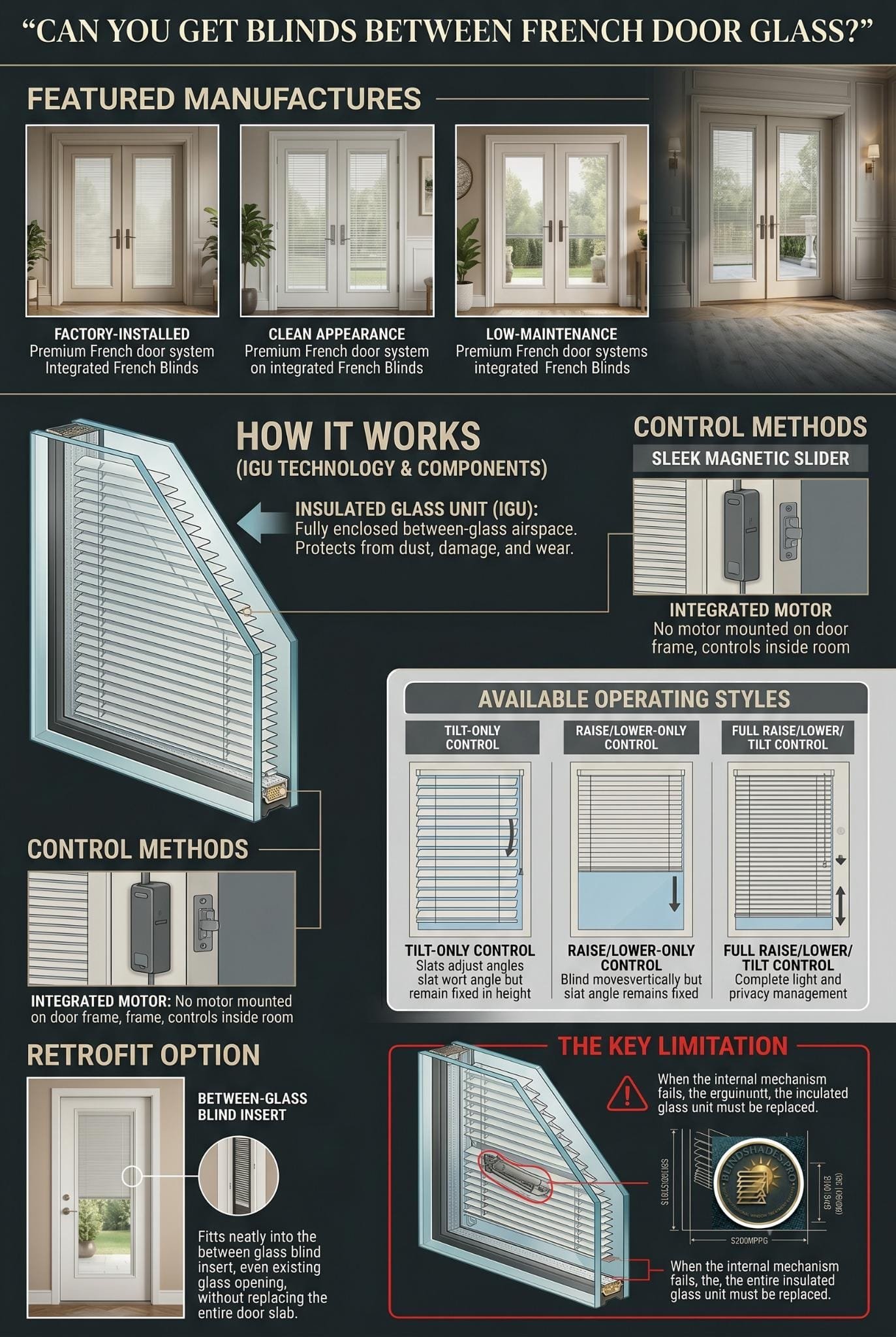
Key Takeaways:
- Yes, you can put blinds between French door glass, but the way they are installed and how they work is fundamentally different from surface-mounted door blinds; between-glass blinds are sealed inside the insulated glass unit (IGU) during manufacturing and are operated by a magnetic slider or motor on the exterior glass frame — there are no exposed cords in the room, no dust accumulation on the slats, and no swinging against the glass when the door opens; the trade-off is that when the mechanism fails, the entire IGU must be replaced, not just the blind
- There are three different control types for between-glass blinds, and the type determines what the blind can do: (1) tilt-only systems allow the slats to open and close for light and privacy control but the blind is permanently full-height — you can never clear the glass to expose the full view; (2) raise/lower-only systems let you raise the blind fully out of view but the slats are fixed at one tilt angle; (3) full raise/lower/tilt systems (available on Pella, Andersen premium lines) provide complete venetian-blind-equivalent control; most budget and mid-market between-glass blinds use tilt-only or raise/lower-only systems
- The blind mechanism warranty and the door warranty are different terms: Pella’s blind mechanism has a 5-year warranty while the rest of the door is lifetime; when a between-glass blind mechanism fails outside the 5-year window, the homeowner pays the full cost of IGU replacement — typically $400 to $1,500 per panel; ask the manufacturer specifically what the blind mechanism warranty term is, not just the door warranty
- The stuck slats diagnostic before ordering a replacement IGU: slide the external magnetic control smoothly from top to bottom; if the slider itself moves freely but the slats do not respond, the internal mechanism has failed and IGU replacement is required; if the slider is rough, sticky, or catches on the guide rail, the external magnetic assembly may be misaligned or damaged — this is sometimes repairable by removing the side trim and repositioning the slider without replacing the glass
- The most cost-effective repair when between-glass blinds fail outside warranty: replace the IGU with standard double-pane glass (no blind; approximately $150 to $400 per panel) and add a surface-mounted door blind (roller shade, cellular shade, or magnetic blind; $50 to $200); total cost $200 to $600 versus replacing with a new between-glass IGU at $400 to $1,500; the surface-mounted blind loses the no-cord aesthetic but gains independent replaceability if it ever fails again
⭐ Quick Answer — Can You Put Blinds Between French Door Glass?
- Yes — How Blinds Between French Door Glass Work and What Makes Them Different: Blinds between French door glass are standard Venetian-style aluminum slats permanently sealed inside the insulating glass unit (IGU) during manufacturing. They are operated by a slim magnetic slider on the exterior glass frame — no exposed cords in the room, no dust on the slats, no swinging against the glass when the door opens. Framewell (February 2026) confirms: “Blinds-between-glass, also sold as enclosed or integral blinds, use Venetian-style slats permanently sealed between two panes of glass. They are operated by a slim slider, magnetic control, or motor on the frame instead of exposed cords in the room.” The trade-off: when the mechanism fails, the entire IGU must be replaced — not just the blind. The three main manufacturers are Pella, Andersen, and ODL. A retrofit option (ODL door glass insert: $100 to $350) lets you add between-glass blinds to an existing door by replacing only the glass pane — without replacing the door slab
- The Three Control Types — The Specification Most Buyers Miss When Ordering Blinds Between French Door Glass: JustAnswer confirms: “That style of internal mini blinds is available in several different designs. Some models can raise, lower, and tilt, while others only tilt.” The control type determines what the blind can actually do: (1) Tilt-only: the slats rotate open or closed but the blind is permanently full-height — it occupies the entire glass panel at all times and you can never clear the glass to expose the full unobstructed view; even with slats fully open, horizontal aluminum bars are visible across the glass panel; best suited for privacy-focused applications where full glass exposure is not needed. (2) Raise/lower-only: the blind can be fully raised out of the visible glass area but the slats are fixed at one tilt angle — no fine light control. (3) Full raise/lower/tilt (premium): complete venetian-blind-equivalent control; both raising and tilt angle are independently adjustable; available on Pella Designer Series, Andersen A-Series, premium Marvin. Most entry-level and mid-market between-glass blind products use tilt-only systems. Confirm the control type before ordering — it is not always prominently listed on product pages
- The 5-Year Warranty Gap and the $1,500 Repair Bill — The Financial Risk Absent From All Guides: The blind mechanism warranty and the door warranty are different terms with different durations. A DoItYourself.com forum user confirmed directly about a Pella product: “the warranty on the blinds was only 5 years and the door is 10 years [lifetime for the rest].” When the between-glass blind mechanism fails after the 5-year window, the homeowner pays the full cost of IGU replacement. For one Pella ThermaStar vent panel, the forum user was quoted $1,500 for replacement. JDM Sliding Doors Blog (April 2025) states Pella and Andersen offer 10 to 20 year warranties — these figures conflict with the forum data, suggesting warranty terms vary by product line. The action: ask the manufacturer specifically what the blind mechanism warranty term is for the exact product you are purchasing — not just the door warranty. Confirm whether the mechanism warranty covers parts only or includes labor for IGU replacement. A 5-year mechanism warranty on a French door operated multiple times daily is a material financial consideration that no product page prominently discloses
- The Stuck Slats Diagnostic — Run This Before Spending $1,500 on IGU Replacement: When blinds between French door glass stop responding, the repair path depends entirely on which component has failed. JustAnswer expert confirms the diagnostic: “If the slider operates smoothly but the blinds remain unresponsive, the internal mechanism has likely failed — you’ll need to replace the glass panel unit.” The two-step diagnostic: (1) Locate the external magnetic slider on the glass frame edge. (2) Slide it slowly from top to bottom and observe. Interpretation: if the slider moves smoothly but the slats do not respond at any point = internal mechanism failure (stripped gear, detached internal magnet, jammed internal cord); IGU replacement is the only solution. If the slider moves roughly, catches, or feels sticky at certain points = external magnetic slider or guide rail problem; attempt external repair first — remove the side trim (typically clipped or lightly glued), inspect the guide rail for debris or misalignment, reposition the slider; no glass replacement needed for this failure mode. This diagnostic test takes two minutes and can determine whether you need a $1,500 IGU replacement or a free fix
- The Reliability Hierarchy and the Cheapest Repair When Between-Glass Fails Outside Warranty: Blinds between French door glass vary significantly in reliability by manufacturer: Pella and Andersen sit at the premium tier with 10 to 20 year warranty coverage (confirm product-specific terms); ThermaTrue uses a snap-in glass piece design that allows blind mechanism replacement without full IGU swap — a significant advantage; Marvin is mid-premium; ODL is the budget retrofit tier where forum complaints document early failure (“brand new and can’t open blinds — $300 waste”). When between-glass blinds fail outside warranty, the most cost-effective repair is to replace the IGU with standard double-pane glass (no blind; approximately $150 to $400 per panel at a glass shop) and add a surface-mounted door blind (roller shade, cellular shade, or magnetic blind; $50 to $200) — total $200 to $600 versus replacing with a new between-glass IGU at $400 to $1,500. The surface-mount conversion loses the no-cord aesthetic advantage but the blind becomes independently replaceable if it ever fails again. See [Are Magnetic Blinds Good for French Doors](/guide/magnetic-blinds-for-french-doors/) for the best no-drill surface-mount options
- Best Sources: Blinds-between-glass reliability analysis, argon gas U-factor impact, and mechanical failure modes → Framewell between-glass reliability guide · Control type variations, stuck slats diagnostic, magnetic slider repair, and IGU replacement guidance → JustAnswer French door built-in blinds FAQ · Manufacturer comparison (Pella, Andersen, ODL), installed costs $1,500 to $4,500, and warranty overview → JDM Sliding Doors Blog
⚠️ The Argon Gas Trade-Off and the Condensation Double-Failure Risk: Two energy and longevity concerns absent from all buying guides for blinds between French door glass. (1) Argon gas U-factor impact: standard double-pane IGU glass is filled with argon gas between the panes (denser than air; reduces heat transfer). When blind slats occupy that space, Framewell (February 2026) confirms: “they sometimes prevent the use of argon gas in double-pane units, nudging the U-factor higher and reducing efficiency.” However, JustAnswer expert confirms for Pella and Andersen specifically: “the glass is an insulated unit that is laminated together at the factory when the blinds are installed between the panes and argon gas is injected.” The premium manufacturers inject argon around the blind slats. For ODL retrofit inserts and budget between-glass products, argon maintenance is less certain — confirm the U-factor specification and whether argon is maintained before ordering. (2) Condensation double-failure: the magnetic slider mechanism on the glass frame edge moves every time the blind is operated, creating micro-movement at the seal junction over years. This micro-movement can degrade the insulating seal at the slider entry point. When the seal fails, warm humid interior air enters the space between the panes and condenses on the cold outer pane — visible fogging inside the IGU that cannot be cleared. This fogging failure can occur separately from and after the blind mechanism failure, resulting in two discovery events but one solution: IGU replacement. Surface-mounted door blinds have no equivalent failure mode affecting the glass. See the full energy efficiency analysis below.
💡 The ODL Retrofit Insert and the Complete Worth-It Comparison: The ODL retrofit glass insert is the most underreported option in the between-glass blinds category. ODL makes self-contained door glass inserts with between-glass blinds designed specifically to retrofit existing door glass openings — you replace only the glass pane without touching the door slab. Installation: remove the inner trim ring (clipped or lightly glued); score and remove the old glass insert; insert the ODL unit; replace the trim ring. ODL insert cost: $100 to $350 versus $1,500 to $4,500 for a new door. Size limitation: ODL is available in standard residential door glass sizes only — measure the existing glass opening before ordering. Reliability limitation: ODL’s magnetic control mechanism has documented early failure reports on forums; for primary entrance French doors operated multiple times daily, Pella or Andersen is the more reliable specification. The complete worth-it comparison by use case: Primary entrance patio-facing French doors (aesthetics top priority) = between-glass is worth the premium for the no-cord, no-swing, no-dust performance; specify Pella or Andersen with full raise/lower/tilt control and confirm mechanism warranty term. Bedroom French door (blackout needed, budget priority) = surface-mounted cordless cellular shade or magnetic blind delivers equivalent light control at $50 to $200 with no IGU dependency; see What Are the Best Blinds for French Doors. Failed between-glass outside warranty = convert to standard glass ($150 to $400) plus surface-mount ($50 to $200) for $200 to $600 total versus new between-glass IGU at $400 to $1,500. Interior or secondary French doors with light use = ODL retrofit at $100 to $350 is an acceptable cost-effective option if the low-traffic usage pattern reduces the early-failure risk. For the full installation guide after selecting a surface-mount blind, see How Do You Install Blinds on French Doors. See the complete worth-it verdict table below.
📖 Read the complete guide below for: how blinds between French door glass work (IGU-sealed magnetic slider operation), the three control types (tilt-only = permanently visible even when “open”; raise/lower-only = fixed tilt angle; full raise/lower/tilt = premium Pella/Andersen only), the four manufacturers compared by reliability (Pella/Andersen premium 10-20yr warranty; ThermaTrue snap-in accessible; ODL retrofit $100-$350 with documented early failures), the 5-year blind mechanism warranty gap (vs. lifetime door warranty; confirm product-specific terms), the argon gas U-factor trade-off (Framewell Feb 2026 confirmed; premium brands inject argon; budget may not), the stuck slats two-step diagnostic (slider smooth + no response = IGU replacement; slider rough/sticky = external repair attempt first), the condensation double-failure risk (micro-movement at slider degrades seal; fogging after blind failure = second IGU replacement), and the surface-mount conversion repair strategy ($200-$600 total vs. $400-$1,500 for new between-glass IGU).
How Do Blinds Between French Door Glass Actually Work?
The mechanism most buyers have never seen explained.
<strong>Blinds between French door glass</strong> are standard Venetian-style aluminum slats permanently sealed inside the insulated glass unit — the double-pane glass assembly that forms the transparent panel of the door. The slats occupy the space between the two panes of glass.
Framewell (February 2026) describes the product: “Blinds-between-glass, also sold as enclosed or integral blinds, use Venetian-style slats permanently sealed between two panes of glass. They are operated by a slim slider, magnetic control, or motor on the frame instead of exposed cords in the room.”
The magnetic control mechanism: A slim magnetic slider runs along the vertical edge of the glass frame on the exterior room-facing surface. This external slider contains a magnet. Inside the sealed glass space, a corresponding magnet is attached to the blind’s control assembly. When you slide the external control up or down, the internal magnet follows through the glass, tilting or raising the slats without any physical opening in the glass seal.
What the sealed design delivers:
- No exposed cords in the room — the operating magnetic slider is a thin flush channel on the glass edge
- No dust accumulation on the slats — the interior space is sealed; the slats are only accessible by wiping the outer glass surfaces
- No swinging against the glass when the door opens — the blind is inside the glass, immune to door movement
- No cord entanglement with door hardware — relevant to French door operation
What the sealed design costs: If the internal mechanism fails — stripped tilt gear, frayed internal cord, jammed slat — the glass unit cannot be opened for repair without destroying the insulating seal. The IGU must be replaced.
The Three Control Types — The Specification Most Guides Skip
The control type determines what the blind can and cannot do — absent from all competitor guides.
JustAnswer confirms: “That style of internal mini blinds is available in several different designs. Some models can raise, lower, and tilt, while others only tilt.”
Control Type 1 — Tilt Only
The slats can be rotated from fully open (horizontal, parallel to the glass = maximum light) to fully closed (angled to close gaps between slats = minimum light). The blind is permanently full-height — it occupies the entire glass panel from top to bottom at all times.
The implication buyers miss: A tilt-only between-glass blind means you can never clear the glass to expose the full unobstructed view. Even when the slats are in the fully open position, the horizontal slats are visible across the glass panel. For a bedroom French door where full glass exposure is sometimes wanted, a tilt-only system permanently adds a visual element to the glass that cannot be removed.
Best suited for: Privacy-focused applications where the view through the glass is not the primary purpose — internal French doors between a hallway and a room, or a study where glare control is the goal.
Control Type 2 — Raise/Lower Only
The blind can be fully raised into the top of the IGU (out of the visible glass area) or lowered to any position. The slats are fixed at one tilt angle — typically 45 degrees or fully open — and cannot be adjusted for light diffusion.
The implication: When the blind is raised, the full glass view is unobstructed. When lowered, light transmission is determined by the fixed slat angle only. No fine light control between raised and lowered positions.
Control Type 3 — Full Raise/Lower/Tilt (Premium)
Two separate magnetic controls — one for raising/lowering and one for tilting — or a single motor that manages both functions. Full venetian-blind-equivalent control. The blind can be raised out of view entirely OR lowered to any position with slats tilted to any angle.
Available on: Pella Designer Series, Andersen A-Series, premium Marvin products.
The practical standard: Most entry-level and mid-market between-glass blind products use tilt-only systems. Full raise/lower/tilt is a premium specification. Confirm the control type before ordering — it is not always prominently listed on product pages.
The Four Manufacturers — Reliability and Warranty Compared
Pella — Premium Tier
The most widely available premium between-glass blind system in the USA. Available at Home Depot and Lowe’s in standard sizes and through Pella dealers for custom. Pella’s between-glass blinds use a magnetic control for tilt and raise/lower operations on most models.
The critical warranty detail absent from most reviews: A DoItYourself.com forum confirms directly: “the warranty on the blinds was only 5 years and the door is 10 years [lifetime for the rest].” JDM Sliding Doors Blog (April 2025) states: “Reputable brands like Pella and Andersen offer 10–20 year warranties.” These two sources contradict each other — warranty terms can vary by product line within Pella. Confirm the blind mechanism warranty specifically for the product you are purchasing before committing. A 5-year warranty on a mechanism operated multiple times daily for a primary entrance French door is a significant financial consideration.
Pella repair path when mechanism fails: JustAnswer expert confirms: “You don’t need to replace the entire door. Most built-in blinds are sealed within the glass unit — you’ll need to order a replacement insulated glass unit (IGU) with the blinds pre-installed from the door manufacturer or a glass supplier.” For one Pella ThermaStar vent panel, a forum user was quoted $1,500 for replacement.
Andersen — Premium Tier
Andersen’s between-glass blind systems are available in the A-Series and 400 Series product lines. Andersen’s glass units include Low-E SmartSun coatings compatible with the blind installation.
JDM Sliding Doors Blog confirms Andersen offers 10 to 20 year warranties. Confirm blind mechanism warranty term specifically for the purchased model.
ThermaTrue — Accessible Repair Design
HomeConstructionImprovement.com notes: “At least one manufacturer is building units that the shades are enclosed in a separate piece of glass and snapped into place. This allows you to remove them, change them, or replace them without needing to replace the main glass assembly.”
This snap-in design is a significant advantage over fully sealed IGU systems — if the blind mechanism fails, the snap-in glass cartridge can be removed and replaced without an IGU replacement. At a confirmed 4-year service life on one reviewer’s installation with no problems, ThermaTrue is an underreported option in the between-glass blind market.
ODL — Retrofit Budget Tier
ODL makes door glass inserts with between-glass blinds specifically designed as retrofits for existing door glass openings. An ODL insert replaces only the glass pane in an existing door — the door slab stays in place.
The ODL retrofit installation process:
- Remove the inner trim ring from the existing door (typically clipped or lightly glued; pry gently)
- Score the adhesive seal on the outer frame
- Remove the existing glass insert
- Insert the ODL unit into the opening
- Replace the inner trim ring
ODL cost: $100 to $350 for the insert itself. This compares favorably with a new door at $1,500 to $4,500.
The ODL reliability concern: HomeConstructionImprovement.com documents a forum complaint: “Brand new and can’t open blinds even in open position. $300 waste.” ODL’s magnetic control system has documented early failure reports compared to Pella and Andersen. For a primary entrance French door operated multiple times daily, Pella or Andersen is the more reliable specification. For a secondary or interior French door with light usage, ODL’s retrofit is a practical cost-effective option.
ODL sizing limitation: Available in standard residential door glass sizes only. Measure the existing door glass opening before ordering — if it is non-standard, ODL will not have a matching unit.
The Argon Gas Trade-Off — The Energy Efficiency Detail No Buying Guide Covers
Why between-glass blinds can reduce the window’s insulating performance.
Standard double-pane IGU glass: the space between the two panes is filled with argon gas, which is denser than air and reduces heat transfer between the warm and cold sides of the glass.
Framewell (February 2026) confirms the limitation: “Integral blinds can help with comfort by controlling glare and solar gain, but they occupy space in the insulated gap and sometimes prevent the use of argon gas in double-pane units, nudging the U-factor higher and reducing efficiency according to several manufacturers of windows with built-in blinds.”
The manufacturer-specific answer: JustAnswer expert confirms for Pella and Andersen sealed units: “The glass is an insulated unit that is laminated together at the factory when the blinds are installed between the panes and argon gas is injected.” Premium manufacturers inject argon gas around the blind slats during manufacturing. The slats occupy space in the gap but argon is still present.
For budget products and ODL retrofits: Argon maintenance in retrofit units and budget between-glass blind products is less certain. The ODL insert, for example, may not maintain an argon-filled space equivalent to a factory-sealed premium IGU.
The practical guidance: For primary entrance French doors where energy performance matters, confirm with the manufacturer whether argon gas is included in the IGU assembly and what the U-factor is for the between-glass blind unit compared to a standard double-pane unit. This information is on the NFRC label of any qualifying window product.
What Happens When Between-Glass Blinds Fail — The Complete Diagnosis and Repair Guide
Step 1 — Run the Stuck Slats Diagnostic
Before concluding that IGU replacement is necessary, confirm which component has failed.
The diagnostic test (JustAnswer expert confirmed):
- Locate the external magnetic slider or control handle on the glass frame edge
- Slide the control slowly and smoothly from the top position to the bottom position
- Observe whether the slats inside respond at any point
Interpretation:
- Slider moves smoothly but slats do not respond at all: internal mechanism has failed (stripped gear, detached internal magnet, jammed internal cord); IGU replacement is required
- Slider moves roughly, catches, or feels sticky at certain points: external magnetic slider or guide rail has a problem; this may be repairable without glass replacement
- Slider moves but slats respond only partially or for part of the range: mixed failure; start with the external repair attempt before concluding IGU replacement is needed
Step 2 — Attempt External Slider Repair (If Indicated)
JustAnswer expert: “You can typically remove the side trim, which is either clipped or lightly glued, to access the guide. If the slider is sealed between the glass with the blinds (indicating no visible moving parts outside), then it is a sealed glass unit.”
For models with an external magnetic slider track:
- Pry the side trim strip gently — it is typically held by adhesive or plastic clips
- Inspect the slider guide rail for debris, deformation, or detached magnets
- Remove any obstruction; verify the slider magnet is intact and positioned correctly
- Replace the trim strip; retest the slider
If this does not resolve the issue, proceed to IGU replacement.
Step 3 — Order IGU Replacement or Consider Conversion
Option A — Replace with a new between-glass IGU (same design):
- Order from the door manufacturer using the door serial number for exact sizing
- Pella vent panel replacement: approximately $400 to $1,500 depending on size and model
- Andersen glass unit: similar range
- ODL insert replacement: $100 to $350
Option B — Convert to standard glass + surface-mounted blind (cost-saving): The most cost-effective repair when the between-glass blind is outside its warranty period:
- Replace the failed IGU with a standard double-pane glass insert (no blind): $150 to $400 per panel at a glass shop
- Add a surface-mounted door blind to the door face (roller shade, cellular shade, or magnetic blind): $50 to $200
Total conversion cost: $200 to $600 — significantly less than a new between-glass IGU replacement.
The trade-off: The surface-mounted blind has exposed hardware and potentially cords visible in the room — the main aesthetic advantage of between-glass (no cords, no hardware) is lost. For a primary entrance French door facing a garden or patio where aesthetics matter, the between-glass replacement may justify the cost. For a secondary or utility-area French door, the surface-mount conversion is typically the practical choice.
The Condensation Warning — The Double-Failure Risk
Why between-glass blind failure can lead to a second, unrelated failure.
The argon gas seal in a double-pane IGU keeps humid interior air from entering the space between the panes. The magnetic slider mechanism on the glass frame edge is the most physically stressed point of the IGU assembly — it moves every time the blind is operated, creating micro-movement at the seal junction.
Over years of operation, this micro-movement can degrade the seal integrity at the slider’s entry point. When the seal fails:
- Warm humid interior air enters the space between the panes
- The air contacts the cold outer pane and condenses
- Fogging appears inside the IGU — visible between the panes but inaccessible
At this point, the IGU must be replaced even if the blind slats are still functioning. The double-failure scenario — first the blind mechanism fails, then months later the seal fails and fogging appears — results in two separate problem-discovery moments but one solution: full IGU replacement.
Surface-mounted door blinds (roller shades, cellular shades, magnetic blinds) have no failure mode that affects the glass or seal. When a surface-mounted blind mechanism fails, you replace the blind only.
Is the Worth-It Verdict — Between-Glass vs. Surface-Mounted
| Factor | Between-Glass Blind | Surface-Mounted Door Blind |
|---|---|---|
| Exposed cords in room | NONE | YES (unless cordless/motorized) |
| Dust accumulation on slats | NONE | YES (regular cleaning required) |
| Swings against glass on door movement | NEVER | YES (hold-downs essential) |
| Entry cost (new door) | $1,500–$4,500 installed | $0 (existing door) |
| Entry cost (retrofit) | $100–$350 (ODL insert) | $50–$200 |
| Mechanism warranty | 5–20 years (confirm by model) | Product warranty only (1–3 years typical) |
| Repair if mechanism fails | Replace IGU ($400–$1,500) | Replace blind only ($50–$200) |
| Energy efficiency impact | Potential U-factor increase (confirm with manufacturer) | NO impact |
| Condensation risk if seal fails | YES (fogging between panes) | NO |
| Full-height tilt-only systems | Blind permanently visible in glass | Blind raises fully out of view |
| Available on existing doors | YES (ODL retrofit) | YES (any door) |
The worth-it verdict: Between-glass blinds are worth the premium for primary entrance French doors where aesthetics are the top priority — particularly patio-facing French doors visible from the garden or exterior. The no-cord, no-swing, no-dust design is genuinely superior for high-visibility applications.
For bedroom French doors, utility-area French doors, or any French door where budget or repairability are priorities, surface-mounted cordless cellular shades or magnetic blinds deliver equivalent functional performance at significantly lower cost with no IGU dependency. See our complete door-mounted blind guide: What Are the Best Blinds for French Doors.
Frequently Asked Questions
Can you put blinds between French door glass? Yes. Between-glass blinds are Venetian-style aluminum slats sealed inside the insulating glass unit of a French door and operated by a magnetic slider or motor on the exterior glass frame. The three main manufacturers for French door between-glass blinds are Pella, Andersen, and ODL. Pella and Andersen produce them as factory-built door options; ODL makes retrofit glass inserts that fit into existing door glass openings without replacing the full door slab.
What happens when between-glass French door blinds stop working? When the internal mechanism fails in a sealed IGU, the glass unit must be replaced — the blind cannot be accessed for repair without destroying the insulating seal. First run the diagnostic test: if the external magnetic slider moves smoothly but the slats do not respond, the internal mechanism has failed and IGU replacement is required. If the slider moves roughly or catches, the external mechanism may be repairable. Replacement IGU costs range from $100 to $350 for ODL units to $400 to $1,500 for Pella vent panels.
Do between-glass blinds affect energy efficiency? The slats occupy space in the insulated gap between the panes and can potentially reduce insulating performance. Framewell (February 2026) confirms this concern. However, Pella and Andersen confirm they inject argon gas around the blind slats during factory assembly. For budget and retrofit products, argon gas may not be maintained at the same level as a standard IGU. Confirm the U-factor and argon specification with the manufacturer before purchasing.
Can you add between-glass blinds to existing French doors without replacing the door? Yes, using ODL door glass inserts. ODL makes self-contained glass inserts with between-glass blinds that replace only the glass pane in an existing door slab. The existing door stays in place. You remove the inner trim ring, remove the old glass pane, insert the ODL unit, and replace the trim ring. ODL inserts are available in standard door glass sizes and cost $100 to $350.
What is the warranty on between-glass French door blinds? Warranty terms vary by manufacturer and product line. One source confirmed that Pella’s blind mechanism had a 5-year warranty while the rest of the door carried a lifetime warranty. JDM Sliding Doors Blog states Pella and Andersen offer 10 to 20 year warranties. Always confirm the blind mechanism warranty term specifically — not just the door warranty — with the manufacturer before purchasing.
Is it cheaper to repair or replace between-glass French door blinds that have failed? When between-glass blinds fail outside the warranty period, replacing the IGU with standard double-pane glass plus adding a surface-mounted door blind is typically the most cost-effective solution. Standard glass IGU replacement costs $150 to $400 per panel at a glass shop; adding a surface-mounted blind costs $50 to $200, for a total of $200 to $600. Replacing with a new between-glass IGU costs $400 to $1,500. The surface-mount conversion loses the aesthetic advantage of between-glass but gains independent replaceability.
Related Guides on BlindShades.pro
- The Best French Door Blinds & Shades Buying Guide
- What Are the Best Blinds for French Doors
- How Do You Measure French Doors for Blinds
- Are Magnetic Blinds Good for French Doors
- How Do You Install Blinds on French Doors
- How Do You Stop French Door Blinds From Swinging
By Michael Turner | 30 Years Home Improvement Expertise | Updated 2026 | BlindShades.pro
