What Are the Best Vertical Blinds for French Doors?

Authored By Michael Turner -30 Years Home Improvement Expertise | Updated 2026 | BlindShades.pro
Updated on July 15, 2026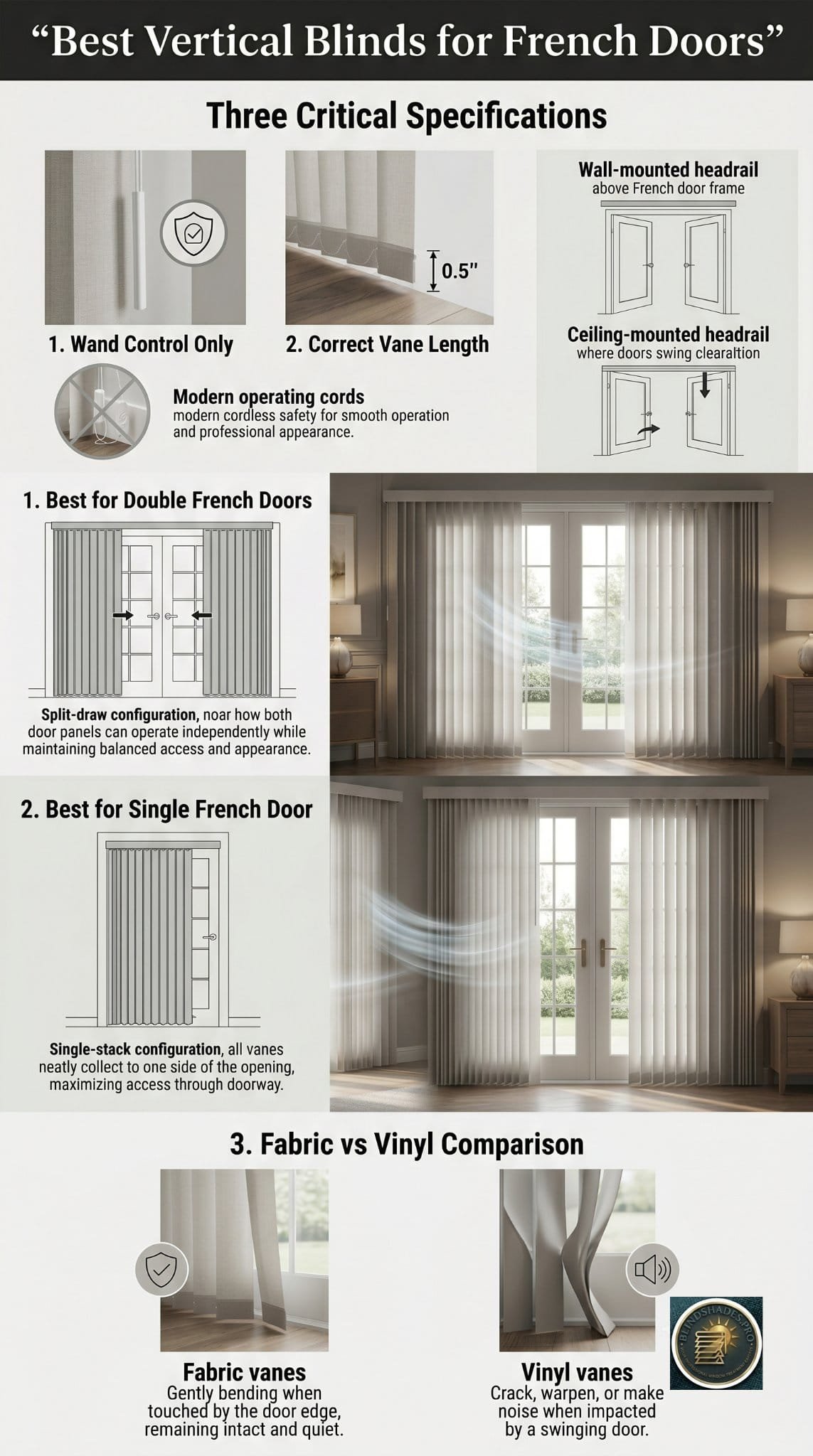
Key Takeaways:
- Vertical blinds for French doors mount on the wall or ceiling above the door frame — NOT on the door face — so the doors swing freely beneath the headrail; the critical operational consequence: for inswing French doors (doors that open into the room), the door panel swings through the space occupied by the hanging vanes; you MUST traverse the vanes to one side before opening an inswing French door or the door panel will knock the vanes from their carriers; for outswing French doors, the door swings away from the vane space — you can open the door without traversing first; this inswing traverse requirement every time the door opens is the most important practical consideration when choosing vertical blinds for French doors
- For double inswing French doors, specify a SPLIT DRAW (vanes open from center to both sides); this allows you to traverse only the half on the side of the door you are opening while leaving the other half closed; a single stack left or right on a double inswing door means traversing all vanes every time either door opens, which is operationally inconvenient; for a single French door, single stack to the side opposite the handle is the standard specification
- Standard vertical blind vanes are 89mm (3.5 inches) wide; full-height vanes for a French door (approximately 78 to 82 inches long) weigh approximately 1 to 2 lbs each in vinyl and 0.5 to 1 lb in fabric; when a door opens, the air displacement moves the hanging vanes; vinyl vanes are heavier and crack when struck by the door panel; fabric vanes are lighter (less movement from air displacement), bend rather than crack on contact, and are the correct specification for inswing French doors; vinyl is better suited for kitchen or utility French doors where wipe-clean durability is the priority
- For double French doors, calculate the vane carrier spacing relative to the center seam between the two door panels; standard carrier spacing is 3.5 inches; for a 56-inch double door opening, approximately 16 vanes will be required; ensure your total width and vane count does not place a carrier at the exact center seam point — a vane positioned at the door panel junction will be contacted by both doors on opening and will be the first to fail
- Individual vane replacement is the most underreported advantage of vertical blinds for high-traffic French doors: when a vane is damaged by door contact, you replace only that one vane for $5 to $25 rather than replacing the entire blind; cellular shades, roller shades, and Roman shades require full replacement if the fabric is damaged; for a door that opens multiple times daily over 10 to 15 years, vertical blind repairability significantly reduces the lifetime cost of window covering maintenance
⭐ Quick Answer — What Are the Best Vertical Blinds for French Doors?
- The Best Specification and the Inswing Traverse Rule Most Buyers Miss: The best vertical blinds for French doors are fabric vanes on a wall or ceiling-mounted headrail with split draw for double inswing doors and single stack for single French doors. The most important operational fact absent from all buying guides: for inswing French doors, you MUST traverse the vanes to one side before opening the door — the door panel swings THROUGH the space occupied by the hanging vanes. If you open an inswing French door without traversing first, the door panel strikes the vanes and knocks them from their carriers. This traverse-before-opening sequence runs every time the door is used. For outswing French doors, the door swings away from the vane space — no traverse is required before opening, and the vertical blind can remain fully closed while the door is open. 1ClickBlinds (April 2026) confirms vertical blinds for doors solve the “clearance” problem: vanes traverse to one side, stacking compactly in just 15 to 20cm — far less than the 30 to 40cm per side required by curtains. Wand control is standard (corded window coverings banned in USA and Canada as of June 1, 2024)
- Fabric vs Vinyl — The Material Rule for French Door Vertical Blinds: The vertical blind material for French doors is determined by the door’s location and swing direction. Fabric vanes (RECOMMENDED for most French doors): fabric vanes for a full-height French door (approximately 78 to 82 inches) weigh approximately 0.5 to 1 lb per vane; this lighter weight means less movement from air displacement when the door opens, and fabric bends rather than cracks when contacted by the door panel; fabric vanes are the correct specification for inswing French doors in living rooms, bedrooms, dining rooms, and primary entrance applications; 1ClickBlinds confirms fabric slats range “from sheer voile-style fabrics that diffuse light softly without blocking it, through to dense woven materials that offer genuine privacy in daylight.” Vinyl vanes (for kitchen and utility French doors): vinyl is heavier (1 to 2 lbs per full-height vane), cracks rather than bends on repeated door contact, and rattles more from air displacement; the advantage is wipe-clean durability — a damp cloth removes grease, cooking residue, and moisture in seconds; Blinds Chalet confirms: “PVC: wipe with mild soap and water”; vinyl is the correct specification for kitchen, utility room, or garage French doors where wipe-clean performance outweighs the rattle and crack disadvantages. Blackout-lined fabric (foam-backed or coated) adds near-blackout capability while remaining lighter than vinyl — the correct specification for bedroom French doors
- Split Draw vs Single Stack — The French Door-Specific Traverse Direction Decision: For vertical blinds for French doors, the traverse draw direction is not a preference — it is a specification determined by door configuration. Double inswing French doors = split draw: a split draw headrail traverses vanes from the center outward to both sides; for double inswing French doors, the left door swings through the left half and the right door swings through the right half; split draw allows you to traverse only the half on the door you are opening while leaving the other half in place; a single stack on a double inswing door requires ALL vanes to be traversed every time either door opens — operationally inconvenient for the door whose vanes have been stacked away. Blinds Chalet confirms: “split draw opens from the center to both sides; left or right stack parks all vanes on one side to keep a doorway clear.” Single French door = single stack to the side opposite the handle: stack away from the handle keeps the stacked vane bulk away from the door’s operational hardware. Outswing French doors = either draw works: since no traverse is required before opening an outswing door, split draw or single stack is purely a preference decision
- Carrier Spacing and the Door Seam Problem on Double French Doors: When ordering vertical blinds for French doors covering a double door pair, one specific calculation prevents a failure point: the position of the carrier at the center seam between the two door panels. Standard vertical blind carrier spacing is 3.5 inches (89mm). For a standard 56-inch double French door opening, approximately 16 carriers will be required. If the standard spacing places a carrier at exactly the center seam point (28 inches for a 56-inch opening, which is exactly 8 × 3.5 inches = carrier #8 at the seam), the vane at that carrier will be contacted by the right edge of the left door AND the left edge of the right door every time either panel opens — this is the first vane that will fail. When ordering, request that the retailer confirm no carrier falls within 1 inch of the center door seam; if standard spacing places one there, a minor total width adjustment (plus or minus 1 inch) shifts the carrier spacing to clear the seam. The 1-inch adjustment is visually imperceptible in the installed blind
- Individual Vane Replacement — The Most Underreported Advantage for High-Traffic French Doors: The best vertical blinds for French doors are not only the best at opening day — they are the most economical over the service life of a high-traffic door. A primary entrance French door may open 10 to 20 times per day. Over 10 years, that is 36,000 to 73,000 operations — the highest-frequency window covering application in most homes. At this usage rate, occasional door-vane contact is inevitable. Blindsgalore confirms: “One of the practical advantages of vertical blinds is that a damaged or stained vane can often be replaced individually without swapping out the entire set.” Cost comparison: individual vane replacement = $5 to $25 per vane; full cellular shade replacement = $50 to $200; roller shade = $55 to $160; Roman shade = $75 to $300. A vertical blind that loses one vane per year to door contact costs $5 to $25 per year to maintain versus $50 to $200 every few years for a full shade replacement. Order a handful of spare vanes at initial purchase and store them — vane discontinuation is a real risk after several years and pre-ordering spares eliminates replacement colour-matching delays
- Best Sources: Curtain stack-back comparison, fabric vane spectrum, blackout foam-backed vane specification, panel track as contemporary alternative → 1ClickBlinds vertical blinds for French doors guide 2026 · Vane rattle on door opening, corded ban June 2024, individual vane replacement program → Blindsgalore vertical blind alternatives · Split draw vs single stack, ceiling mount, 0.5-inch above floor, PVC cleaning → Blinds Chalet custom vertical blinds
⚠️ Headrail Projection Clearance for Inswing French Doors and the Ceiling Mount Rule: A wall-mounted vertical blind headrail projects 2 to 4 inches from the mounting surface. For inswing French doors, this projection creates a potential clearance problem. When an inswing French door opens to its full 90-degree position, the door panel is approximately parallel to the wall beside the door — the door panel’s back face approaches the wall surface. If the headrail is wall-mounted directly above the door frame and projects 3 inches from the wall, the open door panel may contact the headrail fascia or brackets. The clearance test: measure the distance between the door frame face and the wall surface above the door; if this depth is less than 4 inches, the headrail projection may be obstructed. The ceiling mount solution: Blinds Chalet confirms: “use the supplied brackets for ceiling mount inside soffits or for wall mount above the opening; always anchor into structural members for wide or heavy installations.” Ceiling mounting positions the headrail at the ceiling and eliminates the door-panel-strikes-headrail problem entirely; ceiling mount also provides a longer vane length (ceiling to floor = maximum coverage) and a visual floor-to-ceiling effect that enhances room height. For inswing French doors with limited wall depth above the door frame, ceiling mount is the correct specification. Vane length for all vertical blind French door installations: Blinds Chalet confirms: “for outside mount, order the length to sit about half inch above the floor or sill for smooth traverse and easy cleaning.” This applies equally to ceiling-mounted and wall-mounted headrails — always specify 0.5 inch above floor for the vane bottom. For the installation sequence including bracket placement, valance attachment, and hold-down positioning, see How Do You Install Blinds on French Doors. See the full inswing vs outswing operation guide below.
💡 Panel Track — The Modern 2026 Alternative with Identical French Door Clearance Performance: Panel track blinds function identically to wall-mounted vertical blinds for French doors for door clearance operation: both mount on the wall or ceiling above the door frame; both traverse to one side (or split from center) to clear the door opening before an inswing door is opened; neither mounts on the door face; both provide full floor-to-ceiling coverage. The difference is visual and operational: panel track uses 20 to 24-inch wide fabric panels (3 to 4 panels for a 56-inch double French door opening) instead of 3.5-inch vanes (16 panels for the same opening); fewer, wider panels traverse faster than 16 individual vanes. 1ClickBlinds (April 2026) confirms panel tracks are “one of our top recommendations for modern sliding door blinds” and describes them as “contemporary, chic” versus traditional vertical blinds. Blindsgalore positions panel tracks as the “upgraded, modern take” on vertical blinds for patio and French door applications. The decision framework: contemporary or transitional interior where clean lines matter = specify panel track; maximum budget efficiency or traditional aesthetic = specify fabric vertical blind; either traverse identically for inswing French door clearance. Individual panel replacement for panel tracks costs $15 to $50 per panel — slightly higher than $5 to $25 per vertical vane, but still significantly less than full blind replacement. For the complete panel track specification guide including fabric options and motorized panel track for smart home integration, see What Are the Best Panel Track Blinds for French Doors. See the full panel track comparison table below.
📖 Read the complete guide below for: the 3 material options (fabric for inswing/living/bedroom; vinyl for kitchen/utility; blackout-lined fabric for bedroom), the inswing traverse rule (door swings through vane space — traverse first every time), the outswing advantage (no traverse required before opening), the split draw vs single stack decision by door configuration, the carrier spacing calculation for double French doors (avoid carrier at center seam — 3.5-inch spacing; 16 vanes on 56-inch opening; 1-inch width adjustment shifts carrier off seam), headrail projection clearance for inswing doors (2-4 inch projection; ceiling mount eliminates problem), individual vane replacement economics ($5-$25 per vane vs $50-$300 full blind; 36,000-73,000 door cycles over 10 years), and the panel track comparison (20-24-inch panels; 3-4 vs 16 vanes; identical traverse operation; 2026 contemporary trend).
Related guides: where verticals fit (and where they cannot) inside the door-treatment system is mapped in the French door window treatment guide.
Best Vertical Blinds for French Doors — The 3 Material Options Compared
Why material choice matters more for French door vertical blinds than for any other application.
Vertical blinds for French doors experience physical contact with the door panel, air movement from door opening, and daily mechanical traversal — all at higher frequency than vertical blinds on a fixed window. The material determines how the vane responds to each of these stresses.
Option 1 — Fabric Vanes (RECOMMENDED for Most French Doors)
Fabric vanes are the correct material specification for residential French doors — particularly inswing French doors.
1ClickBlinds (April 15, 2026) confirms fabric slats are “the most widely used option and the most versatile… available in a wide spectrum of weights, from sheer voile-style fabrics that diffuse light softly without blocking it, through to dense woven materials that offer genuine privacy in daylight.”
Why fabric is better than vinyl for French door applications:
- Weight: fabric vanes are lighter than vinyl at equivalent dimensions (approximately 0.5 to 1 lb per full-height vane vs. 1 to 2 lbs for vinyl); lighter vanes create less momentum when air displacement from door opening causes movement; less momentum = less rattle, less carrier stress
- Impact response: fabric vanes bend when contacted by a door panel; vinyl vanes crack; a fabric vane that is gently nudged by an opening door is unharmed; a vinyl vane struck repeatedly at the same point develops a stress fracture and eventually snaps
- Acoustic performance: fabric vanes absorb sound rather than generating the clicking/clattering noise that vinyl vanes produce when they strike each other
- Appearance: fabric vanes have a softer, more residential appearance consistent with French door aesthetics; vinyl vanes are more industrial in character
Fabric vane weight options for French doors:
- Sheer fabric (lightweight, voile-type): maximum light transmission; minimum privacy; best for rooms where daylight is valued and curtain-like appearance is wanted; lightest weight = least rattle
- Medium-weight fabric: balanced light filtering and privacy; most common specification for living room and dining room French doors
- Blackout or room-darkening fabric: maximum privacy; heavier than sheer but still lighter than vinyl of equivalent opacity; correct for bedroom French doors
Option 2 — Vinyl (PVC) Vanes (Recommended for Kitchen and Utility French Doors)
Vinyl vanes are wipe-clean and highly moisture-resistant, making them the correct material for kitchen French doors, utility room French doors, and any application where grease, moisture, or condensation is a concern.
Blinds Chalet confirms: “PVC: Wipe with mild soap and water.” A damp cloth removes grease, cooking residue, and moisture from vinyl in seconds. Fabric vanes require vacuuming or gentle spot cleaning and cannot be wiped aggressively.
The limitations for French door applications:
- Heavier than fabric: more air-displacement movement; more rattle when vanes contact each other
- Crack rather than bend on door contact: higher probability of needing individual vane replacements in high-traffic installations
- Louder: the clicking of vinyl-on-vinyl when vanes oscillate is more noticeable than fabric
The specification: vinyl for kitchen, utility, bathroom, or garage French doors where wipe-clean is essential; fabric for all living areas, bedrooms, and primary entrance French doors.
Option 3 — Fabric With Blackout Liner (Premium Fabric for Bedroom French Doors)
A fabric vane with a blackout foam-backing or sewn-in blackout liner combines the handling advantages of fabric with near-blackout light control. 1ClickBlinds confirms: “Blackout blinds in a vertical slat format use a foam-backed or coated fabric that blocks the vast majority of incoming light when the slats are closed.”
The blackout liner adds marginal weight relative to standard fabric but remains lighter than vinyl. The correct specification for bedroom, nursery, or media room French doors where both daytime privacy and near-blackout are required.
The Inswing vs Outswing Operation — The Critical French Door Distinction
Why this one difference changes every aspect of operating vertical blinds on French doors — absent from all competitor guides.
Inswing French Doors — The Traverse Requirement
Inswing French doors open INTO the room. When you open an inswing French door with wall-mounted vertical blinds above the opening, the door panel swings through the space occupied by the hanging vanes.
The operational consequence: You must traverse the vanes to one side BEFORE opening the door. If you open the door without traversing first, the door panel strikes the vanes, potentially knocking them from their carriers or breaking them.
The daily routine on inswing French doors with vertical blinds:
- Traverse vanes to clear the side of the door you are opening
- Open the door
- Traverse vanes back after closing the door
This sequence runs every time the door is used. Blindsgalore acknowledges: “The vanes break easily. They clatter when you open the door.” This is specifically the inswing contact problem.
Mitigating the inswing traverse requirement:
- Specify a split draw: for double inswing French doors, split draw means traversing only the half on the opening door’s side; the other half stays in place; significantly reduces the traverse burden per opening
- Motorized traversal: specify a motorized headrail that automatically traverses the vanes before the door can be opened; a door sensor integration (compatible with smart home systems) can trigger automatic traversal when the door handle is pressed
- Consider panel track instead: panel track blinds have the same traverse-to-clear operation but the wider (20–24 inch) panels are fewer in number and traverse faster than 16+ individual vanes; see What Are the Best Panel Track Blinds for French Doors for the full panel track comparison
Outswing French Doors — The Advantage
Outswing French doors open AWAY from the room. The door panel swings toward the exterior. The hanging vanes remain inside the room — the door never enters the vane space.
The operational consequence: No traverse is required before opening an outswing French door with wall-mounted vertical blinds. You can open the door regardless of vane position. The vertical blind can remain fully closed while the door is open. This is a significant operational advantage over inswing.
The specification note for outswing: Side clearance becomes more important. An outswing door’s exterior swing requires clearance beyond the door frame. Ensure the wall-mounted headrail bracket position and any side valance or fascia trim does not obstruct the door’s exterior swing path.
Split Draw vs Single Stack — The French Door Specification
The traverse draw direction decision — absent from all guides as a French door-specific recommendation.
Double Inswing French Doors — Specify Split Draw
A split draw headrail traverses vanes from the center outward to both sides simultaneously. The center of the blind is the opening point.
For double inswing French doors:
- The left door panel swings through the left half of the blind space
- The right door panel swings through the right half
- With split draw: traverse only the left half to open the left door; the right half stays in place
- With single stack to the right: ALL vanes must traverse every time either door opens — operationally inconvenient for the door whose vanes are stacked away from it
The split draw specification: Blinds Chalet confirms: “split draw opens from the center to both sides.” Order split draw for all double inswing French door applications.
Single French Door or Double Outswing — Single Stack
For a single French door, single stack to one side is standard. Stack toward the wall opposite the door handle — this keeps the stacked vanes away from the door’s operational hardware and movement arc.
Blinds Chalet confirms: “left or right stack parks all vanes on one side to keep a doorway clear.”
Carrier Spacing and the Door Seam Problem on Double French Doors
The ordering precision most buyers overlook — absent from all guides.
Standard vertical blind carriers are spaced 3.5 inches (89mm) apart — matching the standard vane width. For a double French door where two door panels meet at a center seam:
The calculation for a standard 56-inch double French door:
- 56 inches ÷ 3.5 inches per carrier = 16 carriers (approximately)
- Center seam at 28 inches = carrier #8 lands at the seam point (28 inches ÷ 3.5 = 8.0)
- In this calculation, a carrier lands exactly at the center door seam
- This vane will be contacted by the right edge of the left door AND the left edge of the right door every time either panel opens
How to order to avoid the door seam problem:
- When ordering, note the total blind width and the approximate carrier count your retailer specifies
- Confirm with the retailer that no carrier falls within 1 inch of the center door seam
- If the standard spacing places a carrier at the seam, request a minor width adjustment (plus or minus 1 inch on the total width) to shift the carrier spacing so the seam falls between two carriers
- The 1-inch adjustment is imperceptible in the installed blind’s appearance
Headrail Projection and Mounting — The Inswing Clearance Rule
Why ceiling mount is often the better choice for inswing French doors.
A vertical blind headrail mounted on the wall above the door frame projects from that wall surface by approximately 2 to 4 inches. For inswing French doors, this projection creates a potential clearance problem.
When an inswing French door opens to its full 90-degree position, the door panel is approximately parallel to the wall beside the door. At this position, the door panel’s back face is at the wall surface. If the headrail is wall-mounted directly above the door frame and projects 3 inches from the wall, the open door panel may contact the headrail’s fascia or brackets.
The clearance test before ordering: Measure the distance between the door frame face and the wall surface above the door. This is the available mounting depth. If this depth is less than 4 inches, the headrail projection may be constrained.
The ceiling mount solution: Blinds Chalet confirms: “Use the supplied brackets for ceiling mount inside soffits or for wall mount above the opening. Always anchor into structural members for wide or heavy installations.”
Ceiling mounting positions the headrail at the ceiling rather than on the narrow wall above the door frame. Ceiling mount:
- Eliminates the door-panel-strikes-headrail problem entirely
- Provides a longer vane length (ceiling to floor = maximum coverage)
- Requires locating ceiling joists or using appropriate ceiling anchors for the headrail weight
- Creates a floor-to-ceiling visual effect that enhances room height
CC Shutters (February 2026) confirms the carrier mechanism advantage: “vertical blinds utilize carriers suspended from a track; vanes pivot and slide with less vertical strain because lifting forces are absent. Component wear occurs at carrier wheels and pivot joints rather than cords.”
Individual Vane Replacement — The Most Underreported Advantage for French Doors
Why repairability makes vertical blinds the most economical long-term choice for high-traffic French doors.
French doors are the highest-traffic window covering application in most homes. A primary entrance patio French door may open 10 to 20 times per day. Over a 10-year period, that is 36,000 to 73,000 operations — far more than any fixed window treatment experiences.
At this usage rate, damage from occasional door-vane contact is inevitable. The repair economics distinguish vertical blinds from all other French door blind options:
| Treatment | Damage from Door Contact | Repair Cost |
|---|---|---|
| Vertical blind vane (single vane damaged) | Replace one vane | $5–$25 per vane |
| Cellular shade (fabric scuffed/torn) | Replace entire shade | $50–$200 |
| Roller shade (fabric crease/tear) | Replace entire shade | $55–$160 |
| Roman shade (fabric damaged) | Replace entire shade | $75–$300 |
| Panel track panel (damaged) | Replace one panel | $15–$50 per panel |
Blindsgalore confirms: “One of the practical advantages of vertical blinds is that a damaged or stained vane can often be replaced individually without swapping out the entire set.”
The ordering practice: Keep your order information (vane dimensions, color code, punch style) on file. Some retailers offer vane matching services. Reorder a handful of replacement vanes at the time of initial purchase and store them — this avoids the delay and potential discontinuation risk when a replacement is needed years later.
How to Measure Vertical Blinds for French Doors
The measurement protocol for wall-mounted vertical blinds — different from door-mounted blinds.
Unlike door-mounted cellular or roller shades (which are measured to the glass panel dimensions), wall-mounted vertical blinds are measured to the WALL OPENING dimensions plus overlap allowances.
Width measurement:
- Measure the full width of the door opening from wall surface to wall surface
- Add 2 to 4 inches on each side for overlap on the wall surface
- For a 60-inch double French door rough opening: 60 + 4 + 4 = 68-inch blind width minimum
- Ensure the stacked vane position (when traversed to one side) does not extend into an adjacent wall corner or piece of furniture
Height measurement:
- Ceiling mount: measure from ceiling to floor; specify vane length at 0.5 inches above floor
- Wall mount above door: measure from desired headrail bracket position to floor; specify vane length at 0.5 inches above floor
- Blinds Chalet confirms: “for outside mount, order the length to sit about half inch above the floor or sill for smooth traverse and easy cleaning”
For the full French door measurement protocol including glass panel dimensions for door-mounted blinds, see our complete guide: How Do You Measure French Doors for Blinds.
Panel Track vs Vertical Blinds — The Modern Upgrade Decision
Why 2026 trend data shows panel track replacing traditional vertical blinds for French doors.
Panel track blinds function identically to wall-mounted vertical blinds for French door clearance:
- Both mount on the wall or ceiling above the door frame
- Both traverse to one side (or split from center) to clear the door opening
- Both provide full floor-to-ceiling coverage
- Neither mounts on the door face
The difference is visual and operational:
| Factor | Traditional Vertical Blind | Panel Track Blind |
|---|---|---|
| Panel width | 3.5-inch (89mm) vanes | 20–24 inch fabric panels |
| Number of panels | 16+ for 56-inch opening | 3–4 for same opening |
| Visual style | Classic/traditional | Contemporary/architectural |
| Traverse speed | Multiple vanes | 3–4 wide panels = faster |
| Stack width when open | 15–20cm | Similar or narrower |
| Individual panel replacement | YES ($5–$25 per vane) | YES ($15–$50 per panel) |
| Blackout capability | YES (foam-backed fabric vanes) | YES (blackout panel fabric) |
| 2026 trend direction | Declining for residential | Growing — replacing vertical blind |
1ClickBlinds (April 15, 2026) confirms: “Panel tracks… panels of fabric slide smoothly on a track, creating a clean, architectural look. They are one of our top recommendations for modern sliding door blinds.”
Blindsgalore also positions panel tracks as the “upgraded, modern take” on traditional vertical blinds.
The decision rule: If the French door is in a contemporary or transitional interior where clean lines matter, specify panel track. If the installation requires specific budget constraints, maximum light-blocking performance, or a traditional aesthetic, specify fabric vertical blinds. Both traverse identically for door clearance. See our full guide: What Are the Best Panel Track Blinds for French Doors.
Top Brands for French Door Vertical Blinds
Blindsgalore — Best Overall Selection and Vane Replacement Program
The most comprehensive US vertical blind selection for French doors. Fabric and vinyl vane options; wand control standard; replacement vane program; split draw and single stack options. Blindsgalore’s installation support is confirmed by their own data: “99% of our customers install their own window coverings.”
Blinds Chalet — Best Value with Split Draw and Ceiling Mount Options
Blinds Chalet offers split draw headrails at mid-market pricing, ceiling mount brackets included, and replacement vane programs. Their sizing guide specifically addresses patio and French door applications with the 0.5-inch-above-floor vane length recommendation.
Blinds To Go — Best Retail Showroom for In-Person Selection
For buyers who want to see fabric vane weights, opacities, and textures in person before ordering for a French door application. Wand controls standard; valance included; color matching between fascia and vanes.
Bali Blinds — Best for Motorized French Door Vertical Blinds
Bali’s motorized vertical blind headrail allows traversal via remote, app, or voice command — eliminating the manual traverse-before-opening requirement for inswing French doors. The automated traversal can be integrated with Alexa or Google Home for hands-free operation.
Frequently Asked Questions
What are the best vertical blinds for French doors? The best vertical blinds for French doors are fabric vanes (not vinyl) on a wall or ceiling-mounted headrail with split draw for double inswing doors. Fabric vanes are lighter, bend rather than crack on door contact, and rattle less from air displacement when the door opens. Specify wand control (corded window coverings are banned in the USA and Canada as of June 1, 2024). For bedroom French doors, specify fabric vanes with blackout lining.
Do vertical blinds mount on the door or on the wall for French doors? Vertical blinds for French doors mount on the wall or ceiling above the door frame, not on the door face. This is the standard installation for vertical blinds on any door application. The doors swing freely beneath the headrail. The critical operational consequence for inswing French doors is that the door panel swings through the vane space — the vanes must be traversed to one side before opening an inswing French door.
Should I use split draw or single stack vertical blinds for French doors? For double inswing French doors, specify split draw so each door’s half of the blind can be traversed independently. A single stack for a double inswing door requires all vanes to be traversed every time either door opens. For a single French door, single stack to the side opposite the handle is the standard. For outswing French doors of any configuration, either split draw or single stack works because no traverse is needed before opening.
Why do vertical blinds rattle on French doors? Vertical blind vanes rattle on French doors for two reasons. First, when the door opens, the air displacement moves the hanging vanes, causing them to swing and contact adjacent vanes. Second, if the door panel contacts a vane during opening, the vane swings and creates noise. Fabric vanes rattle less than vinyl because they are lighter (less momentum from air movement) and flexible (they absorb contact energy rather than transmitting it to adjacent vanes).
Can I replace individual vertical blind vanes when they are damaged by the door? Yes. Individual vane replacement is one of the primary advantages of vertical blinds for high-traffic French door applications. A single damaged vane can be replaced for $5 to $25 per vane without replacing the entire blind. Keep your original order details on file for vane matching. Blindsgalore and most major retailers offer replacement vane programs.
Related Guides on BlindShades.pro
- The Best French Door Blinds & Shades Buying Guide
- What Are the Best Blinds for French Doors
- What Are the Best Panel Track Blinds for French Doors
- How Do You Measure French Doors for Blinds
- How Do You Install Blinds on French Doors
- How Do You Stop French Door Blinds From Swinging
By Michael Turner | 30 Years Home Improvement Expertise | Updated 2026 | BlindShades.pro
