Alternatives to Pleated Blinds

Authored By Michael Turner -30 Years Home Improvement Expertise | Updated 2026 | BlindShades.pro
Updated on July 2, 2026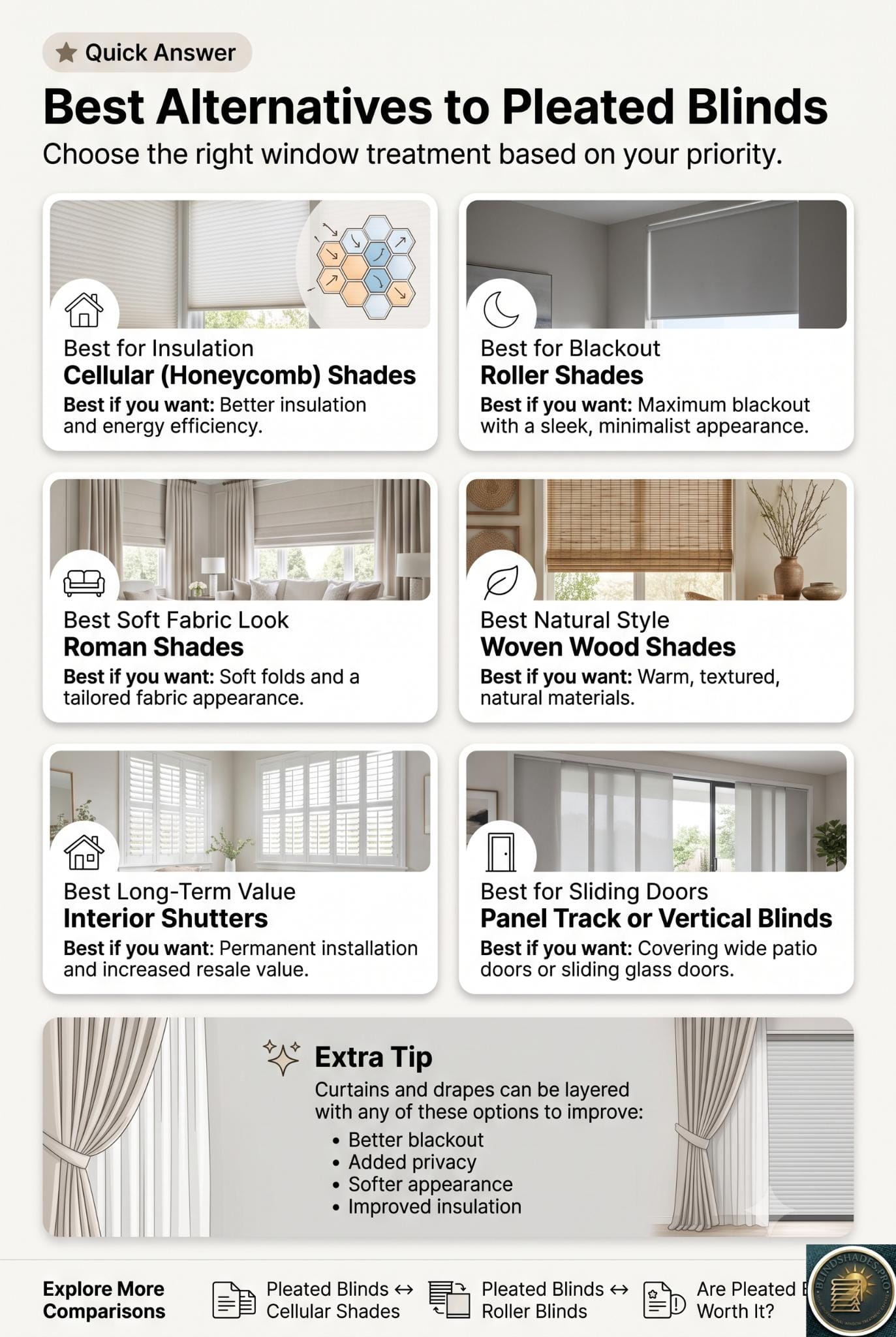
Authored by Michael Turner — 30 Years of Home Improvement Expertise | BlindShades.pro
The best alternatives to pleated blinds depend on why you are switching. If you want better insulation, cellular (honeycomb) shades are the natural upgrade; for the most complete blackout and a minimalist look, roller shades win; for soft, tailored fabric, Roman shades; for a warm, natural texture, woven wood shades; for a solid, permanent, high-end look, shutters; and for wide sliding doors, panel track or vertical blinds. Curtains and drapes are the flexible layering option that pairs with any of them. Each trades something for what it gains over a pleated blind, more insulation or darkness usually costs more, while cheaper options give up the fabric look. This guide walks through all seven alternatives, organized by the reason you would choose each, and compares every one honestly back to a pleated blind so you can pick the right switch for your room.
Key Takeaways
- Start with why you are switching. The right alternative depends on your priority: insulation, blackout, softness, natural look, durability, doors, or budget.
- Cellular shades are the insulation upgrade. Honeycomb cells trap air for far better energy efficiency than a single-layer pleated blind.
- Roller shades are the blackout and minimalist pick. A flat fabric sheet blocks light more completely and gives a clean, modern line.
- Roman shades and woven woods add richer texture. Roman shades give soft tailored folds; woven woods give a warm, natural material look.
- Match the alternative to the room. Shutters and panel tracks suit specific needs like permanence or wide doors, while curtains layer with anything.
⭐ Quick Answer
The best alternatives to pleated blinds depend on why you are switching, so match the option to your priority.
- Want better insulation: cellular, or honeycomb, shades trap air for energy efficiency, as Hunter Douglas explains.
- Want the best blackout and a minimal look: roller shades block light more completely with a flat fabric panel.
- Want soft or natural texture: Roman shades for tailored fabric, or woven wood shades for a warm, natural look, styles The Shade Store features.
- Want permanence or wide-door coverage: shutters add lasting value, while panel track or vertical blinds suit sliding doors, options Blindsgalore covers.
- On a budget: curtains, basic roller shades, or no-drill shades. Compare cellular shades, vertical blinds, or our best pleated blinds guide.
Why Look Beyond Pleated Blinds?
Pleated is great value, but it has real limits.
Pleated blinds are affordable, stylish, and space-saving, but their single fabric layer means they insulate very little, rarely achieve total blackout, and offer a lighter look than some rooms call for. So people look for an alternative when they want more warmth and energy savings, a genuinely dark bedroom, a richer or more natural material, a more permanent fixture, or a treatment sized for wide doors. The good news is there is a strong alternative for each of those needs. The trick is to start with your priority, then match the alternative to it, rather than shopping by product name. The sections below are organized exactly that way.
The Alternatives, by Priority
Match the reason you are switching to the best option.
| If your priority is | Best alternative | Why |
|---|---|---|
| Insulation and energy savings | Cellular shades | Honeycomb cells trap air |
| Maximum blackout, minimal look | Roller shades | Flat sheet seals light |
| Soft, tailored fabric | Roman shades | Fabric folds, structured look |
| Natural, warm texture | Woven wood shades | Real bamboo and grasses |
| Permanence and resale value | Shutters | Solid, built-in fixture |
| Wide sliding doors | Panel track or vertical | Slides sideways to clear the door |
| Flexible layering | Curtains and drapes | Pair with any shade |
This table is the quickest way to choose: find your priority on the left and start with the alternative on the right. Because every switch is a trade-off, here is what each alternative gains and gives up compared with a pleated blind:
| Alternative | You gain | You give up |
|---|---|---|
| Cellular shades | Insulation, cleaner stack | A little cost, easy cleaning |
| Roller shades | Blackout, wipe-clean, minimal look | The textured fold |
| Roman shades | Soft, tailored, upscale fabric | Slim profile, lower price |
| Woven wood shades | Natural texture and warmth | Precise light control |
| Shutters | Permanence, durability, resale value | Affordability and flexibility |
| Panel track / vertical | Wide-door coverage | Compact look on small windows |
The sections that follow explain each one in turn.
Cellular Shades: The Insulation Upgrade
The closest alternative, with far better energy efficiency.
Cellular shades, also called honeycomb shades, look almost identical to pleated blinds from the front but add a second fabric layer that forms honeycomb-shaped air pockets. Those trapped-air cells give cellular shades much better insulation and a cleaner, more uncluttered stack, which is why they are the most popular upgrade from pleated. What you give up is a little cost, cellular runs higher, and slightly easier cleaning, since dust can lodge in the cells. If insulation, energy savings, or a darker bedroom is your reason for switching, cellular is the natural choice. The full head-to-head is in pleated blinds vs cellular shades, and options are covered in our best cellular shades guide.
Roller Shades: Blackout and Minimalism
A flat sheet for the darkest, cleanest look.
Roller shades are a single flat piece of fabric that wraps around a tube, giving a sleek, low-profile, modern look. Their big advantages over pleated blinds are more complete blackout, because a flat blackout panel seals light better than folded fabric, and effortless cleaning, since there are no pleats to trap dust. What you give up is the textured, architectural fold that gives pleated its character, and a little stacking compactness. If a genuinely dark bedroom, a minimalist aesthetic, or a wipe-clean surface for a kitchen or bathroom is your priority, roller is the switch. Compare them directly in pleated blinds vs roller blinds, and see options in our best roller shades guide and best roller blinds guide.
Roman Shades: Soft, Tailored Fabric
The upgrade for a richer, more decorative fabric look.
Roman shades give you the softness of fabric with more structure and presence than a pleated blind. When lowered, they hang as a smooth or gently folded panel; when raised, they stack into soft, tailored fabric folds. Compared with pleated blinds, Roman shades feel more luxurious and decorative, with heavier fabrics and a more custom, upholstered look. What you give up is the pleated blind’s slim profile and lower price, Romans are bulkier when stacked and generally cost more. If you want a soft, high-end fabric statement in a living room, dining room, or bedroom, Roman shades are the elegant alternative.
Woven Wood and Natural Shades
For a warm, textured, natural-material look.
| Natural option | Material and look |
|---|---|
| Woven wood shades | Bamboo, reeds, jute; warm dappled light |
| Bamboo shades | Light, airy, coastal and boho feel |
| Grass and jute weaves | Organic texture, eco-friendly |
| Add a liner | Restores privacy and darkening |
If you searched for a natural alternative to pleated blinds, woven wood shades are the answer. Made from real bamboo, reeds, jute, and grasses, they bring warmth, organic texture, and an eco-friendly material that a manufactured pleated fabric cannot match. They filter light with a soft, dappled glow and suit relaxed, coastal, boho, and nature-inspired interiors. Compared with pleated blinds, woven woods give far more textural character; what you give up is precise light control, since natural weaves let some light through, though you can add a liner for privacy and darkness. For a warm, natural, textured room, woven woods are the standout choice.
Shutters: The Permanent Option
A solid, built-in fixture with lasting value.
Where pleated blinds are a soft, replaceable treatment, plantation shutters are a permanent, built-in fixture with solid louvers that tilt for light and privacy. They offer excellent durability, a high-end architectural look, strong light control, and can add resale value to a home. Compared with a pleated blind, shutters are far more substantial and long-lasting; what you give up is affordability and flexibility, shutters are the most expensive option here and are fixed once installed. If you want a permanent, premium, value-adding treatment and are willing to invest, shutters are the alternative to consider.
Panel Track and Vertical Blinds: For Wide Doors
Sideways-sliding options for sliding glass and patio doors.
For a wide window or a sliding glass or patio door, a treatment that slides sideways often beats one that lifts. Panel track blinds use wide fabric panels that glide across on a track, and vertical blinds use hanging vanes that rotate and draw to the side, both purpose-built for wide, door-height openings where a lifting pleated blind is less practical. Compared with pleated, these give better coverage and operation on very wide spans; what you give up is the compact folded look on standard windows. If your reason for switching is a big slider or patio door, start with panel track or best vertical blinds.
Curtains, Drapes, and Cheap Alternatives
The flexible layer, and the budget routes.
| Budget alternative | What you get |
|---|---|
| Curtains or drapes | Soft layering, wide style range, easy to hang |
| No-drill fabric or paper shades | Cheap, temporary, renter-friendly |
| Roller shades (basic) | Low-cost function and blackout |
| Layering sheer plus a drape | Flexible light and privacy on a budget |
Curtains and drapes are the classic flexible alternative, offering endless textures, colors, and patterns, and they layer beautifully over or instead of a shade, a sheer plus a heavier drape gives adjustable light and privacy. They are also often the budget-friendly route, along with basic roller shades and no-drill fabric or paper shades for renters. If cost is your main reason for looking beyond pleated, curtains and simple roller or paper shades deliver function for less, though they give up the tailored, built-in look of a fitted shade. Layering curtains over any shade also boosts darkness and insulation cheaply.
Which Alternative Should You Choose?
Let the room and the priority decide.
The simplest way to choose is to name your single biggest priority and match it: cellular for insulation, roller for blackout and a clean look, Roman for soft tailored fabric, woven wood for natural texture, shutters for permanence and value, panel track or vertical for wide doors, and curtains for flexible, budget-friendly layering. Many homes mix several, cellular in bedrooms, roller in wet rooms, woven woods in living spaces. If you are still deciding whether to move on from pleated at all, weigh the case in are pleated blinds worth it, and for the full range of pleated options before you switch, see our best pleated blinds guide.
Best Sources
- Hunter Douglas — on cellular shades trapping air for temperature regulation, and the range of shade styles as alternatives by look and function.
- The Shade Store — on styling roller, Roman, and fabric shades for modern and large windows, and the trade-offs between formats.
- Blindsgalore — on cellular, roller, panel track, and drapery as alternatives, and matching them to durability and door needs.
- Stoneside — on roller, cellular, Roman, and modern drape alternatives to blinds for contemporary windows.
- Blinds.com — on honeycomb, panel track, and vertical alternatives for patio and sliding doors and how to filter by need.
Related Guides
- Best Pleated Blinds Buying Guide
- Pleated Blinds vs Cellular Shades
- Pleated Blinds vs Roller Blinds
- Are Pleated Blinds Worth It?
Frequently Asked Questions
What is a good alternative to pleated blinds?
The best alternative depends on why you are switching. For better insulation, cellular (honeycomb) shades are the natural upgrade; for the most complete blackout and a minimalist look, roller shades; for soft, tailored fabric, Roman shades; for a warm, natural texture, woven wood shades; for permanence and resale value, shutters; and for wide sliding doors, panel track or vertical blinds. Curtains and drapes layer flexibly with any of them. Rather than shopping by product name, name your single biggest priority, insulation, darkness, texture, budget, or doors, and match the alternative to it.
What is the best alternative to pleated blinds for insulation?
Cellular, or honeycomb, shades are the best alternative to pleated blinds for insulation. They look almost identical to pleated shades from the front but add a second fabric layer that forms honeycomb-shaped air pockets, and that trapped air greatly improves energy efficiency, slowing heat loss and gain through the window. Pleated blinds, with their single fabric layer, insulate very little by comparison. So if lowering heating and cooling costs or improving comfort on a drafty window is your goal, cellular is the clear upgrade, at a somewhat higher price that can pay back through energy savings over time.
What is a cheap alternative to pleated blinds?
The most budget-friendly alternatives to pleated blinds are curtains, basic roller shades, and no-drill fabric or paper shades. Curtains and drapes offer a wide style range and layer easily for adjustable light and privacy; basic roller shades deliver low-cost function and even blackout; and no-drill peel-and-stick shades are inexpensive and renter-friendly, installing without tools. Layering a sheer curtain with a heavier drape also gives flexible control on a budget. These options give up the tailored, built-in look of a fitted shade, but if cost is your main concern, they cover a window for less while still controlling light.
What is a natural alternative to pleated blinds?
Woven wood shades are the best natural alternative to pleated blinds. Made from real bamboo, reeds, jute, and grasses, they bring warm, organic texture and an eco-friendly material that manufactured pleated fabric cannot match, filtering light with a soft, dappled glow. They suit relaxed, coastal, boho, and nature-inspired interiors. The trade-off is less precise light control, since natural weaves let some light through, but adding a liner restores privacy and darkening. If you want a warm, textured, natural-material look rather than a smooth manufactured fabric, woven woods are the standout choice.
Should I replace my pleated blinds?
Only if a specific need is going unmet, since pleated blinds are affordable and versatile. Replace them if you want noticeably better insulation (choose cellular), a genuinely dark bedroom (roller or shutters), a richer or more natural material (Roman or woven wood), a permanent value-adding fixture (shutters), or a treatment sized for wide sliding doors (panel track or vertical). If your pleated blinds work well for the room and only need a repair or refresh, keeping them is usually the better value. Weigh the decision in our guide on whether pleated blinds are worth it before switching.
