Are Roman Shades Outdated? What’s In Style in 2026

Authored By Michael Turner -30 Years Home Improvement Expertise | Updated 2026 | BlindShades.pro
Updated on July 8, 2026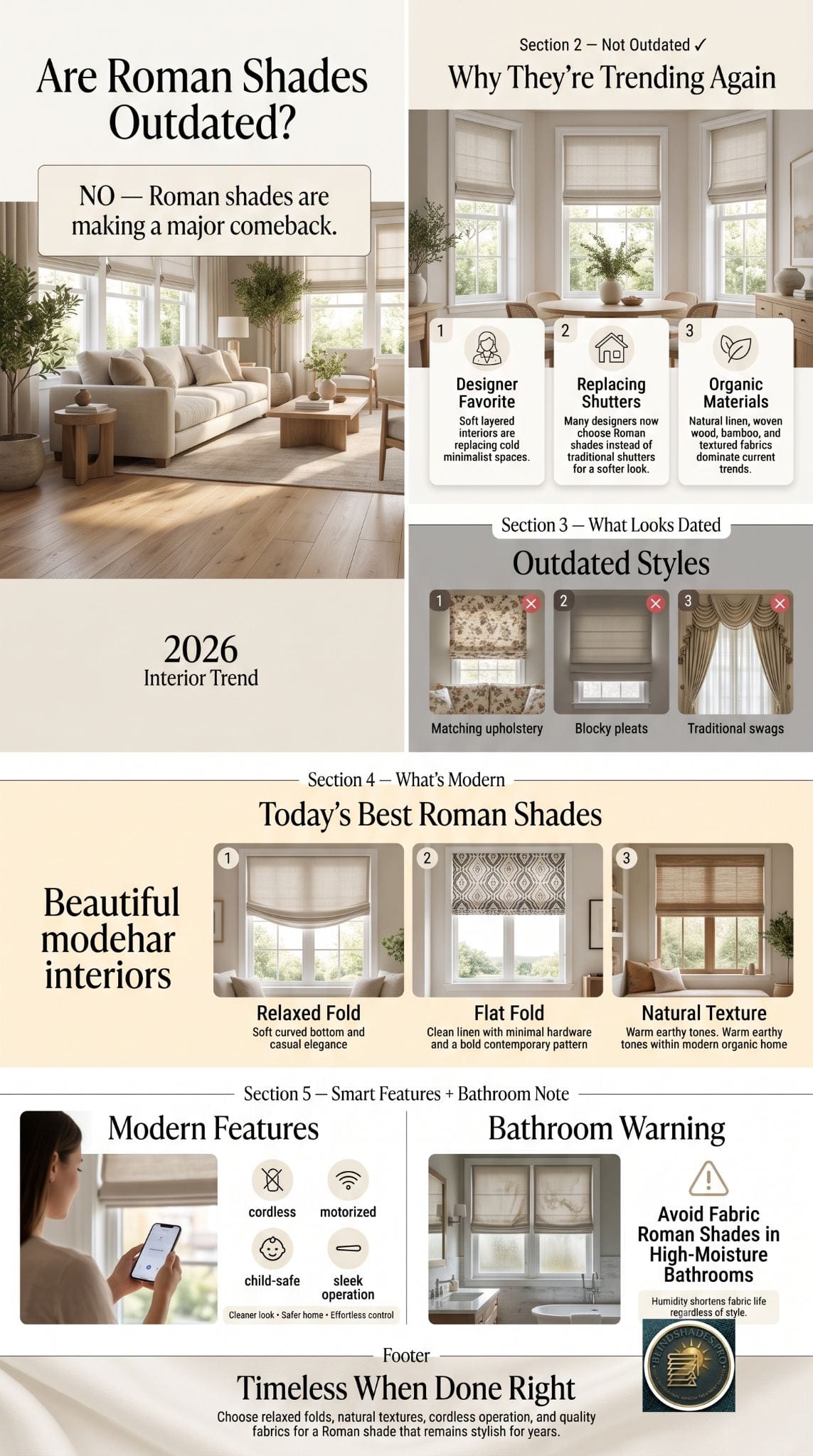
By Michael Turner | 30 years in window treatments
No — Roman shades are not outdated. They are in the middle of a genuine renaissance, and Better Homes & Gardens reports that sleek Roman shades are actively replacing shutters for better light control and furniture-placement flexibility. But the honest answer has a second half nobody gives you: while the product is thriving, certain executions of it are firmly dated. Martha Stewart’s designers name Roman shades that perfectly match the upholstery and bedding as a look they are tired of. So the real question is not whether Roman shades are outdated — it is whether your Roman shade is. This guide separates the two.
🎯 5 Key Takeaways
- The product is not outdated; specific executions are. Roman shades are trending upward, but matchy-matchy fabric coordination, stiff blocky pleats, and heavy swagged valances read dated in 2026.
- The relaxed fold is the “it” treatment. Apartment Therapy calls relaxed Roman shades 2026’s trendiest window covering, praised for a polished yet approachable look that softens boxy windows.
- Designers are choosing Romans over shutters. Better Homes & Gardens reports sleek Roman shades are replacing shutters for better light control and furniture-placement flexibility — the opposite of a dying trend.
- Woven wood and natural texture drive the renaissance. The market shift toward soft, organic interiors has pushed woven-wood and linen Romans to the front in both modern and traditional rooms.
- They are still wrong for some rooms. Roman shades are fabric, so high-moisture rooms like bathrooms remain a genuinely poor fit — that is a specification limit, not a style verdict.
⭐ Quick Answer
Are Roman shades outdated? No. They are in a renaissance as designers move toward softer, more organic interiors, though certain executions of them are dated. The short version:
- Not outdated: Better Homes & Gardens reports sleek Roman shades are replacing shutters for better light control and furniture-placement flexibility.
- What is dated: shades that perfectly match your upholstery or bedding, a look Martha Stewart designers avoid, plus stiff blocky pleats and heavy swagged valances.
- What is current: the relaxed fold, called 2026’s trendiest window treatment by Apartment Therapy, along with woven wood and flat folds; see which fold to choose.
- Modern and safe: cordless and motorized lifts give sleek, child-safe operation; the full specification is in our Roman shades guide.
- Still not for bathrooms: fabric Roman shades fail in high moisture regardless of style, so use a roller shade there instead.
Best Sources: Better Homes & Gardens (window treatment trends); Martha Stewart (outdated window treatments designers avoid); Apartment Therapy (relaxed Roman shades trend); Blindsgalore (are Roman shades still in style); Blinds Chalet (Roman shade trends); Window Covering Manufacturers Association (cordless safety standard).
Are Roman Shades Outdated in 2026?
No — Roman shades are not outdated. They are in a renaissance, serving as a top pick for designers transitioning away from stiff, minimalist spaces toward softer, more organic interiors.
The trend evidence is unusually one-directional. Blinds Chalet states plainly that Roman shades are not outdated and remain popular because their soft fabric look and tailored design work in both traditional and modern rooms. Blindsgalore goes further, telling readers to forget any notion that Roman shades are dated. And the strongest signal comes from an outlet writing about what is going out of style: Better Homes & Gardens reports that sleek Roman shades are replacing shutters, citing better light control and furniture-placement flexibility. When a “going out of style” article names your product as the replacement, the trend question is settled.
Apartment Therapy adds the specific driver, calling relaxed Roman shades 2026’s trendiest window treatment. Roman shades combine the functionality of a blind with the softness and texture of drapery — precisely the quality a market moving toward warmth and organic materials is buying.
So why does the question keep getting asked? Because plenty of dated Roman shades exist, and people mistake the execution for the product.
What Actually Makes a Roman Shade Look Dated?
The Dated-Execution Rule: Roman shades are not outdated, but specific executions are — change the fold, the fabric, and the coordination, and a dated shade becomes a current one without changing the product.
This is the distinction every ranked page misses, and it is the useful part of the answer. Martha Stewart’s designers do not say Roman shades are out; they say Roman shades that perfectly match the upholstery, bedding, or other fabrics may once have been the hallmark of a coordinated room, but designers now avoid it. That is a critique of coordination, not of Roman shades. Here is what reads dated versus current.
| Dated execution | Current execution |
|---|---|
| Shade fabric matching upholstery or bedding exactly | A shade that contrasts or complements, never matches |
| Stiff, blocky, heavily structured pleats | The relaxed fold with a soft bottom curve |
| Heavy swagged valances and fringe | A clean cassette or simple headrail |
| Busy small-scale florals as a default | Woven wood, natural texture, or a bold modern print |
| Corded lift systems | Cordless or motorized operation |
Change nothing but those five variables and the same Roman shade moves from 1998 to 2026. That is the whole trick, and it explains why the internet contains both “Roman shades are timeless” and “I hate Roman shades” in equal measure.
What Roman Shade Styles Are In Style Right Now?
Three executions define current Roman shades: the relaxed fold, woven wood and natural textures, and flat folds carrying bold patterns or clean linen.
Each of these is named repeatedly across the trend coverage, and each maps to a specific room and effect.
| Current style | What it is | Best for |
|---|---|---|
| Relaxed fold | A gentle flowing curve at the bottom, no bottom stiffener | Softening bedrooms and casual living spaces |
| Woven wood / bamboo | Natural organic weaves in earthy tones | Adding warmth to modern and traditional rooms |
| Flat fold | A smooth panel when lowered, crisp horizontal folds when raised | Bold patterns or clean linen, contemporary rooms |
| Cordless / motorized | Cord-free lift, app or remote control | Sleek operation and child safety |
The relaxed fold is the runaway favorite because it skips the stiff, blocky pleats that made older Roman shades feel heavy. Woven wood is the texture play driving the whole “soft modern” shift. And a flat fold is what you choose when the fabric itself is the statement — a bold pattern lies perfectly flat when lowered. Which fold suits your fabric and room is the decision we work through in flat vs relaxed vs hobbled Roman shades.
On the safety point, modern Roman shades come cordless or motorized as standard, because under the ANSI/WCMA A100.1 standard from the Window Covering Manufacturers Association corded products are restricted — so a cord-free lift is both the current look and the safe one.
Why Do Some People Say They Hate Roman Shades?
Almost every “I hate Roman shades” complaint traces to a mismatch — the wrong fold, the wrong room, or a dated matchy-matchy execution — rather than to the product itself.
The forums are blunt about it: one long-running thread opens with the writer saying everyone does Roman shades and they look ugly and dumb. That reaction is real and worth taking seriously rather than waving away. In practice it comes from three specific failures, each with a fix.
| The complaint | What actually went wrong | The fix |
|---|---|---|
| “They look fussy and busy” | Wrong fold for the fabric — a hobbled fold breaks up a print | Use a flat fold for patterns |
| “They get dirty and look tired” | Wrong room — decorative fabric in a grease- and dust-heavy kitchen | Use a wipe-clean roller shade there |
| “They look dated and matchy” | Fabric coordinated to match upholstery or bedding | Contrast or complement; never match exactly |
| “They block my window when up” | Stack bulk on a short window | Mount higher, or choose a flat fold |
The pattern is that none of these is a fault of the Roman shade itself. A hobbled shade with a busy print reads fussy, while a flat fold with the same print reads modern. A decorative fabric Roman in a high-traffic kitchen collects dust and grease, and people blame the shade rather than the placement — a roller shade belongs there, as our Roman shades vs roller shades comparison explains. And matchy-matchy coordination is the exact look Martha Stewart’s designers flag. Fix those three and the objection largely dissolves.
What Are the Real Drawbacks of Roman Shades?
The honest drawbacks are cost, cleaning, stack bulk, and moisture — none of which is a style problem, and all of which are worth knowing before you buy.
Being straight about the limits is what separates a trend answer from a sales pitch.
| Drawback | Why it happens | The workaround |
|---|---|---|
| Higher cost | More fabric, a liner, and sewing labor than a roller shade | Reserve Romans for rooms where the look earns it |
| Traps dust; spot-clean only | Fabric folds hold dust | Vacuum regularly; avoid grease-heavy rooms |
| Stacks tall when raised | All that fabric bunches at the top | Mount higher, or choose a flat fold |
| Poor in bathrooms | Fabric fails in high moisture | Use a vinyl roller or faux-wood blind instead |
| Needs about 2 inches of depth | Thick construction for an inside mount | Outside-mount on a shallow window |
That bathroom row is the one place a confident “not outdated” answer must still say no. Roman shades are fabric, and high moisture warps, mildews, and degrades fabric — a specification limit that has nothing to do with fashion. For the full specification picture, see our best Roman shades buying guide.
Are Roman Shades Worth It, or Should You Choose Something Else?
Roman shades are worth it when you want fabric softness with precise light control, and worth skipping when you need a wipe-clean, low-cost, or moisture-tolerant treatment.
The trend answer only matters if the purchase makes sense, so here is the practical verdict. Buy Roman shades for living rooms, bedrooms, and dining rooms where warmth, texture, and pattern belong, and where their better insulation and room-darkening — especially with a blackout liner — do real work. Skip them for bathrooms, grease-heavy kitchens, and budget-driven whole-house projects, where roller shades or faux-wood blinds serve better for less. If darkness is the goal, the liner choice matters more than the trend, which we cover in blackout vs light-filtering Roman shades. The style question is settled; the specification question is the one that decides whether you will be happy.
Related Buying Guides
- The Best Roman Shades Buying Guide — the full specification
- Flat vs Relaxed vs Hobbled Roman Shades — the fold that keeps it current
- Blackout vs Light-Filtering Roman Shades — the liner decision
- Roman Shades vs Roller Shades — when a roller is the better call
Frequently Asked Questions
Are Roman shades outdated? No. Roman shades are not outdated; they are in a renaissance as designers move toward softer, more organic interiors, and Better Homes & Gardens reports sleek Roman shades are replacing shutters. What is outdated are specific executions: shades that perfectly match your upholstery or bedding, stiff blocky pleats, and heavy swagged valances. Change the fold, fabric, and coordination and the same product reads current.
Are Roman shades going out of style? No, the opposite. Trend coverage consistently places Roman shades as trending upward, with Apartment Therapy naming relaxed Roman shades 2026’s trendiest window treatment. The shift toward soft modern interiors, natural texture, and woven wood has increased demand. Roman shades combine the function of a blind with the softness of drapery, which is exactly what current interiors want.
Are Roman shades out of style in 2026? Not at all. In 2026 they are trending, with the relaxed fold, woven wood, and flat folds in bold patterns leading the category, and cordless or motorized lifts making them both sleek and child-safe. The only genuinely dated looks are matchy-matchy fabric coordination, stiff blocky pleats, and heavy valances with fringe.
What are the drawbacks of Roman blinds? Roman blinds cost more than roller shades because of the extra fabric, liner, and sewing labor; their folds trap dust and are usually spot-clean only; they stack into a tall pile that can block the top of the view; they need roughly two inches of depth for an inside mount; and they are a poor choice for bathrooms and other high-moisture rooms because they are made of fabric.
What is the newest trend in window coverings? The dominant direction is soft modern: natural textures such as woven wood and bamboo, relaxed folds that replace stiff structured pleats, and cord-free operation through cordless or motorized lifts. Better Homes & Gardens notes sleek Roman shades are replacing shutters for better light control, while layered treatments pairing a shade with drapery continue to grow.
Are Roman shades good for kitchens and bathrooms? Kitchens can work with a simple flat-fold shade kept away from grease and steam, though a wipe-clean roller shade is often the better choice. Bathrooms are a genuine no: Roman shades are fabric, and sustained high moisture warps, mildews, and degrades them. Use a vinyl roller shade or faux-wood blind in a bathroom regardless of what is in style.
