Are Roman Shades Worth It? An Honest Cost and Value Guide

Authored By Michael Turner -30 Years Home Improvement Expertise | Updated 2026 | BlindShades.pro
Updated on July 10, 2026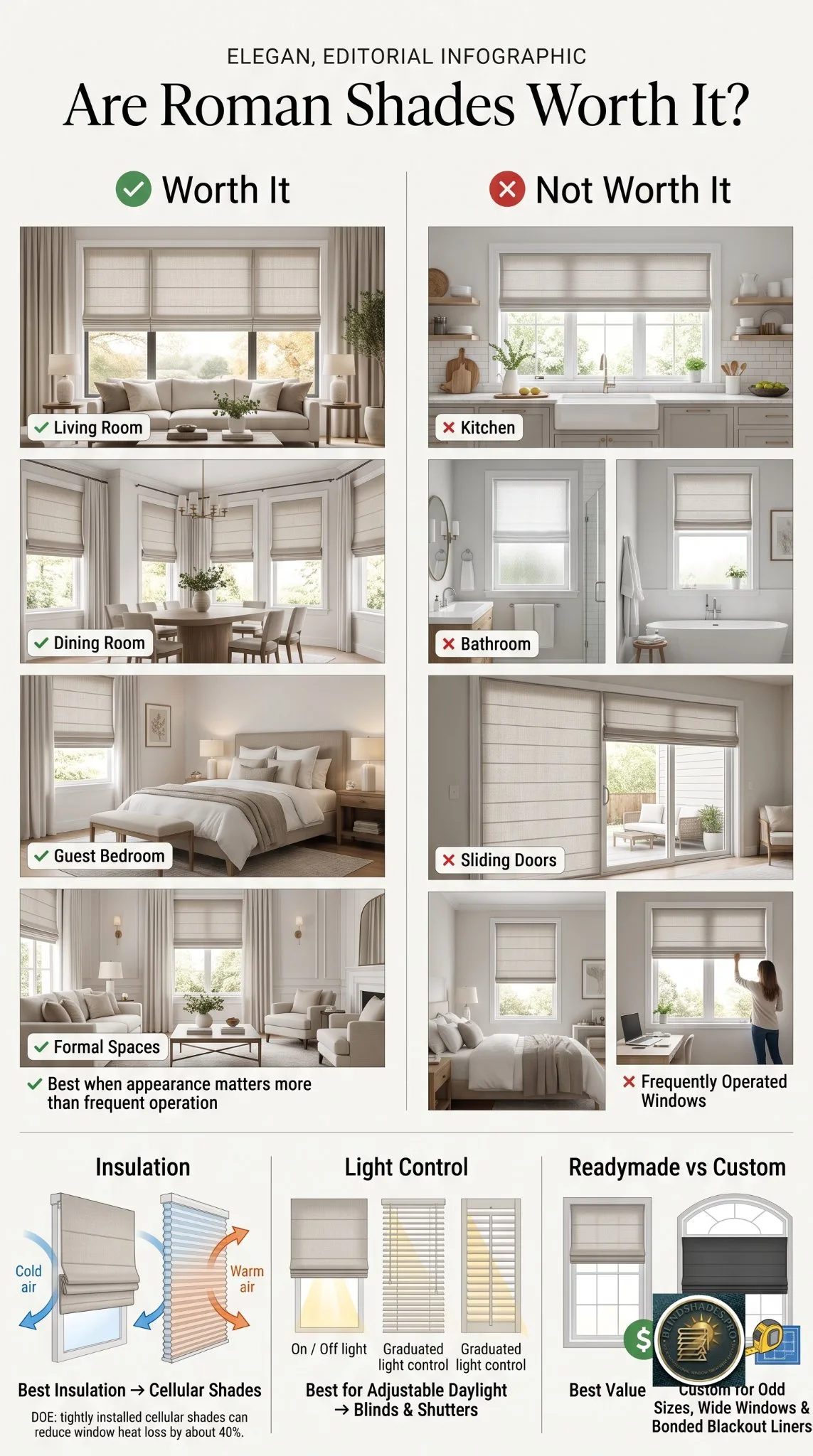
By Michael Turner | 30 years in window treatments
Roman shades are worth it on a window you look at and rarely operate, and a poor buy on a window you work. They are not the insulation upgrade the internet says they are. Before you spend anything, notice who is answering this question. Almost every page that ranks for it belongs to a company that sells Roman shades, and every one of them says yes. The people who own them are considerably less enthusiastic.
🎯 5 Key Takeaways
- Check the source before you check the price. Of the pages Google ranks for this query, the ones answering “absolutely” are retailers. The forum threads answering “it depends” are owners.
- The insulation argument is the weakest one. The Department of Energy publishes figures for cellular shades, not Roman shades, and Roman shades do not appear among the Attachments Energy Rating Council’s rated categories.
- Cost is the real question, and it is a readymade-versus-custom question. Google’s own AI Overview puts custom Roman shades at roughly three hundred to more than one thousand dollars per window.
- You cannot tilt a Roman shade. It is up or down. If you need graduated privacy with a view, you need slats, not fabric.
- Operating frequency decides everything. A shade you move twice a year is a good investment. A shade you move twice a day is a maintenance liability.
⭐ Quick Answer
Are roman shades worth it? Yes on a window you look at and rarely operate; no on a window you work. Before you weigh the price, notice who is answering. Almost every page ranking for this question belongs to a company that sells roman shades, and every one of them says yes.
- Worth it: living rooms, dining rooms, guest rooms, and any window where fabric earns its keep visually. See where they shine in a bedroom.
- Not worth it: kitchens, bathrooms, sliding doors, and windows you raise and lower every day.
- The insulation claim is the weakest one. The Department of Energy credits tightly installed cellular shades with cutting heat loss through windows by about forty percent. It publishes no equivalent figure for roman shades.
- Roman shades are not an AERC-rated category. DOE’s Building America Solution Center lists blinds, cellular, roller, pleated and solar screens as rated. Buying for energy? Start with cellular honeycomb shades.
- Readymade is the sensible default. Custom earns its cost on odd sizes, wide spans and bonded blackout liners — not on a standard window. Compare the full category in our roman shades buying guide.
Utilities agree on which product insulates: Minnesota became the first state to add AERC-certified cellular shades to its Technical Reference Manual. No state has done so for roman shades.
Best Sources: U.S. Department of Energy and Oak Ridge National Laboratory (cellular shade energy performance); Attachments Energy Rating Council via DOE’s Building America Solution Center (rated product categories); U.S. Consumer Product Safety Commission and the Window Covering Manufacturers Association (ANSI/WCMA A100.1-2018); Emily Henderson (readymade Roman shade experience, January 2026); Google AI Overview (custom price range, citing Emily Henderson); Reddit r/HomeDecorating and Houzz (owner sentiment).
Are Roman Shades Worth It?
Yes, conditionally — and the condition is not the one every ranking page tells you about.
Look at who is answering. Gotcha Covered says “Absolutely!” Gotcha Covered sells Roman shades. UNICURT says their timeless appeal makes them worthwhile. UNICURT sells window coverings. Slats Blind Shop, Unique Perspective Window Coverings, 3 Day Blinds, Smartwings and Blinds Chalet all publish an enthusiastic yes, and all of them sell the product.
The only editorial voice on the first page belongs to Emily Henderson, who wrote in January 2026 that readymade Roman shades are a good, simple mid-range option — that they are not especially beautiful, but they are functional and quiet. She has ordered thirteen of them. That is the most useful sentence written about Roman shades anywhere on this search result, and it is a long way from “absolutely.”
Meanwhile Google ranks a Reddit thread titled “I hate Roman shades,” with forty-nine answers, directly beneath the retailers. It ranks a Houzz thread asking whether they are worth the money or whether you should buy drapes instead. When a search engine surfaces dissent on a commercial query, it is because the commercial pages have supplied none.
The Worth-It Test: Look, Load, Light, Life
The Worth-It Test: four questions that settle it before you price anything. Look, Load, Light, Life. Fail any one and a different product will serve you better and cost less.
| Question | Worth it when | Not worth it when | Buy instead |
|---|---|---|---|
| Look — is the window seen? | The window frames a room you sit in and fabric softens it | The window is behind a sink, a desk, or a door | Roller shade or blind |
| Load — how often is it operated? | Seasonally, or once a day at most | Several times daily; a shade you work wears fast | Roller or vertical |
| Light — do you need graduated control? | You want the shade fully up or fully down | You want light and privacy at once | Wood blind or shutter |
| Life — can the fabric survive the room? | Dry, low-traffic, moderate sun | Kitchen grease, bathroom damp, harsh western sun | Faux wood or vinyl |
Most disappointed buyers failed the Load or Light question and were never told the questions existed.
What Are the Drawbacks of Roman Blinds?
No tilt, fabric that cannot be wiped, a stack that eats the top of the window, and a price that climbs steeply once you go custom.
Google asks this in its People Also Ask box and the retailers answer it in one line before returning to the pros. Here it is properly.
The flexibility problem is structural. A venetian blind gives you a hundred positions between open and closed, because you can tilt the slats and keep the view while losing the sightline. A Roman shade gives you two useful positions and a stack of gathered fabric in between. If your daily need is “light in, neighbours out,” fabric will not do it.
Cleaning is the second. Roman shades are textile, so they are spot-cleaned or dry-cleaned rather than wiped. In a kitchen that is a slow accumulation you cannot reverse. In a bathroom it is a moisture problem.
Third, the operating cycle. Every raise and lower works the cords, the rings, and the fabric memory. A shade cycled twice daily will show sag and uneven folds years before a seasonal one does.
Fourth, cords. Under ANSI/WCMA A100.1-2018, effective December 15, 2018, stock window coverings sold in the United States must be cordless or have inaccessible or short cords, which the CPSC defines as eight inches or less. WCMA states stock products account for more than eighty percent of coverings sold in the United States and Canada. Custom Roman shades remain the exception, so specify cordless deliberately.
Are Roman Shades Actually Good Insulation?
This is the claim to be most suspicious of, because it is the one every seller repeats and the one with the least independent evidence behind it.
The insulation argument appears in Google’s AI Overview, in 3 Day Blinds’ energy-efficiency post, and across the retailer pages. Here is what the evidence actually supports.
The U.S. Department of Energy credits tightly installed cellular shades with reducing heat loss through windows by about forty percent, and with cutting unwanted solar heat gain by up to sixty percent. Studies at DOE’s Oak Ridge National Laboratory found cellular shades can reduce heating energy needs by almost twenty-five percent. Minnesota became the first state to add AERC-certified cellular shades to its Technical Reference Manual, meaning utilities now count them as a verified efficiency measure.
| Covering | Independently rated? | Published DOE figure | Verdict |
|---|---|---|---|
| Cellular shade | Yes, an AERC-rated category | About forty percent less heat loss | The insulation product |
| Roller shade | Yes, an AERC-rated category | Rated for U-factor and SHGC | Modest, measurable |
| Pleated shade | Yes, an AERC-rated category | Rated for U-factor and SHGC | Modest, measurable |
| Blind | Yes, an AERC-rated category | Rated for U-factor and SHGC | Weak insulator |
| Roman shade | Not among AERC’s listed categories | None published | Buy for looks, not R-value |
DOE’s Building America Solution Center lists the Attachments Energy Rating Council’s rated categories as storm windows, blinds, cellular shades, roller shades, pleated shades, and solar screens. Roman shades are not on that list. A lined Roman shade certainly does something — a layer of fabric against glass always does — but nobody has published a number for it, and the product that has published numbers costs less. If energy performance is why you are buying, read our guide to cellular honeycomb shades first.
Are Roman Shades Better Than Roller Shades?
For looks, yes. For everything measurable, no.
Google asks this too, alongside “What is the alternative to Roman shades?” The honest comparison puts Roman shades behind on almost every functional axis and ahead on the one that made you search in the first place. Our full Roman shades vs roller shades comparison goes deeper.
| Alternative | Cost | Insulation evidence | Graduated light | Cleanability | Look |
|---|---|---|---|---|---|
| Roman shade | Moderate to high | None published | No | Spot or dry clean | Softest |
| Roller shade | Low | AERC rated | No | Wipe clean | Minimal |
| Cellular shade | Low to moderate | Strongest, DOE figures | No | Vacuum | Plain |
| Wood or faux blind | Low to moderate | Weak | Yes, tilt | Wipe clean | Traditional |
| Shutter | Highest | Good | Yes, tilt | Wipe clean | Architectural |
| Drapery | Varies | Moderate | No | Launder or dry clean | Softest, bulkier |
The alternative to a Roman shade depends on which of its four qualities you were actually buying. Wanted softness? Drapery. Wanted light control with a view? Blinds or shutters. Wanted energy performance? Cellular. Wanted the clean line with less money and less upkeep? A roller shade.
Are Roman Shades Outdated?
No, but the internet is arguing about it, and a saturated trend is not a dead one.
A Reddit thread carrying forty-nine answers is titled “I hate Roman shades.” Houzz and Facebook threads weigh them against drapes and wooden blinds. The style question is really a construction question: flat-fold and plain-fold read as tailored and current, while relaxed and hobbled styles date faster and need re-dressing by hand after every adjustment. We take that argument apart in are Roman shades outdated, and our guide to flat vs relaxed vs hobbled Roman shades explains which is which.
What Should You Actually Spend?
The real decision is readymade versus custom, not Roman versus something else.
Google’s AI Overview, drawing on Emily Henderson, puts custom Roman shades at roughly three hundred to more than one thousand dollars per window. That is the number driving every “worth it” search, and for a standard-sized window in an ordinary room it is difficult to justify.
| Tier | What you get | When it pays |
|---|---|---|
| Readymade | Fixed widths, cordless, basic liner | Standard windows in ordinary rooms. The default |
| Mid-market custom | Your exact width, choice of liner and lift | Odd sizes, wide spans, blackout requirements |
| Designer or workroom | Fabric selection, bonded liners, motorization | Feature windows, or when the shade is the room |
Buy readymade for the ordinary windows and put the saved money into custom on the one window that deserves it. That is what thirteen readymade shades in a designer’s own house tells you.
Related Buying Guides
- The Best Roman Shades Buying Guide — the full category
- Best Cellular Honeycomb Shades — the insulation alternative
- Best Roman Shades for a Bedroom — where they earn their place
- Roman Shades for Sliding Glass Doors — where they usually do not
- Flat vs Relaxed vs Hobbled Roman Shades — which styles age well
- Uneven Roman Shade Folds — what heavy use does over time
Frequently Asked Questions
Are Roman shades worth it? On a window you look at and rarely operate, yes. On a window you work daily, or one where you need light and privacy at the same time, no. Note that nearly every page answering this question online belongs to a company that sells Roman shades. The only editorial voice on Google’s first page, Emily Henderson, calls readymade Roman shades a good, simple mid-range option rather than a triumph.
What are the drawbacks of Roman blinds? They have no tilt, so they are open or closed with nothing useful in between. They are fabric, so they must be spot-cleaned or dry-cleaned rather than wiped. The raised stack occupies the top of the window. Frequent operation wears the cords, rings, and fabric memory. And custom versions are expensive, at roughly three hundred to more than one thousand dollars per window according to Google’s AI Overview.
Are Roman shades good insulation? Less than the sellers imply. The Department of Energy credits tightly installed cellular shades with reducing heat loss through windows by about forty percent and unwanted solar heat gain by up to sixty percent, and Oak Ridge National Laboratory has found cellular shades can cut heating energy needs by almost twenty-five percent. Roman shades do not appear among the Attachments Energy Rating Council’s rated categories, and no equivalent figure is published for them.
Are Roman shades better than roller shades? For appearance, yes — fabric folds soften a room in a way a flat roller cannot. For cost, cleaning, durability under daily use, and documented energy performance, the roller shade wins. Choose the Roman shade when the window is a feature and the roller shade when it is a function.
What is the alternative to Roman shades? It depends what you were buying. For softness, drapery. For light control with a view, wood blinds or shutters, both of which tilt. For energy performance, cellular shades. For a clean line at lower cost and lower upkeep, a roller shade. For sliding doors, a sideways-stacking treatment such as vertical blinds or panel track.
Are Roman shades expensive? Custom ones are. Google’s AI Overview puts custom Roman shades at roughly three hundred to more than one thousand dollars per window, which is why so many people search whether they are worth it at all. Readymade shades sit far below that and are the sensible default for a standard window. Spend the difference on the one window that deserves a custom shade.
