The Best Roman Curtains & Roll-Up Curtains Buying Guide (2026)

Authored By Michael Turner -30 Years Home Improvement Expertise | Updated 2026 | BlindShades.pro
Updated on July 20, 2026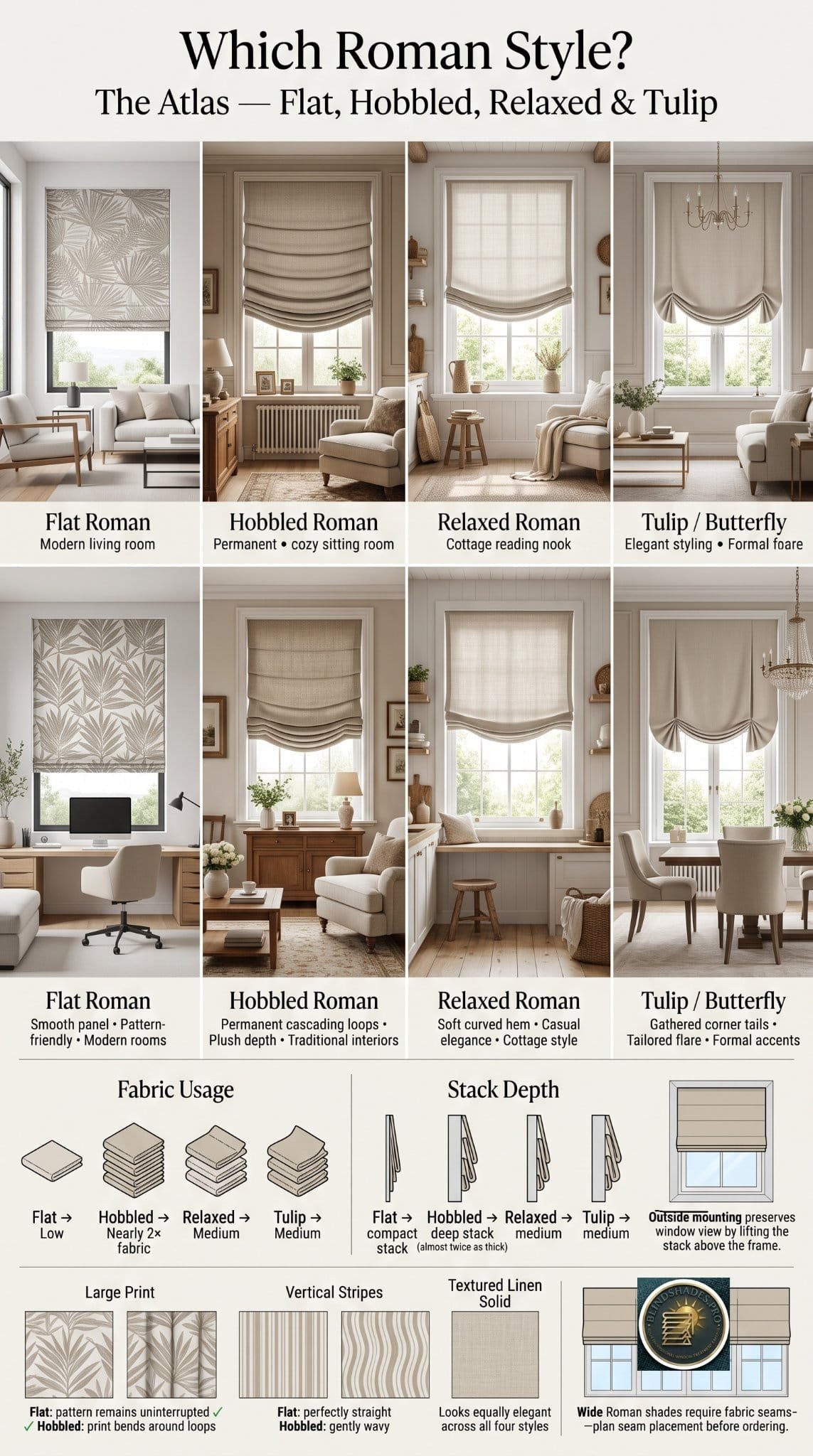
By Michael Turner — 30 years in the window treatment industry
One search, two products: roman curtains fold — the fabric lifts into neat horizontal pleats, the softer and more decorative rise in the whole window world — while roll-up curtains roll, the reed, matchstick, bamboo, and simple fabric shades that wind onto themselves like a scroll. Most of this market never tells you which one you’re looking at, and the two behave differently on every axis that matters: stack, softness, light, and price. So this guide runs the Rise Test — Fold or roll first, Fabric second (linen and blackout on the folding side; reed and bamboo on the rolling side, with the community’s six-vote liner formula that bridges them), Fit third (wide windows, stock sizes, and the operation lanes) — and sorts a catalog that runs from a forty-five-dollar stock classic to a specialist who has sewn seventeen thousand five hundred shades to measure.
Key Takeaways
- Fold versus roll is the whole first decision: romans pleat upward with a soft, tailored stack; roll-ups wind into a tube — different silhouettes, different stack depths, different rooms, and this guide routes each honestly.
- The style atlas matters more than the brand: flat, hobbled, relaxed, and tulip romans are four different looks sharing one mechanism — and hobbled roman shades are the plush answer most buyers don’t know the name of.
- The community’s best formula bridges both worlds: matchstick bamboo with a liner on the backside — texture from the street, real light control from the room — the six-vote answer this guide promotes to a method.
- Judge the SKU, never the store: one retailer’s custom romans span three point nine, four point three, and three point four across three listings — the same-brand-spread lesson, again, and the star next to the exact product is the only star that counts.
- The value ladder is unusually complete: a four-point-four stock classic at about forty-five, thirteen-hundred-review soft folds mid-market, and a made-to-measure specialist tier quoted per window — every budget has a proven rung.
⭐ Quick Answer — The Best Roman Curtains & Roll-Up Curtains
The best roman curtains roll up curtains split by the Rise Test — Fold (roman shades lift into neat pleats), Roll (reed and bamboo wind like a scroll), Fabric and Fit deciding the rest:
- Best folding roman: the soft-fold custom class at four point four across roughly thirteen hundred reviews — with the deep folding-shade decision mapped in the roman shades guide, this page’s routing twin.
- Best stock value: IKEA’s RINGBLOMMA at four point four across two fifty-four, about forty-five — the answer to the roman shades IKEA search, in-store returns included at IKEA.
- Best roll-up: the reed class at four point one across five hundred thirty-seven, about sixty-two — and the six-vote community formula: matchstick bamboo WITH a back liner, texture outside, light control inside; the material story lives in the woven wood and bamboo shades guide.
- The editorial record: the seven-favorite roundup at Architectural Digest and the ready-made verdict (Pottery Barn romans excellent, the one-tug handle) at Emily Henderson’s review record.
- The darkness grade: blackout-lined romans darken deeply with a glow frame — honest bedroom grade, with the full science in the blackout blinds guide.
Quick Specification Reference
| Specification | Roman & roll-up reality (2026) |
|---|---|
| The split | Roman curtains FOLD into pleats; roll-up curtains ROLL onto themselves |
| The roman styles | Flat (tailored) · hobbled (plush loops) · relaxed (soft swag) · tulip (gathered tails) |
| The roll-up family | Reed, matchstick, bamboo, and plain fabric roll-ups |
| The bridge formula | Matchstick bamboo WITH a back liner — texture outside, light control inside; the community’s six-vote method |
| The operation lanes | Cordless tug, cord lift, motorized, top-down-bottom-up, no-drill |
| The price ladder | About twenty-five (budget blackout) to forty-five (stock classic) to two-forties (big-base customs) to specialist quotes near a thousand |
| The wide-window rule | Fabric widths seam past roughly seventy-two inches — ask where the seam falls before ordering wide |
| The blackout truth | Roman blackout is a lined fabric with a glow frame, not a cave — the honest grade for bedrooms |
| The return-window outlier | One traditional retailer offers three-hundred-sixty-five-day returns — the category’s most generous terms |
Read the complete guide below for: the six picks across both families, the Rise Test, the fold-or-roll routing table, the style atlas with hobbled finally explained, the material table with the liner formula, every operation lane, wide-window and sizing rules, and the warning table with the same-store spread flagged.
What Are the Best Roman Curtains & Roll-Up Curtains in 2026? — Our Picks
Review volumes are stated exactly as the market shows them — and this category’s editorial record is unusually rich, so the attributions ride along.
| Pick | Product | Rating / reviews | Price (words) | The lane |
|---|---|---|---|---|
| Best Overall Roman | Blindster Soft Fold Premium Roman | 4.4 across ~1,300 | About two forty-six | The market’s biggest base — the soft-fold look at custom sizing |
| Best Stock Value | IKEA RINGBLOMMA Roman | 4.4 across 254 | About forty-five | The stock-size classic; the roman shades IKEA search answered |
| Best Cordless Mid-Market | Chicology Cordless Roman | 4.2 across 660 | About fifty-eight | The big-box aisle’s proven pick |
| Best Blackout Roman | Sun Zero Textured 100% Blackout Cordless | 4.3 across 278 (sibling 4.3 across 206) | About eighty-six to ninety-four | The roman shades blackout answer, honestly graded below |
| Best Roll-Up | Reed Roll-Up Shade (cord-free class) | 4.1 across 537 | About sixty-two | The rolling family’s own big base — texture by the yard |
| Best Made-to-Measure Tier | Gotain MTM Roman program | Specialist — 17,500 shades made, per their own count | About five fifty to nine sixty per window | Crafted to exact specification — the workroom lane |
The editorial record, attributed: the design-magazine roundup (February 13, 2026) spans its seven favorites from sheer linen to budget-friendly blackouts with a nod to the budget bamboo; the ready-made review verdict (June 7, 2026) is that Pottery Barn and PB Kids roman shades are excellent — very good quality, with the tug handle you pull to lower and raise in one tug — carried here as that reviewer’s tested experience; and the custom programs at the big configurators deserve the same-store honesty this site applies everywhere: one retailer’s three custom roman listings score three point nine across one thirty-two, four point three across sixty-eight, and three point four across forty-four — same logo, three verdicts, judge the SKU. The traditional-retail outlier worth naming: the country-store lane runs classic linen-blend and insulated romans (five point oh across eleven on the insulated; four point six across nine on the top-down) with a three-hundred-sixty-five-day return window — the most generous terms in this entire market.
The Rise Test: Fold · Fabric · Fit
Three questions in order — how it rises, what it’s made of, and how it fits your window and hands — and the first one splits the whole search term.
| Rise Test step | The question | The failure it prevents |
|---|---|---|
| Fold (or roll) | Pleats, or a tube? | The tailored bedroom that wanted soft folds and got a bamboo scroll — or the porch that wanted the scroll |
| Fabric | Linen, blackout, insulated — or reed and bamboo? | The unlined bamboo in a west bedroom; the heavy blackout where glow was the point |
| Fit | Width, mount, operation? | The seventy-eight-inch order that arrived with a surprise center seam |
Fold or Roll? One Search, Two Products
The definitional line this market keeps stating and never building on — roman shades fold into neat pleats when lifted, unlike roller shades, which roll up — is the routing table this guide finally draws.
| You want | The product | The tell | The deep guide |
|---|---|---|---|
| Soft horizontal pleats, tailored fabric, the decorator’s rise | Roman shades (roman curtains, roman blinds — three names, one product) | The stacked folds at the top when raised | The full folding-shade decision — fabrics, cordless depth, blackout grades — lives in our roman shades guide, this guide’s routing twin |
| Natural texture that winds up like a scroll | Reed, matchstick, and bamboo roll-up curtains | The visible tube at the top; ties or cords holding the roll | The material story — weaves, liners, sustainability — is our woven wood and bamboo shades guide’s territory |
| The scroll mechanism in plain fabric | Fabric roll-up shades | Budget porch-and-cabin classics | This guide’s roll-up sections |
| The gathered, poufed cousin | Balloon and Austrian shades | Hem poufs or full shirring | Our balloon and Austrian shades guide — the soft family’s formal wing |
| The smooth cylinder on a spring or chain | Roller shades | No pleats, no visible roll of slats — a clean fabric cylinder | A different product family entirely; the naming overlap is the market’s oldest confusion |
The register note that explains this page’s own search term: roman curtains and roll-up curtains are the curtain-register names — common in marketplace listings and international English — for what US retail mostly labels roman shades and roll up shades. Same products, two vocabularies, one guide sorting both. The practical payoff of getting the split right on day one: everything downstream divides cleanly — the style atlas below belongs to the folding family, the material table’s second half to the rolling one, the liner formula bridges them on purpose, and neither of the twin deep-dives this guide routes to will ever contradict what you learned here. One search, two products, one map.
Which Roman Style? The Atlas — Flat, Hobbled, Relaxed, Tulip
Four looks share one mechanism, and the style decides the room — with hobbled roman shades finally explained as the plush answer most buyers can’t name.
| Style | The construction | The tell | The room |
|---|---|---|---|
| Flat roman | One smooth panel; pleats appear only when raised | Crisp face, pattern-friendly | Modern rooms; the print-fabric showcase |
| Hobbled roman | Permanent cascading loops — fabric doubled into soft waves even when lowered | The plush, dimensional face | Traditional and cozy rooms; the depth answer |
| Relaxed roman | An unstructured hem that swags gently at the bottom | The soft smile at the hem | Casual, cottage, and the single-swag restraint |
| Tulip / butterfly | Gathered tails at the hem corners | The tailored flare | Formal accents — one step shy of the balloon family |
| The wide note | All four seam past fabric width | Ask where the seam falls | The wide roman shades question, answered in the sizing table |
The style atlas is where the nine-styles and six-types explainers in this market stop; the buying consequence they skip: hobbled styles use nearly double the fabric of flat (priced accordingly, and heavier on wide windows), relaxed styles resist precise blackout lining (the swag wants ease), and flat romans are the only style that showcases a large-scale print without folding it into confusion. Two more consequences worth carrying to checkout. Stack depth differs by style — a flat roman raised fully stacks compact, a hobbled one stacks nearly twice as deep, and on a short window that stack can eat a third of the glass; the fix is an outside mount a few inches above the frame so the raised stack hovers over wall instead of window, the same visual-height trick decorators bill for. And pattern behavior is a style decision before it’s a fabric one: stripes stay honest on flat faces and go gently seasick in hobbled loops, small all-over prints survive anything, and solids-with-texture (the linen tier’s whole argument) are the one choice that flatters all four constructions equally — which is quietly why the specified market defaults to them.
Which Fabric — or Which Reed? The Material Table
Linen to blackout on the folding side, reed to bamboo on the rolling side — and the six-vote liner formula that bridges them.
| Material | The family | The verdict |
|---|---|---|
| Linen and linen-blends | Roman | The classic — soft light, texture, the specified look |
| Blackout-lined fabric | Roman | The bedroom grade: real darkness through the material, a glow frame at the edges — the full science is in our blackout blinds guide |
| Insulated / thermal romans | Roman | The energy-efficient thermal option the traditional retailers lead with — the winter case is our thermal and insulating blinds guide’s |
| Reed and matchstick | Roll-up | Texture by the yard; light-porous by nature |
| Bamboo | Roll-up (and woven romans) | The warm organic middle — the design press’s budget favorite |
| ⭐ THE LINER FORMULA | The bridge | The community’s six-vote answer for a warm, glare-free room: chestnut matchstick bamboo romans WITH liners on the backside — texture facing the street, a light-controlling liner facing the room; order the liner at purchase (privacy or blackout grade), because retrofitting one is a sewing project |
How Should They Operate? The Lift Table
Cordless is the modern default, and this category adds two lanes of its own — the one-tug handle and the top-down roman.
| Operation | How it works | The note |
|---|---|---|
| Cordless tug | A handle or the hem itself — one tug to lower and raise, in the ready-made reviewer’s own delighted phrasing | The child-safe default; the whole cordless case lives with our cordless coverage |
| Cord lift | The classic side cords | Fine for adult rooms; cleat high, cords short — the standing safety rule |
| Motorized roman | Remote and app lifts in the custom fleets | High and wide windows |
| Top-down-bottom-up | The roman that opens from the top — privacy below, sky above | The country-store lane carries it; the full logic is in our top down bottom up blinds guide |
| No-drill roman | Tension and clamp mounts in the custom-curtain fleets | The renter lane — the wider toolbox is our no drill blinds guide |
| Day-night roman | Dual-layer romans in the linen fleets | Both moods, one shade — the family logic from our day-night blinds guide |
What About Wide Windows and Sizing?
The wide roman shades question has a seam in it — and the stock-versus-custom fork decides most budgets.
| Situation | The rule | The note |
|---|---|---|
| Standard windows | Stock sizes win on price | The forty-five-dollar classic exists because most windows are ordinary |
| Wide roman shades (past ~72 inches) | Fabric widths seam — ask WHERE before ordering | A centered seam on a flat roman is visible; hobbled styles hide seams in the loops |
| Very wide (past ~96) | Two shades on one headrail-line beat one giant | Independent lift, no sag, easier cleaning |
| Roll-ups, wide | Reed rolls get HEAVY wide | Split wide runs; the roll’s weight is the limit |
| Odd sizes | The made-to-measure lane | Measure three times, smallest figures govern — the discipline from our made to measure blinds guide, and the specialist tier exists for exactly this |
| Living-room walls | The best roman curtains roll up curtains for living room searches usually mean a wide bank | Mix the atlas: flat romans on the picture window, roll-ups on the flanks — one palette, two rises |
How Do You Clean Roman and Roll-Up Shades?
Two families, two care regimes — and the folding family’s biggest care mistake is the washing machine.
The roman regime: vacuum monthly with the brush head, working down the face and along each pleat’s valley where dust settles; spot-clean with barely damp cloth and mild soap, blotting rather than rubbing. The machine-wash temptation is the mistake — most romans are constructed, not sewn flat: lining, rib pockets, dowels, and cord rings come apart or pucker in a wash, and blackout linings crease permanently. If a roman is labeled washable, the ribs come out first and the drying is flat and patient; if it isn’t labeled, it isn’t. Hobbled styles add one habit: dress the loops by hand after every full raise-and-lower cycle for the first week, and the waves train themselves to fall evenly for years. The roll-up regime is easier and dustier: reed and matchstick weaves shed light through a thousand gaps and collect dust on a thousand ledges — a monthly pass with the vacuum’s brush on low suction, outdoors twice a year if they’ll travel (roll them closed, carry them out, and a soft brushing on the porch rail beats any indoor method). Liners on the bridge-formula shades follow the roman rules on the liner side and the reed rules on the face. And both families share the sun-fade habit worth stealing from the curtain world: on bright southern windows, rotate identical shades between windows at mid-life so the fade evens instead of striping one shade first.
One more life the roll-up family lives that romans never will: the porch. Reed and bamboo roll-ups are the traditional outdoor-adjacent shade — porches, sunrooms, pergola edges — because the scroll mechanism shrugs at breeze and the material was never precious about weather. The honest limits: natural reed grays and dries in real sun-and-rain exposure (a season or three of good looks, then character, then replacement — priced accordingly at sixty dollars it’s a fair trade), covered placement doubles the life, and true weather duty belongs to the synthetic exterior products in our outdoor and patio blinds guide, where the wind and water rules get their full engineering. Indoors, that same easygoing construction is why roll-ups suit sunrooms, cabins, and kitchens — the rooms where a little humidity and a lot of light would bully fussier fabric.
Where Should You Buy — and the Warning Table
The lanes: IKEA for the stock classic (store four point oh across seventeen hundred, thirty-five-to-fifty-five range, in-store returns), the big-box aisles for Chicology and the blackout tier, the custom configurators with the SKU-not-store rule applied, the curtain-fleet makers for linen and no-drill romans, the country-store lane for insulated classics on the year-long return window, and the specialist tier when the window deserves a workroom.
| Warning | The listing | The rule |
|---|---|---|
| The same-store spread | 3.9/132 · 4.3/68 · 3.4/44 — three customs, one retailer | Judge the SKU, never the logo |
| The 5.0-across-1 fleet | Multiple curtain-maker listings at one review | Shop reputation and returns, not the star |
| Premium thin bases | 4.6 across 9 · 5.0 across 11 | Charming, unproven — the year-long return window is the hedge |
| Discount theater | Forty to sixty-nine percent “off” across the grid | The recurring sale price is the real price |
| The naming soup | Roman curtains, blinds, shades; roll-up vs roller | The routing table is the decoder — and roller shades are a different product |
Best Sources on Roman & Roll-Up Curtains
- The nine-styles and six-types explainers — the fold-into-neat-pleats definitional line and the softer-more-decorative case, credited as this guide’s routing premise.
- The design-magazine roundup (February 13, 2026) — seven favorites, sheer linen to budget blackouts.
- The ready-made review record (June 7, 2026) — the Pottery Barn verdict and the one-tug handle detail, carried as that reviewer’s tested experience.
- The warm-room community thread — the six-vote matchstick-with-liner formula this guide promoted to a method.
- The maker programs themselves — the seventeen-thousand-five-hundred-shade specialist count and the year-long return window, cited as the market’s own shape.
Related Buying Guides
- Best Roman Shades — the routing twin: the deep folding-shade decision
- Best Woven Wood & Bamboo Shades — the reed and bamboo material story
- Best Balloon & Austrian Shades — the soft family’s gathered wing
- Best Blackout Blinds & Shades — the darkness science behind the linings
- Best Thermal & Insulating Blinds — the insulated roman’s winter case
- Best Top Down Bottom Up Blinds — the roman that opens from the top
- Best Day-Night Blinds — dual-layer light logic
- Best No Drill Blinds — the renter’s roman lane
- Best Kitchen Window Blinds & Shades — where romans and roll-ups both classic
- Best Made to Measure Blinds — the specialist tier’s discipline
FAQ
What is the difference between roman curtains and roll-up curtains? Roman curtains (roman shades) fold — the fabric lifts into neat horizontal pleats, the softer and more decorative rise; roll-up curtains roll — reed, matchstick, bamboo, or plain fabric winding onto itself like a scroll. Different silhouettes, stacks, and rooms; the routing table in this guide sorts every variant.
What are hobbled roman shades? Romans sewn with permanent cascading loops, so the face shows soft dimensional waves even when fully lowered — the plush, traditional look. They use nearly double a flat roman’s fabric, price and weigh accordingly, and are the style most buyers love in photographs without knowing its name.
Are roman shades good for blackout? Blackout-lined romans genuinely darken through the material — the honest grade is deep room-darkening with a glow frame at the edges rather than a sealed cave. For bedrooms they’re excellent; for absolute darkness, side-channel systems remain the specialist answer.
What is the bamboo-with-liner trick? The community’s six-vote formula for a warm, glare-free room: matchstick or bamboo roll-up romans with a privacy or blackout liner sewn on the backside — natural texture facing out, real light control facing in. Order the liner with the shade; retrofitting one later is a sewing project.
Do IKEA roman shades hold up? The stock classic carries four point four across two hundred fifty-four at about forty-five — a genuinely proven value for standard windows, with the trade-off stated: stock sizes only, so odd windows graduate to the custom and made-to-measure lanes.
How wide can a roman shade be? Fabric widths seam past roughly seventy-two inches — ask where the seam falls before ordering, since flat styles show it and hobbled styles hide it in the loops. Past about ninety-six inches, two shades run cleaner than one giant, and heavy reed rolls hit their weight limit even sooner.
The Bottom Line
Decide the rise and the rest is shopping. Fold: flat for prints and modern lines, hobbled for plush depth, relaxed for the soft swag — with the thirteen-hundred-review soft-fold base and the forty-five-dollar stock classic bracketing every budget between them. Roll: reed and bamboo for texture that winds up like a scroll — and the six-vote liner formula whenever texture needs to keep a secret from the sun. Fit: seams asked about before wide orders, one tug where hands are small, top-down where the sky deserves in, and the workroom tier when the window has earned it. Two products, one search, zero confusion left — and the deeper you go into either family, the twin guides are already waiting.
